
Intro
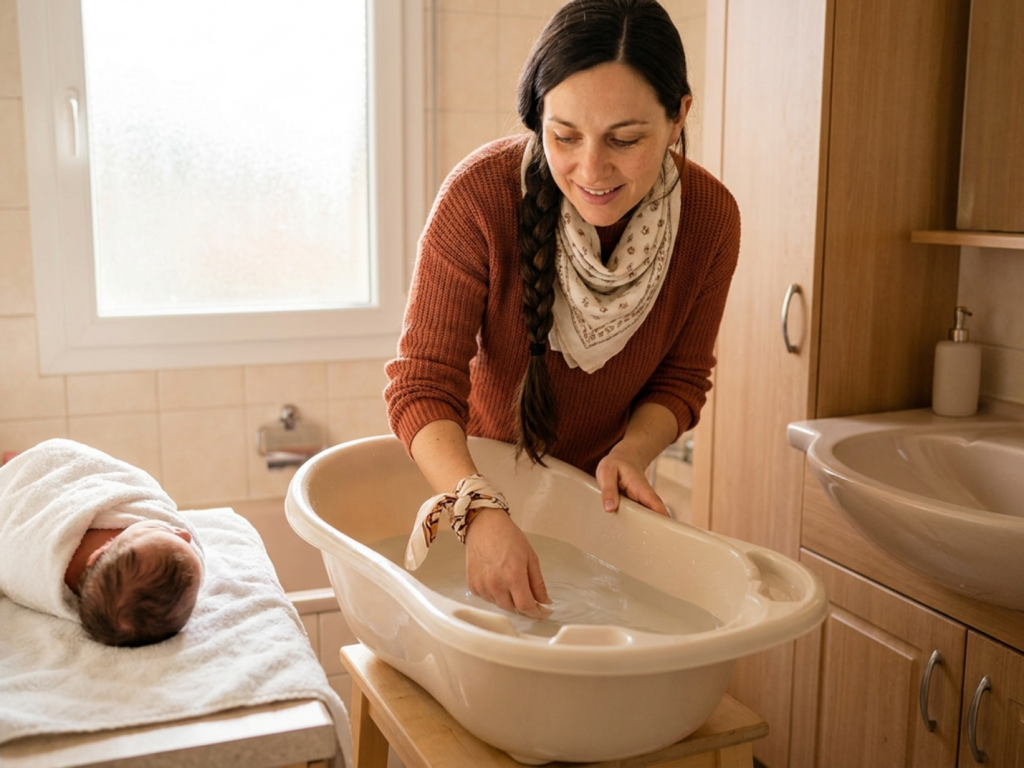
There is no single best clock time to bathe a baby. In practice, the best time is the one that fits your baby’s cues and your household well enough that the bath can be done calmly, safely, and without rushing.
For many families, the question is less about finding a medically perfect hour and more about choosing a predictable window that respects feeding, sleep, and temperature regulation. That matters even more in the newborn period, when babies lose heat quickly and may need a delayed first bath rather than an immediate one.
Highlights
The best bath time is usually when the baby is awake, content, and the caregiver is not rushed.
Bathing right after a feed is usually a poor fit, especially if the baby tends to spit up or seems uncomfortable.
Some families prefer morning baths; others use bath time as part of a predictable bedtime routine for babies.
For newborns, the first bath is a separate question from later routine bathing, and delaying it can be appropriate.
The most useful routine is the one that matches the baby’s cues, the family’s schedule, and basic safety needs.
There is no universal clock time
Medical guidance does not identify one best time of day to bathe every baby. The more useful rule is to pick a time when the baby is awake, content, and unlikely to be interrupted by feeding or sleep pressure. That simple idea is consistent with the practical advice from major pediatric sources: a bath should fit the baby, not force the baby to fit the bath.
This is especially important for newborns. In the first day of life, many hospitals and families now delay the first bath rather than rushing it. The newborn’s temperature regulation is still immature, so a delay can reduce the risk of hypothermia and may support early breastfeeding. For routine bathing later on, the exact hour matters less than the conditions around the bath: warm room, prepared supplies, enough time, and a calm caregiver.
The best window is a calm, alert baby
The most reliable timing cue is the baby’s state. A baby who is awake, settled, and not showing strong hunger cues is usually a better candidate than one who is crying, exhausted, or just fed. Bathing straight after a feed can increase spit-up, discomfort, or fussiness, so it is better to wait a bit after feeding rather than using the bath as an immediate next step.
Parents often look for signs that the baby is ready: relaxed posture, moderate alertness, and steady breathing. If the baby becomes increasingly distressed once the bath starts, the bath is already too long or too late in the day for that particular child. In that situation, the practical move is not to push through but to shorten the session, reschedule, or switch to a simpler wash-up. Good timing is the point at which the bath feels uneventful, not impressive.
Morning, afternoon, or evening
Morning baths work well for some families because the caregiver is fresher, the home is less chaotic, and the baby may be more alert. Afternoon baths can be easier when the day has settled but bedtime is still far enough away that there is no pressure. Evening baths are popular because they can become part of a predictable bedtime routine for babies, with the bath serving as a cue that the day is winding down.
That said, a bath does not reliably make every baby sleepy. Some infants find water stimulating, become more alert, or cry more in the evening if they are already tired. If a bedtime bath seems to increase arousal instead of lowering it, move it earlier in the day. The better question is not whether morning or night is superior in theory, but which timing produces a calm, repeatable pattern for your baby.
Newborn timing is different from later baths
The newborn period deserves special caution because babies are less able to regulate heat, and their skin barrier is still developing. The evidence base suggests that delaying the first bath for at least 24 hours may reduce hypothermia and may improve breastfeeding outcomes, although the certainty of that evidence is low. That means the first bath should not be treated as an automatic same-day task unless the baby’s care team advises otherwise.
A safe newborn bathing routine is built around preparation rather than speed. Have everything ready, keep the room warm, and keep the bath brief. For many newborns, the choice is not a matter of finding the perfect time slot so much as finding a window when the baby is stable, warm, and settled. Newborn bath water temperature also matters, but timing and temperature work together: a bath that is well timed and comfortably warm is much easier on the baby than one that is rushed or delayed until the baby is already upset.
Use feeding, sleep, and family flow to decide
When families ask for a practical rule, the clearest one is this: bathe the baby when the daily flow allows for calm attention. That usually means not during a hunger peak, not immediately after a feed, and not when the household is at its most rushed. If the baby tends to feed and then settle into sleep, a bath may fit better before that sleep window rather than after it. If the baby tends to be more alert in the morning, morning may be the easier choice.
There is also a caregiver-side reason to think in terms of routine rather than the clock. Bathing a slippery infant requires focus, and caregiver exhaustion and safe care are linked. If you are too tired to feel steady and attentive, the best time is the time when another adult can help or when you can do the bath without rushing. A routine is useful only if it can be repeated without strain.
For older infants, consistency can matter more than the exact hour. A familiar sequence, such as bath, pajamas, feed, and quiet time, can support a predictable bedtime routine for babies even though the bath itself is not a sleep treatment. If you notice that changing the bath time makes the baby less settled, return to the time of day that has the fewest cues of hunger, fatigue, or overstimulation.
When timing needs extra caution
Some babies need individualized guidance. If your baby was premature, is medically fragile, has temperature instability, or has been told to avoid full baths for a period of time, ask a pediatric clinician or newborn nurse before setting a routine. Timing decisions can also change if the baby is unwell, feeding poorly, or recovering from a procedure. In those cases, the right answer may be to postpone bathing or use a different type of wash until the baby is more stable.
Be alert to the baby’s response during and after a bath. Shivering, pallor, persistent crying, color change, or difficulty settling afterward can mean the bath was poorly timed or too long. If bathing repeatedly leads to distress, do not assume the baby is being difficult; the routine may need adjustment. A clinician can help you decide whether the issue is timing, temperature, skin sensitivity, or something else that should be assessed in context.
When to pause and reassess
- Do not bathe the baby straight after a feed if it tends to cause spit-up or discomfort.
- Do not choose a time when the baby is very hungry, very tired, or already hard to settle.
- Do not rush the bath if you are distracted or exhausted; timing also includes caregiver readiness.
- Do not assume the first bath should happen immediately after birth; in some settings, delaying it is appropriate.
- Do not continue a bath that makes the baby cold, pale, or increasingly distressed.
Tools & Assistance
- Your pediatrician or family doctor
- A postpartum nurse or midwife
- Newborn discharge instructions from your hospital or birth center
- A pediatric nurse advice line
FAQ
What is the best time of day to bathe a baby?
The best time is when the baby is awake, content, and not immediately after a feed. There is no single medically superior hour.
Is bedtime the best time for a baby bath?
It can be, if the bath helps your baby settle and fits a predictable bedtime routine. Some babies become more alert, so earlier timing may work better.
Should I bathe my baby after feeding?
Usually not right away. Waiting a bit after feeding can reduce discomfort and spit-up.
When should a newborn have the first bath?
Many newborns benefit from a delayed first bath, often at least 24 hours after birth when clinically appropriate. Your care team may advise differently based on the baby’s condition.
What if my baby cries every time I try to bathe them?
That often means the timing, temperature, or duration needs adjustment. If it keeps happening, ask a pediatric clinician for advice.
Sources
- Mayo Clinic — Baby bath basics: A parent's guide
- NHS — Washing and bathing your baby
- PubMed — Timing of the first bath in term healthy newborns: A systematic review
Disclaimer
This article is for general education and does not replace individualized medical advice. Ask your pediatrician, midwife, or other qualified clinician about your baby's bathing schedule, especially for newborns or babies with medical concerns.














Please log in to leave a comment.