
Intro
Trimming a baby’s nails can feel unexpectedly stressful. Newborn fingernails are tiny, thin, and often surprisingly sharp, while babies move unpredictably and may curl their fingers just when you are trying to help. If you feel nervous, you are not alone; many careful caregivers worry about nicking the skin or cutting too close.
The goal is not a perfect manicure. The goal is to reduce sharp edges that can scratch your baby’s face or skin while protecting the delicate nail folds, fingertip pads, and toe pads. With the right timing, baby-safe tools, good lighting, and a calm technique, nail care can become a brief, low-drama part of routine infant care.
Highlights
Filing with a soft emery board is often the safest approach for newborn nails, especially in the first days and weeks.
If you clip, use baby nail scissors or baby clippers with rounded tips, not adult-sized clippers.
The safest moments are usually when your baby is asleep, calm after feeding, or relaxed after a bath.
Pulling the fingertip or toe pad gently away from the nail helps reduce the risk of cutting skin.
If bleeding, swelling, pus, increasing redness, or unusual tenderness occurs, contact a healthcare professional.
Why baby nails need special care
Baby nails grow quickly, and newborn fingernails may need attention more often than many caregivers expect. Fingernails can grow fast enough to need trimming or filing about once or twice a week, while toenails usually grow more slowly and may need care less often. The exact rhythm varies by baby, so checking nails during routine care is more useful than following a rigid schedule.
Infant nails are soft and flexible, but the surrounding skin is delicate. The nail plate may be thin, and the boundary between the free edge of the nail and the fingertip can be hard to see. This is why a small, controlled approach matters. Cutting too aggressively can injure the fingertip pad, the lateral nail fold, or the hyponychium, the sensitive tissue under the nail edge.
Sharp nails matter because babies often rub their faces, startle, and move their hands without full motor control. Scratches are usually minor, but they can be upsetting and, if the skin barrier is broken, may occasionally become irritated or infected. Safe nail care is therefore both comfort care and basic skin protection.
Choose the safest tools
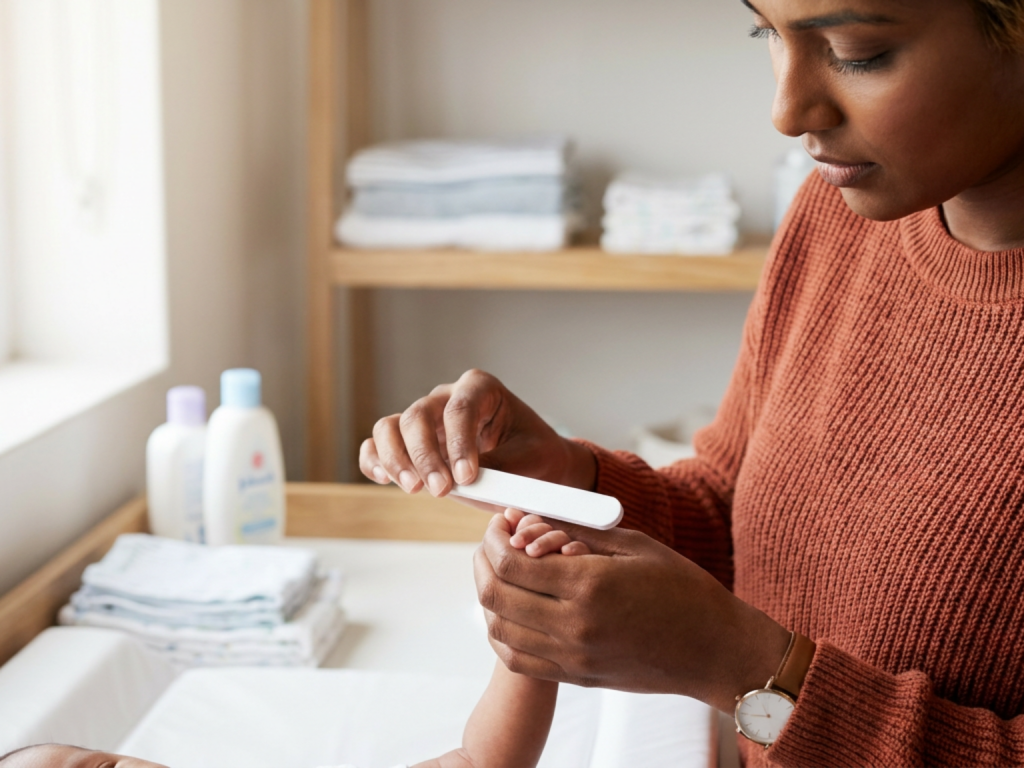
For many newborns, a soft nail file or emery board is the safest first-choice tool. Filing lets you smooth sharp edges without placing a blade near the skin. This is especially helpful when nails are very small, when your baby is squirmy, or when you are still building confidence.
If you choose to cut the nails, use tools designed for infants. Baby nail scissors and baby nail clippers usually have smaller cutting surfaces and rounded tips, which give better control around tiny fingers and toes. Avoid adult nail clippers because they are larger, stronger, and easier to position incorrectly on a small nail.
- Use a soft emery board for smoothing or shortening very thin nails.
- Use baby nail scissors or baby clippers with rounded tips if clipping is needed.
- Clean tools before use and store them dry.
- Choose a well-lit area so you can clearly see the nail edge and skin.
- Avoid biting or tearing the nails, which can create ragged edges and introduce oral bacteria.
Before handling your baby’s hands or feet, practice hand hygiene before newborn care. Clean hands and clean tools lower the chance that a small accidental break in the skin becomes irritated.
Pick the right time
Timing often determines whether nail care feels manageable or chaotic. Many babies move less when they are asleep, making sleep one of the safest times to trim or file. Choose a moment when your baby is deeply settled enough that their hands are relaxed rather than clenched.
Another useful time is after a bath, when nails may be softer. If nail care becomes part of a safe newborn bathing routine, dry your baby well first, make sure they are warm, and move to a stable, well-lit place before using any tool. A baby who is wet, cold, hungry, or overstimulated is more likely to wriggle.
If your baby is awake, it may help to have another adult gently hold or distract them. One caregiver can stabilize the hand or foot while the other trims. The helper should not forcefully restrain the baby; the aim is steady support, not pressure. If the baby becomes very upset, it is fine to stop and try again later. There is no benefit to pushing through a stressful moment unless a sharp nail is causing an immediate problem.
Step-by-step: trimming fingernails
Start by positioning your baby safely. Place them on a firm, stable surface or hold them securely in your lap with the hand you are trimming well supported. Good lighting is essential. If you are tired, rushed, or your hands are shaking from stress, pause and choose another time.
- Hold one finger at a time, keeping the rest of the hand gently supported.
- Press the fingertip pad down and away from the nail edge. This creates space between the nail and skin.
- If filing, use short, gentle strokes in one direction or small controlled motions to smooth sharp edges.
- If clipping, make small cuts rather than one large cut.
- Follow the natural curve of the fingernail, but avoid cutting deeply into the corners.
- Use an emery board afterward to smooth any rough or sharp edge.
For fingernails, clipping along the natural curve helps prevent sharp corners. However, do not chase every tiny irregularity. Over-trimming can be more harmful than leaving a small amount of white nail edge. If the nail is very close to the skin, filing may be safer than clipping.
Some caregivers find it helpful to trim only one or two nails at a time. This is a perfectly reasonable strategy. Baby nail care does not need to be completed in one sitting.
Step-by-step: trimming toenails
Toenails usually need less frequent trimming than fingernails. They are also more likely to be hidden by socks, footed pajamas, and curled toes, so check them regularly during diaper changes, baths, or dressing.
For toenails, gently pull the toe pad away from the nail before cutting. Use baby-safe clippers or scissors and make small controlled cuts. Many caregivers are taught to trim toenails straighter across than fingernails to reduce pressure at the corners, but infant toenails are tiny and vary in shape. The practical rule is to avoid cutting into the side folds or digging at corners.
If a toenail edge seems embedded, red, swollen, or painful, do not try to cut deeply into the side of the nail. That can worsen irritation. Instead, keep the area clean, avoid tight socks or footwear, and ask your baby’s healthcare professional for guidance.
If you accidentally nick the skin
Even careful caregivers sometimes nick a fingertip or toe. It is upsetting, but a small superficial cut can usually be managed calmly. First, stop trimming. Apply gentle pressure with clean gauze or a clean cloth until bleeding stops. Keep the area clean and observe it over the next day or two.
Avoid using a tight bandage on a baby’s finger or toe unless a clinician specifically recommends it, because small bandages can come loose and become a choking hazard, and tight wrapping can affect circulation. Also avoid applying non-prescribed medicated ointments, antiseptics, or powders without professional advice, especially in newborns or premature infants.
Contact a healthcare professional if bleeding does not stop with gentle pressure, the cut appears deep, the nail is partly torn, or you notice signs of infection such as spreading redness, swelling, warmth, pus, increasing tenderness, or fever. In a young infant, especially a newborn, it is appropriate to seek advice early if you are uncertain.
Common mistakes to avoid
The most common mistake is trying to trim when the baby is alert, hungry, crying, or flailing. Movement increases the chance that the tool slips. Another common mistake is using adult clippers, which can remove too much nail or catch skin because they are not scaled for infant anatomy.
- Do not bite baby nails; it can tear the nail and transfer bacteria from an adult mouth.
- Do not peel or rip a nail that seems partly loose.
- Do not cut nails extremely short; leave a small smooth edge when possible.
- Do not dig into nail corners, especially on toes.
- Do not rely on mittens as a substitute for nail care indefinitely; mittens may reduce scratching temporarily but do not smooth sharp nails.
If you feel anxious, begin with filing only. Confidence usually improves after a few calm attempts. It is also reasonable to ask a nurse, midwife, pediatric clinician, or experienced caregiver to demonstrate technique in person.
When to ask for medical guidance
Nail care is usually routine, but some situations deserve professional input. Ask your baby’s clinician if the nail area is persistently red, swollen, draining, bleeding repeatedly, or seems painful when touched. Also seek advice if the nail looks significantly deformed after trauma, if the nail separates from the nail bed, or if your baby has a medical condition that affects bleeding, immunity, skin integrity, or wound healing.
Premature infants and babies with complex medical needs may have more fragile skin or specific infection-prevention instructions. In those cases, follow the care plan from your neonatal or pediatric team. If there is any conflict between general nail-care advice and individualized medical guidance, the individualized guidance should take priority.
Caregivers also deserve support. If nail trimming triggers intense fear because of a previous nick or because the baby is very active, ask your pediatric office to show you a safe technique. A brief demonstration can make the process feel much more manageable.
Safety cautions
- Do not use adult nail clippers on newborn or infant nails.
- Do not bite, tear, or peel baby nails because this can injure skin and introduce bacteria.
- Stop and seek advice if bleeding does not stop with gentle pressure.
- Call a healthcare professional for spreading redness, swelling, pus, warmth, fever, or worsening tenderness.
- Avoid tight bandages on fingers or toes unless specifically advised by a clinician.
Tools & Assistance
- Soft emery board or baby nail file
- Baby nail scissors with rounded tips
- Baby nail clippers designed for infants
- Clean gauze or clean cloth for accidental nicks
- Pediatric clinician, nurse, or midwife for hands-on guidance
FAQ
How often should I trim my baby’s nails?
Fingernails may need trimming or filing once or twice a week because they grow quickly. Toenails usually grow more slowly and may need less frequent care.
Is filing safer than clipping for a newborn?
Yes, filing with a soft emery board is often the safest option for very small newborn nails because it avoids placing a blade near delicate skin.
Should I trim baby nails while my baby is asleep?
Often, yes. Many babies move less during sleep, which can make trimming or filing safer and calmer. Use good lighting and support one finger or toe at a time.
What should I do if I cut my baby’s skin?
Stop trimming and apply gentle pressure with clean gauze or a clean cloth until bleeding stops. Seek medical advice if bleeding persists, the cut is deep, or signs of infection appear.
Can I use mittens instead of trimming nails?
Mittens can temporarily reduce scratching, but they do not remove sharp nail edges. Regular gentle filing or trimming is still needed when nails become sharp or long.
Sources
- MedlinePlus — Nail care for newborns: MedlinePlus Medical Encyclopedia
- Boys Town National Research Hospital — Clipping Your Baby's Nails
- MyHealth Alberta — Caring for a Baby's Nails
Disclaimer
This article is for general educational purposes and is not a substitute for medical advice. Consult a pediatric healthcare professional for concerns about injury, infection, bleeding, or your baby’s individual health needs.














Please log in to leave a comment.