
Intro
Learning to eat from a spoon is a gradual developmental process, not a single milestone that happens on a fixed date. Some babies are ready to be fed with a spoon at about 6 months, while others need more time to develop the postural stability, oral-motor coordination, and interest needed for comfortable practice. The goal is not to make a baby finish a portion or use utensils neatly, but to support safe, responsive exploration.
It also helps to distinguish between being ready to receive food from a spoon and being ready to use a spoon independently. Babies may accept purées from a caregiver well before they can load, orient, and bring a spoon to their own mouth accurately. Both stages are normal, and progress is often uneven.
Highlights
Most babies can begin learning to eat from a spoon around 6 months when broader signs of readiness are present.
Independent spoon use usually develops later than spoon-feeding, often during the second year of life.
A supported upright position, appropriately prepared textures, and responsive pacing make practice safer and more comfortable.
Mess, spilling, mouthing the utensil, and inconsistent interest are expected parts of learning.
A healthcare professional can help evaluate feeding concerns, especially when swallowing, growth, or developmental skills are affected.
What “Ready for a Spoon” Really Means
Readiness for a spoon has two related but distinct meanings. A baby may be ready to accept complementary food from a caregiver’s spoon, or ready to participate actively by grasping and guiding a spoon toward the mouth. The first skill generally develops earlier. The Centers for Disease Control and Prevention notes that most babies can swallow puréed food from a spoon at about 6 months, whereas beginning to use a spoon independently commonly occurs around 10 to 12 months. Accurate, efficient spoon use takes longer and may continue developing through 18 to 24 months.
These age ranges are general developmental references rather than deadlines. A baby’s feeding skills are influenced by postural control, neuromuscular coordination, sensory preferences, prior oral experiences, and whether the baby was born prematurely. Corrected age may be relevant for some preterm infants. A pediatric clinician should help interpret readiness when there are medical, developmental, or nutritional concerns.
Spoon-feeding is one part of complementary feeding. Breast milk or infant formula remains an important source of nutrition during the early transition, while solid foods provide opportunities to learn tastes, textures, and coordinated eating skills. Early spoon practice should therefore be viewed as learning, not as a test of how much a baby can consume.
Signs Your Baby May Be Ready
Readiness is best judged by a cluster of developmental behaviors, not by age alone. A baby who is ready to explore food by spoon will usually demonstrate reasonably stable head and neck control and can sit upright with support while maintaining alignment of the head, trunk, and pelvis. This posture supports breathing, visual attention, hand use, and oral-motor control.
Other useful cues include interest in food, such as watching others eat, reaching toward food, or opening the mouth when a spoon approaches. The baby should be able to accept a small amount at the front of the mouth and use the lips and tongue to remove food from the spoon. Early attempts may involve pushing food back out because the tongue-thrust reflex is still maturing; occasional expulsion does not necessarily mean the baby is not ready.
Readiness also includes the ability to communicate at least some acceptance and refusal. A baby may lean toward the spoon, open the mouth, or remain engaged when interested. Turning the head away, closing the mouth, losing interest, or becoming distressed can indicate a need to pause. The Tennessee Department of Health includes these behaviors, along with supported sitting and head control, among practical signs that spoon-feeding may be appropriate.
Readiness is not established by reaching for food alone. Curiosity is meaningful, but it should be considered alongside posture, head control, oral skills, and the ability to stay alert during a brief feeding interaction.
Spoon-Feeding Versus Independent Spoon Use
When a caregiver offers a spoon, the caregiver controls much of the timing, trajectory, and amount. The baby’s primary tasks are to orient toward the food, open the mouth, accept the spoon, remove food with the lips and tongue, and coordinate swallowing. These are substantial skills, and they may require repeated low-pressure opportunities.
Independent use adds several more demands. The baby must grasp an appropriately sized utensil, scoop or receive food on it, stabilize the wrist and forearm, judge the distance to the mouth, rotate the spoon, and maintain enough control to avoid dropping its contents. These tasks require visual-motor integration and bilateral coordination. A baby may be very capable of eating from a caregiver’s spoon while still being months away from reliably feeding themselves.
Many babies can start practicing before they can scoop. A caregiver can place a small amount of suitable food on a pre-loaded spoon and allow the baby to grasp it. The baby may mouth the handle, turn the spoon over, smear food, or bring an empty utensil to the mouth. These actions are practice, not failure. Offering two spoons can also allow the caregiver to continue feeding while the baby explores another utensil, provided the interaction remains supervised.
Independent spoon use is often inconsistent for a long period. Even toddlers who can bring a spoon to the mouth may prefer their hands for certain foods or may alternate between self-feeding and accepting help. Skill acquisition is typically nonlinear and affected by fatigue, hunger, illness, temperament, and the physical properties of the food.
How to Introduce a Spoon Responsively
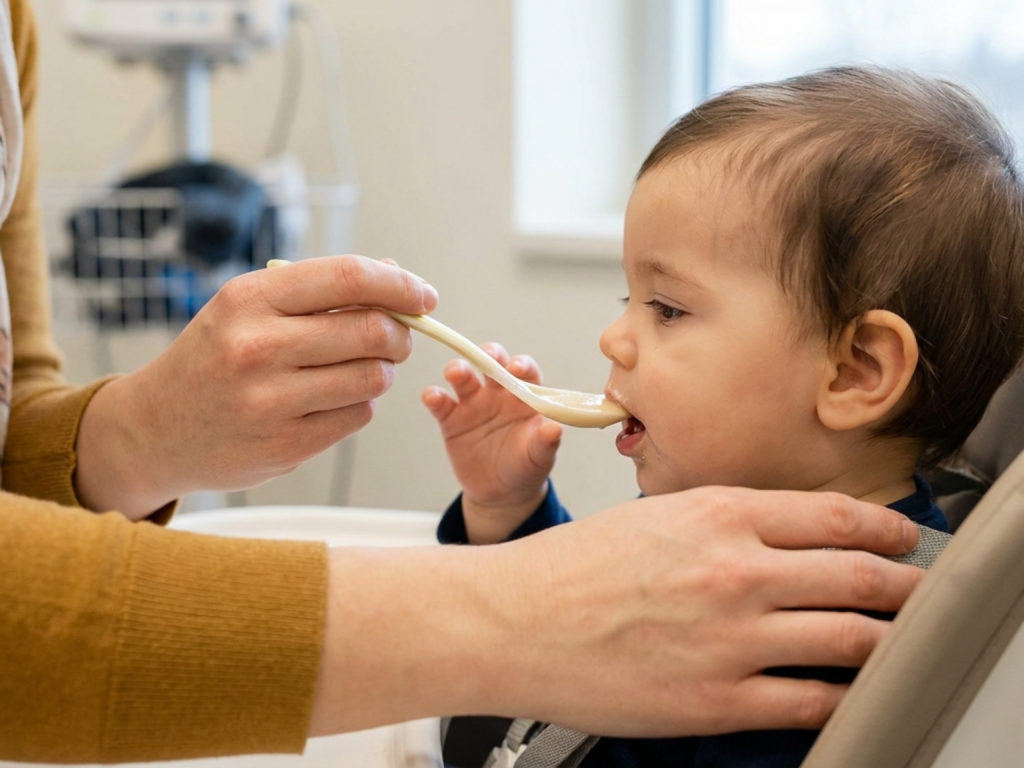
Begin when the baby is alert and reasonably calm, rather than overtired or extremely hungry. Seat the baby upright in a stable high chair or other clinician-approved feeding seat, with the body well supported. Place a small amount of an appropriate smooth or mashed food on a shallow infant spoon. Present it at the baby’s level and wait for the baby to open the mouth or otherwise signal interest.
Bring the spoon gently toward the mouth without scraping food onto the upper lip or forcing it between closed lips. Allow the baby time to close the lips around the spoon and remove the food. Then withdraw slowly. A pause between spoonfuls gives the baby time to organize the food, swallow, breathe, and decide whether to continue. The caregiver should follow the baby’s cues rather than aiming for a predetermined number of bites.
For self-feeding practice, offer a pre-loaded spoon with a manageable amount of food and let the baby direct the movement. The caregiver can demonstrate by using a spoon nearby, but should avoid repeatedly taking control of the baby’s hand. If the baby drops the utensil, it may be calmly replaced when appropriate. Keep practice brief and end when the baby turns away, closes the mouth, pushes the spoon away, becomes upset, or shows signs of fatigue.
Mess is developmentally expected. A washable mat, bib, and limited portion can reduce practical stress without turning the meal into a performance. Praise participation neutrally, for example by acknowledging that the baby touched or tasted the food, rather than using pressure, distraction, or rewards to increase intake.
Texture, Position, and Safety
Food texture should match the baby’s developmental abilities and the guidance of a healthcare professional. Early spoon foods are often smooth, thin purées or soft mashed foods, but babies gradually need experience with thicker and more varied textures as their skills develop. Texture progression should be intentional and safe; a baby who manages a thin purée may not yet manage a sticky, fibrous, firm, or mixed-texture food.
Always feed a baby who is awake and seated upright, with an adult close enough to observe continuously. Do not feed while the baby is reclined, walking, playing, or riding in a moving vehicle. A spoon should be small, shallow, smooth, and free of damaged parts. Avoid placing a large amount of food on the utensil or leaving a spoon in the baby’s mouth.
Gagging can occur as babies learn to manage new textures. It is typically noisy and may involve coughing or retching. Choking is different and may be quiet, with ineffective coughing or difficulty breathing. Caregivers should learn infant choking first aid before introducing solids and should follow current emergency guidance. No feeding method eliminates choking risk, so close supervision and safe food preparation remain essential.
Do not add cereal or other food to a bottle unless a clinician specifically instructs you to do so for a medical reason. Thickening liquids without professional direction can create feeding and aspiration risks. Honey should not be offered before 12 months, and foods that are hard, round, sticky, or otherwise high risk should be prepared according to current infant-feeding safety guidance.
Why Progress May Look Uneven
Feeding is a complex neuromotor and sensory activity. A baby may accept a spoon one day and refuse it the next, particularly during teething, illness, disrupted sleep, or a change in texture. This variability does not automatically indicate a problem. Repeated exposure without pressure can help a baby become familiar with a utensil and a food, but acceptance may take many opportunities.
Some babies prefer to touch and smell food before tasting it. Others immediately mouth the spoon but struggle to keep food on it. Sensory responses, oral-motor planning, and hand-to-mouth coordination mature at different rates. It is appropriate to provide opportunities for both caregiver-assisted feeding and age-appropriate self-feeding, while respecting the baby’s refusal cues.
Growth and overall nutrition matter more than the neatness of a single meal. If a baby is consistently taking very little, has difficulty swallowing, coughs or chokes frequently during feeds, has persistent vomiting, shows significant distress, or is not growing as expected, consult a pediatrician or other qualified feeding professional. A speech-language pathologist with expertise in pediatric feeding may assess oral-motor function, swallowing safety, and sensory or behavioral factors when indicated.
Families of babies with neurological conditions, craniofacial differences, reflux-related complications, cardiopulmonary disease, or other medical needs may require individualized feeding recommendations. In those situations, general milestones should not replace the plan provided by the baby’s clinical team.
Supporting the Transition Into Toddlerhood
As the baby becomes a toddler, spoon practice can become more active and purposeful. Offer foods with a consistency that can stay on a shallow spoon without requiring forceful scooping, such as thick yogurt, mashed vegetables, oatmeal, or soft purées, when these foods fit the child’s dietary plan. Initially, the caregiver may load the spoon and hand it over. Later, the child can practice dipping, scooping, and carrying the utensil a short distance.
Keep expectations realistic. A toddler may need a second utensil, a stable bowl with a broad base, or a plate with a raised edge. Small amounts reduce frustration and make it easier to recover from spills. Some children benefit from alternating a few self-fed spoonfuls with caregiver assistance, while others prefer to control the entire interaction.
Continue to offer varied foods and allow the child to decide whether and how much to eat from what is offered. Responsive feeding supports autonomy while preserving the caregiver’s responsibility for providing safe, developmentally appropriate food. Utensil skill is only one component of feeding competence; comfort, swallowing safety, nutritional adequacy, and a positive relationship with eating are equally important.
Safety Reminders
- Never leave a baby unattended with food or a spoon.
- Feed only when the baby is awake and positioned upright.
- Learn current infant choking first aid; choking is an emergency.
- Do not force food, scrape food into the mouth, or continue after refusal cues.
- Seek professional advice for recurrent coughing, choking, breathing changes, vomiting, or poor growth during feeding.
Tools & Assistance
- A stable, upright feeding seat with appropriate support
- A shallow infant spoon and a second spoon for supervised exploration
- A washable floor mat and bib for low-stress practice
- A current infant choking first-aid course
- A pediatrician or pediatric feeding specialist for individualized concerns
FAQ
At what age can a baby start eating from a spoon?
Many babies can begin accepting puréed or mashed food from a spoon at about 6 months, when they show several readiness signs such as good head control, supported sitting, interest in food, and the ability to remove food from the spoon with the lips and tongue.
When should a baby use a spoon independently?
Some babies begin attempting independent spoon use around 10 to 12 months, but accurate and consistent use often develops later, during the second year. Spilling and alternating between hands and utensils are normal.
What if my baby pushes food out with the tongue?
Occasional tongue-thrusting can occur while oral skills are developing. Pause and observe the broader readiness pattern. If the behavior is persistent or accompanied by coughing, distress, swallowing difficulty, or poor growth, discuss it with a pediatric clinician.
Should I guide my baby’s hand while they use a spoon?
You can demonstrate, offer a pre-loaded spoon, or provide gentle support when needed, but avoid controlling every movement. Allowing the baby to explore helps build hand-to-mouth coordination and autonomy.
Is gagging during spoon practice normal?
Gagging can occur as babies learn to manage food and textures, and it is usually noisy. Choking may be quiet and involve ineffective coughing or breathing difficulty. Supervise continuously and learn infant choking first aid.
Sources
- Centers for Disease Control and Prevention — Fingers, Spoons, Forks, and Cups
- Solid Starts — Tips on How to Teach Baby to Use a Spoon
- Tennessee Department of Health — ABC's of Spoon Feeding
Disclaimer
This article provides general educational information and is not a diagnosis or a substitute for individualized medical advice. Consult your pediatrician or qualified healthcare professional about your baby’s feeding readiness, safety, nutrition, or development.














Please log in to leave a comment.