
Intro
Choosing a baby shampoo in the United States is less about finding a single universally "best" bottle and more about matching a gentle cleanser to an infant’s skin, scalp, and bath routine. For many healthy babies, especially newborns, the goal is simple cleansing with minimal irritation and as little disruption to the skin barrier as possible.
The medical literature does not support brand hype better than basic formulation principles. A good product is usually mild, appropriately pH-balanced, easy to rinse, and tolerated by sensitive skin. Parents and caregivers should still check with a pediatric clinician when a baby has eczema, persistent scalp scale, redness, or a suspected reaction to a product.
Highlights
The best baby shampoo is usually the one that cleans gently, rinses easily, and does not trigger dryness or irritation.
For healthy infants, a simple formula often matters more than premium branding or marketing language.
Fragrance-free or lightly fragranced products may be reasonable, but sensitive skin usually does better with fewer unnecessary ingredients.
Newborn bathing should be gentle and not frequent enough to dry the skin barrier.
Persistent scalp rash, oozing, or marked flaking deserves medical review rather than trial-and-error shopping.
What makes a baby shampoo the best choice
In practice, the best baby shampoo in the US is the one that fits a baby’s skin physiology. Infant skin has a developing barrier, higher water loss than adult skin, and a lower tolerance for harsh surfactants and repeated cleansing. That is why the safest default is not an aggressive foaming product, but a mild cleanser designed for sensitive skin.
For a medically literate reader, the useful question is not “Which brand is winning?” It is “Which formulation is least likely to disrupt the stratum corneum and cause irritant dermatitis?” A simple product with limited additives, low fragrance burden, and a comfortable rinse profile is usually a better bet than a heavily marketed formula with many botanical extras. In healthy full-term infants and toddlers, a lightly fragranced baby skin-care product was well tolerated in home use, which suggests that tolerability depends more on the whole formulation than on a single label claim. Still, tolerance in a study does not mean every baby will respond the same way.
What to look for on the label
When you read an American baby shampoo label, several features are more useful than the front-of-package claims. A mild baby shampoo should be easy to rinse, have a short ingredient list when possible, and avoid strong fragrance if the baby has sensitive skin or a family history of atopy. “Tear-free” mainly means the product is less irritating to the eyes; it does not automatically mean the formula is superior for scalp health.
Many caregivers look for terms such as fragrance-free, hypoallergenic, or pediatrician tested. Those terms can help, but they are not standardized medical guarantees. It is more defensible to focus on function: does the product cleanse without leaving the scalp dry, sticky, or red? Some babies tolerate lightly fragranced products well, but if there is dryness, eczema, or a history of product reactions, a fragrance-free cleanser is the conservative choice.
It is also reasonable to be cautious with essential oils, heavy botanical blends, and strongly perfumed products. Natural origin does not equal low irritancy. In infant skin care, simplicity usually outperforms novelty.
Newborns, infants, and toddlers do not all need the same shampoo
Age matters. Newborns often need less shampoo than older infants because their hair and scalp are washed less often and their skin barrier is still maturing. MedlinePlus advises simple newborn bathing routines and emphasizes that babies do not need frequent full baths. That guidance aligns with skin physiology: excessive cleansing can dry the scalp and worsen irritation.
For a healthy full-term newborn, a very mild cleanser used sparingly may be enough for occasional hair washing. Older infants and toddlers who sweat more, eat solids, crawl, or spend more time outdoors may need a product that can remove dirt without leaving residue. The target is effective cleansing, not deep degreasing. The study of natural baby skin-care products in healthy infants and toddlers found good tolerability overall, which supports a measured approach for uncomplicated skin.
If a child has eczema, recurrent dryness, or a known tendency toward irritant reactions, product choice becomes more individualized. In that setting, even a product labeled for babies can be too harsh for a particular child. The right move is to ask the pediatric clinician how often to bathe and what type of cleanser best fits the skin pattern.
How to wash hair without stressing the scalp
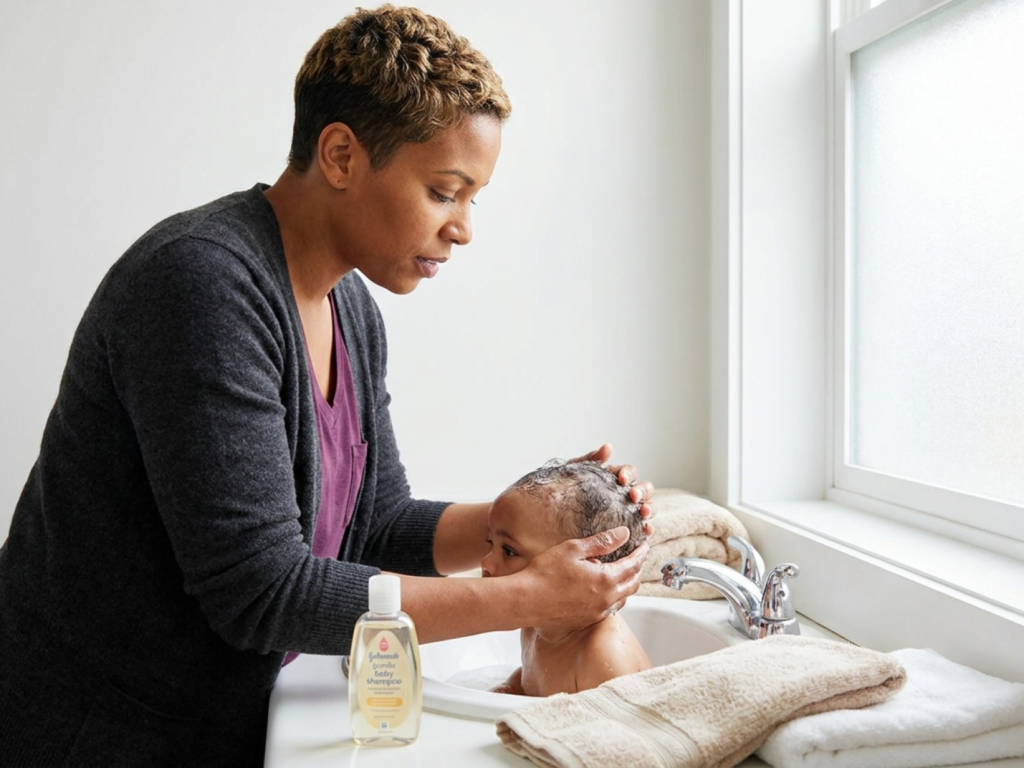
The way shampoo is used matters as much as the bottle itself. Use warm not hot water, apply only a small amount, and rinse thoroughly so surfactant residue does not stay on the skin. A prolonged lather or vigorous scrubbing is more likely to irritate than to help. For many babies, shampoo does not need to be part of every bath.
Evidence from a randomized trial found that a children’s liquid soap preserved skin pH and moisture better than conventional soap after the first bath. That finding does not prove one universal baby shampoo standard, but it does reinforce a practical principle: products closer to physiologic pH and with a gentler cleansing profile are more compatible with infant skin. In other words, the best cleanser is one that supports the skin barrier rather than stripping it.
For babies with scalp scale, careful cleansing and soft brushing may be recommended by a clinician, especially when the issue is consistent with common cradle cap. The point is to loosen scale gently, not force it off. If the scalp looks inflamed, cracked, or painful, stop experimenting and get medical advice.
When a shampoo issue is really a skin problem
Sometimes what looks like a shampoo problem is actually a skin condition that needs assessment. Persistent redness, flaky plaques, oozing, foul odor, hair loss, swelling, or significant itch suggest more than simple cleansing mismatch. If symptoms start soon after a product change, the cleanser may be an irritant or, less commonly, part of a contact reaction. But a product history alone is not enough to make a diagnosis.
Cradle cap, infantile seborrheic dermatitis, eczema, and other inflammatory scalp conditions can overlap in appearance. A parent may reasonably try a milder shampoo first, but ongoing symptoms deserve a pediatric review. That is especially true if the rash spreads beyond the scalp, if the baby seems uncomfortable, or if the skin is breaking down. A clinician can decide whether a different cleanser is enough or whether treatment is needed for the underlying condition.
Medical caution matters here: do not keep rotating products in the hope that one will eventually work if the scalp is worsening. Repeated exposure can irritate already vulnerable skin. A short, careful evaluation is often more useful than a long series of brand trials.
A practical US buying strategy
In the US market, there is no shortage of baby shampoos in pharmacies, supermarkets, mass retailers, and online stores. The practical strategy is to shortlist a few products that fit the same basic profile: mild, easy to rinse, appropriate for sensitive skin, and free of unnecessary extras. Price alone is not a reliable marker of quality. A modest formula that works well for a particular infant is better than a premium bottle that leaves the scalp dry.
Families can also think about the bathing routine as a whole. If the baby is otherwise comfortable, a gentle bath schedule and sparse shampoo use may matter more than chasing an ideal bottle. For parents who are unsure, the pediatrician or pharmacist can help interpret the ingredient list in context. The goal is not perfection. It is a consistent routine that keeps the infant clean without causing skin stress.
So the most accurate answer to “best baby shampoo US explained” is this: choose the gentlest product that your baby tolerates, use it sparingly, and escalate to medical advice when the scalp or skin stops behaving like normal healthy skin.
When to get medical advice
- Stop the product if a new rash, swelling, hives, or marked dryness appears.
- Seek urgent care for breathing trouble, facial swelling, or widespread allergic symptoms.
- Do not assume persistent scalp scale is only cosmetic if it is red, painful, or oozing.
- Ask a pediatric clinician before using medicated shampoos on an infant.
- Recurrent irritation after several products suggests the skin needs evaluation, not more trial products.
Tools & Assistance
- Pediatrician or family medicine visit
- Pharmacist label review at a local pharmacy
- MedlinePlus infant bathing guidance
- Product ingredient list and directions on the bottle
FAQ
How often should a baby shampoo be used?
Often less than parents expect. Many babies do not need shampoo at every bath; the frequency depends on age, scalp oil, and skin tolerance.
Is fragrance-free always better?
It is the most conservative choice for sensitive skin, but some healthy infants tolerate lightly fragranced products. The key issue is irritation, not marketing language.
Can I use adult shampoo on my baby?
Sometimes a mild adult cleanser may be tolerated, but baby formulations are usually chosen because they are gentler and easier to rinse from infant skin and eyes.
What if my baby has cradle cap?
A gentle cleanser may help with basic scalp care, but persistent or inflamed scale should be reviewed by a clinician rather than treated as routine dirt.
Sources
- PubMed Central — Tolerance of natural baby skin-care products on healthy, full-term infants and toddlers in the home setting
- MedlinePlus — Infant and Newborn Care
- PubMed Central — Randomized trial with soaps - what happens to a newborn's skin?
Disclaimer
This article is for general information only and does not replace individualized medical advice, diagnosis, or treatment from a qualified clinician.














Please log in to leave a comment.