
Intro
Babies develop through ordinary, repeated interactions rather than through formal training. Talking during a diaper change, offering supervised floor time, responding to a smile, or singing during feeding can support motor, sensory, communication, and social-emotional development. The most useful activities are brief, enjoyable, and adapted to your baby's alertness and abilities.
Milestones describe skills that many children achieve within an expected range, not a strict timetable. Premature infants may need assessment using corrected age, and individual variation is common. Use play to create opportunities, not pressure, and discuss concerns about movement, communication, hearing, vision, or loss of skills with a pediatrician or other qualified healthcare professional.
Highlights
Responsive interaction, including eye contact, talking, singing, and imitation, supports early communication and social-emotional development.
Supervised tummy time while awake helps build the strength and coordination needed for later movement.
Simple household activities can promote reaching, grasping, visual tracking, object permanence, and cause-and-effect learning.
Follow your baby's cues: enjoyable repetition is more useful than prolonged or overstimulating sessions.
Milestone variation is normal, but persistent asymmetry, regression, or significant concerns warrant professional advice.
Start With Responsive Interaction
The foundation of infant learning is a responsive relationship: the caregiver notices the baby’s signals and responds in a timely, warm, and predictable way. Hold your baby close, make eye contact when they are receptive, and imitate their facial expressions or vocalizations. When the baby coos, pause and answer as though you are having a conversation. This early turn-taking supports attention, reciprocity, and the foundations of language.
Skin-to-skin contact, gentle talking, and singing can be used from the newborn period. Narrate routine care in a calm voice: say what you are doing during bathing, dressing, or feeding, and name familiar people and objects. Babies do not need sophisticated toys to learn. They benefit from repeated exposure to human voices, faces, rhythms, and emotional expressions.
Observe whether your baby is alert, relaxed, and interested. Averted gaze, fussing, stiffening, yawning, or frantic movements may indicate fatigue or overstimulation. In that situation, reduce the sensory input, offer comfort, and try again later. Developmental play should be reciprocal and pleasurable, not a performance test.
Build Early Motor Strength Safely
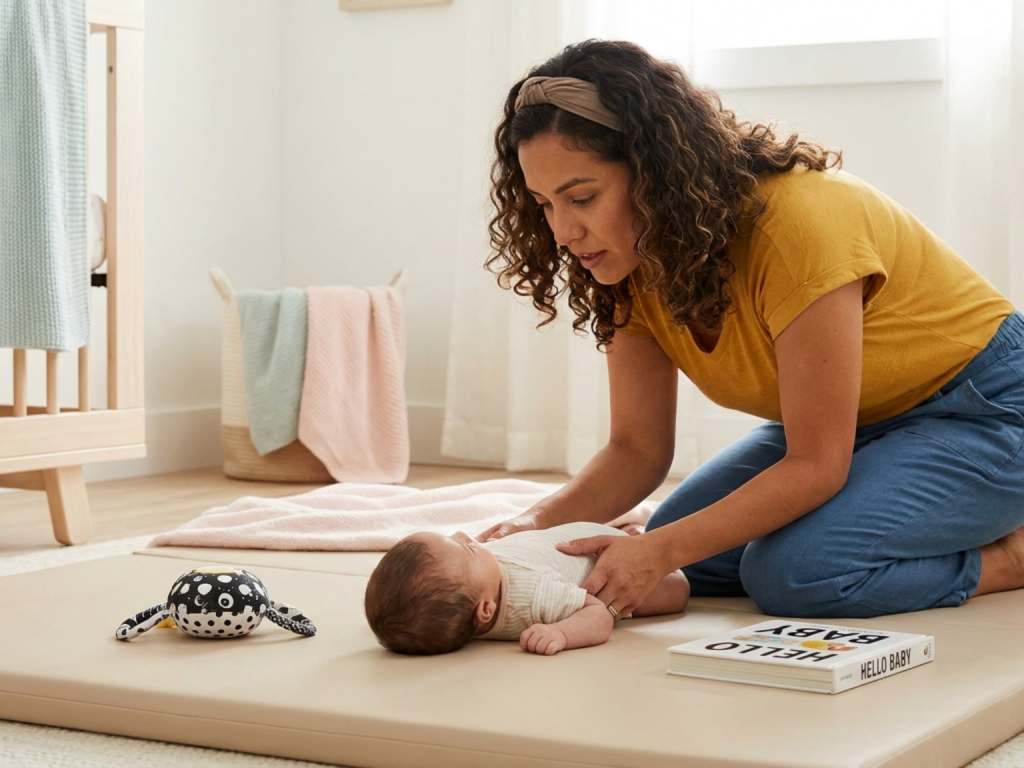
For young infants, short periods of prone positioning, commonly called tummy time, are an important way to practice lifting and turning the head, stabilizing the shoulders, and extending the trunk. Begin when your baby is awake and supervised, using a firm, clear surface. A caregiver can lie face-to-face with the baby, place a rolled towel under the chest if advised by a healthcare professional, or position a high-contrast object nearby to encourage head turning.
Several brief sessions may be more tolerable than one long session. As strength improves, place yourself or an interesting toy slightly to one side so the baby has a reason to shift weight and look in different directions. Around the middle of the first year, placing a toy just beyond reach can encourage reaching, pivoting, rolling, and early problem-solving. Allow the baby time to attempt the movement rather than immediately handing over the object.
Provide safe movement opportunities on the floor instead of relying for long periods on restrictive equipment. Do not use tummy time for sleep. Infants should be placed on their backs for sleep on a separate, firm, flat sleep surface, according to current safe sleep guidance. Avoid pulling a baby into sitting or standing before they are ready, and avoid devices that limit natural movement or create a fall hazard.
Encourage Reaching, Grasping, and Coordination
Motor development progresses from broad, less controlled movements toward more accurate reaching and grasping. Offer one lightweight, age-appropriate object at a time within visual range. High-contrast patterns can be useful for young infants, while colorful objects, varied shapes, and safe textures may attract an older infant’s attention. Move an object slowly from side to side, allowing the baby to visually track it without forcing the head or eyes.
When your baby begins reaching, place toys at midline and then slightly to either side. This gives opportunities to bring the hands together, reach across the body, and practice bilateral coordination. Let the baby hold, mouth, shake, and release objects under close supervision. A soft rattle or a crinkly fabric book can introduce cause-and-effect learning: the baby’s action produces a sound or movement.
As grasping becomes more deliberate, use large objects that cannot fit into the mouth and have no detachable parts, sharp edges, cords, or toxic materials. Do not place small foods or objects within reach because choking risk remains significant throughout infancy. The aim is exploration with safe materials, not precision or speed.
Use Songs, Books, and Conversation for Language
Language learning begins before recognizable words. Read picture books even when your baby cannot yet follow a story. Hold the book close enough for visual attention, point to a picture, label it, and wait briefly for a response. You can describe colors, sounds, actions, and familiar objects in simple sentences. Repetition is beneficial because it helps the infant detect speech patterns and associate sounds with meaning.
Singing adds predictable rhythm, changes in pitch, and pauses that invite participation. Songs with gestures, such as clapping or gently moving hands, combine auditory and visual information with social interaction. When your baby babbles, respond by repeating the sound and adding a word. This creates early language reciprocity and teaches that communication can be shared.
Point out objects during walks around the home or outside: a window, a spoon, a tree, or a family pet. Follow the baby’s gaze and interests rather than constantly redirecting attention. Limit background television and other passive media; face-to-face conversation is more adaptable and meaningful for an infant’s developing communication system.
Support Social and Emotional Development
Peekaboo, pat-a-cake, and simple imitation games combine anticipation, memory, attention, and social enjoyment. Hide your face briefly behind your hands, then reveal it with a familiar phrase. Later, partially hide a toy beneath a cloth and give the baby time to search. This object permanence play for babies helps them begin to understand that an object may still exist when it is temporarily out of sight.
Use predictable routines to support emotional regulation. A short song before a diaper change, a consistent phrase before sleep, or a calm greeting after waking can help the baby anticipate what comes next. When the infant becomes distressed, respond with holding, a quiet voice, rocking, or a reduction in stimulation. Comforting a baby does not spoil them; reliable responses help establish safety and support the gradual development of self-regulation.
Social games should respect the baby’s boundaries. Stop tickling, bouncing, or face-to-face play if the baby turns away, cries, becomes unusually tense, or appears overwhelmed. The caregiver’s ability to adjust the interaction is itself a powerful developmental experience.
Make Daily Care Developmental
Developmental practice does not need to be separated from family life. During feeding, pause to make eye contact and respond to facial expressions. During dressing, name body parts and allow the baby to feel a soft fabric. During bathing, describe the water and splash gently if the baby enjoys it. During a stroller walk, point out changing light, sounds, and movement while maintaining appropriate physical support.
These routine care developmental moments provide repeated practice with attention, sensory processing, communication, and social prediction. They also help caregivers learn the baby’s individual patterns. A baby who is most alert after a nap may tolerate floor play then, whereas another may prefer short interactions between feeds. A flexible routine is generally more sustainable than a rigid schedule.
Keep activities short enough that the baby can remain engaged. Repeating a familiar game across several days is useful, but vary the position, object, voice, or setting slightly as skills emerge. Progress may appear as greater endurance, more purposeful reaching, improved visual tracking, or increased social response before a dramatic new milestone is visible.
Adapt Activities to the First Six Months
From birth to approximately 3 months, prioritize close contact, face-to-face interaction, talking, singing, and brief supervised prone play. Offer high-contrast images or simple toys at a comfortable viewing distance. The baby may show progress through more sustained eye contact, head control, quiet alertness, and responsive sounds rather than through large movements.
From approximately 4 to 6 months, many infants become more active and interested in their surroundings. Continue supervised tummy time and add toys that encourage reaching, rolling, grasping, and transferring objects between hands. Games such as peekaboo, pat-a-cake, and hiding a toy briefly can support social attention and early cognitive skills. Pointing out objects and responding to babbling can reinforce emerging communication.
Age ranges are approximate. Temperament, opportunity, health, sensory abilities, and prematurity can affect when a skill appears. Focus on the direction of progress and the quality of interaction rather than comparing one baby with another. A pediatric clinician can help interpret development in the context of the child’s medical history.
Know When to Ask for Professional Guidance
Routine developmental surveillance is part of pediatric care. Share observations if your baby consistently uses one side much more than the other, has difficulty moving an arm or leg, seems unusually floppy or stiff, does not respond to sounds or faces as expected, or is not progressing in a way that concerns you. Persistent infant movement asymmetry may have many explanations, but it deserves assessment rather than repeated home exercises without guidance.
Contact a healthcare professional promptly if your baby loses a previously acquired skill. Loss of a skill is different from ordinary variation and should be discussed even if the child otherwise seems well. A clinician may assess hearing, vision, tone, reflexes, motor function, communication, and social interaction, and may recommend developmental screening or early intervention services for infants when appropriate.
Bring concrete examples to appointments: when the behavior occurs, which positions are difficult, what activities the baby enjoys, and whether the pattern is changing. Videos recorded for clinical review may be helpful when permitted and obtained safely. Seeking advice is a way to obtain support early, not a prediction of a diagnosis.
Safety reminders
- Supervise all awake floor play and tummy time; never leave an infant unattended on an elevated surface.
- Use a clear, firm play surface and keep pillows, loose blankets, cords, and small objects away from the baby.
- Place infants on their backs for sleep and keep sleep spaces free of loose bedding and soft items.
- Avoid toys with small parts, magnets, button batteries, long cords, or materials that can break or detach.
- Stop an activity when the baby shows distress, fatigue, breathing difficulty, color change, or unusual weakness.
- Seek prompt medical advice for loss of skills, marked asymmetry, or concerns about hearing, vision, movement, or responsiveness.
Tools & Assistance
- A daily observation note recording new movements, sounds, social responses, and activities the baby enjoys
- A firm floor mat and a small selection of age-appropriate, washable toys
- Board books with simple pictures, songs, and familiar phrases
- Regular well-child visits with a pediatrician, family physician, or child health nurse
- Local early intervention or developmental assessment services when recommended by a healthcare professional
FAQ
How much tummy time does a baby need?
Offer frequent, brief periods of supervised tummy time while the baby is awake, increasing the total gradually as tolerated. There is no need to force a duration when the baby is fatigued or distressed. Tummy time is for awake play, not sleep.
What if my baby dislikes tummy time?
Try placing the baby on your chest while you are fully awake, getting face-to-face at floor level, or using a brief session after a nap rather than immediately after feeding. Change the position or stop when the baby becomes upset, and ask a clinician for advice if tolerance remains very limited.
Do babies need expensive educational toys?
No. Safe household interactions, books, songs, faces, and simple toys can provide rich opportunities for learning. Choose objects that are large enough to prevent choking, free of detachable parts, and appropriate for the baby's developmental stage.
Should I worry if my baby reaches a milestone later than another baby?
Not necessarily. Milestones occur across ranges, and babies differ in temperament, health, experience, and corrected age if born prematurely. Discuss persistent concerns, lack of progress, significant asymmetry, or loss of a skill with a healthcare professional.
Can play cause a baby to reach milestones faster?
Play cannot guarantee a particular timetable. Its purpose is to provide safe opportunities for practice, connection, and exploration. Responsive interaction and regular healthcare follow-up are more appropriate goals than trying to accelerate development.
Sources
- Centers for Disease Control and Prevention — Milestones by 6 Months | Learn the Signs. Act Early.
- Mayo Clinic — Infant development: Birth to 3 months
- Mayo Clinic — Infant development: Milestones from 4 to 6 months
Disclaimer
This article provides general educational information and is not a diagnosis or a substitute for individualized medical advice. Consult a qualified healthcare professional about your baby's development, safety, or any concerning change.
















Please log in to leave a comment.