
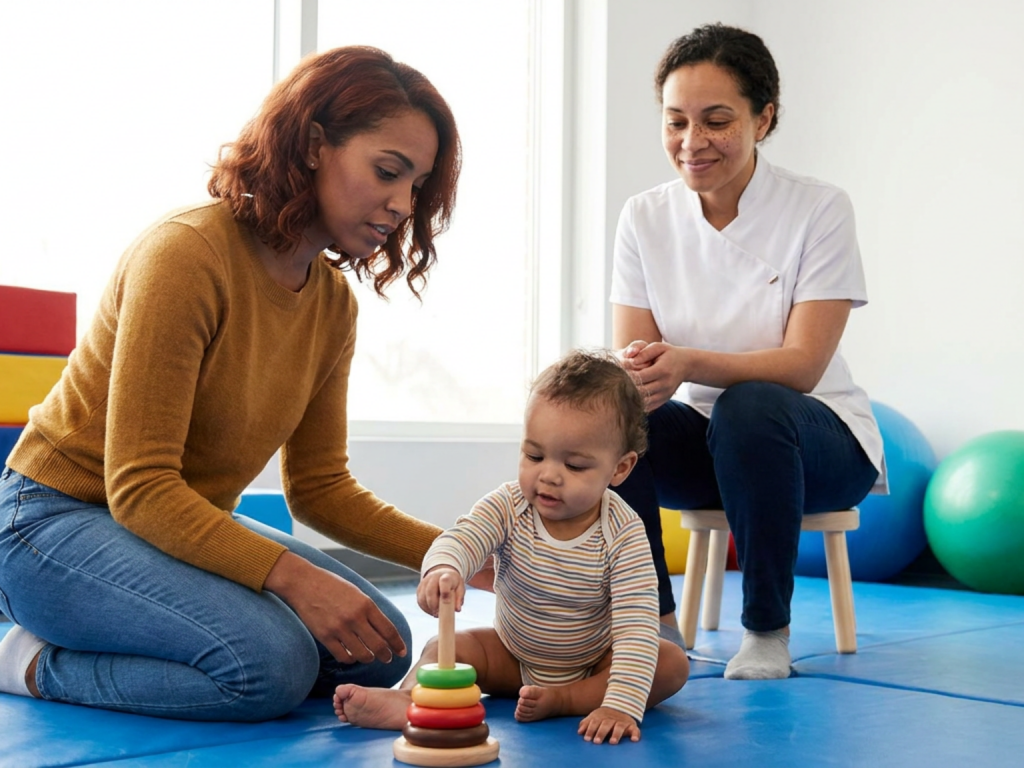
Intro
Baby development can feel like a series of sudden surprises: one week your baby is staring intently at your face, and soon they are smiling, reaching, rolling, babbling, or trying to pull up. Underneath those visible moments is a gradual neurologic and behavioral progression. Milestones are not isolated achievements; they are functional skills that tend to emerge over time and become the building blocks for later movement, communication, learning, relationships, and self-care.
Understanding how milestones build on each other can make development feel less like a checklist and more like a connected story. It can also help families notice patterns: not only whether a baby has reached a single skill, but how earlier skills are supporting the next ones. Every child develops at an individual pace, and timing varies, especially for babies born preterm when corrected age for preterm babies may be used. Still, persistent concerns, developmental regression in babies, or marked differences in movement, communication, social engagement, feeding, or play should be discussed with a pediatric healthcare professional.
Highlights
Milestones usually emerge in connected sequences: head control supports sitting, sitting supports reaching and play, and early sounds support later words.
Development happens across domains at the same time. Motor, language, cognitive, social-emotional, and adaptive skills influence one another.
Variation is common, but patterns matter. A baby who is steadily gaining new abilities may look different from another baby and still be developing typically.
Families do not need to teach every milestone directly. Responsive interaction, safe floor play, routines, and observation support the brain-body practice babies need.
Professional guidance is important when skills are not progressing, previously acquired abilities are lost, or caregivers have a strong concern.
Milestones are building blocks, not finish lines
Developmental milestones are behaviors or skills that many children show by certain ages. They include actions such as smiling socially, bringing hands to the mouth, rolling, sitting, pointing, using words, following directions, pretending, and participating in dressing or feeding routines. Medical organizations often group these skills by age and developmental domain because that structure helps families and clinicians observe progression over time.
The important nuance is that a milestone is rarely a standalone event. A baby who reaches toward a toy has already developed visual attention, postural control, shoulder stability, hand opening, and motivation to explore. A toddler who uses a two-word phrase has built on earlier listening, social reciprocity, imitation, babbling, joint attention, and single-word communication. When one skill appears, it often reflects many smaller capacities working together.
This is why development can seem uneven. A baby may invest a great deal of neurologic energy in movement for several weeks and appear quieter verbally, then begin babbling more once their posture is more stable. Another baby may be socially expressive before they are especially mobile. These differences do not automatically indicate a problem, but they remind us to look at the whole developmental picture.
Motor skills create the platform for exploration
Infant gross motor development often follows a head-to-toe and center-out pattern. Early head control makes it easier for babies to visually scan the environment. Trunk strength supports rolling, sitting, and eventually transitions in and out of positions. Sitting improves hand use because the baby no longer needs to use all their energy simply to remain upright. Crawling, cruising, and walking then expand the baby’s ability to choose what to explore.
Supervised tummy time while awake is one practical example of how early experience supports later skills. During tummy time, babies practice lifting the head, bearing weight through the arms, turning toward sounds, and coordinating vision with movement. These components can contribute to rolling, pushing up, reaching, and eventually more complex movement patterns.
Fine motor development in infancy also builds step by step. A newborn’s hands are often fisted. Over time, babies open their hands, swipe at objects, grasp intentionally, transfer toys between hands, rake small objects, use a pincer grasp, and eventually stack, scribble, feed themselves, or turn pages. Fine motor gains depend on vision, posture, sensory processing, and cognition. For example, a baby who can sit steadily may have more freedom to use both hands for exploring a toy, which strengthens problem-solving as well as hand control.
Movement quality matters along with timing. Families should mention persistent infant movement asymmetry, consistently using one side much more than the other, unusual stiffness or floppiness, or loss of motor skills to a pediatric clinician. These observations do not establish a diagnosis by themselves, but they may warrant closer assessment.
Communication grows from interaction before words
Early communication milestones begin long before a baby says a recognizable word. Newborns communicate through crying, body state, gaze, and facial expression. Over the first months, babies increasingly attend to voices, calm to familiar caregivers, smile socially, coo, laugh, take turns with sounds, and experiment with pitch and rhythm. Babbling later provides practice with the oral-motor patterns and auditory feedback that support speech.
Language development is tightly connected to social interaction. A caregiver who pauses, responds, imitates sounds, labels objects, and follows the baby’s focus is helping build the neural architecture for communication. This back-and-forth exchange is sometimes called serve-and-return interaction: the baby signals, the adult responds, and the baby learns that communication has an effect.
Later language milestones build on this foundation. Pointing, showing objects, waving, and looking between a person and an object are forms of joint attention. They show that a child is beginning to share interest, not just request help. Single words often emerge from repeated routines: milk, up, dada, ball, more. Two-word combinations then add relationships between ideas, such as “more banana” or “mama up.” Understanding usually develops alongside expression, so clinicians may ask what a child seems to comprehend as well as what they can say.
Caregivers should seek advice if they notice limited response to sound, reduced eye contact or social reciprocity, loss of babbling or words, or concern that a baby is not communicating needs in developmentally expected ways. Hearing evaluation, developmental surveillance, and pediatric developmental screening can help clarify what support may be useful.
Cognition and play become more complex through practice
Cognitive milestones describe how babies learn, remember, solve problems, and understand cause and effect. At first, learning is sensory and relational: a baby studies faces, tracks movement, mouths toys, and repeats actions that produce interesting results. Over time, babies realize that objects continue to exist when hidden, that actions can be repeated intentionally, and that tools or gestures can help them get what they want.
Play is one of the clearest ways to see cognitive development building on itself. A young baby may simply look at or mouth a rattle. Later, they shake it on purpose, bang it, transfer it, drop it to see what happens, and look for it after it falls. A toddler may use the same kind of learning to feed a doll, push a toy car, copy household routines, or begin pretend play. Pretend play depends on memory, symbolic thinking, imitation, social observation, and motor planning.
Routines also support cognitive growth. Predictable sequences, such as bath, pajamas, book, and bed, help babies learn anticipation and organization. Repetition does not make the day boring for a baby; it gives the nervous system a stable pattern from which to notice variation. When a caregiver says the same words during a familiar routine, the child links language, action, emotion, and expectation.
Because cognitive skills are expressed through movement, communication, and social behavior, concerns may show up in many ways. A child may seem unusually difficult to engage, may not explore objects, may not imitate, or may not progress in play complexity. These signs are worth discussing with a clinician, especially when combined with other developmental concerns.
Social-emotional skills link safety, learning, and independence
Social-emotional development in infancy is not separate from “learning”; it is one of the main routes through which learning happens. Babies are biologically prepared to orient toward faces, voices, touch, and caregiver regulation. When adults respond consistently, babies begin to develop trust, emotional regulation, and confidence to explore.
Early social milestones include calming when comforted, looking at faces, smiling in response, enjoying social games, recognizing familiar people, showing preferences, and eventually using caregivers as a secure base. A mobile baby may crawl away to explore and then look back to check the caregiver’s reaction. That quick glance is developmental work: the baby is integrating motor ability, attachment, social referencing, and risk assessment.
As babies become toddlers, social-emotional milestones support cooperation and self-care. A child who understands routines may lift an arm for a sleeve, bring shoes, imitate brushing hair, or help with cleanup. These adaptive skills build on motor planning, receptive language, memory, and the desire to participate with others. Independence does not appear all at once; it is scaffolded by many small opportunities to try.
It is also normal for new skills to bring frustration. A baby who wants to move but cannot yet crawl, or a toddler who understands more than they can say, may become upset. Supportive caregiving does not mean preventing all frustration. It means staying emotionally available, naming feelings, keeping boundaries safe, and offering developmentally appropriate help.
Why developmental timing varies
Developmental milestone charts describe common patterns, not exact deadlines for every child. Genetics, temperament, opportunities for practice, medical history, prematurity, sensory differences, sleep, feeding, family routines, and environmental context can all influence when skills appear. Two healthy babies may reach the same milestone weeks or months apart and both continue along a typical trajectory.
For babies born preterm, clinicians often use corrected age for preterm babies during the first years when interpreting milestones. Corrected age estimates development based on the baby’s due date rather than birth date. This can prevent unrealistic expectations while still allowing clinicians to monitor progress carefully.
At the same time, wide normal variation should not be used to dismiss caregiver concerns. Parents and caregivers often notice subtle patterns before a brief office visit can capture them. Developmental screening questionnaires are designed to gather structured information about skills across domains. They do not diagnose by themselves, but they help identify when a child may benefit from closer evaluation or early support.
A helpful question is not only “Has my baby reached this milestone?” but also “What is my baby doing more of over time?” Progress, curiosity, engagement, and increasing complexity often matter as much as a single date on a chart.
How caregivers can support the chain of skills
Caregivers support milestones most effectively through ordinary, responsive interaction. Babies do not need formal lessons. They need safe chances to move, communicate, rest, repeat, and connect with people who notice their signals.
- Offer safe floor play with supervised tummy time while awake, side-lying play, reaching, rolling opportunities, and freedom from prolonged restrictive positioning when the baby is awake and supervised.
- Talk during routines using simple, warm language: name body parts during dressing, describe foods during meals, and pause so the baby can respond with sounds, looks, or gestures.
- Follow the baby’s attention. If they stare at a spoon, ball, or dog, label it and let the interaction grow from their interest.
- Use repetition. Songs, peekaboo, books, and predictable daily sequences strengthen memory, anticipation, social turn-taking, and language mapping.
- Encourage effort without forcing positions or skills. Babies learn through practice, but pushing a body into a posture it cannot yet control may be uncomfortable or unsafe.
- Share observations with your pediatric team, especially if you notice plateauing, developmental regression in babies, persistent asymmetry, feeding difficulty, or reduced social engagement.
If screening suggests a delay, early intervention services for infants can provide developmental therapies and family coaching. Seeking support is not a failure or a label; it is a way to give a child’s developing nervous system more targeted opportunities to practice.
When to seek medical guidance
- Any loss of previously acquired skills, such as stopped babbling, fewer gestures, or reduced movement ability, should be discussed promptly.
- Persistent infant movement asymmetry, unusual stiffness, marked floppiness, or feeding and swallowing concerns warrant pediatric evaluation.
- Limited response to sounds, limited social engagement, or lack of progress in communication should be reviewed with a healthcare professional.
- Use corrected age for preterm babies when advised, but keep scheduled developmental surveillance and screening visits.
- If your caregiver instinct says something is not right, ask for pediatric developmental screening rather than waiting in uncertainty.
Tools & Assistance
- Well-child visits with developmental surveillance and standardized screening
- A written milestone journal noting new skills, concerns, and examples
- Hearing and vision evaluation when communication or visual tracking concerns arise
- Early intervention services for infants when screening or clinical concern suggests support
- Safe daily play routines that include movement, language, turn-taking, and rest
FAQ
Do babies need to master one milestone before the next appears?
Not always. Skills overlap and develop in parallel, but earlier abilities often make later ones easier. For example, better trunk control can support reaching, play, and communication.
Is it a problem if my baby skips a milestone such as crawling?
Some babies use different movement strategies, and timing varies. Discuss it with your pediatric clinician if you notice asymmetry, weakness, stiffness, lack of exploration, or delays in other domains.
How should I think about milestones if my baby was premature?
Clinicians often use corrected age for preterm babies when reviewing early milestones. Your pediatric team can explain how long to use corrected age and whether extra monitoring is recommended.
Can I speed up development with special exercises?
Most babies benefit from responsive interaction, safe floor play, talking, reading, routines, and time to practice. Avoid forcing skills; ask a healthcare professional for individualized advice if you are concerned.
What is the difference between a delay and normal variation?
Normal variation means a child progresses at an individual pace while continuing to gain skills. A possible delay is more concerning when progress stalls, several domains are affected, or a child loses skills.
Sources
- Children's Hospital of Philadelphia — Developmental Milestones
- Centers for Disease Control and Prevention — Module 2: Understanding Children's Developmental Milestones
- Cleveland Clinic — Child Development: Milestones & Stages
Disclaimer
This article is for general educational purposes and is not a diagnosis or treatment plan. Always consult your pediatrician or another qualified healthcare professional about developmental concerns.














Please log in to leave a comment.