
Intro
When a preschooler refuses instructions or seems unable to listen, daily routines can become emotionally exhausting. Parents may wonder whether the child is being defiant, overwhelmed, distracted, or genuinely not understanding what is being asked.
Highlights
Preschool refusal is often a mix of immature self-regulation, limited receptive language, transitions, fatigue, and the child’s need for autonomy.
Effective strategies usually involve short, specific instructions, visual cues, predictable follow-through, and positive reinforcement for cooperation.
Persistent difficulty listening across home and preschool should prompt consideration of hearing, speech-language, developmental, attention, sleep, and emotional factors.
Why preschoolers may refuse instructions
Preschoolers are not small adults with reliable impulse control. Their prefrontal networks, language comprehension, working memory, and emotional regulation are still developing. A child may hear the words “put your shoes on” but not integrate the instruction with the sequence of stopping play, finding shoes, tolerating frustration, and completing the task. What looks like deliberate refusal may be a developmental bottleneck.
That said, refusal can still become a pattern. Children learn quickly when delaying, yelling, running away, or ignoring an adult helps them avoid a task or gain extra attention. This does not mean the child is manipulative in an adult sense. It means behavior is being shaped by predictable outcomes. If an instruction is repeated ten times and then abandoned, the child may learn that not responding is effective.
Common contributors include hunger, fatigue, overstimulation, inconsistent routines, transitions away from preferred activities, receptive language concerns in children, anxiety, sensory overload, and limited ability to shift attention. Some preschoolers also struggle more in noisy classrooms than at home, because listening requires filtering competing sounds, watching social cues, and understanding multi-step directions at the same time.
Distinguishing refusal from difficulty understanding
A medically useful question is not simply “Will my child listen?” but “Can my child understand, remember, and act on this instruction in this setting?” Receptive language is the ability to understand spoken language. A child with receptive language weakness may appear oppositional because they miss key words, rely on routines rather than comprehension, or become embarrassed and avoidant when they do not understand.
Clues that listening difficulty may be more than ordinary boundary-testing include frequent confusion with new directions, better performance when shown rather than told, difficulty answering “who,” “what,” or “where” questions, problems following two-step commands, or behavior concerns in multiple settings. A child may also seem to listen selectively: responding immediately to a favorite show but not to a classroom instruction. This can happen because motivation, context, visual cues, and familiarity greatly affect performance.
Hearing should also be considered. Intermittent conductive hearing loss from middle-ear fluid, recurrent otitis media with effusion, or unrecognized hearing differences can affect speech perception, especially in background noise. Age-appropriate hearing testing and, when indicated, a speech-language pathologist evaluation can help clarify whether the child’s “not listening” reflects comprehension, attention, hearing, or behavior patterns.
How to give instructions a preschooler can actually follow
Preschoolers do best with instructions that are brief, concrete, and close to the moment of action. Instead of calling across a room, move near the child, get down to their level, use their name, and wait for a brief orienting response. Eye contact can help some children, but it should not become a power struggle; the goal is shared attention, not forced staring.
Use positive, specific wording. “Walk with the cup” is easier to process than “Don’t spill that.” “Put the blocks in the blue bin” is clearer than “Clean up.” If the task has several parts, give one step at a time or use a visual routine. Many preschoolers cannot reliably hold a three-step verbal sequence in working memory, especially when emotionally activated.
Helpful instruction habits include:
- Use fewer words: “Shoes on, then outside.”
- State what to do, not only what to stop doing.
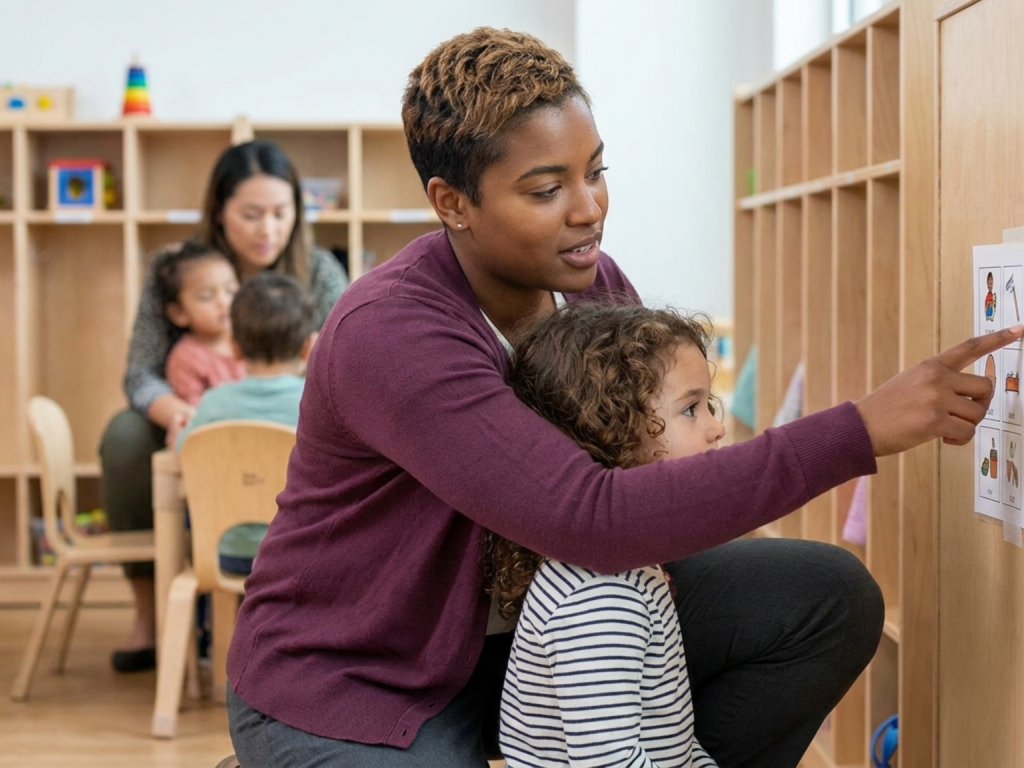
- Pair speech with gestures, pictures, or modeling.
- Ask the child to show you the first step rather than repeat the whole direction.
- Give instructions when you are ready to follow through, not as background commentary.
After giving a direction, pause. Rapid repetition can become noise and may teach the child to wait until the adult sounds angry. A calm pause also gives the child processing time, which is particularly important for listening comprehension in preschoolers.
Transitions, choices, and predictable follow-through
Many refusals occur during transitions: leaving the playground, turning off a tablet, getting dressed, or moving from free play to meals. A transition asks the child to stop something rewarding and start something less preferred. Transitional warnings are often more effective than sudden commands. For example: “Five more minutes, then bath,” followed by “One more turn, then bath.” Timers, picture schedules, and songs can make the change less abrupt.
Choices give preschoolers a sense of control while preserving the adult’s boundary. The choice should be limited and acceptable either way: “Do you want the red cup or the blue cup?” “Do you want to hop to the bathroom or walk?” Avoid choices when there is no real choice, such as “Are you ready to leave?” if leaving is required.
If-then statements can connect behavior to a logical next step: “If the toys are in the basket, then we can read the story.” This is not a threat; it is a simple sequence. Follow-through matters. If the adult says the story happens after cleanup, then the adult should help the child begin cleanup and keep the sequence consistent.
Consequences for preschoolers should be immediate, brief, nonphysical, and related when possible. Long lectures and delayed punishments usually do not teach the desired skill. Calm follow-through for children is more effective than escalating volume, bargaining, or repeatedly changing the rule.
Positive reinforcement and reducing power struggles
Children repeat behaviors that work. Positive reinforcement means noticing and rewarding cooperation, effort, and small steps toward the goal. This is different from vague praise. “You came to the table the first time I asked” gives useful information. “You put one shoe on by yourself” highlights the exact behavior to repeat.
Many families understandably give the most attention when a child refuses. The child hears repeated instructions, explanations, emotional reactions, and negotiations. Meanwhile, quiet cooperation may receive little attention. Deliberately “catching” the child being cooperative can shift the pattern. Praise should be immediate and specific, and it can be paired with warmth, high-fives, stickers, or access to a preferred activity when appropriate.
For minor whining or a brief tantrum that is not unsafe, planned ignoring may help when paired with praise for the next appropriate behavior. This does not mean ignoring distress, fear, pain, or dangerous behavior. It means not giving extra power to a behavior that is functioning mainly to delay or avoid a simple limit. When the child re-engages, respond warmly and guide the next step.
Power struggles often decrease when adults use fewer words and more structure. A calm script such as “I will help you start” can prevent a long debate. The adult can gently guide the first action, such as handing the child a shoe or pointing to the first picture in the routine, while maintaining a neutral tone.
When to seek professional support
It is reasonable to seek help when refusal is intense, persistent, worsening, or present across home, preschool, and community settings. Professional input is also important if the child has delayed speech, unclear speech, limited comprehension, regression of skills, frequent ear infections, suspected hearing loss, sleep disruption, aggressive behavior, extreme distress with transitions, or difficulty participating in preschool routines.
A pediatric clinician can review growth, sleep, hearing risk, neurologic history, developmental milestones, medication exposures, family stressors, and signs of anxiety or neurodevelopmental differences. Developmental surveillance and screening may identify whether more formal assessment is needed. A speech-language pathologist can assess receptive and expressive language, pragmatic communication, and how well the child follows directions with and without visual support.
Research on listening comprehension interventions suggests that children can improve when they are explicitly taught to coordinate language with visual and motor cues. In practical preschool terms, this supports approaches such as modeling the action, pointing to relevant objects, using pictures, and practicing instruction-following in playful, low-pressure contexts. These strategies are educational supports, not a substitute for individualized medical or developmental evaluation when concerns are significant.
If behavior is highly disruptive, parent management training for noncompliance or consultation with an early childhood mental health clinician may help caregivers use consistent reinforcement, clear limits, and developmentally appropriate consequences. The aim is not to label a preschooler as “bad,” but to understand the function of the behavior and teach replacement skills.
Building a listening-supportive home routine
A home plan works best when it is simple enough to use on a hard day. Choose one or two high-stress routines, such as getting dressed or bedtime, and make them predictable. Use the same short phrases, the same order, and the same visual cues. Preschoolers often cooperate better when they know what comes next.
For example, a morning routine might use pictures for toilet, clothes, breakfast, shoes, and preschool bag. The adult gives one instruction at a time and praises each completed step. If the child refuses, the adult offers a limited choice or helps start the action without a lecture. Over time, the routine itself carries some of the behavioral load.
Also consider the child’s physiologic state. Listening declines when a child is tired, hungry, constipated, ill, overstimulated, or recovering from a long day of social demands. Reducing background noise, using face-to-face communication, and allowing extra transition time can substantially improve cooperation. For some children, visual schedules for difficult transitions are not optional extras; they are the scaffold that makes listening possible.
Finally, protect the relationship. A preschooler who refuses instructions still needs connection, play, affection, and chances to succeed. Ten minutes of child-led play can reduce attention-seeking refusal and remind both parent and child that the relationship is bigger than the behavior problem.
Seek timely advice if
- Your child seems unable to understand simple directions or loses previously acquired language or social skills.
- There is suspected hearing loss, frequent ear infections, or difficulty listening in noisy settings.
- Refusal is accompanied by aggression, self-injury, severe anxiety, or unsafe running away.
- Behavior problems occur across home and preschool despite consistent, developmentally appropriate strategies.
- Caregiver stress is high or discipline is becoming harsh, frightening, or difficult to control.
Tools & Assistance
- Pediatric visit for developmental surveillance, hearing risk review, and referral planning
- Age-appropriate hearing testing with an audiology professional when concerns exist
- Speech-language evaluation for receptive language and instruction-following concerns
- Preschool behavior support plan using consistent routines, visuals, and reinforcement
- Parent management training or early childhood mental health consultation for persistent noncompliance
FAQ
Is my preschooler refusing on purpose?
Sometimes refusal is intentional avoidance, but it is often mixed with immature self-control, language demands, fatigue, or transition difficulty. Focus on patterns rather than blame.
How many times should I repeat an instruction?
Usually once, then pause and follow through calmly. Repeating many times can teach a child to wait until the adult becomes upset.
Should I punish my child for not listening?
Use brief, logical, nonphysical consequences and strong positive reinforcement for cooperation. Harsh or delayed punishment is less helpful for preschool learning.
When should I request a speech-language evaluation?
Consider evaluation if your child often misunderstands directions, struggles with new instructions, has speech-language delays, or has behavior problems across settings.
Can visual supports really help listening?
Yes. Pictures, gestures, modeling, and routines reduce working-memory load and help children connect spoken words to actions.
Sources
- Johns Hopkins Medicine — How to Get a Toddler to Listen
- National Institutes of Health (PMC) — Learning to Listen: Changes in Children's Brain Activity and the Impact of a Language Simulation Listening Comprehension Intervention
- Child Mind Institute — Our three-year-old daughter doesn't listen and misbehaves in school: How can we improve her behavior?
Disclaimer
This article is for general educational purposes only and does not diagnose or treat any child. Consult a pediatrician, audiologist, speech-language pathologist, or qualified mental health professional for individualized guidance.


















Please log in to leave a comment.