
Intro
Teaching children about fire safety can feel emotionally heavy: no caregiver wants to frighten a child, yet children need clear, practiced rules long before an emergency occurs. The goal is not to create fear, but to build calm familiarity with what to do when smoke, flames, alarms, or hot surfaces are present.
Because children vary widely in impulse control, sensory processing, mobility, language, and developmental readiness, fire safety teaching works best when it is simple, repetitive, and adapted to the child in front of you. A supportive plan can protect children while also helping adults respond quickly and consistently.
Highlights
Children learn fire safety best through calm repetition, short rules, and realistic practice rather than one long lecture.
Core home rules include staying away from matches and lighters, knowing two ways out of each room, crawling low under smoke, and never going back into a burning building.
Smoke alarms, family fire drills, and a designated outdoor meeting place turn abstract instructions into a usable emergency plan.
Burns and smoke exposure can be medically serious; caregivers should seek professional help when symptoms are concerning or when they are unsure.
Start with calm, concrete rules
Children do not need graphic stories to understand that fire is dangerous. They need brief, concrete rules they can remember under stress. A useful starting point is: fire is a tool for adults, not a toy for children. This framing avoids making fire mysterious or exciting while still setting a firm boundary.
For preschool and early school-age children, use the same words every time: “Do not touch matches or lighters. Tell a grown-up.” “If the smoke alarm sounds, go outside.” “Do not hide from firefighters.” Repetition matters because emergencies impair executive function, the brain’s ability to plan, inhibit impulses, and shift attention. Even adults can freeze during danger; children need rehearsed scripts.
Keep teaching sessions short. A five-minute conversation while checking smoke alarms may be more effective than a long, frightening talk. Invite questions, but answer simply. If a child asks whether a fire could happen at home, a reassuring but honest response might be: “It is not likely today, and we practice because practice helps us stay safe.”
Children who are anxious, autistic, have sensory sensitivities, or have a trauma history may need extra preparation. The sound of an alarm can be painful or overwhelming. Consider warning the child before a planned alarm test, offering hearing protection during practice, and using visual schedules or social stories. If a child has complex medical, developmental, or mobility needs, ask their clinician, school team, or local fire department about individualized evacuation planning.
Build a home escape plan children can actually use
A fire escape plan should be simple enough for a sleepy child to follow. Walk through every room and identify two ways out when possible, such as a door and a window. Show children which exits are realistic for them and which require adult help. If windows are part of the plan, adults should understand safe use of escape ladders and whether the child is developmentally able to follow instructions.
Choose one outdoor meeting place that is easy to recognize: a mailbox, a neighbor’s porch, a tree away from the building, or another safe landmark. The rule is: get out, go to the meeting place, and stay there. Children should hear clearly that they must never re-enter a burning building for a toy, pet, blanket, phone, or another person. Re-entry is for trained firefighters.
Practice family fire drills at least twice a year and vary the scenario. Try one drill from the bedroom area and another from a living space. Practice during daylight first; once children understand the plan, consider a calm evening practice so they learn what the home feels like in lower light.
During drills, teach children to respond to the smoke alarm, not to wait for an adult to explain. This is especially important if an adult is asleep, injured, or in another part of the home. At the same time, children should know that in a real emergency they should follow the supervising adult’s directions if an adult is able to help.
Teach what to do with smoke, hot doors, and alarms
Smoke is often more dangerous than flames because it can irritate and injure the airway, reduce oxygen availability, and impair visibility. Children should learn to get low and crawl under smoke when escaping. Explain that cleaner air is usually closer to the floor, so “crawl low and go” is easier to remember than a technical explanation.
Door safety is another practical skill. Teach children to feel a closed door, the doorknob, or the space around the door with the back of the hand before opening it. If it feels hot, they should not open it. They should use the second way out if available or get to a window where they can call for help. If the door is cool and there is no smoke entering, they may open it slowly and be ready to close it if smoke or heat is on the other side.
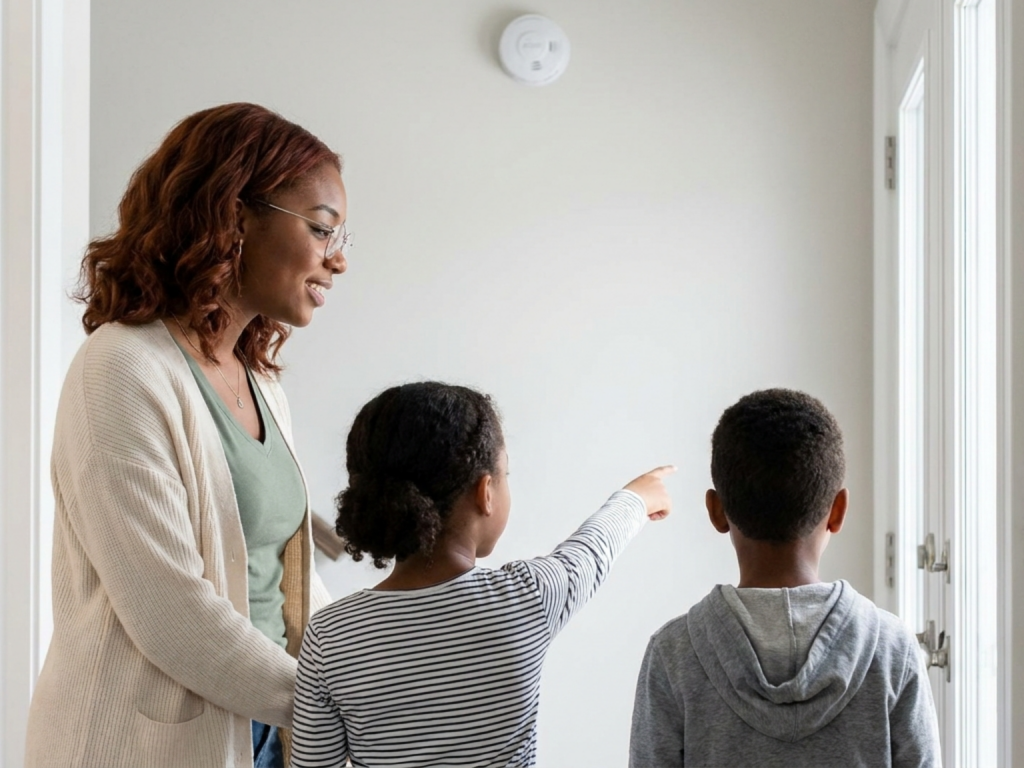
Smoke alarms should be installed and maintained according to local guidance and manufacturer instructions. Children need to know the sound. During a planned test, say: “This sound means leave the home and go to our meeting place.” Avoid teaching children to investigate the alarm; the child’s job is to get out.
For medically literate caregivers, it helps to remember that smoke inhalation can cause delayed respiratory symptoms. Cough, wheeze, hoarseness, soot around the mouth or nose, altered mental status, chest tightness, or severe breathing difficulty in children after a fire or smoke exposure should be treated as urgent. Do not try to determine severity alone when symptoms are significant; contact emergency services or a healthcare professional.
Practice STOP, DROP, and ROLL for clothing fires
If clothing catches fire, running can increase airflow and make flames spread faster. Children should learn the sequence STOP, DROP, and ROLL. Practice it physically, like a safety drill, so the body remembers the action.
- Stop: freeze immediately instead of running.
- Drop: get down to the ground and cover the face with hands if possible.
- Roll: roll over and over until the flames are out.
Keep the practice calm and matter-of-fact. Demonstrate on a carpet or mat, then let the child try. Some children may laugh or become silly; that is common when children feel nervous. Gently return to the rule: “This is a serious safety move, and practicing helps your body remember.”
Children should also know to shout for an adult immediately if they are burned. For minor thermal burns, reputable fire-safety guidance advises cooling the burn with water for 3 to 5 minutes and telling an adult right away. Do not apply butter, toothpaste, ice, or home remedies. Burns involving the face, hands, genitals, large areas, blistering, electrical injury, chemical exposure, inhalation risk, or significant pain should be assessed urgently by healthcare professionals. When in doubt, seek medical advice rather than minimizing the injury.
Reduce curiosity risks: matches, lighters, candles, cooking, and electricity
Children are naturally curious, and curiosity increases when forbidden objects are visible. Store matches and lighters out of sight and out of reach, ideally locked away. Do not rely on “child-resistant” designs as childproof. The same principle applies to candles, incense, fire starters, and fireplace tools.
Make a household rule that children bring any found match or lighter to an adult without punishment. If a child fears punishment, they may hide the object. A safer script is: “You will not be in trouble for telling me. Matches and lighters are for adults only.”
Cooking areas need specific boundaries. Teach young children to stay outside a marked “kid-free zone” around the stove, oven, grill, or outdoor fire pit. Turn pot handles inward, supervise closely, and avoid carrying hot liquids while holding a child. Scald burns from hot water, soup, tea, or oil can be deep and medically significant, especially in infants and toddlers because their skin is thinner and their body surface area is proportionally larger.
Electrical safety is also part of fire prevention. Children should not plug in multiple devices without adult permission, place cords under rugs, use damaged chargers, or put objects into outlets. Older children and preteens may need explicit rules about charging phones, tablets, or gaming devices on hard surfaces rather than under pillows or blankets, where heat can build up.
Teach emergency calling without creating false alarms
Children should know how to call emergency services, but they also need boundaries. A practical rule is: call 9-1-1 or the local emergency number when there is a fire, someone is badly hurt, or an adult cannot call. Explain that emergency numbers are not for practice calls, jokes, curiosity, or testing the phone.
Role-play what the dispatcher may ask: “What is your address?” “What happened?” “Is anyone hurt?” “Are you inside or outside?” Children who are old enough can memorize their address, apartment number, and caregiver phone number. For younger children, post emergency information in a consistent place and ensure babysitters or relatives know it.
In a real fire, the preferred sequence is usually: get out first, then call from outside or from a neighbor’s phone if needed. A child should not stay inside to search for a phone. If an adult is present and able, the adult handles calling while directing evacuation.
Medical emergencies can overlap with fire events. Smoke exposure, burns, falls during escape, panic-related hyperventilation, and asthma exacerbations may occur. Caregivers who understand pediatric emergency warning signs are better prepared to seek timely help, but children should not be expected to evaluate medical severity. Their job is to alert an adult, leave danger, and call emergency services only when an adult cannot.
Make fire safety inclusive, routine, and emotionally safe
Fire safety plans should fit the child, not the other way around. A toddler may need containment and supervision more than verbal teaching. A school-age child can practice two exits and STOP, DROP, and ROLL. A preteen may be ready to help test alarms, identify hazards, and discuss responsible use of appliances. Children with limited mobility, hearing differences, visual impairment, seizures, chronic lung disease, or medical equipment may need a written pediatric medication plan and emergency evacuation instructions shared with caregivers, school staff, and respite providers.
Keep the emotional tone steady. After drills, praise specific behaviors: “You went to the meeting place and stayed there.” “You remembered not to go back inside.” This builds competence instead of fear. If a child becomes very distressed, pause, validate the feeling, and return later in smaller steps.
Caregivers should also plan for nights and babysitters. Keep pathways clear, close bedroom doors when appropriate as part of local safety guidance, and ensure visiting caregivers know the exits, meeting place, alarm sounds, and any child-specific needs. If the child uses oxygen, a ventilator, mobility aids, or other medical equipment, ask the healthcare team and local fire service about safe evacuation planning.
Finally, revisit rules after moves, renovations, new appliances, or developmental changes. Fire safety is not a one-time lecture; it is a family habit. The most effective message is compassionate and consistent: adults work to prevent fires, and children can learn simple actions that help keep everyone safer.
Seek urgent help when danger signs appear
- Call emergency services immediately for any active fire, trapped person, or significant smoke exposure.
- Get urgent medical help for burns to the face, hands, genitals, large areas, blistering burns, chemical burns, electrical burns, or severe pain.
- Treat cough, wheeze, hoarseness, confusion, fainting, soot near the mouth or nose, or severe breathing difficulty after smoke exposure as urgent.
- Do not let a child re-enter a burning building for pets, toys, blankets, or belongings.
- Do not use ice, butter, toothpaste, or home remedies on burns; seek professional guidance when unsure.
Tools & Assistance
- Test smoke alarms and replace batteries or devices according to manufacturer and local safety guidance.
- Create a two-exit map for each room and choose one outdoor family meeting place.
- Practice family fire drills at least twice a year, including a calm nighttime scenario when appropriate.
- Store matches, lighters, candles, and fire-starting materials locked away and out of sight.
- Ask your local fire department about child-friendly fire safety education or individualized evacuation planning.
FAQ
At what age should children start learning fire safety rules?
Start in toddlerhood with simple boundaries such as “hot, do not touch” and “matches are for adults.” Add escape practice, two exits, and emergency calling as the child’s language, memory, and judgment develop.
How often should families practice a fire drill?
Many fire-safety organizations recommend practicing at least twice a year. Practice more often after moving, changing bedrooms, renovating, or if a child needs extra repetition.
Should children learn to call 9-1-1?
Yes, when developmentally ready. Teach that emergency numbers are for real danger, and that in a fire they should get outside first if possible and call only when an adult cannot.
What should a child do if smoke is in the hallway?
They should stay low, crawl under smoke, and use the safest exit. If a door feels hot, they should not open it and should use another exit or signal for help from a window.
What if my child is terrified of smoke alarms?
Use gradual exposure, warnings before tests, visual supports, and reassurance. If distress is intense or linked to sensory or trauma concerns, consider asking a pediatrician, therapist, or school support team for individualized strategies.
Sources
- Save the Children — 10 Tips for Keeping Children Safe in a Home Fire
- American Red Cross — Fire Safety for Kids
- U.S. Fire Administration — Fire Safety for Children
Disclaimer
This article is for general education and does not replace medical evaluation, emergency services, or individualized fire-safety advice. For burns, smoke exposure, breathing difficulty, or uncertainty about a child’s condition, consult healthcare professionals or emergency services promptly.
















Please log in to leave a comment.