
Intro
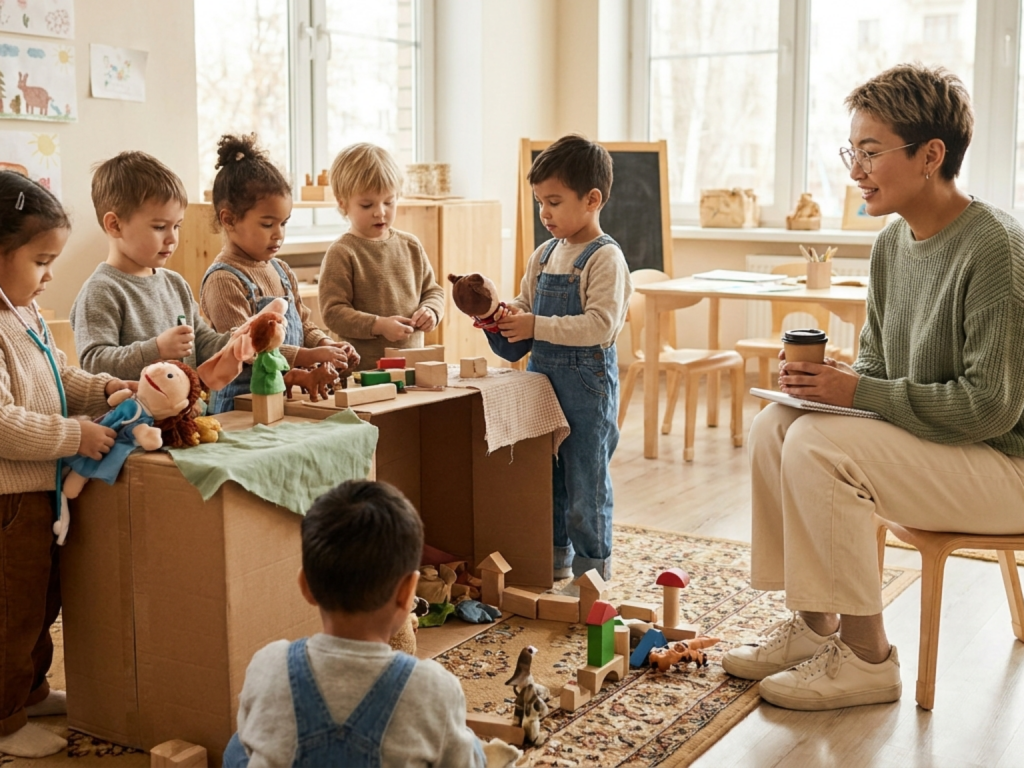
Preschool imagination can look like a cardboard box becoming a clinic, a spoon becoming a microphone, or a blanket becoming the ocean. These playful moments are not “just play”; they are part of how young children practice language, emotional regulation, social reasoning, motor planning, and flexible thinking.
Families and educators may feel pressure to provide elaborate toys or constant instruction, but preschoolers often benefit most from safe, responsive, open-ended play. The goal is not to make every child perform creatively on command. It is to create conditions where curiosity, pretend roles, storytelling, movement, and problem-solving can emerge at the child’s developmental pace.
Highlights
Pretend play supports expressive language, narrative skills, social understanding, and emotional rehearsal in preschool children.
Open-ended materials such as boxes, fabric, blocks, puppets, and everyday household objects often stimulate richer creativity than highly scripted toys.
Adult involvement is most helpful when it is responsive and collaborative, not controlling or overly corrective.
Screen-based play is not automatically harmful, but co-play, discussion, and balance with hands-on activity matter.
Some differences in play may reflect temperament, neurodevelopmental variation, stress, hearing or language concerns, or sensory processing needs; professional guidance can help when concerns persist.
Why creative play matters in the preschool years
Preschool children are building neural networks for language, attention, memory, self-regulation, and social cognition at a remarkable pace. Creative and imagination games give them a low-risk environment to test ideas: “What happens if I am the doctor?” “How does a baby dinosaur feel?” “Can this bridge hold three blocks?” In medical and developmental terms, play integrates cognitive flexibility, symbolic representation, motor planning, affect regulation, and executive function.
Pretend play is especially powerful because it allows a child to use one object, action, or role to represent another. A banana can become a phone; a chair can become a bus. This symbolic capacity overlaps with later literacy and mathematics because children must understand that marks, numbers, and words can stand for real-world objects and ideas. In this way, play-based preschool learning is not a distraction from school readiness; it is one route toward it.
Imaginative play also supports social-emotional development. When children negotiate roles, invent rules, or repair a play disagreement, they practice perspective-taking and impulse control. A child who says, “You be the firefighter and I will be the cat” is coordinating language, planning, and peer interaction. These skills do not appear evenly in all children. Some preschoolers prefer solitary construction, sensory exploration, or repetitive themes before they become comfortable with cooperative pretend play.
Pretend role-play games that build language and empathy
Role-play is one of the easiest ways to begin. You do not need a full costume set. A towel can be a cape, a paper bag can be a shopping basket, and a few cups can create a café. Common themes include clinic, grocery store, animal rescue, space mission, family picnic, train station, hair salon, restaurant, or construction site.
To support language, narrate gently without dominating: “The patient has a cough. What should the doctor ask?” or “The train is late. How can the passengers feel better?” These prompts encourage vocabulary, sequencing, and emotional labeling. Children who create elaborative make-believe stories often practice the same narrative components used in later reading comprehension: setting, characters, problem, actions, and resolution.
Useful role-play ideas include:
- Clinic or veterinary office: The child checks a doll, stuffed animal, or toy dinosaur. Keep it playful and avoid frightening medical details.
- Grocery store: Children sort foods, “pay” with paper circles, count items, and practice polite social scripts.
- Rescue team: Blocks become mountains, animals need help, and the child plans a safe route.
- Post office: Preschoolers draw “letters,” deliver them, and practice names, directions, and memory.
If a child repeats one scenario many times, that is not necessarily a problem. Repetition can support mastery, emotional processing, and working memory. You can add one small variation: “Today the veterinarian has two animals waiting,” or “The grocery store is out of apples; what else could we buy?”
Storytelling, puppets, and make-believe worlds
Storytelling games help preschoolers organize thoughts over time. Begin with a simple structure: “Once there was…” “Every day…” “One day there was a problem…” “So they tried…” “At the end…” This predictable frame reduces cognitive load while leaving room for imagination. Children may use drawings, toys, puppets, felt pieces, blocks, or their own bodies to act out the story.
Puppet play can be especially helpful for children who are shy, anxious, or still developing expressive language. Speaking through a puppet creates psychological distance: the puppet can be scared, silly, angry, or brave. Adults can model problem-solving through a puppet without lecturing the child. For example, a puppet might say, “I wanted the red block, but my friend has it. What can I do?” This supports conflict resolution during group play while keeping the emotional intensity manageable.
Make-believe worlds also invite deeper thinking. Build a farm, ocean, city, cave, moon base, or rainforest using blocks, fabric, recycled containers, and toy figures. Ask open-ended questions: “Who lives here?” “What do they need to stay safe?” “What happens when the river gets too wide?” These questions encourage planning and causal reasoning.
For children with speech or language delays, reduce verbal pressure. Offer choices, gestures, visual supports, or sound effects. A child can participate by moving the puppet, pointing, choosing a character, or making animal sounds. If concerns about comprehension, speech clarity, vocabulary, or social communication persist, a speech-language pathology evaluation may be appropriate.
Open-ended art and construction games
Open-ended art is different from crafts where every child is expected to make the same final product. In creative preschool art, the process matters more than the outcome. Paint, crayons, collage paper, clay, tape, cardboard tubes, leaves, stickers, fabric scraps, and safe recycled materials invite experimentation. The adult’s role is to provide safety, language, and encouragement, not to correct the child’s design.
Try prompts that do not have a single correct answer: “Make a home for a tiny animal,” “Create a machine that helps people,” “Paint how thunder might sound,” or “Build a bridge for a toy car.” These games strengthen fine motor coordination, visual-spatial reasoning, bilateral hand use, and problem-solving. They may also reveal sensory preferences: some children love finger paint, while others strongly avoid sticky textures. Respecting those differences helps the child stay regulated.
Construction play with blocks, magnetic tiles, cushions, or boxes supports early engineering concepts. Preschoolers test balance, symmetry, height, weight, and cause-effect relationships. When a tower falls, adults can validate frustration and invite experimentation: “That was disappointing. What could make the bottom stronger?” This builds frustration tolerance without shame.
Children who struggle with scissors, grasp, body awareness, or motor planning may still enjoy creative play with adaptations such as larger crayons, pre-torn paper, chunky blocks, vertical surfaces, or hand-over-hand assistance only when welcome. If motor or sensory concerns interfere with daily activities, an occupational therapy evaluation for preschoolers can help clarify supportive strategies.
Movement, music, and outdoor imagination walks
Imagination is not only quiet table play. Many preschoolers think best while moving. Movement games combine vestibular input, proprioception, rhythm, imitation, and symbolic play. A child may become a slow turtle, a spinning leaf, a robot, a firefighter climbing stairs, or a cloud floating across the sky. These games support body awareness, inhibitory control, and motor sequencing.
Simple movement games include “animal parade,” “weather dance,” “freeze like a statue,” “cross the lava,” and “delivery mission.” You can add early executive function by changing rules: “When the drum is slow, move like a bear; when it is fast, move like a bird.” Keep instructions brief and developmentally appropriate. Preschoolers are still learning to inhibit impulses, so mistakes are part of the learning process.
Outdoor imagination walks are particularly rich. A stick can be a wand, a leaf can be a boat, and a puddle can be a lake. Ask the child to search for “tiny homes,” “dragon footprints,” “treasure shapes,” or “sounds that tell a story.” Nature play supports sensory integration, observation, vocabulary, and emotional regulation. It also offers a less restrictive environment for children who need larger movements than indoor spaces allow.
Safety remains essential. Supervise near roads, water, heights, animals, and unfamiliar plants. For children with asthma, allergies, mobility needs, or medical devices, adapt outdoor play in consultation with the child’s healthcare team when needed.
Adults as co-players: how to scaffold without controlling
Research on children’s digital and non-digital play highlights a consistent theme: adult participation and peer interaction can shape the quality of imaginative engagement. The most supportive adults observe first, then join at the child’s level. Instead of directing every step, they expand the child’s idea by adding language, emotion, or one manageable challenge.
Helpful scaffolding sounds like: “You made a tall tower. Who lives there?” “The puppy looks worried. What does it need?” “I wonder how the astronauts will get home.” Less helpful responses include frequent correction, quizzing, or taking over the story. If a child says the cow is flying to the moon, the developmental value may come from exploring the idea, not from correcting farm animal behavior.
Co-regulation before self-regulation is also important. A preschooler who becomes upset when play changes may need help calming before they can problem-solve. You might say, “You really wanted to be the driver. Let’s take a breath, then we can make a plan.” This validates emotion while maintaining boundaries.
Peer play adds another layer. Children using gadgets or toys with siblings or peers may show more flexible imaginative responses than those playing alone because they must respond to another mind. Still, some children need shorter playdates, smaller groups, or adult-supported turn-taking before cooperative play feels safe.
Screen-based imagination games: balance and co-play
Many families wonder whether computer games, tablets, or interactive media reduce imagination. The available evidence is nuanced. One study of 5- to 6-year-old children did not find a direct relationship between imagination and the amount of time spent playing computer games, but it did find that the social context of use mattered. Children who used gadgets with siblings or peers showed higher imagination flexibility scores than children who played alone or only with an adult.
This does not mean unlimited screen time is beneficial. Preschoolers also need sleep, outdoor movement, hands-on exploration, conversation, and face-to-face play. Screen-based activities are most useful when they are age-appropriate, interactive, not frightening, and connected to real-world play. For example, after a child plays a simple building game, invite them to build a similar structure with blocks. After watching a short animal video, create a pretend animal hospital or habitat.
Adults can strengthen active screen time by asking, “What happened first?” “What could the character try next?” or “Can we act that out with toys?” Avoid using screens as the only regulation tool whenever possible, because children also need practice with co-regulation, sensory strategies, and human comfort. Families with concerns about sleep, behavior, attention, or anxiety related to media use should discuss individualized guidance with a pediatric clinician.
Adapting imagination games for different developmental profiles
Not every preschooler pretends in the same way. Some children prefer lining up toys, building precise structures, repeating scripts, or exploring sensory properties such as spinning, pouring, or sorting. These patterns can be part of typical variation, temperament, giftedness, stress responses, or neurodevelopmental differences. The goal is not to force a child into a narrow idea of “normal” pretend play, but to expand participation respectfully.
Start from the child’s interest. If the child loves vehicles, create a garage, road repair crew, car wash, or emergency route. If the child loves animals, build a habitat or feeding station. If the child uses few words, model short phrases: “Car stuck,” “Help, please,” “Go fast,” or “Dog sleepy.” If sensory sensitivities are present, offer choices: dry collage instead of finger paint, quiet puppets instead of loud music, or heavy-work movement before seated play.
Watch for persistent concerns that deserve professional input: loss of previously acquired play or language skills, minimal response to name, very limited shared attention, marked distress with small changes, frequent aggressive behavior that does not improve with support, or play that is extremely restricted and interferes with daily functioning. These signs do not confirm a diagnosis, but they are reasons to seek developmental screening or referral. Early support can reduce stress for both the child and caregivers.
When to seek professional guidance
- Contact a pediatrician if your child loses previously acquired language, social, or play skills.
- Ask for support if play is consistently accompanied by extreme distress, aggression, or inability to recover with comfort.
- Consider hearing, vision, speech-language, or developmental evaluation if communication concerns persist.
- Seek urgent medical advice for sudden behavioral change, lethargy, seizures, head injury, or suspected poisoning.
- Consult an occupational therapist if sensory or motor difficulties significantly limit daily routines or play.
Tools & Assistance
- Create a rotating basket of open-ended materials such as boxes, scarves, blocks, puppets, and safe recycled containers.
- Use short storytelling prompts: character, place, problem, idea, ending.
- Schedule brief daily pretend play time where the adult follows the child’s lead.
- Ask your pediatrician about developmental screening if play, language, motor, or social concerns persist.
- Coordinate with preschool teachers to understand how your child plays alone, with adults, and with peers.
FAQ
What age do preschool children usually start pretend play?
Simple pretend play often begins in toddlerhood and becomes more elaborate during the preschool years. Timing varies, and quality of interaction is often more important than a specific milestone date.
Do imagination games require special toys?
No. Everyday objects, boxes, fabric, blocks, paper, puppets, and outdoor materials often encourage richer flexible thinking than highly scripted toys.
Should adults correct unrealistic pretend ideas?
Usually no, unless safety is involved. If a child says a cow is flying to the moon, you can join the story and expand language rather than turning the moment into a factual correction.
Can screen games support imagination?
They can, especially when age-appropriate, interactive, shared with peers or caregivers, and connected to real-world play. Balance with sleep, movement, conversation, and hands-on activities remains important.
What if my child does not enjoy pretend play?
Begin with the child’s interests and preferred sensory style. If limited play is accompanied by language, social, motor, or regression concerns, consult a pediatrician or developmental professional.
Sources
- National Center for Biotechnology Information (NCBI) — Active screen time and imagination in 5–6-years-old children
- Child Mind Institute — The Power of Pretend Play for Children
- MCCA Education — Imaginative Play Activities for Kids (Easy Ideas)
Disclaimer
This article is for general educational purposes and does not diagnose or treat any condition. Consult a qualified healthcare professional for concerns about your child’s development, behavior, communication, or health.













Please log in to leave a comment.