
Intro
Preschool activities can be joyful, messy, repetitive, and surprisingly sophisticated. Between ages 3 and 5, children are building neural networks that support language, executive function, motor coordination, early numeracy, social cognition, and emotional regulation. The best activities do not need expensive materials; they need safety, warmth, repetition, and an adult who can notice what the child is trying to understand.
This guide offers practical, developmentally sensitive ideas for home, preschool, or community settings. It is not meant to diagnose developmental delay or replace individualized advice. If a child has medical complexity, sensory differences, motor impairment, speech-language concerns, or recurrent behavioral distress, a pediatrician, developmental specialist, occupational therapist, speech-language pathologist, or early childhood educator can help adapt activities safely.
Highlights
Play is not a break from learning; for preschoolers, it is a primary route for cognitive, language, motor, and social development.
Guided play, where adults ask thoughtful questions without taking over, can support vocabulary and conceptual learning while preserving motivation.
Safe sensory, movement, science, art, and pretend-play activities can be adapted for different temperaments, abilities, and attention spans.
Activities should be supervised, choking-aware, and responsive to fatigue, hunger, illness, sensory overload, and sleep needs.
Why activities matter from ages 3 to 5
From 3 to 5 years, children move from primarily sensorimotor exploration toward more symbolic, verbal, and rule-based play. A 3-year-old may sort objects by color, narrate a pretend meal, and ask “why” repeatedly. A 5-year-old may plan a block structure, negotiate roles in pretend play, recognize patterns, and explain a simple cause-and-effect relationship. These skills are not isolated milestones; they overlap through play.
Preschool activities support multiple domains at once. Pouring water develops hand strength, bilateral coordination, estimation, and early physics concepts. A nature scavenger hunt supports vocabulary, visual discrimination, inhibitory control, and curiosity. Pretend clinic play can build empathy, sequencing, and emotional language. For a medically literate reader, it may help to think of good preschool play as an integrated developmental intervention: it recruits sensory processing, motor planning, language networks, working memory, and social cognition in a low-pressure context.
The aim is not to accelerate academics prematurely. Developmentally appropriate preschool learning respects attention span, body needs, emotional security, and the child’s intrinsic motivation. Short activities, often 10 to 20 minutes, may be more effective than long sessions. Repetition is beneficial because preschoolers consolidate learning through repeated exposure, variation, and active recall.
The adult role: guided play without taking over
Research on early science learning suggests that guided play can produce learning gains comparable to, and sometimes greater than, direct instruction for conceptual and vocabulary outcomes. The adult’s role is to shape the environment, introduce precise language, ask testable questions, and help the child reflect. This differs from lecturing or correcting every step.
A useful pattern is: notice, wonder, test, and name. For example, while blowing bubbles, an adult might say, “I notice the big wand made a big bubble. I wonder what will happen with the small wand. Should we test it?” After the child tries, the adult can introduce vocabulary such as “surface,” “stretch,” “pop,” or “compare.” This supports explicit instruction in preschool science while still keeping the child active and curious.
Questions work best when they are concrete and answerable. Instead of “What is air?” ask, “What do you think will happen to this balloon if we let go?” Instead of “Why do shadows exist?” ask, “What happens to your shadow when you move closer to the lamp?” These questions encourage preschoolers to form early mental models that will later connect with formal science concepts.
Adults can also scaffold social behavior. During block play, say, “You both want the long block. What are two fair plans?” During art, say, “You look frustrated that the glue is sticky. Let’s pause and wipe your fingers.” This kind of co-regulation helps children gradually internalize planning, flexibility, and emotional language.
STEM activities: science, building, and early problem-solving
Preschool STEM does not require worksheets. It works best through direct exploration, simple materials, and visible effects. The goal is to help children observe, predict, compare, classify, and revise ideas.
- Balloon air experiment: Inflate a balloon, pinch it closed, then release the air slowly. Ask what the child feels and hears. This introduces air movement, pressure, and cause-and-effect.
- Bubble investigation: Offer different bubble wands, straws, or loops. Compare bubble size, shape, and popping. Use words such as “larger,” “smaller,” “round,” and “fragile.”
- Shadow play: Use a safe lamp or sunlight. Move toys closer and farther from the light source. Invite children to make body shapes and observe how shadows change.
- Magnet testing: Provide a magnet and objects such as a spoon, paper clip, fabric, wooden block, and plastic lid. Make two groups: “sticks” and “does not stick.” Keep small objects away from children who still mouth items.
- Seed planting: Plant beans or herbs in clear cups or small pots. Children can water, observe roots or sprouts, and draw changes over time.
Simple chemistry and physics demonstrations can be memorable, but they require adult control of materials. Color-changing milk with food coloring and dish soap can show movement and surface tension. A floating egg in salt water can introduce density. Vinegar and baking soda reactions can demonstrate gas formation. These are demonstrations for supervised exploration, not independent play.
Building challenges also develop early engineering. Ask a child to build a bridge for a toy animal, a tower taller than a book, or a ramp that lets a toy car roll farther. If the structure collapses, avoid framing it as failure. Ask, “What could make the base stronger?” This supports persistence, spatial reasoning, and early mathematics skills in preschoolers.
Language, literacy, and storytelling activities
Language development at this age is strengthened by conversation, shared attention, songs, rhymes, and meaningful print exposure. Children do not need formal reading drills to become literacy-ready. They need rich oral language, phonological awareness, narrative practice, and enjoyable contact with books.
Shared reading is one of the most flexible activities. Rather than reading every page exactly as written, pause to ask, “What do you think will happen next?” “How does this character feel?” or “Can you find something that starts with the same sound as sun?” This builds vocabulary, inference, emotional understanding, and early sound awareness.
Story baskets are useful for children who prefer active play. Place a few objects in a basket, such as a toy animal, cup, scarf, and block. Invite the child to create a story. Adults can model narrative structure: beginning, problem, action, and ending. A 3-year-old may use one or two sentences; a 5-year-old may create a sequence with dialogue. Both are valuable.
Everyday routines can become language activities. Cooking together introduces verbs such as stir, pour, peel, and measure. Sorting laundry teaches categories and descriptors. Walking outside supports location words such as under, beside, behind, and between. These activities can pair well with Healthy meals for preschoolers when children help wash vegetables, count fruit pieces, or describe textures.
For children with speech or language delays, bilingual exposure, hearing concerns, or neurodevelopmental differences, do not wait for frustration to escalate. A speech-language pathologist or pediatric clinician can help determine whether support is needed and how to adapt communication without reducing the child’s opportunities to participate.
Movement, sensory, and fine-motor activities
Preschool bodies need movement. Gross-motor play supports muscle strength, vestibular processing, proprioception, coordination, and self-regulation. Structured movement games for preschoolers can be brief and playful: animal walks, obstacle courses, freeze dance, follow-the-leader, beanbag toss, or “red light, green light.” These games also train inhibitory control and working memory.
Fine-motor activities prepare the hands for dressing, feeding, drawing, and later handwriting. Offer playdough squeezing, tearing paper, threading large beads, using tongs to move pom-poms, painting with cotton swabs, or cutting soft paper with child-safe scissors. Focus on hand strength and control, not perfect products. If a child avoids all hand activities, has marked asymmetry, loses skills, or seems unusually weak or clumsy, discuss this with a pediatrician or occupational therapist.
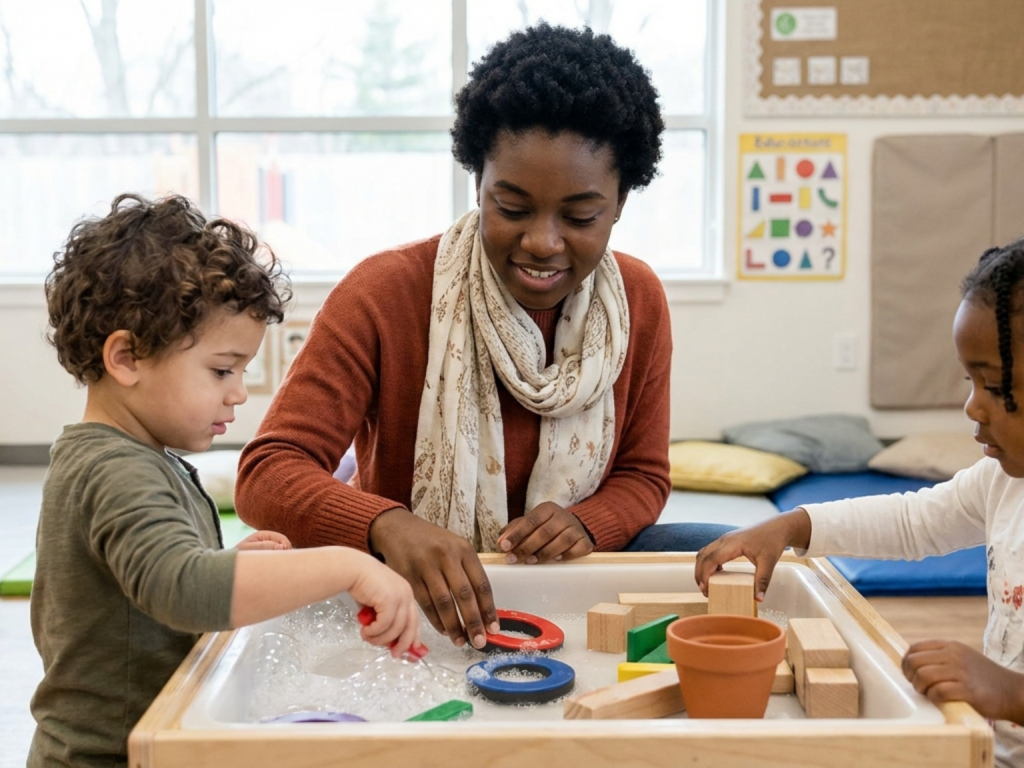
Sensory play can be calming for some children and overwhelming for others. Water play, kinetic sand, rice bins, finger paint, and textured fabrics can support tactile exploration. However, children with pica, mouthing behaviors, food allergies, eczema flares, or aspiration risk may need modified materials. Edible-looking sensory materials should still be supervised, because choking and airway risks remain.
A helpful approach is to offer sensory choice. Say, “You can touch the paint with a brush or with your finger,” or “You can stand near the water table and watch first.” Respecting a child’s sensory boundaries builds trust and reduces avoidant behavior over time. Sensory differences are not “bad behavior”; they may reflect neurodevelopmental variability, fatigue, anxiety, or prior uncomfortable experiences.
Art, pretend play, and social-emotional learning
Art activities help preschoolers practice symbolic thinking, planning, emotional expression, and fine-motor control. Open-ended materials are often better than crafts with one correct result. Offer crayons, washable paint, collage paper, glue sticks, cardboard tubes, fabric scraps, or natural materials. Ask process-focused questions: “Tell me about your picture,” “What did you decide to add?” or “How did you make that color?”
Pretend play becomes increasingly complex from ages 3 to 5. Children may act out family routines, grocery shopping, construction work, veterinary visits, space travel, or restaurant scenes. Pretend play supports perspective-taking, sequencing, problem-solving, and emotional rehearsal. A child who is anxious about a medical appointment may benefit from playing doctor with a doll, practicing listening with a toy stethoscope, or narrating what happens during a checkup. This should be gentle and child-led, not forced exposure.
Social-emotional learning in preschool is embedded in ordinary play. Children learn to wait, share materials, repair conflicts, recognize feelings, and tolerate disappointment. Adults can coach rather than shame. Try phrases such as, “You wanted the truck, and waiting is hard,” followed by, “Let’s set a timer,” or “Ask, ‘Can I have it when you’re done?’”
For group settings, cooperative activities can reduce competition. Build one large mural, create a shared block city, plant a class garden, or act out a story with multiple roles. Some children need visual schedules, quieter spaces, or shorter group times. Persistent aggression, extreme withdrawal, frequent dysregulation, or loss of previously acquired social skills should prompt discussion with a pediatrician, mental health clinician, or early childhood specialist.
Outdoor and community-based activities
Outdoor play offers variable sensory input, larger movement opportunities, and direct contact with living systems. A nature scavenger hunt can include finding something rough, smooth, green, round, wet, or noisy. Children can compare leaves, observe insects without handling them, count steps, follow a map, or collect safe natural items for art. Teach respectful observation: “We can look closely, but we do not hurt the bug.”
Gardens, parks, libraries, botanic gardens, children’s museums, farms, and planetariums can make abstract ideas concrete. A planetarium visit may support questions about day, night, and shadows. A botanic garden can extend seed planting into real-world observation. Libraries often provide story times that combine songs, movement, and early literacy.
Outdoor activities require risk assessment. Check for traffic, water hazards, unsafe plants, animal feces, sharp objects, extreme temperatures, and sun exposure. Use helmets for wheeled activities. Supervise climbing based on the child’s motor ability, not just age. Risky play has developmental value when it is appropriately supervised and scaled; hazardous play is different and should be prevented.
Outdoor time can also support sleep and regulation, especially when paired with predictable meals and rest. If a child is frequently exhausted, snoring, struggling with exercise tolerance, or having recurrent wheeze, pain, or dizziness during play, seek medical advice before increasing activity intensity.
Adapting activities for different children and family realities
There is no single “right” preschool activity schedule. A child in a small apartment, a busy multigenerational home, a rural setting, or a full-day preschool program can still learn through everyday routines. The most powerful ingredients are responsive interaction, safe materials, and repeated chances to try.
For children with developmental delays or disabilities, activities can be adapted by changing the sensory load, motor demand, language complexity, duration, or social expectations. Use larger handles for grasping, picture choices for communication, fewer materials to reduce overwhelm, or parallel play before expecting turn-taking. For children with attention differences, alternate movement and seated tasks. For children with anxiety, preview activities and allow observation before participation.
Short routines can help families who feel stretched. Try a 10-minute morning movement game, one shared book after lunch, a water-pouring activity before dinner, or a screen-free bedtime routine with songs and storytelling. Consistency matters more than elaborate planning.
Caregivers may also need permission to simplify. Preschoolers do not require constant enrichment. Boredom, quiet time, and independent play can foster creativity and self-directed problem-solving. If caregivers feel overwhelmed, irritable, or unable to enjoy the child at all, it is appropriate to seek support from healthcare professionals, family services, or trusted community resources. Supporting the adult is part of supporting the child.
Safety and medical caution
- Supervise all activities involving water, magnets, balloons, small objects, scissors, heat, vinegar, baking soda, or food-like sensory materials.
- Avoid small items for children who mouth objects or have choking risk; seek guidance for children with swallowing or aspiration concerns.
- Do not force sensory play; distress, gagging, panic, or shutdown are signs to pause and adapt.
- Consult a pediatrician if a child loses skills, has persistent motor asymmetry, severe language delay, recurrent injuries, or frequent extreme dysregulation.
- Children with asthma, seizures, allergies, cardiac conditions, or complex medical needs may need individualized activity precautions.
Tools & Assistance
- Create a weekly activity basket with safe household materials, books, art supplies, and simple science objects.
- Use a visual schedule for children who benefit from predictability and transitions.
- Ask a pediatrician about developmental screening if learning, motor, language, or behavior concerns persist.
- Consult an occupational therapist or speech-language pathologist for individualized adaptations.
- Visit libraries, parks, gardens, museums, or early childhood centers for supervised community learning.
FAQ
How long should a preschool activity last?
Many 3- to 5-year-olds do well with 10 to 20 minutes, though some activities may last longer when the child is deeply engaged. Stop or modify the activity if the child is tired, hungry, distressed, or unsafe.
Are worksheets necessary for school readiness?
Usually no. Preschool school readiness skills are often built through conversation, books, drawing, counting real objects, movement games, pretend play, and problem-solving.
What if my child refuses messy play?
Offer choices such as brushes, gloves, tools, or watching first. Avoid forcing touch. If sensory avoidance is intense or interferes with daily care, consider discussing it with a pediatrician or occupational therapist.
Can science experiments be safe for preschoolers?
Yes, when they use age-appropriate materials and close adult supervision. Avoid ingestion, eye exposure, small magnets, choking hazards, and unsupervised chemical reactions.
How can I support learning if I have very little time?
Use routines you already have: count socks, describe cooking steps, read one short book, sing in the car, or ask prediction questions during bath time. Responsive interaction is more important than elaborate setup.
Sources
- PMC (PubMed Central) — Emerging interest in science during early childhood period: Guide play and inquiry
- Accelerate Learning — 25 Preschool STEM Activities For Early Childhood Teachers
- Brightwheel — 21 Easy Preschool Science Activities and Experiments [2026 Guide]
Disclaimer
This article is for general educational purposes and does not diagnose, treat, or replace medical care. Consult a qualified healthcare professional for concerns about a child’s development, behavior, safety, or medical needs.
















Please log in to leave a comment.