
Intro
Choosing shoes for a child can feel unexpectedly high-stakes. Feet are growing, gait is changing, school and play demands are intense, and children may not reliably describe discomfort until a shoe has already caused rubbing or avoidance of activity. A supportive everyday shoe is not about making a child’s foot rigid; it is about giving enough structure, fit, traction, and comfort for walking, running, climbing, and learning skills safely.
Most healthy children do not need corrective or highly specialized footwear. However, thoughtful shoe selection can reduce avoidable irritation, slipping, fatigue, and poor fit during rapid growth. If your child has persistent pain, frequent tripping, asymmetry, a known neuromuscular or musculoskeletal condition, diabetes, inflammatory disease, or concerns about foot posture or gait, a pediatrician, podiatrist, physiotherapist, or orthotist can help individualize advice.
Highlights
Children generally need shoes once they are walking outdoors or in environments where protection and traction are needed, not as a way to force foot development.
The best everyday shoes usually combine a firm heel counter, secure fastening, adequate toe room, a flexible forefoot, and a grippy sole.
Growing feet need frequent fit checks because children may outgrow shoes before they complain of pain.
Supportive does not mean stiff everywhere; a shoe should stabilize the rearfoot while allowing natural movement through the front of the foot.
Why supportive everyday shoes matter during growth
Children’s feet are not simply smaller adult feet. Bones, cartilage, ligaments, muscles, fat pads, and neuromotor control mature over years. Early walkers often have a broad-based gait, variable foot placement, and visible flatness due to ligamentous laxity and a normal plantar fat pad. As balance, strength, and proprioception improve, gait becomes more efficient. Footwear should protect the foot while allowing this natural motor learning to continue.
Research on children’s footwear and gait suggests that shoes can influence stride characteristics, joint motion, plantar pressure distribution, and muscle activity. This does not mean every shoe will permanently shape a child’s foot, but it does support a cautious approach: avoid shoes that are too tight, overly heavy, slippery, unstable, or so rigid that they interfere with normal movement.
For infants and pre-walkers, shoes are usually unnecessary except for warmth or protection. Barefoot time in safe indoor settings can help sensory feedback and intrinsic foot muscle use. Once a child is walking outside, attending preschool, or using shared public spaces, shoes become protective equipment: they guard against cuts, heat, cold, impact, and infection risk while providing traction on changing surfaces.
The goal is not to diagnose arch height at the shoe shop or to chase an ideal footprint. Many young children have flexible flat feet without symptoms. Instead, caregivers can focus on function: the child should be able to walk, run, squat, climb, and play without pain, skin injury, frequent shoe loss, or obvious compensation caused by the shoe itself.
Core features of a good everyday shoe
A supportive children’s shoe balances structure and mobility. Start with the heel. A firm heel counter, the reinforced area around the back of the shoe, helps hold the rearfoot in place and reduces excessive side-to-side collapse of the shoe. It should resist being fully squashed between your fingers, but it should not dig into the Achilles tendon or malleoli.
The front of the shoe should flex where the toes bend, near the metatarsophalangeal joints, rather than folding through the middle like a soft slipper. This flexible forefoot allows push-off during walking and running. At the same time, the midsole should have enough substance that the shoe does not twist excessively or allow the foot to slide over the edge of the sole during play.
A broad toe box matters. Children’s forefeet are often relatively wide, and toes need room to spread for balance. The shoe should be wider at the forefoot than at the heel, not tapered sharply at the toes. Pointed or narrow fashion shoes can compress the toes and create rubbing, nail pressure, or reluctance to wear the shoes.
Secure fastening is another major feature. Laces, hook-and-loop straps, buckles, or adjustable toggles should hold the foot back into the heel cup. Slip-on shoes may be convenient, but if the child must claw their toes to keep them on, gait can become less efficient and the risk of blisters or falls may increase. For preschoolers building independence, closures that are easy to manage but still adjustable often work well.
The outsole should provide grip without being bulky. A sturdy sole with good traction is especially useful for playgrounds, wet paths, polished school floors, and sports-adjacent play. Avoid very smooth soles for everyday wear, and be cautious with very thick platform-style soles, which can reduce ground feel and increase instability.
Fit checks: length, width, depth, and heel hold
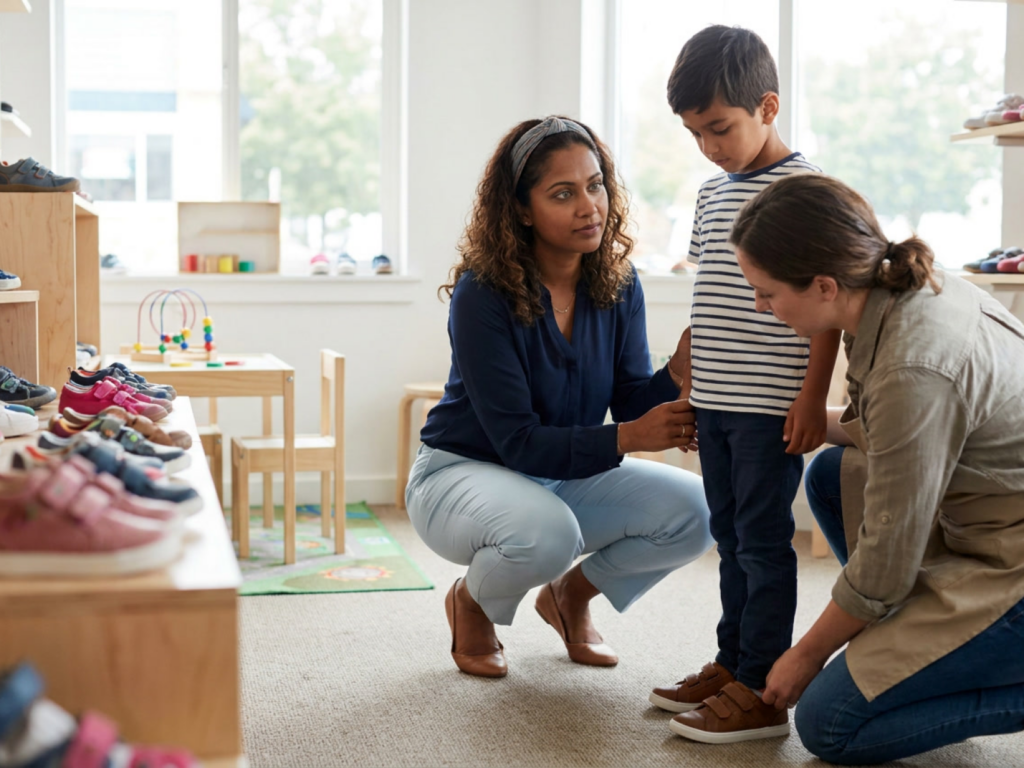
Fit is more important than brand. Measure both feet, because one is commonly slightly larger. Fit the larger foot, and check the shoe while the child is standing, when the foot is weight-bearing and slightly longer. A practical guide is to allow a small thumb-width or approximately 10 to 12 millimeters of growing room in front of the longest toe, depending on the child’s age and shoe design. Too little space causes pressure; too much space can make the foot slide and create tripping or friction.
Width and depth deserve equal attention. The upper should not bulge outward dramatically, leave red marks, or press across the instep. You should be able to fasten the shoe securely without pulling straps to their limit. If the shoe leaves deep impressions on the top of the foot or the child complains that it feels tight only after several hours, consider a wider or deeper style rather than simply increasing length.
Heel hold is checked by watching the child walk. The heel should stay seated without repeated slipping. Mild movement is normal, especially in new shoes, but the shoe should not flap or require toe gripping. For sandals, an enclosed or well-secured heel is usually safer for younger children than backless slides, particularly at preschool or on playground equipment.
Ask the child specific questions rather than only, "Do they fit?" Try: "Do your toes touch the end when you walk downhill?" "Does anything pinch here?" "Can you run and stop?" Also inspect the skin after wear, especially over the toes, heel, navicular area, and lateral forefoot. Redness that fades quickly can be normal; persistent marks, blisters, nail changes, or avoidance of activity suggest the fit or shoe type needs reassessment.
Because children grow in spurts, fit checks should be routine. Toddlers and preschoolers may need checking every one to three months, while older children may manage every three to four months unless they report discomfort or show sudden growth. School shoes that looked roomy in September may be cramped well before the end of term.
Choosing by age, activity, and setting
Toddlers need shoes that are light, flexible at the front, secure at the heel, and easy to put on correctly. Overly stiff boots can make early walking more awkward. For a toddler who is still refining balance, a low-profile sole and good ground contact are usually preferable to a heavy, elevated shoe. Indoor barefoot play, when safe and appropriate, can coexist with protective outdoor footwear.
Preschool children need durability and safety. Closed-toe shoes are often required for childcare or preschool because they protect toes during running, climbing, tricycle use, and messy play. This is also the age when independence matters: shoes that a child can fasten consistently may reduce frustration, but they still need enough adjustability to hold the foot. If a child has sensory sensitivities, seams, tongue position, sock texture, and pressure over the instep may be as important as the shoe size.
School-age children often wear shoes for long days that include classroom sitting, walking, stairs, playground activity, and sometimes sport. A school shoe should not be selected only for appearance or uniform compliance. Look for a supportive midsole, firm heel counter, secure closure, and a sole that bends at the forefoot. If school rules require a particular style, try to find the most foot-friendly version within those limits.
Sports and high-impact activities may require activity-specific footwear. A running shoe, football boot, dance shoe, hiking shoe, or court shoe is designed for different movement patterns and surfaces. Everyday shoes do not have to be specialist athletic shoes, but children who participate in frequent sport may need separate footwear to reduce slipping, improve comfort, and prevent premature wear of their main school shoes.
Seasonal choices also matter. In hot weather, sandals should still fasten securely and ideally include heel support for active play. In wet or cold weather, waterproof boots can be useful, but many are stiff and poorly breathable. If boots are needed, reserve them for the conditions they are designed for and switch to a more flexible everyday shoe when possible.
When support needs are more individual
Some children need more tailored footwear decisions. This may include children with persistent foot, ankle, knee, hip, or back pain; recurrent sprains; significant asymmetry; toe walking beyond the expected developmental window; neuromuscular conditions; hypermobility with fatigue or instability; inflammatory arthritis; congenital foot differences; or a history of surgery or orthotic use. In these situations, the right shoe may depend on examination findings, gait assessment, range of motion, strength, and the child’s functional goals.
Orthoses, arch supports, heel lifts, and modified footwear should not be chosen casually for a growing child without clinical input. Some children benefit from prescribed devices, but others do not need them, and an ill-fitting insert can create pressure or alter shoe fit. If a clinician has prescribed orthoses, bring them when buying shoes. The shoe must have enough depth, a removable insole if needed, and a fastening system that secures both the foot and the device.
Flexible flat feet are a common source of parental worry. If a child has no pain, no functional limitation, and normal participation, reassurance may be appropriate; however, painful, rigid, asymmetric, or worsening foot posture deserves professional evaluation. Similarly, in-toeing, out-toeing, knock knees, and bow legs can have developmental patterns, but marked asymmetry, pain, regression, or impaired activity should be assessed rather than managed by shoe choice alone.
Children who cannot communicate discomfort clearly need closer observation. This includes very young children, children with developmental differences, and children with reduced sensation. Check socks and skin regularly, watch for changes in walking, and avoid assuming that silence means comfort. A shoe that is safe for one child may be unsuitable for another because of tone, coordination, sensory processing, or medical history.
Practical shopping habits that help families
Shop later in the day if possible, because feet can be slightly larger after activity. Bring the socks the child will usually wear with the shoes. If the shoes are for school, consider whether they must accommodate thicker winter socks, orthoses, or uniform requirements. Have the child walk, jog a few steps if safe, squat, and climb a low step. Movement reveals fit problems that standing still may hide.
Inspect the shoe before buying. Press the heel counter, bend the forefoot, twist the sole gently, feel inside for rough seams, and check whether the insole lies flat. Look at the outsole pattern for traction. Compare both shoes, because manufacturing irregularities can occur. If buying online, use a retailer with easy returns and try shoes indoors on a clean surface until you are sure of fit.
Secondhand shoes can be economical, but they need careful review. Avoid shoes with a collapsed heel counter, uneven outsole wear, compressed cushioning, odor suggesting persistent dampness, or an upper molded to another child’s foot. Lightly used occasion shoes may be acceptable, while heavily worn everyday shoes are less likely to provide reliable structure.
Do not rely on a long break-in period for children’s everyday shoes. A supportive shoe should feel comfortable from the start, aside from mild unfamiliarity. Pain, limping, blisters, or refusal to wear the shoes are not normal adaptation. Also be wary of buying several sizes too large to "last longer." Oversized shoes can trip children, increase friction, and undermine the support you were trying to buy.
Finally, involve the child without handing over the whole decision to style. Offer two or three appropriate options and let them choose among them. This respects autonomy and can improve adherence while keeping the clinical priorities intact: fit, function, safety, and comfort.
When to seek professional advice
- Persistent foot, ankle, knee, hip, or back pain should not be managed by shoe changes alone.
- Limping, sudden refusal to walk, swelling, warmth, redness, or night pain needs medical assessment.
- Repeated tripping, marked asymmetry, rigid flatfoot, or progressive gait change warrants evaluation.
- Children with diabetes, reduced sensation, neuromuscular conditions, or prescribed orthoses need individualized footwear guidance.
- Blisters, nail pressure, or skin breakdown that recurs despite size changes should be reviewed.
Tools & Assistance
- Use an in-store measuring service from a trained shoe fitter when available.
- Bring current shoes to appointments so a clinician can inspect wear patterns if gait is a concern.
- Schedule regular home fit checks using standing length, toe room, heel hold, and skin inspection.
- Consult a pediatrician, podiatrist, physiotherapist, or orthotist for persistent pain or complex needs.
FAQ
Do children need shoes with arch support?
Many healthy children do not need special arch support. A well-fitting shoe with a firm heel counter, secure closure, and flexible forefoot is often sufficient. Painful, rigid, or asymmetric feet should be assessed by a clinician.
Are barefoot shoes good for children?
Some minimalist shoes may suit some children in safe settings if they fit well and protect the foot, but very thin or unstructured shoes may not be ideal for long school days, rough playgrounds, or children needing extra stability. Consider the child’s activity and medical history.
How often should I replace my child’s everyday shoes?
Replace shoes when they are outgrown, structurally worn, slippery, or causing skin marks or discomfort. Young children may need fit checks every one to three months; older children still need regular checks during growth spurts.
Is it okay for siblings to share hand-me-down shoes?
Lightly used shoes may be reasonable if the heel counter, sole, fastening, and cushioning remain intact and the fit is correct. Avoid shoes with uneven wear, collapsed structure, or an upper shaped to another child’s foot.
Sources
- Health Service Executive (HSE) — Choosing shoes for toddlers and children
- PubMed Central — Understanding the Role of Children's Footwear on Gait and Foot Development: A Narrative Review
- Australasian Podiatry Council — Buying kids' school shoes
Disclaimer
This article is for general educational information and is not a diagnosis or individualized medical advice. Consult a qualified healthcare professional for persistent pain, gait concerns, medical conditions, or orthotic needs.








Please log in to leave a comment.