
Intro
Holiday traditions can be joyful, complicated, comforting, stressful, or all of these at once. For children, repeated seasonal rituals often become part of autobiographical memory, family identity, and emotional security. For parents, the holidays can raise practical and psychological questions: Which traditions should we keep? How do we include children without overwhelming them? What if our family structure, culture, health needs, finances, or beliefs do not match the holiday images around us?
Parenting through holidays is not about creating flawless celebrations. It is about using rituals, routines, storytelling, and boundaries to support connection. A medically literate approach also recognizes that sleep disruption, sensory overload, food-related stress, grief, infection risk, and caregiver burnout can affect children’s regulation and family functioning. Thoughtful traditions work best when they are emotionally safe, developmentally appropriate, culturally respectful, and adaptable to the real needs of the people in the household.
Highlights
Holiday traditions help children experience belonging, continuity, and shared meaning when they are predictable and emotionally safe.
Parents do not need to reproduce every inherited ritual; adapting traditions can protect children’s sleep, sensory regulation, medical needs, and mental health.
Inclusive holiday parenting means respecting different beliefs, cultures, family structures, and levels of participation without making any child feel excluded or responsible for adult expectations.
Simple rituals such as cooking together, lighting a candle, calling relatives, volunteering, or reading a seasonal story can be as meaningful as expensive events.
Medical or developmental concerns during holidays should be discussed with qualified healthcare professionals rather than managed through guesswork or online advice alone.
Why holiday traditions matter to children
Children understand the world through repetition, sensory cues, and relational patterns. A song played every year, a familiar recipe, a walk to see lights, or a bedtime story on a particular evening can become a predictable marker in time. Predictability supports emotional regulation because the child’s nervous system can anticipate what comes next. In developmental terms, rituals can strengthen secure attachment, narrative identity, and a sense of belonging.
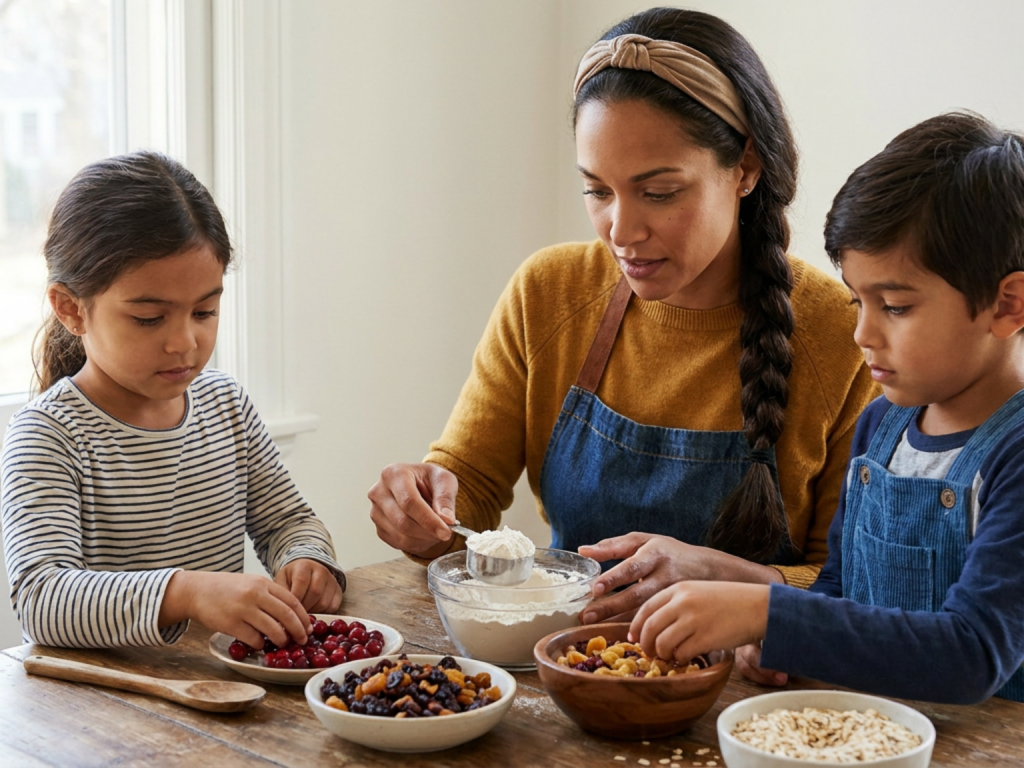
Holiday traditions with children do not have to be elaborate. A child may remember the warmth of helping stir batter more vividly than an expensive outing. The Kids Mental Health Foundation emphasizes that traditions can build positive memories and family connection when parents explain the meaning behind them and involve children in age-appropriate ways. This matters because children are not only watching what adults do; they are learning what the family values.
Traditions also provide a structure for intergenerational family connection. Grandparents, relatives, chosen family, and community members may transmit stories about migration, faith, resilience, humor, or loss. These stories can help children place themselves within a larger family narrative. At the same time, not every inherited practice remains healthy or feasible. Parenting includes the authority to preserve, modify, or retire rituals that no longer serve the family.
Choosing traditions that fit your family now
A useful parenting question is not, “What are we supposed to do?” but, “What meaning do we want this tradition to carry?” Some families emphasize religious observance, some emphasize cultural continuity, some focus on rest, service, food, music, nature, or reconnection after a busy year. The most supportive traditions are aligned with family values and realistic about time, money, health, and emotional bandwidth.
The National Association for the Education of Young Children recommends thoughtful decision-making around holidays: adults can ask whether a holiday should be celebrated, learned about, or left out in a particular setting, and whether participation respects family beliefs. Parents can use a similar lens at home. A ritual may be meaningful for one household and uncomfortable for another. Children benefit when adults communicate this without shame: “This is what our family does,” or “Other families celebrate differently, and we can be curious and respectful.”
Creating meaningful family traditions often starts with small choices. Consider the following criteria:
- Meaning: Does the tradition express love, gratitude, remembrance, faith, generosity, play, or rest?
- Feasibility: Can the adults sustain it without excessive debt, exhaustion, or resentment?
- Child fit: Is it appropriate for the child’s age, temperament, sensory profile, and medical needs?
- Inclusion: Does it allow family members to participate without hiding important parts of who they are?
- Flexibility: Can it change during illness, travel, grief, divorce, or financial strain?
Involving children without overloading them
Children often feel more connected to traditions when they have a role. Toddlers can place napkins on a table, choose a song, or put safe decorations in a basket. School-age children can help cook, create cards, learn a family story, or choose a charitable activity. Adolescents may want more autonomy: planning a dish, leading a game, setting up a video call, or negotiating time with friends.
Participation should not become performance pressure. A child who refuses a photo, avoids a crowded room, or becomes dysregulated during a ceremony is not necessarily being disrespectful. Fatigue, hunger, sensory load, social anxiety, neurodevelopmental differences, or changes in routine can exceed a child’s coping capacity. Co-regulation means the adult helps the child return to a manageable state through calm presence, reduced stimulation, predictable limits, and repair after conflict.
Parents can make expectations explicit before an event: who will be there, how long it may last, what the child can do if overwhelmed, and which behaviors are nonnegotiable for safety. For some children, a visual schedule, a quiet corner, headphones, a familiar snack, or permission to take breaks can prevent escalation. For children with autism, ADHD, sensory processing differences, feeding disorders, or anxiety disorders, holiday routines for neurodivergent children may need advance planning with clinicians, therapists, or school support teams.
Food, sleep, sensory needs, and medical realities
Holiday traditions often center on food, travel, late nights, and close contact. These can be pleasurable, but they can also destabilize children with allergies, diabetes, gastrointestinal conditions, eating disorder histories, migraines, epilepsy triggers, immunocompromise, or medication schedules. Parents should avoid improvising medical changes around celebrations. If a child has a chronic condition, discuss holiday plans with the child’s pediatrician or specialist, especially when routines, meals, sleep, or exposure risks will change.
Medical adaptations to food rituals can preserve meaning while reducing risk. A family recipe can be adjusted for an allergen, a child can bring a safe dish, or relatives can be told clearly that “just a little” exposure is not acceptable. For children with feeding challenges, pressuring bites may increase distress and aversion. The tradition can be participation in preparation, smelling spices, setting the table, or sharing conversation rather than consuming a specific food.
Sleep deserves equal respect. Sleep restriction affects executive function, emotional regulation, immune function, and behavior. A single late night may be manageable for some children, while others need a firm bedtime to avoid days of dysregulation. Sensory regulation during holiday gatherings may involve lowering music volume, limiting flashing lights, avoiding scratchy clothing, taking outdoor breaks, or shortening visits. These accommodations are not failures of celebration; they are parenting strategies that make participation possible.
Respecting diverse beliefs, cultures, and family structures
Holiday seasons can unintentionally center one religion, culture, language, or family form as the default. Children notice whose traditions are displayed, whose foods are named correctly, whose holidays are treated as “normal,” and whose are treated as exotic. ZERO TO THREE encourages honoring every tradition through respectful storytelling, flexible participation, and inclusive activities. For parents, this means helping children understand difference without ranking families.
Inclusive language is practical. Instead of asking, “What did everyone get for Christmas?” an adult might ask, “Does your family have any winter or end-of-year traditions?” Instead of assuming all children visit two parents, adults can say, “People celebrate with many kinds of families and caregivers.” This supports children in adoptive families, foster care, kinship care, single-parent households, blended families, military families, bereaved families, and families separated by migration or incarceration.
How culture influences parenting is especially visible during holidays. Some cultures emphasize elders’ authority, communal meals, religious ritual, formal greetings, or reciprocal gift-giving. Others emphasize child-led play, privacy, or low-key observance. When parents are raising children across cultures or in interfaith households, it can help to name values explicitly: “In this home we are learning both sides of your family,” or “We do not practice that holiday, but we can learn why it matters to others.” Respect does not require every family to celebrate every holiday.
When holidays bring grief, conflict, or stress
Holidays can intensify grief, infertility pain, estrangement, financial stress, parental separation, trauma reminders, or memories of previous family conflict. Children may show distress through irritability, regression, sleep changes, somatic complaints, clinginess, withdrawal, or disruptive behavior. These responses are not diagnoses by themselves, but they are signals that the child may need more support, predictability, and emotional language.
Family traditions during grief can be gentle and optional. A child may want to light a candle, look at photos, cook a loved one’s recipe, visit a meaningful place, or skip a ritual that feels too painful. Adults can model truthful, developmentally appropriate language: “I feel sad because I miss them, and I am also glad we can remember them together.” Avoid forcing children to grieve in a particular way.
Conflict between adults should not be managed through the child. In separated or blended families, children may need reassurance that enjoying one household’s holiday does not betray the other. Calendars, transportation plans, gift expectations, and communication boundaries should be handled by adults whenever possible. If a child’s distress is persistent, severe, associated with self-harm talk, significant functional impairment, panic symptoms, disordered eating, substance use, or traumatic stress symptoms, seek prompt professional support.
Building new traditions with emotional safety
Emotionally safe traditions are predictable, respectful, and repairable. They allow children to participate without humiliation, coercion, or fear. Teasing a child for being shy, forcing affection with relatives, using gifts as behavioral control, or insisting on perfect gratitude can undermine the very connection the holiday is meant to create. Boundaries around body autonomy are part of holiday parenting: children can be encouraged to greet relatives warmly without being forced to hug or kiss.
New traditions can be designed around family capacity. A service-oriented tradition might be choosing items for a food pantry, writing cards to isolated neighbors, or helping with a community project. A rest-oriented tradition might be pajamas, soup, and a shared movie after a demanding week. A movement-based tradition might be a morning walk, dance playlist, or snow play. A remembrance tradition might be telling one story about an ancestor or loved one.
The goal is not to manufacture nostalgia. It is to create repeated experiences that tell children, “You belong here, your needs matter, and our family can adapt.” When a tradition fails, parents can repair: “That was too much for all of us. Next year we will make it shorter.” This kind of reflection teaches flexibility, emotional literacy, and problem-solving.
When to seek extra support
- Consult a pediatrician before changing medication timing, allergy plans, diabetes routines, sleep plans, or infection precautions for holiday events.
- Seek urgent help if a child talks about self-harm, feels unsafe, or shows severe behavioral or emotional deterioration.
- Do not pressure a child to eat foods that may contain allergens or foods that worsen a known medical condition.
- Take persistent sleep disruption, panic symptoms, traumatic stress reactions, or disordered eating behaviors seriously.
- Protect children from adult conflict about money, custody, religion, or extended-family obligations whenever possible.
Tools & Assistance
- Create a simple holiday plan with sleep times, travel expectations, quiet breaks, and safe foods.
- Ask each child to choose one meaningful role, such as decorating, cooking, storytelling, music, or helping others.
- Use inclusive language when discussing holidays that other families celebrate differently.
- Prepare relatives in advance about medical needs, sensory needs, body boundaries, and participation limits.
- Contact a pediatrician, mental health clinician, dietitian, allergist, or occupational therapist when health needs affect celebrations.
FAQ
Do children need big holiday traditions to feel connected?
No. Children often attach meaning to small, repeated rituals such as a song, recipe, walk, story, or call with relatives. Consistency and emotional warmth usually matter more than cost or complexity.
What if my child does not want to participate in a family tradition?
Start by asking what feels hard: boredom, fear, sensory overload, grief, social pressure, or a values conflict. Offer choices where possible, keep safety boundaries firm, and avoid shaming the child.
How can we honor multiple cultures or religions without confusing children?
Children can understand that families carry more than one story. Use clear language about what each tradition means, who practices it, and how your household chooses to participate.
Are holiday meltdowns a sign of a behavioral problem?
Not necessarily. Meltdowns may reflect fatigue, hunger, overstimulation, anxiety, developmental stage, or disrupted routines. If episodes are severe, persistent, or impairing, discuss them with a qualified clinician.
How do we handle relatives who dismiss our child’s needs?
State the boundary calmly and concretely before the event, such as safe foods only, no forced affection, or a planned quiet break. If the boundary is ignored, shorten the visit or change the plan.
Sources
- National Association for the Education of Young Children — Anti-Bias Education and Holidays: Making Thoughtful Decisions
- The Kids Mental Health Foundation — Holiday Traditions Build Connections
- ZERO TO THREE — Honoring Every Tradition: Tips for Supporting Diverse Families During the Holiday Season
Disclaimer
This article is for informational purposes only and does not diagnose, treat, or replace medical care. Consult a qualified healthcare professional for concerns about a child’s physical health, mental health, development, allergies, medications, or safety.















Please log in to leave a comment.