
Intro
Between ages 6 and 9, children move from early school adjustment into a richer social world: friendships become more meaningful, games develop rules, conflicts become more negotiable, and children begin comparing their abilities with those of peers. This stage can be joyful and tender, but it can also bring hurt feelings, exclusion, competition, and new worries about belonging.
Social skills are not fixed personality traits. They are developing neurocognitive, emotional, language, and behavioral capacities that mature with age, practice, adult modeling, and supportive environments. A medically literate view recognizes that social competence is influenced by temperament, executive function, sleep, language development, sensory processing, family stress, school context, and health conditions. Concerns deserve attention, but not premature labeling; when difficulties are persistent or impairing, consultation with pediatric, developmental, mental health, or school professionals is appropriate.
Highlights
Social competence generally increases across the early school years, but the pace varies widely among children.
Ages 6 to 7 often emphasize sharing, cooperation, and same-gender peer play, while ages 8 to 9 bring more complex friendships, competition, and group identity.
Children this age are learning perspective-taking, conflict repair, emotional regulation, and flexible problem-solving.
Adults support social growth best through modeling, coaching, predictable routines, and collaboration with teachers rather than criticism or forced sociability.
What changes socially between 6 and 9 years
The school-age period is a major transition in social development. Children are no longer only practicing parallel or simple cooperative play; they are learning how to enter groups, maintain friendships, follow shared rules, manage disappointment, and interpret other people’s intentions. Research on social skills in children shows a clear age-related progression: older children within the early childhood and early school-age range tend to demonstrate stronger social competence than younger children, reflecting maturation and accumulated practice.
At 6 to 7 years, many children are becoming more cooperative and more capable of sharing materials, taking turns, and participating in structured classroom routines. Friendships matter, but they may still be based on proximity, shared toys, or common activities. Children often prefer playing with peers of the same gender, and they may be very sensitive to fairness: who went first, who got more, and whether rules were followed.
By 8 to 9 years, peer life usually becomes more elaborate. Children may mix friend groups more often, enjoy games with competition, join clubs or teams, and show more interest in group belonging. They may care deeply about being seen as competent, funny, athletic, kind, or good at school. This can motivate growth, but it can also amplify embarrassment, jealousy, or social comparison. A child who says, “Nobody likes me,” may be expressing a transient painful moment rather than a stable social reality, but the feeling still deserves empathy.
The cognitive foundation: perspective, rules, and planning
Social skill development at 6 to 9 years depends strongly on middle childhood cognitive skills. Children become increasingly able to hold more than one idea in mind, consider another person’s viewpoint, and plan a simple activity before acting. For example, a child may start to organize a game by deciding who will play, what rules apply, and what materials are needed. These are social tasks, but they also require executive function: working memory, inhibitory control, cognitive flexibility, and sequencing.
Perspective-taking is especially important. Younger school-age children may understand that another child feels sad, but still struggle to infer why the child is sad or what would help. Older children are more able to recognize that two people can experience the same event differently. This supports empathy, apology, compromise, and more sophisticated friendship repair.
Rules also change meaning. A 6-year-old may see rules as fixed and externally enforced by adults. An 8- or 9-year-old may begin to understand that groups can negotiate rules, make exceptions, or adapt a game so everyone can participate. This shift is valuable, but it can also create arguments when children disagree about what is fair. Adults can help by narrating the thinking process: “You both want the game to feel fair. Let’s name the problem, hear each idea, and choose one rule for this round.”
Friendship, belonging, and self-concept
During these years, children increasingly define themselves through school performance and social capacity. A child may think, “I am good at reading,” “I am bad at sports,” or “I am the funny one.” Peer feedback can become internalized quickly. Positive friendship experiences support confidence and resilience; repeated exclusion or humiliation can contribute to avoidance, irritability, somatic complaints, or low self-esteem.
Friendships at this age are often intense but changeable. A child may have a “best friend” one week and feel rejected the next. This does not always mean something is wrong. Children are practicing loyalty, privacy, negotiation, and repair. They may experiment with clubs, teams, classroom roles, and playground groups. These experiences help them learn what kinds of relationships feel safe and reciprocal.
Parents and caregivers can support belonging without trying to control every friendship. Helpful approaches include asking specific, non-interrogating questions: “Who did you sit near at lunch?” “Was there a moment today when someone was kind?” “Did anything feel unfair?” If a child reports exclusion, it is usually better to validate first, then problem-solve: “That sounds painful. Do you want comfort, ideas, or help talking to your teacher?”
Children also need permission to have different social temperaments. Some thrive in groups; others prefer one close friend, quiet play, or structured activities. Social health does not require popularity. The goal is not to make every child extroverted, but to help each child develop respectful communication, empathy, boundaries, and a sense of connection.
Emotional regulation and conflict repair
Friendship problems in early school age often arise not from lack of caring, but from immature emotional regulation in school-age children. A child may want to share but become overwhelmed when losing a game. Another may understand that hitting is wrong but still react impulsively when teased. Emotional regulation involves recognizing physiological arousal, naming feelings, pausing before action, and choosing a response that fits the situation.
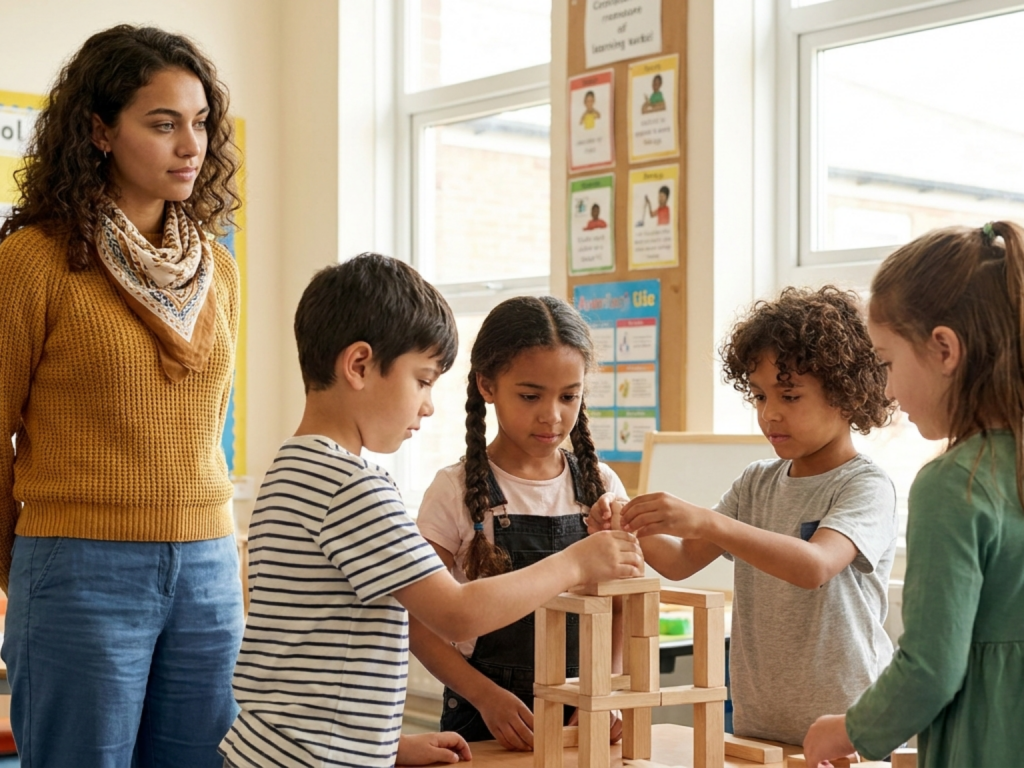
Conflict repair is a teachable sequence. Children benefit from simple, repeated scripts that do not shame them. A repair conversation can include: what happened, how each person felt, what each person needed, and what can be done differently next time. Forced apologies are less useful if the child does not understand the impact. A more developmental approach is: “Your friend’s block tower fell when you pushed the table. Look at his face. What do you think he might be feeling? What could help?”
Adults should expect uneven performance. A child may use excellent coping skills in the morning and melt down after school because of fatigue, hunger, sensory load, or social stress. Regulation is biologically mediated; sleep, nutrition during middle childhood, physical activity, and predictable routines all influence a child’s capacity for patience and social flexibility.
It is also important to distinguish conflict from bullying. Ordinary conflict involves relatively equal power and can often be repaired. Bullying involves repeated aggression, power imbalance, intimidation, or targeted exclusion. If bullying is suspected, adults should take it seriously, document patterns, and involve school staff promptly.
How caregivers can coach social skills at home
Children learn social behavior largely through observation and guided practice. Caregivers do not need to be perfect; they need to be repair-oriented. When adults apologize, use calm words after frustration, respect boundaries, and show empathy, children receive a powerful model.
Practical coaching works best when it is concrete and brief. Before a playdate, a caregiver might preview: “When your friend arrives, you can offer two activity choices. If you both want the same toy, use a timer or choose another plan.” Afterward, the adult can reflect: “I noticed you let him choose the first game. That helped him feel welcome.” Specific feedback strengthens skills more effectively than global praise.
- Practice greetings and entry skills: “Can I play?” “What are you building?” “Do you want to be on the same team?”
- Teach flexible language: “Let’s try it your way first,” “Can we make a new rule?” “I need a break.”
- Use role-play: rehearse losing a game, asking for a turn, handling teasing, or saying no respectfully.
- Encourage empathy: ask what another person might be feeling and what action could help.
- Support body-based regulation: breathing, movement breaks, snacks, hydration, and a consistent bedtime routine can reduce social reactivity.
Physical activity and structured extracurricular groups can be helpful because they offer repeated peer contact with adult guidance. Team sports, music groups, scouting, art clubs, library programs, or supervised neighborhood play can all support social learning. The best fit depends on the child’s interests and stress tolerance, not on adult preference alone.
School partnership and classroom context
School is the central social laboratory for many 6- to 9-year-olds. Teachers observe peer dynamics across recess, lunch, group work, transitions, and classroom routines. If a child is struggling socially, collaboration with school staff can clarify whether the problem is broad, setting-specific, or related to particular peers.
Useful questions for teachers include: Does the child have at least one reciprocal peer connection? Do conflicts occur mainly during unstructured times? Does the child understand directions in group work? Are there signs of anxiety, impulsivity, language difficulty, sensory overload, or academic avoidance in children that may be affecting peer relationships? Social challenges can sometimes be secondary to learning frustration, communication difficulties, fatigue, or fear of making mistakes.
School supports may include social-emotional learning lessons, friendship groups, lunch bunches, recess facilitation, seating adjustments, visual schedules, or explicit teaching of cooperative roles. Some children benefit from being assigned a concrete role in group work, such as materials manager, recorder, or timekeeper. This reduces ambiguity and gives the child a successful way to participate.
When home and school use similar language, children feel less blamed and more supported. A shared phrase such as “pause, name the problem, choose one kind action” can become a bridge between environments. If concerns are persistent, caregivers can ask about developmental surveillance and screening, school-based evaluation processes, or referral to appropriate pediatric or mental health professionals.
When to seek additional help
Variation is normal. Some children are slow to warm up, intensely competitive, highly sensitive, or still learning impulse control. However, additional support is warranted when social difficulties are persistent, impairing, or associated with distress. The goal of evaluation is not to label a child casually, but to understand what skills or supports are needed.
Consider discussing concerns with a pediatrician, child psychologist, developmental-behavioral pediatrician, speech-language pathologist, occupational therapist, or school support team if a child has ongoing difficulty making or keeping friends, frequently misreads social cues, is repeatedly aggressive, is consistently excluded, avoids school because of peer stress, or shows marked anxiety or sadness. Also seek help if there are developmental concerns involving language, attention, repetitive behaviors, sensory distress, motor coordination, sleep-disordered breathing in children, or regression of previously acquired skills.
Social struggles can reflect many pathways: temperament, anxiety, attention-deficit/hyperactivity symptoms, autism-related social communication differences, language disorder, trauma exposure, sleep problems, hearing or vision issues, learning disorders, or environmental mismatch. Only qualified professionals can assess these possibilities. Early, respectful support can reduce shame and help children build durable skills.
Most importantly, children need to know that social learning is learnable. A child who is lonely, impulsive, or often in conflict is not “bad at people” forever. With patient coaching, protected opportunities to practice, and attention to underlying health or developmental needs, many children make meaningful progress.
Seek timely support if
- A child is persistently isolated, rejected, or distressed about peers.
- There is repeated aggression, intimidation, bullying, or targeted exclusion.
- Social difficulties are accompanied by school refusal, somatic complaints, anxiety, sadness, or sleep disruption.
- A child loses previously acquired language, play, or social abilities.
- Concerns include hearing, vision, language, attention, sensory processing, or developmental differences.
Tools & Assistance
- Schedule a nonurgent discussion with the child’s pediatrician if social concerns persist across settings.
- Ask the teacher for specific observations from recess, lunch, group work, and classroom transitions.
- Use brief role-play at home to practice greetings, turn-taking, losing, apologizing, and asking to join.
- Consider structured clubs, sports, arts, or library programs that match the child’s interests and tolerance.
- Request school-based support or evaluation when peer difficulties interfere with learning or attendance.
FAQ
Is it normal for a 6- to 9-year-old to change best friends often?
Yes. Friendships can be intense and changeable at this age. Concern rises when a child is persistently isolated, distressed, bullied, or unable to maintain any reciprocal peer connection.
Should I force my child to socialize more?
Usually no. It is better to provide supported, predictable opportunities and coach specific skills. Some children prefer one close friend or quieter activities, which can be socially healthy.
How can I help my child handle losing games?
Practice outside high-stress moments. Preview expectations, model calm self-talk, praise effort and flexibility, and keep games short enough for success. Persistent intense reactions may signal regulation needs.
When should social problems be evaluated professionally?
Seek guidance when difficulties are persistent, impairing, occur across settings, or are associated with anxiety, aggression, school avoidance, developmental concerns, or loss of skills.
Sources
- National Institutes of Health / PMC — Social skills development in children aged 4–8 years
- Children's Hospital of Orange County — Growth & Development: 6 to 12 Years (School Age)
- American Psychological Association — Cognitive and Social Skills to Expect From 6 to 10 Years
Disclaimer
This article is for educational purposes only and does not diagnose or treat any child. Consult a qualified healthcare or school professional for concerns about development, behavior, mental health, or safety.


















Please log in to leave a comment.