
Intro
Children are not born knowing how to share, take turns, comfort a friend, read facial expressions, or repair a misunderstanding. They build these abilities gradually through brain maturation, repeated experience, language, family relationships, play, culture, and supportive teaching.
Social learning can look uneven. A child may be warm with grandparents but quiet at school, generous one day and possessive the next, or eloquent at home but overwhelmed in a group. This variation is common, and it often reflects the developing nervous system practicing complex skills rather than a lack of kindness or effort.
Highlights
Social skills begin in infancy through gaze, imitation, facial expression, shared attention, and responsive caregiving.
Play is not a break from learning; it is one of the main ways children practice negotiation, empathy, emotional regulation, and flexible thinking.
Children learn best when adults model calm behavior, name emotions, set predictable limits, and give specific praise for prosocial actions.
Persistent social withdrawal, severe aggression, loss of skills, or major functional impairment should be discussed with a pediatrician or qualified child mental health professional.
Social skills start before children can talk
Social learning begins long before a child can say “please,” join a game, or explain how they feel. In infancy, the brain is already organizing information from faces, voices, body movement, touch, and repeated caregiver responses. Research on early social development describes several building blocks: mutual gaze, smiling, imitation, sensitivity to biological motion, joint attention, and later language. These are not isolated milestones; they form an integrated social-cognitive network.
By around 3 months, many infants show increasing interest in mutual gaze, especially when a caregiver’s face is animated and responsive. Eye contact helps the infant notice that another person is emotionally and behaviorally engaged. Over time, the baby learns patterns: a smile may invite connection, a soft voice may signal comfort, and a caregiver looking toward a toy may mean something worth exploring.
Imitation is another early pathway. When a baby copies a facial expression, sound, or gesture, the infant is not merely entertaining adults. Imitation supports turn-taking, attention to another person’s actions, and a primitive sense of shared experience. These early exchanges are the roots of later conversation, cooperative play, and social problem-solving.
Around the end of the first year, joint attention becomes especially important. Joint attention means the child and another person coordinate attention toward the same object or event, often through looking, pointing, showing, or checking back with eye contact. This skill helps infants interpret goal-directed behavior: “What is the adult looking at? What do they want me to notice? What does this object mean?” It also supports vocabulary growth because words are learned more easily when adult and child are focused on the same thing.
The brain, body, and relationships work together
Social competence is both neurological and relational. Children need developing neural systems for attention, emotional regulation, sensory processing, language, memory, and executive function. They also need safe relationships in which to practice. A child cannot learn complex social judgment from instructions alone, just as a child cannot learn to swim by reading about water.
The limbic system, which is involved in emotion and threat detection, interacts with prefrontal brain regions that support inhibition, planning, flexible thinking, and perspective-taking. In young children, these regulatory circuits are still immature. That is why a tired toddler may hit even after being taught “gentle hands,” and why a preschooler may understand sharing in theory but struggle when a favorite truck is taken. The skill may be emerging, but the nervous system may not yet be able to use it reliably under stress.
Co-regulation is central. Before children can consistently self-regulate, they borrow calm from attuned adults. A caregiver who kneels down, uses a steady voice, names the feeling, and holds a limit is helping the child’s body learn what regulation feels like. Over many repetitions, children internalize these patterns.
Temperament also matters. Some children are socially bold, while others are slow to warm, highly sensitive, cautious, or easily overstimulated. These differences are not moral flaws. They influence how much preparation, recovery time, and adult scaffolding a child needs. Understanding how children learn by age can help adults set expectations that are both compassionate and developmentally realistic.
Toddlers learn through imitation, limits, and repetition
Toddlers are intensely social but still egocentric in the developmental sense: they experience their own needs and feelings as urgent and have limited capacity to infer another person’s perspective. They may hug a crying child one moment and grab a toy the next. This unevenness is expected because language, impulse control, and empathy are developing at different speeds.
At this stage, adults teach social skills most effectively through simple language, modeling, and repeated routines. Long lectures rarely help. A toddler benefits more from brief, concrete coaching: “You want the ball. Say, ‘turn please.’ I will help you wait.” The adult’s job is to translate intense impulses into acceptable social actions.
Important toddler social skills include:
- Using gestures or words to request help, comfort, or a turn
- Beginning to tolerate short waits with adult support
- Noticing facial expressions such as happy, sad, or angry
- Practicing gentle touch with people, animals, and objects
- Recovering after frustration with co-regulation
Repetition is not failure. Toddlers need hundreds of supported practice moments to build neural pathways. If a child repeatedly throws toys when frustrated, the adult can protect safety, reduce overstimulation, and teach a replacement behavior. For example: “Blocks are not for throwing. You are mad. You can stomp your feet or ask for help.” This approach combines boundary-setting with emotional literacy.
Preschoolers practice social rules through play
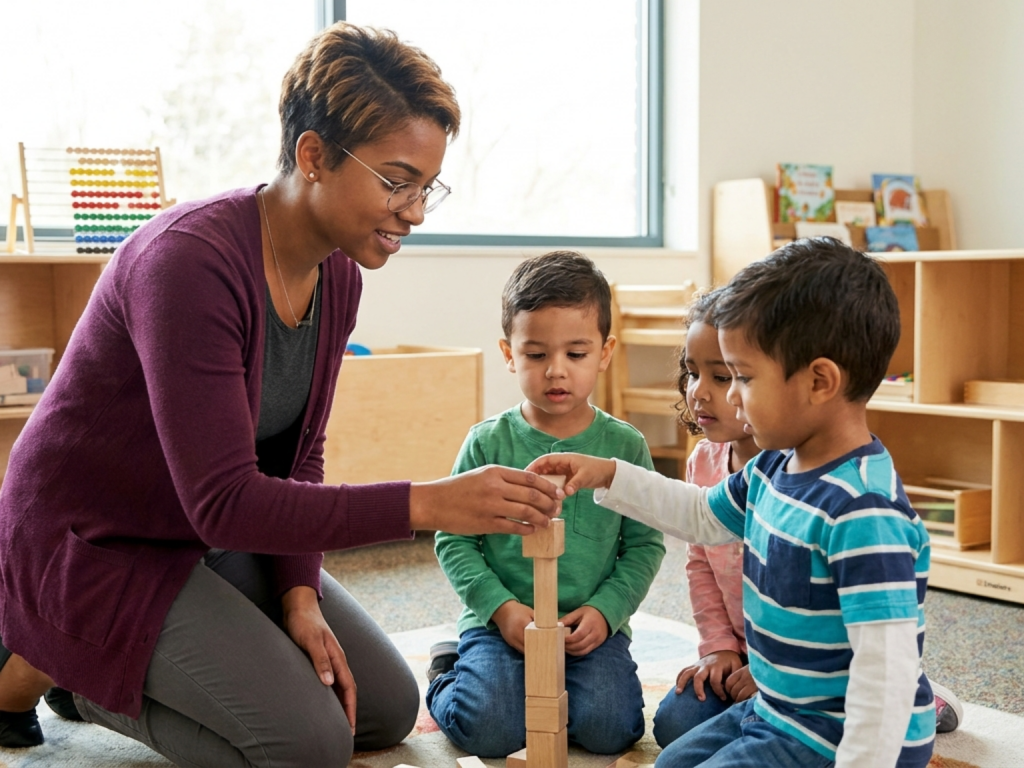
Preschoolers increasingly use language to negotiate, pretend, explain, and repair. This is why play-based preschool learning is so powerful. In pretend play, children practice roles, rules, symbols, cooperation, and emotional flexibility. A pretend restaurant requires someone to be the cook, someone to be the customer, and everyone to agree that a block can represent a sandwich. These playful agreements are early exercises in shared meaning.
Preschool learning skills development often includes social-emotional capacities as much as early literacy or number sense. Children learn to enter a group, ask for a turn, handle “no,” follow multi-step routines, and understand that friends may have different preferences. These are cognitively demanding tasks. They require working memory, inhibition, language comprehension, and perspective-taking.
Adults can support preschoolers by narrating social situations without humiliation. Instead of “Stop being selfish,” a teacher might say, “Maya is still using the marker. You really want it. Let’s ask when she will be done.” This gives the child a script and preserves dignity. Specific praise is also useful: “You moved over so Leo could sit beside you. That was thoughtful,” is more instructive than “Good job.”
Role-playing and storytelling can help children rehearse difficult moments before they happen. A parent might use stuffed animals to act out joining a game, losing a turn, or apologizing after knocking down a tower. How preschoolers learn best is often through concrete, emotionally safe practice rather than abstract moral instruction.
School-age children refine empathy, friendship, and conflict repair
School-age children become increasingly capable of understanding social norms, group identity, fairness, loyalty, and another person’s internal state. They can usually discuss feelings with more nuance and reflect on past behavior. However, peer relationships also become more complex. Friendship may involve inclusion, exclusion, humor, teasing, secrets, competition, and social comparison.
How school age children learn social skills depends partly on opportunities to participate in structured and unstructured peer interactions. Team games, classroom projects, clubs, neighborhood play, music groups, and sports can all provide social practice. The goal is not to make every child extroverted. Rather, the goal is to help each child communicate needs, respect boundaries, cooperate, and recover from mistakes.
Conflict is not automatically harmful. Managed well, conflict teaches perspective-taking and repair. Adults can coach children through a sequence: identify what happened, name each person’s feeling, clarify the need, consider possible solutions, and choose a repair. A repair might be an apology, returning an item, helping rebuild something, or agreeing on a new rule for the game.
Children also learn by observing adult conflict. When adults apologize, calm down before responding, and discuss disagreements respectfully, children receive a living model of social repair. Conversely, chronic harshness, humiliation, or unpredictable responses can make social learning harder by increasing threat arousal and reducing cognitive flexibility.
Language and emotion skills are social tools
Language is one of the most important tools for social learning. Children use words to request, negotiate, explain intentions, tell stories, ask questions, and repair misunderstandings. Receptive language, the ability to understand what others say, is just as important as expressive language. A child who misses subtle instructions or idioms may seem noncompliant when the true issue is comprehension.
Emotion vocabulary also matters. A child who can distinguish “disappointed,” “embarrassed,” “worried,” and “furious” has more options than a child who only knows “mad.” Naming emotions supports interoception, the ability to notice internal body signals, and can reduce the intensity of distress by giving the brain a more organized framework for experience.
Helpful adult phrases include:
- “You look disappointed that the game ended.”
- “It is okay to feel angry; it is not okay to hurt someone.”
- “Let’s think about what your friend might have felt.”
- “What could you say to try again?”
- “Your body looks overwhelmed. Let’s take a quiet break.”
For some children, speech-language delays, hearing difficulties, attention problems, autism-related social communication differences, anxiety, trauma exposure, or sensory processing challenges can affect social participation. These possibilities should be approached with curiosity rather than blame. If concerns are persistent or impairing, a pediatrician, speech-language pathologist, psychologist, developmental-behavioral pediatrician, or occupational therapist may help clarify needs.
Practical ways adults can teach social skills
Social skills are teachable, but they are best taught warmly and consistently. Children usually learn more from “practice with support” than from punishment after a mistake. The most effective strategies tend to be concrete, repeated, and matched to the child’s developmental level.
Useful approaches include:
- Model the behavior. Let children see adults greeting others, waiting, apologizing, and asking consent before touching belongings.
- Use role-play. Practice joining a game, refusing a request politely, or responding to teasing in a calm setting before the real situation occurs.
- Read and tell stories. Pause to ask what a character might feel, want, or misunderstand.
- Create structured group opportunities. Small playdates, cooperative games, supervised sports, art groups, or classroom jobs can build confidence.
- Give specific reinforcement. Praise the exact behavior: “You noticed Sam was left out and invited him in.”
- Teach repair, not shame. After harm, guide the child to make amends and try a better strategy next time.
Adults should also protect the child from chronic social failure. A shy or impulsive child may need smaller groups, shorter visits, visual reminders, sensory breaks, or pre-taught scripts. Success experiences matter because they help the child’s brain associate social interaction with safety and competence.
When to seek extra support
Many social struggles are temporary and improve with maturation, coaching, and supportive environments. Still, some patterns deserve professional attention, especially when they are persistent, intense, or interfere with family life, school participation, safety, or peer relationships.
Consider discussing concerns with a healthcare or developmental professional if a child shows marked loss of previously acquired social or language skills, very limited response to social engagement, persistent inability to use gestures or shared attention, severe aggression, extreme distress in ordinary peer settings, ongoing social withdrawal, or difficulty communicating needs. Concerns should also be raised if teachers report major functional impairment across settings.
It is important not to diagnose a child based on one behavior. Avoiding eye contact, preferring solitary play, being highly active, or feeling anxious in groups can have many explanations. Cultural norms, temperament, language exposure, sleep, hearing, neurodevelopment, stress, and classroom fit all matter. Social anxiety kids explained is a useful concept for some families, but shyness and anxiety are not the same as a clinical disorder.
A good evaluation looks at strengths as well as challenges. It may include developmental history, observation, hearing and vision considerations, language assessment, behavior rating scales, school input, and family context. The aim is not to label a child harshly; it is to understand what support will help the child participate, connect, and feel more secure.
Seek professional guidance promptly if
- A child loses previously acquired language, play, or social engagement skills.
- Aggression, self-injury, or unsafe behavior is frequent or escalating.
- Social fear, withdrawal, or distress prevents school attendance or daily participation.
- A child rarely responds to attempts at shared attention, name calling, or social interaction.
- Caregivers or teachers see persistent impairment across more than one setting.
Tools & Assistance
- Schedule a visit with the child’s pediatrician to review developmental and behavioral concerns.
- Ask the child’s teacher or childcare provider for specific observations across routines and peer settings.
- Use short role-play sessions at home to practice greetings, turn-taking, asking for help, and conflict repair.
- Consider speech-language, occupational therapy, psychology, or developmental evaluation when concerns persist.
- Choose small, structured peer activities where the child can experience social success with adult support.
FAQ
At what age do children start learning social skills?
Social learning begins in infancy through gaze, smiling, imitation, caregiver response, and shared attention. More complex skills such as turn-taking, empathy, and conflict repair develop gradually across childhood.
Is it normal for a child to struggle with sharing?
Yes, especially in toddlerhood and early preschool. Sharing requires impulse control, language, and perspective-taking, which are still developing. Consistent coaching and predictable routines usually help.
Should parents force a shy child to socialize?
Forcing can increase distress. A better approach is gentle exposure, preparation, small groups, familiar settings, and praise for brave attempts. Seek professional advice if avoidance causes major impairment.
Can social skills be taught directly?
Yes. Children benefit from modeling, role-play, storytelling, structured group activities, emotion coaching, and specific praise for behaviors such as helping, waiting, inviting, and repairing.
When should social difficulties be evaluated?
Evaluation is reasonable when difficulties are persistent, intense, unsafe, associated with developmental regression, or interfere with school, family life, communication, or peer relationships.
Sources
- National Center for Biotechnology Information (NCBI) — Development of social skills in children: neural and behavioral aspects
- Robert Wood Johnson Foundation — Social Skills in Kindergarten Help Children Thrive as Adults
- Handspring Health — Essential Guide on Social Skills for Kids
Disclaimer
This article is for general educational purposes and is not a medical diagnosis or treatment plan. Consult a qualified healthcare professional for concerns about a child’s development, behavior, communication, or mental health.
















Please log in to leave a comment.