
Intro
Roseola can be unsettling because it often begins with a sudden high fever in a baby or toddler who may otherwise have only mild respiratory or digestive symptoms. Then, just as the temperature improves and caregivers start to feel relieved, a pink rash appears.
In many children, roseola is self-limited, but the high fever, age of the child, and the possibility of other infections mean it deserves careful observation and, when appropriate, professional medical advice. This article explains the typical pattern, what to watch for, and when to seek urgent care.
Highlights
Roseola classically causes several days of high fever followed by a pink rash as the fever drops.
It is most common in infants and toddlers, especially between about 6 months and 2 years of age.
The rash usually starts on the trunk and may spread to the neck, face, arms, or legs; it is often not itchy and fades within hours to a few days.
Supportive care focuses on fluids, comfort, monitoring, and age-appropriate fever care guided by a clinician or local medical advice.
Urgent assessment is needed for red flags such as breathing difficulty, dehydration, stiff neck, non-blanching rash, seizure, or a very young infant with fever.
What roseola is and why the fever-rash pattern matters
Roseola, also called roseola infantum or exanthem subitum, is a common viral illness of early childhood. It is most often linked to human herpesvirus 6, and less commonly human herpesvirus 7. These viruses are widespread; many children are exposed in the first years of life. The typical illness is memorable because the fever comes first, often abruptly and sometimes quite high, while the rash appears later, usually as the child’s temperature returns toward normal.
This sequence is clinically useful. Many childhood viruses can cause both fever and rash, but roseola is known for a period of fever lasting about three to five days followed by defervescence, meaning the fever breaks, and then a pink maculopapular rash appears. “Maculopapular” means a rash made of flat spots and slightly raised bumps. In roseola, these spots are commonly small, pink, and blanching, meaning they fade temporarily when gentle pressure is applied.
The pattern can also be emotionally confusing for caregivers. A child may seem most unwell during the fever, with fussiness, reduced appetite, or disturbed sleep. Then, just when the fever improves, a rash may raise new concern. In uncomplicated roseola, the rash itself is often a sign that the main febrile phase is ending. Still, no rash should be interpreted in isolation. A child’s age, appearance, hydration, breathing, alertness, fever duration, and any warning signs matter more than the label of a suspected viral rash.
Typical age group, cause, and contagiousness
Roseola mainly affects infants and toddlers, particularly children between about 6 months and 2 years old. It can occur outside that range, but the classic presentation is less common in older children. Very young infants with fever need special caution because their immune systems are still developing and serious bacterial infections can sometimes present subtly. For that reason, fever in babies younger than 3 months should prompt medical advice urgently, regardless of whether roseola is suspected.
The viruses associated with roseola spread through respiratory secretions and saliva. Children may acquire the virus from close contact with an infected person, including someone with very mild or unrecognized symptoms. As with many common childhood viruses, preventing every exposure is difficult, especially in households, childcare settings, and playgroups.
Contagiousness is not always easy to define by appearance alone. A child may be more infectious during the febrile phase than after the rash appears, but practical decisions about childcare should follow local guidance and the child’s overall condition. In general, children with fever should stay home, rest, and avoid close contact with vulnerable people. Return to daycare or group activities is usually considered when the child is fever-free, feels well enough to participate, and meets the setting’s illness policy.
Roseola is not caused by teething, overheating, or a food reaction, although those possibilities may be considered when a child has fever or rash. Because the early fever can resemble many infections, clinicians often diagnose roseola retrospectively, after the characteristic rash appears and the child otherwise fits the typical course.
How the illness usually unfolds
The first stage is usually sudden fever. Temperatures can rise quickly and may be high, sometimes above 39°C or 102.2°F. Some children remain surprisingly alert between fever spikes, while others are irritable, tired, clingy, or less interested in food. Mild symptoms such as runny nose, cough, swollen lymph nodes, loose stools, or eyelid puffiness can occur, but many children have few clues beyond fever.
The fever commonly lasts three to five days. During this phase, fever red flags in children should guide decisions rather than the presumed diagnosis. Watch the child, not only the thermometer: breathing effort, hydration, responsiveness, skin color, and consolability are important clinical signals. A fever log for pediatric triage can help if you need to call a clinician, especially if it includes temperature readings, timing, fluids taken, wet diapers or urination, medicines given, and changes in behavior.
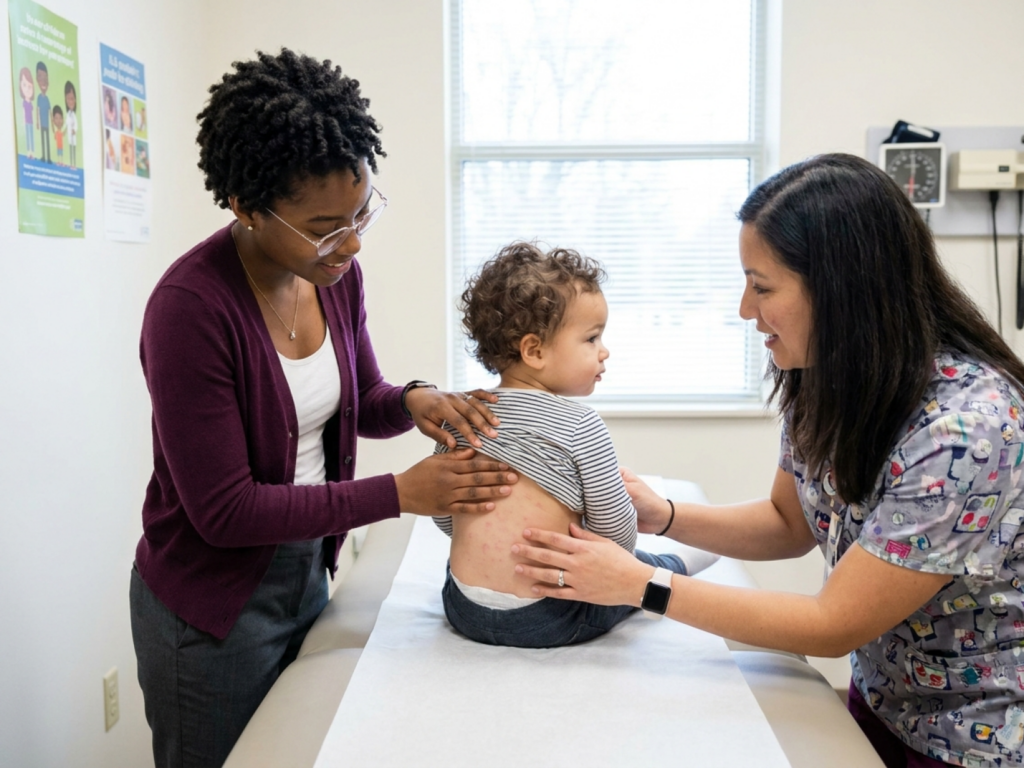
As the fever resolves, the rash appears. This is the second stage. The roseola rash often begins on the chest, abdomen, or back, then may spread to the neck, face, arms, or legs. It is usually pink or rosy, made of small spots or bumps, and often not itchy or painful. It may be faint and easy to miss, especially if the child is warm after a bath or nap. The rash may last a few hours to a few days.
Many children feel better once the rash appears. Appetite and energy may begin to return, though some tiredness can linger briefly after several days of fever. If a child becomes more lethargic, develops new fever after improvement, seems in pain, or has a rash that looks bruised or does not blanch, that pattern is not typical and should be assessed promptly.
Distinguishing roseola from other fever-and-rash illnesses
Roseola is one of many viral rashes in children, and its timing is the key clue: high fever first, rash after the fever drops. Other illnesses may cause rash while the child is still febrile, may involve mouth ulcers or blisters, may be intensely itchy, or may have a different distribution. For example, hand, foot, and mouth disease often involves painful mouth sores and lesions on the palms and soles. Chickenpox typically causes itchy fluid-filled blisters in different stages. Scarlet fever may cause a sandpaper-like rash with sore throat. Measles, now less common where vaccination rates are high but still serious, usually includes cough, runny nose, conjunctivitis, and a spreading rash with persistent fever.
The most concerning rashes are those associated with severe systemic illness. A non-blanching rash with fever, especially purple, red, or bruise-like spots that do not fade under pressure, can indicate bleeding under the skin and requires urgent medical evaluation. Likewise, fever with stiff neck, severe headache, persistent vomiting, confusion, unusual drowsiness, breathing difficulty, or a child who is difficult to wake should be treated as an emergency.
Allergic reactions can also cause rashes, but they often present as raised, itchy welts or hives and may be associated with swelling of the lips or face, wheezing, or vomiting after a trigger. Heat rash, eczema, and contact dermatitis usually do not follow the classic high-fever-then-rash sequence. Still, real children do not always read textbooks: mixed symptoms, incomplete vaccination, recent travel, medication exposure, immune compromise, or known outbreaks can change the level of concern.
Because roseola is often recognized after the fact, caregivers should avoid assuming that every high fever in a toddler is roseola. If the fever is prolonged, the child is very unwell, or warning signs appear, professional assessment is safer than waiting for a rash to clarify the picture.
Home care and monitoring while the fever is present
Supportive care for childhood fever is the main approach for suspected uncomplicated roseola. The goals are comfort, hydration, and close observation. Fever itself is a physiologic response to infection; the number on the thermometer is only one part of the assessment. A child who is drinking, urinating, breathing comfortably, and interacting reasonably between fever spikes is generally less concerning than a child with a lower temperature who is listless, dehydrated, or struggling to breathe.
Offer frequent fluids. Breast milk, formula, water when age-appropriate, or oral rehydration solution may be useful depending on the child’s age and intake. Small, repeated sips can be easier than large volumes. Appetite may be reduced for a few days; fluid intake and wet diapers or urination are usually more important than solid food during the acute febrile phase.
Comfort measures can include light clothing, a comfortably cool room, rest, and cuddling. Avoid cold baths, ice rubs, alcohol rubs, or aggressive cooling, which can cause shivering and distress. Fever medicines should be used only according to age, weight, product instructions, and clinician guidance. Aspirin should not be given to children unless specifically directed by a healthcare professional because of the risk of Reye syndrome in viral illnesses.
Monitor for signs of dehydration in children, such as very few wet diapers, dry mouth, no tears when crying, sunken eyes, unusual sleepiness, or inability to keep fluids down. Keep track of fever duration. If fever persists beyond 3 days, is very high, recurs after improving, or is accompanied by concerning symptoms, contact a healthcare professional for individualized advice.
Febrile seizures and the roseola fever spike
Roseola is one of the illnesses associated with febrile seizures in young children because the fever may rise quickly. A febrile seizure can be frightening: a child may lose consciousness, stiffen, jerk, roll the eyes, or become temporarily unresponsive. Most simple febrile seizures stop within a few minutes and do not mean a child has epilepsy, but any first seizure or prolonged seizure deserves urgent medical evaluation.
If a seizure occurs, place the child on their side on a safe surface, move nearby hazards away, and note the time. Do not put anything in the child’s mouth, do not restrain their movements, and do not try to give food, drink, or medicine during the seizure. Call emergency services if the seizure lasts more than five minutes, the child has trouble breathing, turns blue, is injured, does not recover normally afterward, or if you are unsure what to do.
After a seizure, a child may be sleepy or confused for a short period. Medical professionals may want to evaluate the child’s age, fever source, vaccination status, neurologic recovery, and whether features suggest a simple febrile seizure or a more complex event. Fever medicine may improve comfort but does not reliably prevent febrile seizures, so safety planning and prompt evaluation are more important than trying to keep the temperature at a specific number.
When to call a doctor or seek urgent care
Contact a healthcare professional if you are worried, if the child is younger than 3 months with any fever, or if the fever is high, persistent, or not behaving as expected. Medical advice is also appropriate if your child has an underlying immune problem, complex heart or lung disease, neurologic conditions, recent chemotherapy or transplant, or if they are not fully immunized and have a fever with rash.
Seek urgent help for difficulty breathing, bluish lips, severe lethargy, inconsolable crying, signs of dehydration, a seizure, stiff neck, persistent vomiting, or a non-blanching purple rash. A rash that appears with ongoing high fever, severe illness, or marked pain should not be assumed to be roseola. Similarly, if the child improves and then develops a new fever, worsening cough, ear pain, painful urination, or other focal symptoms, a secondary or different infection may need evaluation.
When you speak with a clinician, be ready to describe the fever timeline, highest measured temperature, how it was measured, medicines used and timing, fluid intake, urine output, exposures, travel, vaccination status, and the rash’s appearance. Photos taken in natural light can help show how the rash evolved, but they should not replace an in-person assessment when red flags are present.
Most children recover fully from roseola with supportive care. The challenge is that the early stage can mimic other infections, and rare complications such as febrile seizures can occur. Trust your concern: if your child looks seriously unwell or something feels different from their usual illnesses, it is reasonable to seek medical care.
Seek urgent medical help if
- Your child is younger than 3 months and has a fever.
- There is difficulty breathing, bluish lips, severe drowsiness, or the child is hard to wake.
- A rash is non-blanching, purple, bruise-like, or appears with a very ill-looking child.
- There are signs of dehydration, such as very few wet diapers, dry mouth, or inability to keep fluids down.
- A seizure occurs, especially a first seizure or one lasting more than five minutes.
- Fever persists, returns after improvement, or is accompanied by stiff neck, persistent vomiting, or severe headache.
Tools & Assistance
- Digital thermometer appropriate for the child’s age
- Fever and fluid intake log for calls with a clinician
- Oral rehydration solution when recommended or appropriate
- Local pediatric advice line or primary care clinic
- Emergency services for breathing difficulty, seizure, or non-blanching rash
FAQ
Is roseola dangerous?
Roseola is usually self-limited, but the high fever can be alarming and may rarely trigger a febrile seizure. Medical review is important if red flags appear or the child is very young or unusually unwell.
Does the rash mean my child is getting worse?
In typical roseola, the rash appears as the fever drops and often means the febrile phase is ending. However, a non-blanching, painful, purple, or illness-associated rash needs urgent assessment.
Can antibiotics treat roseola?
Roseola is viral, so antibiotics do not treat the infection itself. A clinician may evaluate for other causes of fever if the course is atypical or concerning.
Can my child go to daycare with the rash?
Policies vary, but children generally should stay home while febrile or unwell. Return is usually considered when fever-free, well enough to participate, and consistent with daycare rules.
Can a child get roseola more than once?
It is uncommon but possible for children to have roseola-like illnesses caused by related viruses. Recurrent fever or unusual rashes should be discussed with a healthcare professional.
Sources
- MedlinePlus — Roseola: MedlinePlus Medical Encyclopedia
- National Health Service — Roseola
- PubMed — Roseola Infantum: An Updated Review
Disclaimer
This article is for general educational purposes and is not a diagnosis or treatment plan. Always consult a qualified healthcare professional for concerns about a child’s fever, rash, or overall condition.















Please log in to leave a comment.