
Intro
Back labor can be physically intense and emotionally draining, especially when the discomfort does not disappear completely between contractions. It usually refers to labor pain concentrated in the lower back, sacrum, or tailbone region rather than mainly across the abdomen.
Although fetal position often contributes, back labor is a pain pattern rather than a diagnosis. Understanding why it happens, how it differs from other labor pain, and which comfort or medical options may help can make the experience feel less bewildering.
Highlights
Back labor is usually felt as intense pressure or pain over the sacrum and lower back, sometimes continuing between contractions.
An occiput posterior fetal position is a common contributor, but back pain alone cannot establish fetal position.
Back labor does not necessarily mean labor is abnormal or that cesarean birth will be required.
Position changes, sacral counterpressure, heat, water, and medical analgesia may help, although responses vary.
What back labor means
Back labor describes labor pain that is predominantly felt in the lower back, especially over the sacrum just above the tailbone. It may feel like deep pressure, an intense ache, squeezing, or a sharp sensation. Some people also feel pain radiating into the hips, buttocks, or thighs. The defining feature is not simply having a sore back during labor, but having the lower back become a major focus of the labor pain.
The pattern is variable. For some people, the pain rises and falls with labor contractions. For others, a baseline ache persists between contractions and becomes much stronger during each contraction. That continuous component can be especially exhausting because it reduces opportunities to recover.
Back labor is not a separate type or stage of labor, and it is not itself a diagnosis. It may occur in early, active, or second-stage labor, and its intensity does not reliably indicate cervical dilation. A person can experience substantial back pain while labor is progressing normally, while another person with the same fetal position may feel little back discomfort.
Why pressure in the pelvis can be felt in the back
Labor pain is generated by several overlapping mechanisms. During the first stage, uterine contractions and cervical dilation activate visceral sensory pathways. This pain is commonly perceived as cramping or pressure across the lower abdomen, pelvis, and back. As the fetus descends, stretching and pressure involving the vagina, pelvic floor, ligaments, joints, and nearby nerves add a more localized somatic component.
Back labor is thought to become prominent when the fetal head places sustained pressure on the sacrum and adjacent pelvic structures. Distention or compression of visceral and neural tissues may help explain why the pain can remain present between contractions rather than following only the uterus’s rhythmic pattern. Sacroiliac joint strain, pelvic ligament tension, and individual pain processing may also influence where and how strongly the sensation is perceived.
This does not mean the fetus is damaging the spine. The pain generally reflects mechanical pressure and nerve signaling within a crowded, changing pelvis. Nevertheless, the experience is real and can be severe. Pain intensity is influenced by anatomy, fatigue, prior pain experiences, emotional state, labor duration, fetal descent, and the effectiveness of support and analgesia. Severe pain should never be dismissed simply because labor is expected to hurt.
The role of fetal position
The position most often associated with back labor is an occiput posterior fetal position. In this orientation, the back of the fetal skull faces the pregnant person’s spine rather than facing toward the front or side of the pelvis. The harder portion of the skull may therefore press more directly against the sacrum during contractions and descent.
Posterior positioning is common at some point in labor, and many fetuses rotate spontaneously before birth. Some remain posterior and are still born vaginally. Position is dynamic: it can change as the head flexes, descends, and rotates through the pelvis. Back labor from fetal position is therefore not necessarily constant throughout labor.
Other anatomical or personal factors may contribute, including pelvic shape, the relationship between fetal head size and the pelvis, a shorter torso, spinal differences, and a history of pronounced menstrual back pain. These are associations rather than reliable predictors. Back pain does not prove that the fetus is posterior, and the absence of back pain does not exclude that position. A clinician may estimate position through abdominal palpation, vaginal examination, or ultrasound when clarification would affect care.
How back labor differs from typical labor pain
Typical first-stage contraction pain often begins as a wave: discomfort builds, peaks, and recedes as the uterus contracts and relaxes. It may be felt across the lower abdomen, around the pelvis, or in a band extending into the back. Between contractions, the intensity usually decreases substantially, particularly earlier in labor.
Back labor is more concentrated over the sacrum and may have a persistent component. The pain can intensify sharply during contractions but fail to disappear completely afterward. People sometimes describe an urgent need for firm pressure against the painful area. Sacral pressure during pushing may become especially pronounced as the fetal head descends.
This distinction is not absolute. Labor pain exists on a spectrum, and ordinary contractions can be felt primarily in the back without a posterior fetus. Conversely, a posterior fetus may produce abdominal, pelvic, or rectal pressure rather than classic back labor. Individual differences in pain threshold, nerve pathways, fetal station, and pelvic anatomy can produce very different experiences under clinically similar circumstances.
Back labor also differs from the common muscular backache of late pregnancy, which may change with rest, posture, or activity and is not necessarily accompanied by progressive contractions. However, labor can begin with back discomfort. Regular contractions, increasing intensity, pelvic pressure, vaginal bleeding, fluid leakage, or other concerning changes should be discussed with the maternity team rather than interpreted by location alone.
What back labor means for labor progress
Back labor can occur during an otherwise uncomplicated labor. It does not by itself mean that labor has stalled, the fetus is in distress, or operative birth will be necessary. Many people with back labor have spontaneous vaginal births.
A persistent posterior position can sometimes be associated with a longer labor, slower rotation or descent, more intense pain, and a greater likelihood of assisted vaginal birth or cesarean birth. These outcomes are not inevitable, and pain severity alone cannot predict them. Clinicians assess the overall fetopelvic relationship during labor by considering cervical change, fetal station and rotation, contraction pattern, maternal condition, and fetal heart-rate findings.
If progress is slower than expected, the care team may reassess fetal position and the adequacy of contractions, suggest movement or position changes when safe, or discuss medical interventions according to the clinical situation and the person’s preferences. Decisions should be based on the full assessment, not on the presence of lower-back pain alone.
Comfort measures and pain-relief options
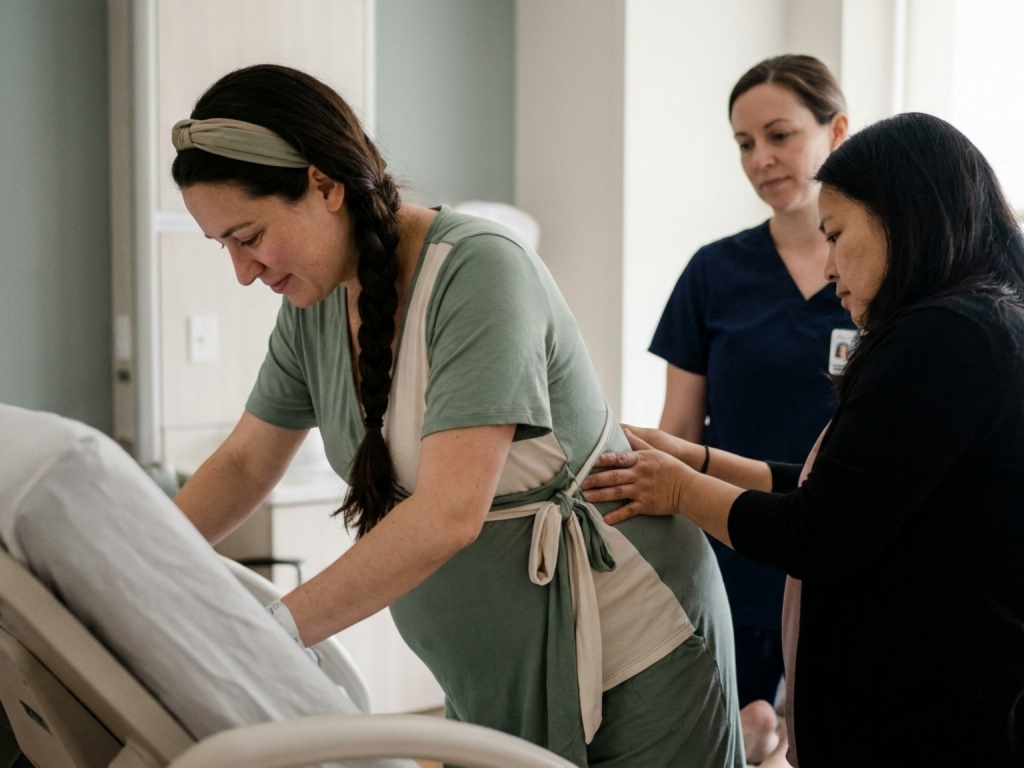
No single method reliably stops back labor, but combining strategies may reduce pressure, improve coping, or create periods of relief. A hands-and-knees position for back labor may feel more comfortable because it removes direct body weight from the sacrum and permits pelvic movement. Forward leaning, side lying, kneeling over an elevated bed, lunging, standing, or slow pelvic rocking may also help. Position changes do not guarantee that a fetus will rotate, but comfort is a worthwhile goal even when rotation does not occur.
Firm sacral counterpressure during contractions is often useful. A support person may press steadily with a palm, fist, or massage tool over the painful area, following the laboring person’s instructions. Hip squeezes, massage, a warm pack, a warm shower, or immersion in water may offer additional relief if they are safe in the birth setting. Heat should be comfortably warm rather than hot, and pressure should stop if it increases pain or causes numbness.
Breathing techniques, low vocalization, focused relaxation, and continuous reassurance can reduce tension and help preserve energy. These approaches do not imply that pain is psychological or that the person should tolerate more than they want. Back labor can remain intense despite excellent preparation and support.
Medical options may include systemic analgesic medication, nitrous oxide where available, or epidural analgesia during labor. An epidural often provides substantial relief, although the degree and distribution of numbness vary. The anesthesia and obstetric teams can explain benefits, limitations, timing, monitoring, and individualized contraindications. Mobility, fetal monitoring, ruptured membranes, bleeding risk, blood pressure, and other clinical circumstances may affect which positions or methods are appropriate. Ask the care team before using heat, immersion, equipment, or demanding movement when monitoring or medical complications are present.
When back pain needs prompt assessment
Back labor itself is usually not dangerous, but a new or unusual pain pattern deserves attention because not every severe back pain in pregnancy is caused by labor. Contact the maternity unit or follow the clinician’s urgent-care instructions if contractions may be starting, membranes may have ruptured, bleeding occurs, or fetal movement is reduced. Possible labor before 37 weeks requires prompt assessment.
During labor, tell the team immediately about sudden severe pain that feels distinctly different from contractions, pain that remains extreme and unchanging, heavy bleeding, fever, faintness, shortness of breath, severe headache, new weakness or numbness, or a strong sense that something is wrong. These findings do not identify a specific complication, but they warrant professional evaluation.
If an epidural or other analgesia is in use, report pain that breaks through abruptly, becomes strongly one-sided, or is accompanied by new neurological symptoms. Clinicians can assess analgesia as well as maternal and fetal wellbeing. Asking for reassessment or stronger pain relief is appropriate; needing medical analgesia is not a failure, and back labor should not be minimized.
Seek prompt maternity assessment
- Possible labor, fluid leakage, or regular contractions before 37 weeks
- Heavy vaginal bleeding, reduced fetal movement, fever, faintness, or shortness of breath
- Sudden severe pain that is constant or distinctly different from contraction waves
- New leg weakness, significant numbness, loss of bladder or bowel control, or difficulty walking
- Abrupt breakthrough or strongly one-sided pain despite epidural analgesia
Tools & Assistance
- Call the maternity triage unit for individualized guidance about contractions, back pain, bleeding, fluid leakage, or fetal movement.
- Ask a birth partner to learn firm sacral counterpressure and hip-squeeze techniques before labor.
- Discuss available movement, water, nitrous oxide, medication, and epidural options with the obstetric and anesthesia teams.
- Use a contraction timer as a communication aid, while following the care team's instructions rather than relying on an app alone.
FAQ
Does back labor always mean the fetus is posterior?
No. Posterior positioning is a common contributor, but back pain cannot confirm fetal position. Clinicians may use examination, abdominal palpation, or ultrasound when needed.
Does back labor mean I will need a cesarean birth?
No. Many people with back labor give birth vaginally. Decisions depend on labor progress, fetal wellbeing, rotation and descent, and the overall clinical picture.
Can position changes turn a posterior fetus?
Some fetuses rotate during labor, with or without specific positioning. Movement may improve comfort and pelvic mobility, but no position guarantees rotation.
Can an epidural relieve back labor?
Epidural analgesia often provides substantial relief, although effectiveness and sensation vary. An anesthesia professional can discuss suitability, benefits, limitations, and monitoring.
Can labor start as back pain without obvious abdominal contractions?
Yes, labor may initially be perceived in the back. Contact the maternity team if pain becomes regular or intensifies, or if there is fluid leakage, bleeding, reduced fetal movement, or concern about preterm labor.
Sources
- American College of Obstetricians and Gynecologists — What is back labor?
- Cleveland Clinic — Back Labor: Signs, How It Feels, Causes & Relief
- PubMed — Low-back pain during labor
Disclaimer
This article provides general medical information and cannot diagnose the cause of pain or replace individualized advice. Contact your maternity team or another qualified healthcare professional with concerns.


















Please log in to leave a comment.