
Intro
Turn taking and sharing in preschool are not simple manners that children either have or lack. They are developing social-emotional, language, motor, and executive-function skills that grow through repeated, supported practice. A preschooler who grabs a toy, cries when a turn ends, or refuses to share is often showing an immature nervous system under social stress, not deliberate unkindness.
For parents, caregivers, and educators, the goal is to build these skills without shame. Warm structure, predictable routines, modeling, and developmentally realistic expectations can help children learn how to wait, negotiate, notice another child’s needs, and recover when disappointment feels big.
Highlights
Preschool sharing is a developmental skill, not a fixed personality trait. Children need adult scaffolding while inhibitory control, working memory, and perspective-taking mature.
Forced sharing can increase distress and conflict. Timed turns, clear scripts, and protected personal items are often more effective.
Persistent or intense difficulty may reflect language, hearing, sensory, attention, anxiety, or developmental concerns. A pediatrician or child development professional can help decide whether evaluation is needed.
Caregivers can teach turn taking through play, routines, visual supports, and calm co-regulation before expecting independent self-control.
Why turn taking is hard in the preschool years
Turn taking asks a young child to coordinate several emerging neurodevelopmental abilities at once. The child must understand the social rule, hold it in working memory, inhibit the impulse to take the desired object, tolerate frustration, track whose turn is next, and often use language to negotiate. These processes depend heavily on executive functions in preschool children, which are still immature because prefrontal cortical networks and their connections with limbic emotion systems continue to develop through childhood.
Preschoolers also think differently from older children. They may understand that another child wants the toy, but in the heat of the moment their own desire can dominate attention. This is not the same as lacking empathy. Many children can comfort a crying friend yet still snatch a truck seconds later because impulse control and emotional regulation are overloaded.
Developmental expectations matter. A 3-year-old may manage very short turns with close adult support and concrete cues, such as a timer or a song. A 4- or 5-year-old may begin to negotiate, trade, or wait through several turns, especially in familiar settings. Even then, fatigue, hunger, sensory overload, illness, transitions, or a novel peer group can reduce self-regulation. Supportive adults recognize that social behavior fluctuates with physiology and context.
Sharing is not the same as giving everything away
Adults often use the word sharing to mean several different behaviors: taking turns with a toy, dividing materials, lending something, playing cooperatively with the same object, or allowing another child to join. These distinctions are important because each one requires a different level of cognitive and emotional flexibility.
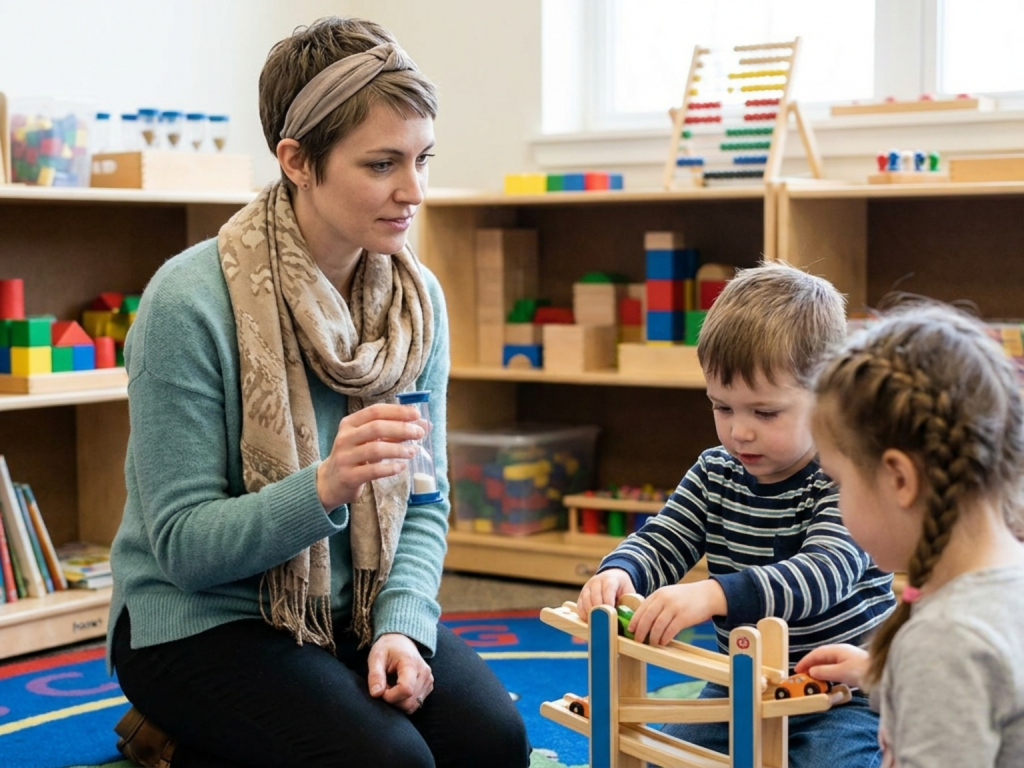
Preschool children benefit from clear, specific language. Instead of saying, “Share,” an adult might say, “It is Maya’s turn with the red shovel until the sand timer is empty. Then it will be your turn.” This gives the child a concrete rule and a visible endpoint. Another useful phrase is, “You can keep using the blocks you have, and Sam can use the blocks in the basket.” That teaches shared space without implying that the child must surrender everything immediately.
Forced sharing can backfire when it teaches children that possession is insecure and adults may remove valued items without warning. It is reasonable to protect certain special objects before a playdate or classroom activity. A child may put a beloved toy away and choose other materials that are “for playing together.” This respects attachment, reduces conflict, and makes generosity more likely because the child feels safer.
Children also need experience receiving a turn, not only giving one up. If adults always pressure the more verbal or compliant child to yield, that child may learn resentment rather than prosocial behavior. Fair systems, such as name cards, turn lists, or rotating roles, help children see that everyone’s needs matter.
The role of co-regulation before self-regulation
Co-regulation before self-regulation is a central principle in preschool social-emotional learning. When a child is distressed about waiting, the adult’s calm nervous system, predictable words, and steady presence help the child’s arousal decrease. Only then can the child use problem-solving skills. A preschooler who is sobbing because a turn ended is unlikely to benefit from a lecture about fairness; the brain is prioritizing threat and loss.
Helpful co-regulation may sound like: “You really wanted more time. Waiting is hard. I will help you.” This validates the feeling without changing the limit. The adult can then offer a concrete next step: “You can hold the waiting card, choose another truck, or sit with me until your next turn.” The message is both compassionate and firm.
Visual and sensory supports are often more effective than repeated verbal reminders. A sand timer, picture schedule, turn-taking bracelet, waiting mat, or simple first-then board can reduce uncertainty. Some children regulate better when they have a small job while waiting, such as counting turns, handing out materials, or being the “timer helper.” These supports are not rewards for poor behavior; they are accommodations for immature executive function.
Adults can model repair after conflict. If a child grabs, the focus should be on restoring safety and teaching the next behavior: “I cannot let you take it from her hands. Let’s give it back. You can say, ‘Can I have a turn when you are done?’” Repair is more useful than shame because it links the child’s action to a prosocial alternative.
Practical strategies for home and preschool classrooms
Turn taking improves when children practice during low-stress moments, not only during conflict. Games with predictable sequences are especially useful: rolling a ball back and forth, building a tower one block at a time, stirring batter in turns, matching cards, or singing verses where each child chooses an animal or movement. These routines make the social rule visible and enjoyable.
Adults can prepare children before peer interaction. A brief preview may include who is coming, which toys are available, which items are put away, and what to do if two children want the same thing. Preschoolers learn best when instructions are short, concrete, and paired with action. Role-play with dolls or puppets can help a child rehearse phrases before emotions run high.
- Use timed turns for high-demand items. A timer externalizes fairness and reduces the adult’s role as the “bad guy.”
- Offer two acceptable choices. “You may wait on the rug or choose the blue car while you wait.”
- Narrate prosocial behavior. “You gave her a turn when the timer rang. She looks happy, and your next turn is coming.”
- Teach exact scripts. “Can I have a turn next?” “I’m still using it.” “Let’s trade.” “You can have it when I’m done.”
- Keep group materials abundant when possible. Preschoolers can practice sharing better when scarcity is not constant.
In classrooms, teachers can design the environment to prevent avoidable conflict. Duplicate popular items, clearly labeled centers, small-group rotations, and limited crowding around sensory tables all reduce social overload. At home, similar principles apply: fewer children, shorter playdates, a snack before play, and a quiet decompression space can make sharing more achievable.
Language, listening, and sensory factors
Some children resist turn taking because they do not fully understand the language used during play. Words such as “after,” “next,” “until,” “trade,” and “finished” are abstract for many preschoolers. Children with expressive language delays may also grab because they cannot quickly produce a request under pressure. Speech-language pathology evaluation can be helpful when a child has difficulty following directions, using phrases to negotiate, or understanding peer communication.
Listening problems in preschoolers can also appear as “not sharing” or “not following rules.” A child who misses parts of instructions because of fluctuating hearing, recurrent otitis media with effusion, background noise, or attention differences may seem oppositional. If a child often says “what,” watches faces intensely, ignores group directions, or has unclear speech, families should discuss age-appropriate hearing testing and developmental surveillance with a healthcare professional.
Sensory processing differences may affect sharing as well. A child who becomes overwhelmed by noise, touch, crowding, or unpredictable movement may guard objects or lash out when peers come close. Another child may seek intense sensory input and crash into others during play. Occupational therapy evaluation for preschoolers may be considered when sensory responses interfere with daily routines, peer play, dressing, feeding, sleep, or safety.
Attention and impulse-control differences can also contribute. It is not appropriate to diagnose a child based on sharing struggles alone, but persistent, cross-setting difficulties with waiting, aggression, extreme impulsivity, or inability to participate in group routines deserve thoughtful assessment. Pediatric clinicians can help distinguish developmental variation from patterns that may need intervention.
Responding to grabbing, refusing, and aggression
When conflict occurs, safety comes first. An adult should calmly block hitting, biting, pushing, or forceful grabbing: “I will not let you hit. I’m moving the truck to keep everyone safe.” A neutral tone helps prevent escalation. The child may need physical space, a quieter area, or adult proximity before rejoining play.
After safety is restored, the teaching sequence can be brief. Name the problem, identify the feeling, state the limit, and practice the replacement behavior. For example: “You wanted the shovel. You grabbed it. Grabbing hurts play. Say, ‘Turn please,’ and I will help you wait.” Long explanations often exceed a dysregulated preschooler’s processing capacity.
It is also important to support the child who was hurt or whose toy was taken. Adults can say, “That was not okay. You were using it, and I will help you get it back.” This reassures the child that fairness includes protection, not just pressure to forgive. Later, when both children are calm, a repair action may be appropriate: returning the toy, helping rebuild a tower, offering a new turn, or checking whether the other child is okay.
Avoid labeling a child as selfish, mean, bossy, or bad. These labels can become part of the child’s self-concept and do not teach the needed skill. Instead, describe behavior and the next step. Children are more likely to grow when adults communicate, “You are having trouble with this skill, and I will help you learn it.”
When to seek extra help
Many preschool sharing struggles improve with maturity, consistent routines, and adult coaching. However, some patterns warrant professional guidance. Consider speaking with a pediatrician, early childhood mental health consultant, speech-language pathologist, occupational therapist, or developmental specialist if difficulties are intense, persistent, or impairing across settings.
Examples include frequent aggression that causes injury, inability to participate in preschool routines despite support, severe distress with ordinary transitions, loss of previously acquired social or language skills, minimal interest in peers, very limited functional communication, or concerns about hearing, vision, sleep, seizures, trauma exposure, or chronic medical conditions. Consultation does not mean something is “wrong” with the child; it is a way to understand the child’s needs and tailor support.
Families and educators should also look at environmental stressors. Overcrowded classrooms, inconsistent discipline, excessive screen exposure, sleep deprivation, food insecurity, parental stress, and frequent transitions can all affect regulation. High-quality preschool programs address social skills through play-based routines, warm relationships, predictable limits, and collaboration with families.
Turn taking and sharing are long-term developmental achievements. The preschool years are a practice ground, not a final exam. With compassionate structure, children can gradually learn that their needs matter, other people’s needs matter, and there are safe ways to handle wanting the same thing at the same time.
When to be cautious
- Seek professional advice if aggression is frequent, escalating, or causes injury.
- Ask about hearing, vision, speech-language, or developmental evaluation if a child repeatedly cannot follow turn-taking directions.
- Do not use shame, threats, or physical punishment to force sharing; these can worsen fear and dysregulation.
- Consider medical or psychosocial contributors such as poor sleep, pain, trauma exposure, or sensory overload.
- If a child loses previously acquired language, play, or social skills, contact a healthcare professional promptly.
Tools & Assistance
- Sand timer, visual schedule, or turn-taking card for predictable waiting
- Short social scripts such as “Can I have a turn next?” and “I’m still using it”
- Pediatrician or family doctor for developmental surveillance and referrals
- Speech-language pathologist, occupational therapist, or early childhood mental health consultant when concerns persist
- Preschool-family communication notebook to track triggers, supports, and progress
FAQ
Should preschoolers be forced to share every toy?
Usually no. It is healthier to protect special items, choose shared toys in advance, and teach timed turns or trading with adult support.
Is refusing to share a sign of a behavior disorder?
Not by itself. Refusing to share is common in preschoolers. Concern increases when difficulties are severe, persistent, aggressive, or occur with language, sensory, hearing, attention, or social concerns.
What is the best phrase to use when two children want the same toy?
Try concrete wording: “She is using it now. Your turn is next when the timer rings. You can wait here or choose another toy.”
How long should a preschooler be expected to wait?
It depends on age, temperament, fatigue, and context. Start with very short waits, use visual supports, and gradually increase waiting time as the child succeeds.
What if my child shares well at school but not at home?
This can be normal. Home may feel safer for big emotions, and siblings often trigger stronger possessiveness. Consistent routines and protected personal items can help.
Sources
- Centers for Disease Control and Prevention — Developmental Milestones
- National Association for the Education of Young Children — Social and Emotional Development
- American Academy of Pediatrics — Emotional Development in Preschoolers
- Center on the Developing Child at Harvard University — Executive Function & Self-Regulation
Disclaimer
This article is for general educational purposes and is not a diagnosis or treatment plan. Consult a qualified healthcare or child development professional for concerns about your child’s behavior, communication, hearing, sensory processing, or development.













Please log in to leave a comment.