
Intro
Waiting is hard for children because patience is not simply a matter of manners. It depends on developing neurocognitive skills: impulse control, working memory, emotional regulation, language, and the ability to imagine a future reward. A toddler who cries in a checkout line or a preschooler who interrupts repeatedly is often showing an immature self-regulation system, not a deliberate attempt to make life difficult.
Highlights
Patience is a developmental skill that grows through repeated, supported practice rather than lectures alone.
Children wait better when adults make time visible, expectations clear, and emotions acceptable.
Games, cooking, gardening, crafts, and turn-taking routines can strengthen delayed gratification in everyday life.
Parents’ own regulation matters: calm modeling teaches the nervous system what waiting can feel like.
Persistent, extreme difficulty with waiting may deserve discussion with a pediatrician, mental health clinician, or developmental specialist.
Patience is a brain-based skill, not a fixed personality trait
Patience is often described as “being good,” but in developmental terms it is closer to self-regulation: the ability to pause, inhibit an impulse, tolerate discomfort, and choose a behavior that fits the situation. These capacities are supported by executive function networks, including attention control, working memory, cognitive flexibility, and inhibitory control. In early childhood, these systems are still under construction.
That means a young child may genuinely understand the words “wait your turn” but still be unable to do it consistently when tired, hungry, overstimulated, or emotionally disappointed. The limbic system, which is involved in emotional reactivity and reward-seeking, can easily outrun the still-maturing prefrontal systems that help with planning and impulse control.
This is why supportive practice matters. Children learn patience through many small moments: waiting for pancakes to cook, taking turns with a toy, planting seeds and checking growth, listening while another person speaks, or completing a craft that requires drying time. These ordinary activities help children connect effort, time, emotion, and outcome.
Why patience matters beyond polite behavior
Patience supports much more than social niceness. It helps children participate in family life, classroom routines, friendships, and eventually academic tasks. A child who can wait briefly is better able to take turns, follow multi-step directions, stay with a puzzle, manage disappointment, and recover when plans change.
Delayed gratification is one part of patience. This means tolerating a short-term discomfort or desire in order to reach a later goal. For a child, that may mean waiting until dinner for a snack, staying seated while a caregiver pays at a shop, or letting a sibling finish a turn. These experiences are small, but they strengthen the child’s capacity to handle frustration without escalating immediately.
Patience also supports child emotional regulation through communication. When a parent says, “You really want the toy now. Waiting feels hard. I will help you,” the child receives two messages at once: the feeling is understandable, and the limit still stands. Over time, this combination builds emotional literacy and behavioral control.
Set developmentally realistic expectations
A common source of conflict is expecting adult-level waiting from a nervous system that is not ready for it. Babies cannot “practice patience” in a moral sense; they need responsive care. Toddlers may wait for seconds or a minute with active support. Preschoolers can often wait longer if the wait is concrete, structured, and emotionally supported. School-age children can handle more delay, but still struggle when stressed, hungry, anxious, sleep-deprived, or highly excited.
Developmentally appropriate expectations reduce shame for the child and frustration for the adult. Instead of saying, “You should know better,” it is often more effective to say, “Waiting is hard. Here is what we are going to do while we wait.” This frames patience as a skill under construction.
Children also vary. Temperament, sensory sensitivity, language ability, sleep quality, neurodevelopmental differences, anxiety, trauma exposure, and family stress can all affect waiting. A child who finds queues, noise, or uncertainty especially difficult may need more scaffolding, not harsher consequences.
Make waiting visible, predictable, and concrete
Young children do not experience time the way adults do. “In five minutes” may mean very little unless they can see, hear, or feel what that means. Making time concrete reduces uncertainty, and uncertainty is a major trigger for dysregulation.
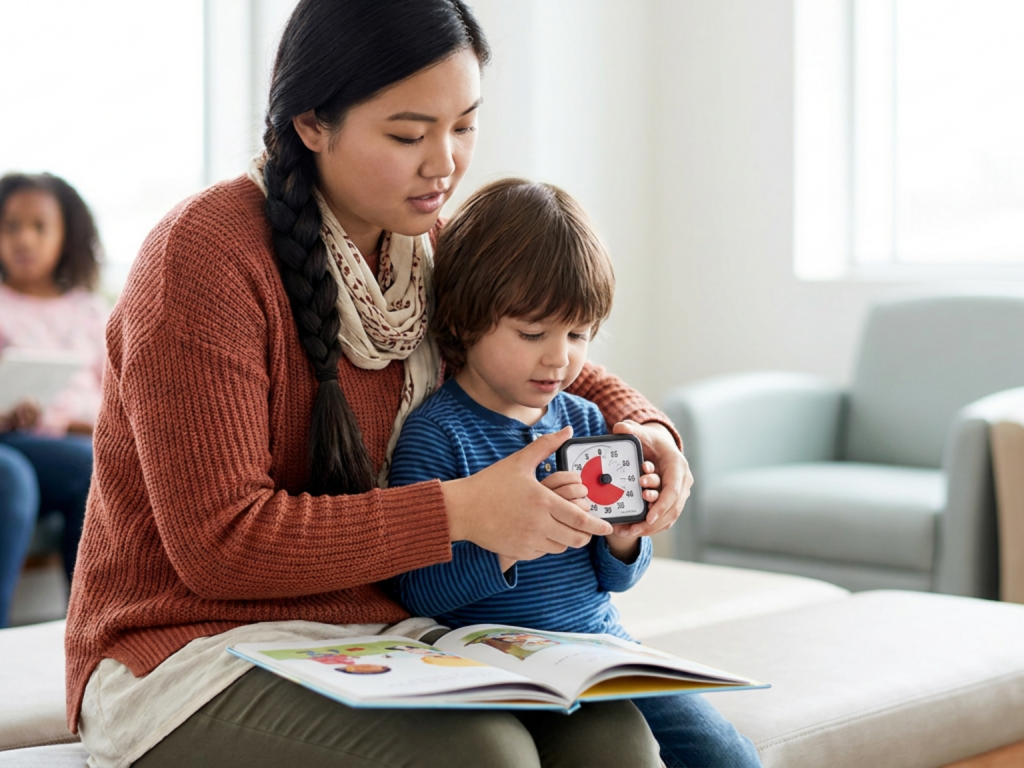
- Use visual cues. A sand timer, kitchen timer, picture schedule, or countdown chart can show that waiting has a beginning and an end.
- Name the sequence. Try, “First I finish this call, then I will read the book,” or “First we pay, then we go to the car.”
- Preview hard waits. Before entering a clinic, supermarket, or restaurant, explain what will happen and what the child can do while waiting.
- Keep promises realistic. If you say “one minute” but take fifteen, the child learns that time language is unreliable.
- Use consistent routines. Predictable meals, bedtime, leaving the house, and screen transitions help the child’s brain prepare for delay.
Predictability does not eliminate frustration, but it reduces the cognitive load. The child no longer has to wonder, “What is happening? When will this end? Did my parent forget me?”
Teach calming skills before the child is already overwhelmed
Children cannot easily learn a new coping skill during a full meltdown. The best time to teach waiting skills is when the child is calm, connected, and only mildly challenged. Short practice is better than long lectures.
Useful calming tools include slow breathing, counting, squeezing a soft object, naming five things in the room, singing a short song, or doing a quiet “waiting job” such as holding the shopping list. These are not tricks to suppress emotion; they are ways to help the autonomic nervous system shift from high arousal toward regulation.
You might say, “Let’s practice waiting for the toast. We can smell it, count to twenty, and watch for it to pop.” In a queue, try, “Your body wants to run. Let’s put your feet on the floor and push your hands together.” Physical strategies often work well because waiting is experienced in the body: restless legs, tense muscles, loud voice, and fast breathing.
Calming skills before a crisis are especially helpful. If the first time a child hears “take a deep breath” is when they are furious, the phrase may feel dismissive. If breathing has been practiced playfully during ordinary moments, it becomes more usable under stress.
Use everyday activities that naturally build patience
Patience grows best when it is embedded in normal life. You do not need a formal curriculum. Many household and play activities already contain small, tolerable delays.
- Cooking and baking: Children can mix, wait for dough to rise, watch food cook, and learn that some outcomes take time.
- Gardening: Planting seeds teaches that growth is gradual and not fully under our control.
- Board games: Turn-taking, rule-following, losing, and waiting for another player all strengthen self-regulation.
- Crafts: Glue drying, paint setting, and step-by-step assembly teach persistence and delayed results.
- Storytime: Waiting to turn a page or discuss a picture can build attention and impulse control.
- Role-play: Pretend restaurant, doctor’s office, bus stop, or classroom games let children rehearse waiting in low-stakes ways.
Adults can narrate the skill gently: “You waited while the cookies cooled. That was difficult, and you did it.” Specific praise helps children notice the behavior they are building.
Respond to impatience with empathy and boundaries
When a child struggles to wait, the goal is not to remove every discomfort or to shame the child for having a feeling. The goal is to combine warmth with a clear boundary. This is often called co-regulation: the adult lends the child a calmer nervous system until the child can gradually internalize those skills.
Helpful phrases include: “I hear you. You want it now,” “Waiting is hard and you are safe,” “I will not let you hit, but I will help you wait,” and “The answer is still no, and I can sit with you while you are upset.” This style supports predictable boundaries and emotional safety.
Try to avoid repeated arguing once the boundary is clear. Long explanations can accidentally increase distress, especially in young children. A concise explanation, a calm tone, and a concrete next step are usually more effective: “The tablet is charging. You can choose blocks or crayons while you wait.”
If you lose patience, repair matters. You can say, “I yelled. That was too much. I was frustrated, and I am going to try again.” Repair does not mean removing the boundary; it models accountability and emotional recovery.
Prepare for high-risk waiting situations
Some waits are predictably harder: medical appointments, traffic, restaurants, checkout lines, sibling activities, travel, and transitions away from screens. Planning ahead is not indulgent; it is preventive regulation.
Consider a small waiting kit with a book, paper, crayons, a snack if appropriate, a quiet fidget, or a simple game. Offer limited choices: “Do you want to sit on my left or right while we wait?” or “Do you want to draw or look at the book?” Choice gives the child a sense of agency without changing the boundary.
For screen-related waiting, be especially clear. Screens provide rapid reward and can make slower activities feel harder immediately afterward. Give advance warnings, use a timer if helpful, and state what comes next: “When the timer rings, the episode is done. Then we wash hands and eat.” Consistent responses to recurring behavior help children learn the pattern through repetition.
When waiting involves safety, such as a parking lot or street crossing, keep instructions short and physical: “Hold my hand now.” In safety-critical moments, the adult may need to act first and explain later.
Model the patience you want your child to learn
Children learn from what adults do under pressure. If a parent sighs aggressively in traffic, snaps at a cashier, or repeatedly interrupts, the child receives a live demonstration that waiting is intolerable. This is not about parental perfection. It is about giving children enough examples of recovery, flexibility, and respectful frustration.
Parents also need support for their own regulation. Hunger, sleep deprivation, financial strain, work stress, and caregiver burnout make it much harder to respond calmly. Protecting parental nervous system regulation is part of teaching patience. A parent who pauses, breathes, lowers their voice, or says, “I need a moment,” is modeling self-control in real time.
It can help to narrate your own waiting in simple language: “I want the line to move faster too. I’m going to take a breath and wait my turn.” This shows that patience does not mean liking the delay. It means managing the delay without hurting ourselves or others.
When to seek professional guidance
Many children struggle with waiting, especially during early childhood. However, it may be worth consulting a pediatrician, child psychologist, occupational therapist, speech-language pathologist, or developmental-behavioral specialist if difficulty waiting is extreme, persistent, or impairing across settings.
Seek guidance if waiting difficulties are accompanied by frequent aggression, prolonged meltdowns, severe sleep problems, major anxiety, loss of developmental skills, significant language delays, sensory distress that disrupts daily life, or concerns raised by teachers or caregivers. These signs do not automatically mean a child has a disorder, but they do suggest the family may benefit from assessment and tailored support.
Medical, developmental, and psychosocial factors can overlap. Hearing problems, sleep disorders, medication effects, neurodevelopmental differences, anxiety, trauma, and family stress can all influence regulation. A qualified professional can help clarify what is happening and recommend safe, individualized strategies.
Use extra caution when waiting problems escalate
- Do not use physical punishment, threats, or humiliation to force patience.
- If a child may hurt themselves, another person, or run into danger, prioritize immediate safety and seek professional help.
- Persistent severe meltdowns, aggression, developmental regression, or major anxiety should be discussed with a healthcare professional.
- Consider sleep, hunger, pain, sensory overload, and medication effects when a child suddenly cannot tolerate waiting.
- If parental stress feels unmanageable, caregiver mental health support is an important part of child safety and regulation.
Tools & Assistance
- Use a visual timer, sand timer, or picture schedule for predictable waits.
- Create a small waiting kit for clinics, restaurants, travel, and errands.
- Practice short turn-taking games when the child is calm.
- Use brief scripts such as “First we wait, then we go” or “Waiting is hard, and I will help.”
- Consult a pediatrician, child psychologist, occupational therapist, or developmental specialist if waiting difficulties are severe or impair daily life.
FAQ
At what age should a child be able to wait patiently?
There is no single age. Toddlers usually need close support and very short waits, while preschool and school-age children gradually manage longer delays. Fatigue, hunger, temperament, and developmental differences strongly affect this skill.
Should I ignore whining when my child is waiting?
Ignoring may sometimes reduce minor attention-seeking behavior, but many children need co-regulation first. Acknowledge the feeling briefly, keep the boundary, and offer a concrete waiting strategy.
Is giving a phone or tablet during waiting harmful?
Occasional use is not automatically harmful, but relying on screens for every wait can reduce opportunities to practice boredom tolerance, conversation, observation, and self-soothing. Balance screens with non-digital waiting tools.
How can I help a child who interrupts constantly?
Teach a specific replacement behavior, such as placing a hand on your arm and waiting for your response. Practice during calm moments, praise small successes, and keep expectations realistic.
When should I worry that impatience is more than normal behavior?
Consider professional guidance if the difficulty is intense, persistent across settings, causes safety concerns, or comes with severe aggression, prolonged meltdowns, developmental regression, major anxiety, sleep problems, or significant sensory distress.
Sources
- Edutopia — Nurturing patience in young children
- MCCA — Teaching Patience to Kids: Simple Everyday Activities
- Cornell Cooperative Extension — The Power of Patience
Disclaimer
This article is for general educational purposes only and does not diagnose, treat, or replace professional medical or mental health advice. Consult a qualified healthcare professional for concerns about your child’s development, behavior, safety, or emotional health.
















Please log in to leave a comment.