
Intro
Meals away from home can be enjoyable and manageable when a child has a secure place to sit. Portable high chair options range from travel high chairs to booster seats and table-mounted designs, but convenience should never displace stability, correct restraint use, or close adult supervision.
This guide can help you compare the practical features of portable seating while keeping your child's developmental readiness and everyday feeding environment in view.
Highlights
The safest portable option is one that fits both the child and the adult chair or table exactly as its manufacturer specifies.
A properly used restraint system, including the crotch strap when supplied, helps reduce fall and slide-out risk.
Portable seating is not interchangeable: booster seats, folding travel chairs, and table-mounted chairs depend on different support surfaces and have different hazards.
A compact product is useful only when its setup is reliable; rushed installation, damaged parts, and unstable furniture can quickly change the risk profile.
Start with readiness and the product instructions
Portable seating should be selected around a child’s current abilities, not only age or the desire to simplify outings. Review the manufacturer’s stated minimum and maximum weight, height, and developmental requirements before each new stage of use. Many products require a child to sit with dependable trunk and head control; some also specify that the child must be able to sit upright without assistance. These requirements matter because an immature ability to maintain posture can increase sliding, leaning, and airway-positioning concerns during feeding.
Labels and instructions are part of the safety equipment. They explain the intended support surface, installation sequence, restraint configuration, recline or tray rules, and the circumstances in which use must stop. A child who is within a published weight limit may still be unsuitable if they can climb, forcefully rock, or repeatedly escape the restraint. Conversely, a child who seems small enough should not use a product below its listed minimum criteria.
For children born prematurely or those with neuromuscular, orthopedic, swallowing, respiratory, or postural needs, standard product criteria may not answer every question. Feeding often involves head and trunk alignment, fatigue, and aspiration risk, meaning food or liquid can enter the airway. Discuss seating position and readiness with the child’s pediatric clinician, feeding specialist, occupational therapist, or other relevant healthcare professional. That discussion should complement, never override, manufacturer instructions.
Portable booster seats for everyday dining chairs
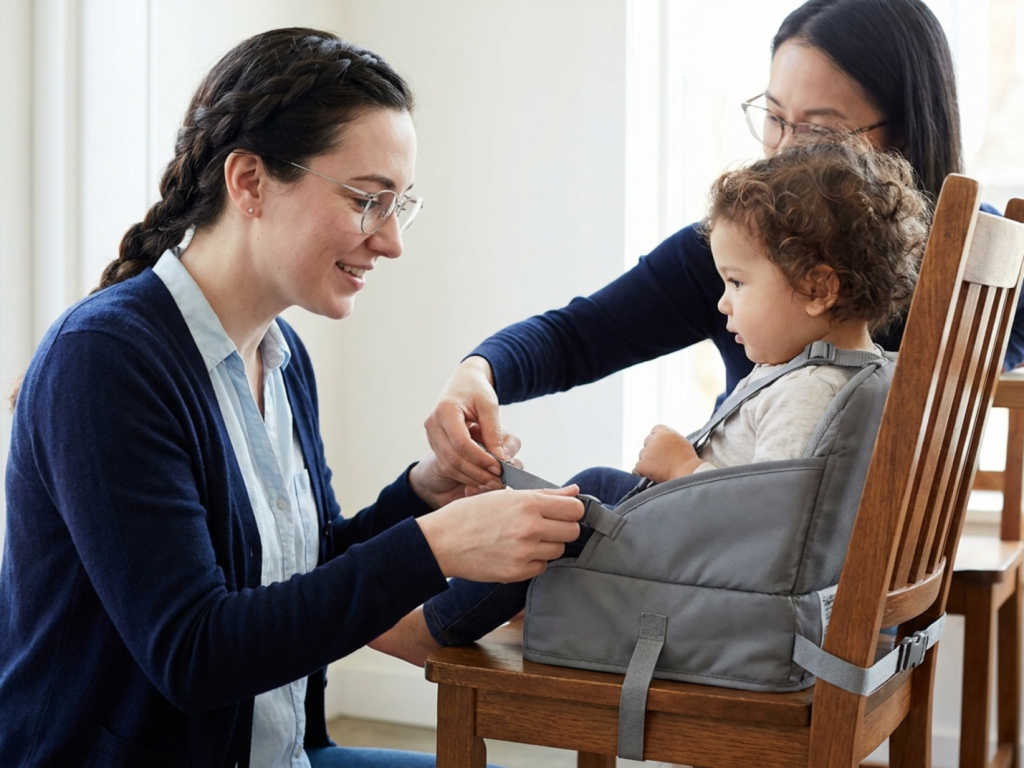
A portable booster seat raises a child on a standard dining chair. Some have a backrest and tray; others are a contoured seat intended to bring an older child closer to the table. Their practical advantage is small size and straightforward transport, especially for visits with relatives or meals at restaurants. Their principal limitation is dependence on the adult chair beneath them.
Before attaching a booster, inspect the adult chair. It should be sturdy, stable, and upright, with a firm seat and back that match the product’s approved installation method. Secure the booster using every provided attachment strap, usually around the chair seat and back. Test for movement after installation: the booster should not slide, twist, tip, or lift from the chair. A dining chair that folds, rocks, has a narrow base, lacks a supportive back, or has a padded/slippery seat may be incompatible even when the straps appear to reach.
Use the child’s harness every time, following the product instructions. A three-point restraint typically includes waist straps and a crotch strap; a five-point harness also includes shoulder straps. The crotch strap is particularly relevant to preventing a child from slipping downward. Do not rely on a tray as a restraint, and do not improvise with belts, towels, or separate straps. A booster also needs its own stable footprint: it should not be placed on a counter, tabletop, bench, stool, or another elevated surface.
- Choose a model with clear chair-attachment instructions and intact buckles.
- Confirm the chair remains level when the child is seated.
- Keep the chair far enough from tables, walls, and counters that a child cannot push away with their feet.
- Remove the booster from service if straps fray, buckles fail, plastic cracks, or the seat no longer attaches securely.
Folding travel high chairs and floor-based designs
Folding travel high chairs usually have their own frame and may include a fabric seat, tray, and harness. They can be practical for picnics, holidays, small homes, or settings without suitable dining chairs. Unlike a booster, they do not rely on an adult chair for their primary support, but they still require a flat, firm, level surface and a fully engaged frame. Portability creates additional points to check because hinges, locking joints, fabric tension, and feet are repeatedly folded and transported.
At every setup, open the chair completely and confirm that each locking mechanism has engaged. Visual checks alone may not be enough; follow the instructions for the product’s intended lock test. Look for bent tubing, cracked plastic, torn fabric, loosened screws, missing feet, or food debris that prevents a joint from closing properly. Keep fingers, especially a child’s fingers, away from folding joints and pinch points during setup and storage.
Place a travel chair where all legs or contact points rest on the same stable surface. Uneven paving, deep carpet transitions, sloped ground, decks with gaps, and crowded restaurant aisles can undermine stability. Never elevate the chair by placing it on a table, countertop, bed, couch, or vehicle seat. A child can move their center of mass rapidly by leaning or reaching, and a light folding frame can become unstable on an unsuitable surface.
For a fabric-based design, check that the seat is correctly tensioned and that the child is not sitting on a twisted strap or partially folded panel. Food can be offered only when the child is securely positioned and an adult is immediately present. Supervision means staying close enough to intervene at once, rather than monitoring from across a room while cooking, unpacking, or speaking with others.
Table-mounted chairs require exact table compatibility
Table-mounted, sometimes called hook-on, chairs clamp directly to the edge of a dining table. Their compact form can be appealing for travel, but their safety depends heavily on the particular table. The chair must securely lock to a heavy, stable table that meets the product’s thickness, edge-profile, and construction requirements. A clamp that appears tight may not be safe on every tabletop.
Do not use a table-mounted chair on glass, glass-topped, pedestal, card, folding, camping, loose, unstable, damaged, or lightweight tables unless the specific product instructions explicitly permit that exact construction. Tables with tablecloths, thick aprons, beveled or rounded edges, leaves, extension mechanisms, drawers, or obstructions underneath may also be incompatible. The clamp needs direct, full contact where the instructions require it. Never compensate for a poor fit with padding, shims, tape, or extra hardware.
After attaching the chair, test it according to the manufacturer guidance before placing the child in it. Recheck it periodically during the meal, especially if the table is bumped or moved. Keep the child away from hot foods, drinks, knives, cords, and objects they could pull from the table. Adults should not lean on, lift, shift, or use the table in a way that destabilizes the attachment while the child is seated.
Use all supplied child restraints, including the crotch strap. A table-mounted chair is not appropriate simply because a child can sit; it must be appropriate for that child, that table, and that exact installation. When there is uncertainty about compatibility, choose another seating arrangement rather than treating the clamp as a general-purpose attachment.
Compare practical features without losing sight of safety
After screening for fit and safety, practical details determine whether a portable chair will be used consistently and correctly. Think through your usual destinations: a restaurant with variable furniture, a grandparent’s dining room, outdoor gatherings, air travel, or a small apartment each creates different constraints. Product dimensions when folded, carrying method, washable surfaces, tray removability, and setup time can all affect whether the chair is realistically manageable.
Prioritize features that support repeatable, error-resistant use. Clearly marked locking indicators, straps that can be tightened without tangling, a harness that is easy to inspect, and a design that stands securely while being loaded can reduce rushed setup errors. Removable fabric and wipeable surfaces can make hygiene easier, but cleaning instructions matter. Food residue can conceal cracks, interfere with a buckle, or compromise a clamp’s grip.
A wide base, stable locking mechanism, and absence of loose parts, sharp edges, or other visible damage are core checks for any high chair design. Consider the caregiver’s needs too. If lifting or carrying aggravates postpartum pain, back pain, joint symptoms, or another mobility limitation, a lighter option may help, but it still must meet all setup requirements. A compact chair that is awkward to secure under time pressure may be less useful than a somewhat larger model with clearer, more reliable installation.
Secondhand products warrant particular caution. Confirm the original instructions are available, all components and labels are present, and there has been no recall or damage. Avoid products with unknown history, altered parts, homemade repairs, missing harness components, or mechanisms that do not lock smoothly.
Create a safer portable feeding routine
Portable equipment works best when paired with a simple, consistent routine. Before each meal, choose the seating location first, then install and test the chair, then place the child in it and secure every restraint. Keep the chair away from nearby surfaces a child can brace against with their feet, as pushing can shift or tip the seating arrangement. Secure the child before offering food, and remain attentive through the entire meal.
Do not leave a child in a portable high chair unattended, even briefly. Avoid moving, carrying, or repositioning the chair with the child inside. Adults may feel pressure to manage luggage, payment, food service, or other children during outings; planning a brief pause or taking turns with another adult can be safer than trying to multitask at the moment restraint or supervision is needed.
Before packing the chair away, clear food from hinges, straps, clamps, and buckles. Inspect it again at home in good light, where emerging wear is easier to notice. Keep the instructions accessible on a phone or with the travel bag, since an infrequently used chair is especially easy to assemble incorrectly. High chair safety depends on product condition and caregiver practice at every use, not on a single successful installation.
Seek prompt medical care after a fall, head impact, suspected injury, breathing difficulty, or choking event. For non-urgent questions about a child’s seating tolerance, feeding posture, or developmental readiness, contact the child’s healthcare professional for individualized guidance.
Portable seating warnings
- Always use every supplied restraint, including the crotch strap when provided.
- Never leave a child unattended in a portable high chair, booster, or table-mounted chair.
- Do not place portable seating on tables, countertops, beds, couches, or other elevated surfaces.
- Do not use a booster on a folding, rocking, unstable, damaged, or otherwise incompatible adult chair.
- Do not use a table-mounted chair unless it securely fits the specific table under the manufacturer's instructions.
- Stop using the product when locks, straps, clamps, buckles, fabric, or frame parts are damaged or missing.
Tools & Assistance
- Read the complete manufacturer manual and current product labels before first use
- Check official recall notices for the exact model
- Measure the dining chair or tabletop against the product's stated compatibility requirements
- Ask a pediatric clinician or feeding specialist about individualized seating and posture concerns
FAQ
At what age can a child use a portable high chair?
Use the manufacturer's developmental, weight, and height criteria rather than age alone. A child generally needs the postural control specified for that product; ask a healthcare professional when there are feeding, neuromuscular, or developmental concerns.
Can a booster seat be used on any dining chair?
No. The chair must be stable and compatible with the booster's attachment system. Avoid folding, rocking, damaged, narrow, or otherwise unstable chairs, and use every attachment strap.
Are table-mounted chairs safe for travel?
They can only be used when the exact table meets the chair manufacturer's requirements and the clamps lock securely. Many restaurant, picnic, folding, glass, and pedestal tables are not suitable.
Do I need to buckle the harness for a short meal?
Yes. Use all restraints every time, even for a brief snack, because movement and falls can happen quickly.
Sources
- Health Canada — High chairs
- HealthyChildren.org / American Academy of Pediatrics — 6 Quick High Chair Safety Tips
- Consumer Reports — High Chair Buying Guide: Types, Safety, Expert Tips
Disclaimer
This article is for general educational purposes and does not replace individualized medical, feeding, or safety advice. Consult a qualified healthcare professional for concerns about your child's development, posture, or feeding safety.














Please log in to leave a comment.