
Intro
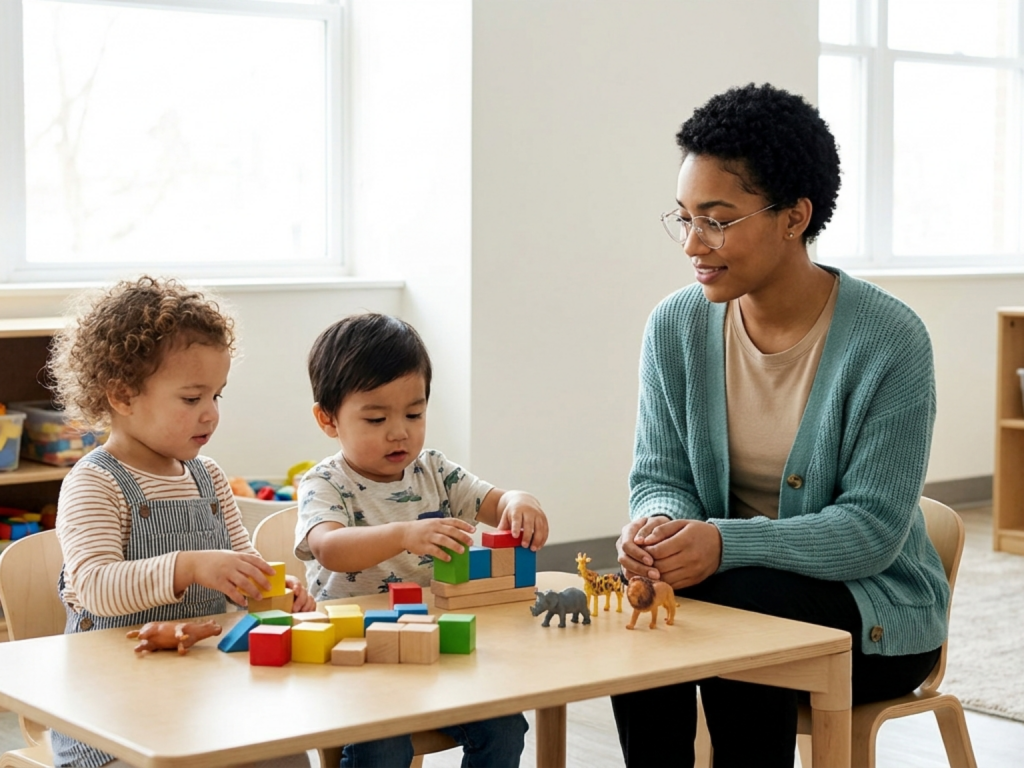
Parallel play can look puzzling: two toddlers sit side by side with blocks, dolls, cars, or sensory materials, yet seem barely to acknowledge each other. For many families, this raises a natural question: is my child being social enough? In most cases, parallel play is not a sign of social failure. It is a developmentally meaningful bridge between solitary exploration and more reciprocal peer interaction.
Highlights
Parallel play is common in toddlerhood and often supports later social play rather than replacing it.
Toddlers may interact through proximity, imitation, shared attention, and brief exchanges before they can sustain cooperative play.
Adults can support peer interaction by arranging low-pressure play opportunities, modeling language, and protecting toddlers from overwhelming expectations.
Persistent loss of social skills, very limited joint attention, or marked distress around peers should be discussed with a pediatric clinician or developmental specialist.
What parallel play is and why it matters
Parallel play describes a pattern in which young children play near one another, often with similar materials, without sustained shared goals or complex conversation. A toddler may roll a truck beside another child, stack blocks next to a peer, or feed a doll while watching another child do the same. The children may not appear to be “playing together” in the adult sense, but they are often socially aware of each other.
In developmental terms, parallel play sits between solitary play and more interactive peer play. It allows toddlers to remain regulated while observing another child’s actions, sounds, emotional reactions, and use of objects. This is especially important because toddlers are still developing expressive language, inhibitory control, perspective-taking, and emotional regulation. They may want connection but lack the neurological maturity to negotiate, share, wait, or compromise consistently.
Recent research supports the idea that parallel play can be a precursor to later social play. A longitudinal social network analysis of preschool children found that a parallel play relationship between two children predicted the later formation of a social play relationship between the same children. This supports a sequential pathway: side-by-side familiarity may help build the comfort and predictability needed for more reciprocal interaction.
How toddlers interact before they truly cooperate
Toddler interaction often begins in small, easy-to-miss moments. A child may glance at a peer, move closer, copy a sound, take the same type of toy, laugh after another child laughs, or protest when a peer takes an object. These behaviors may seem minimal, but they reflect emerging social cognition: the child is noticing another person as an intentional actor.
Many toddlers move through overlapping stages rather than a strict sequence. Solitary play, onlooker behavior, parallel play, associative play, and cooperative play may all appear in the same morning. A child might play alone with trains, watch another child build a tower, then sit nearby with blocks, and later briefly hand over a block. This variability is normal because social demands fluctuate with fatigue, hunger, temperament, language ability, sensory load, and the familiarity of the setting.
Researchers have described “parallel-aware play,” in which a child plays beside a peer while clearly monitoring or responding to that peer. This state can function as a dynamic bridge. One study found that parallel-aware play increased transitions into cooperative-social play and onlooker play, and identified a pattern in child-initiated activity: onlooker behavior may shift into parallel-aware play, which may then shift into cooperative interaction. In everyday terms, watching is not necessarily passive; it may be social preparation.
What is typical by age, with room for individual variation
Many children show parallel play prominently between about 18 months and 3 years, although the timing varies. Younger toddlers may primarily explore materials and tolerate other children nearby. Older toddlers may begin to imitate, exchange toys briefly, chase, laugh together, or use short phrases such as “mine,” “more,” “my turn,” or “baby sleep.” Preschoolers generally become more capable of shared themes, rule-based games, and cooperative pretend play, but even they may return to parallel play when tired or overwhelmed.
It is helpful to interpret social play in the context of the whole child. Temperament matters. A cautious toddler may observe for a long time before joining, while a highly active toddler may approach peers physically before having the language or impulse control to do so gently. Language development also matters: children with stronger receptive and expressive language may negotiate more easily, while children with limited language may rely on gestures, imitation, or physical proximity.
Culture and caregiving context also shape expectations. Some children have daily group care experience, while others mostly interact with adults or siblings. A toddler who is new to a playgroup may need several repeated visits before showing relaxed peer engagement. How toddlers learn through play is strongly influenced by safety, repetition, responsive adults, and opportunities to explore without constant correction.
Supporting peer interaction without forcing social performance
Caregivers can encourage toddler interaction most effectively by lowering pressure and increasing structure. A busy room with many children, scarce toys, and high noise levels may create competition rather than connection. Small, predictable play opportunities are usually easier for toddlers to manage.
Useful strategies include:
- Start small. Arrange play with one familiar child for a short period, ideally when both children are rested and fed.
- Use duplicate or complementary toys. Two trucks, two dolls, or two scoops can reduce conflict while still allowing imitation and shared attention.
- Choose activities with natural turn-taking. Rolling a ball, sending cars down a ramp, putting animals into a barn, or taking turns stirring pretend soup can support simple reciprocity.
- Model social language. Adults can narrate: “You are both building,” “Maya has the blue cup,” or “Sam is waiting for a turn.” This gives toddlers words for what they are experiencing.
- Celebrate brief positive moments. A glance, a shared laugh, or a gentle handoff is meaningful. Overpraising or demanding more can make a toddler self-conscious, so keep encouragement warm and simple.
Adult involvement should be scaffolded, not controlling. The goal is not to make toddlers share every toy or maintain adult-like conversation. The goal is to help them experience peers as interesting, predictable, and emotionally safe.
Sharing, conflict, and emotional regulation
Conflict during toddler play is common and does not mean the playdate has failed. Toddlers have immature prefrontal cortical systems involved in impulse control, flexible thinking, and delayed gratification. They may understand “take turns” in one moment and be unable to apply it in the next. Possessiveness is also developmentally expected because toddlers are still forming a sense of self and ownership.
Adults can respond with calm, concise coaching. Instead of long explanations, use short phrases and physical support: “Stop. I won’t let you hit.” “Truck is in Noah’s hands.” “Your turn after the timer.” “You can have this one.” These responses combine safety, boundary-setting, and language modeling.
Predictable routines can also reduce peer conflict. Before a playdate, put away highly treasured items. Offer enough materials for parallel use. Plan snacks and transitions before children become dysregulated. If a toddler becomes overwhelmed, a short break with a trusted adult can be protective rather than punitive. Toddler behavior management tips often emphasize co-regulation first: young children borrow an adult’s calm nervous system before they can reliably calm themselves.
It is also reasonable to avoid forcing apologies. A scripted “sorry” may have little meaning for a toddler in a heightened state. Repair can be taught through action: helping rebuild a tower, returning a toy, offering a tissue, or practicing “gentle hands” after everyone is calm.
Language, imitation, and pretend play as social bridges
Language and imitation are central to the shift from parallel play to peer interaction. A toddler who copies another child’s tower, animal sound, or pretend feeding action is practicing social learning. Imitation communicates interest before the child can say, “I want to play with you.” Adults can notice and name this: “You saw Ava make a tall tower, and now you are building one too.”
Pretend play can be especially useful because it creates simple roles and scripts. Two toddlers may not negotiate a detailed story, but they can both feed stuffed animals, wash toy dishes, push strollers, or make train sounds. These shared themes support joint attention, symbolic thinking, and early social problem-solving. Early learning in toddlers explained often includes the idea that cognition, language, motor skills, and social-emotional growth develop together rather than in isolated domains.
For children with speech or language delays, peer interaction may need extra support. Visual cues, gestures, simple signs, picture choices, or modeled two-word phrases can help. Caregivers should avoid assuming a child is uninterested in peers simply because verbal language is limited. At the same time, if a child has difficulty understanding language, rarely uses gestures, or does not respond to social bids, discussing developmental screening with a pediatric clinician can be helpful.
When to seek professional guidance
There is a wide range of typical toddler social behavior, and many children who prefer parallel play are developing well. Still, some patterns deserve attention, especially when they are persistent, intense, or associated with regression. Medical and developmental professionals can help distinguish normal variation from concerns that may benefit from early support.
Consider speaking with a pediatrician, health visitor, developmental-behavioral pediatrician, child psychologist, speech-language pathologist, or early intervention program if you notice repeated concerns such as minimal response to name, very limited eye gaze or shared enjoyment, absence of pointing or showing objects, loss of previously acquired words or social skills, extreme distress in ordinary play settings, persistent aggressive behavior that does not improve with support, or very limited interest in people across settings.
This does not mean a diagnosis is inevitable. Many factors can affect social play, including hearing differences, language delay, anxiety, sleep disruption, sensory processing differences, neurodevelopmental conditions, family stress, or limited peer exposure. Early developmental surveillance and screening are designed to identify children who may benefit from support, not to blame families or label a child prematurely.
If you are worried, it is appropriate to ask for an assessment rather than waiting to “see if it passes,” particularly when there is developmental regression. Early support can strengthen communication, regulation, and social participation while respecting the child’s temperament and developmental pace.
When play concerns need prompt attention
- Seek medical advice if your toddler loses previously acquired words, gestures, or social skills.
- Discuss concerns if your child rarely responds to name, pointing, showing, or shared enjoyment.
- Ask for help if peer play causes extreme distress, prolonged dysregulation, or frequent unsafe behavior.
- Consider hearing, vision, speech-language, and developmental screening when social interaction seems unusually limited.
- Do not force group play if a child is overwhelmed; safety and regulation come first.
Tools & Assistance
- Schedule short one-on-one play opportunities with a familiar child.
- Use duplicate toys and simple turn-taking games to reduce conflict.
- Narrate peer actions with brief, concrete social language.
- Ask your pediatric clinician about developmental screening if concerns persist.
- Contact local early intervention services if there is regression or significant delay.
FAQ
Is parallel play normal for a 2-year-old?
Yes. Many 2-year-olds spend substantial time in parallel play. Brief imitation, watching, and playing nearby can be meaningful early social behavior.
Should I make my toddler share during playdates?
Support turn-taking, but avoid expecting mature sharing. Toddlers often need duplicate toys, short turns, and adult co-regulation before they can share reliably.
What if my toddler only watches other children?
Onlooker behavior can be part of learning. If your child is also communicating, showing interest, and gradually becoming comfortable, watching may be preparation for later interaction.
When should I worry about lack of peer interaction?
Seek professional guidance if there is regression, very limited joint attention, minimal response to social bids, or marked distress across settings.
Sources
- PubMed — Understanding the developmental transition between parallel and social play in preschool: A longitudinal multiplex social network analysis
- ScienceDirect — Sequential transition patterns of preschoolers' social interactions: The role of parallel-aware play
- Bass Autism — From Parallel Play to Peer Interaction: Supporting Preschool Social Growth
Disclaimer
This article is for general educational purposes and is not a diagnosis or treatment plan. Consult a qualified healthcare professional for concerns about your child’s development, behavior, hearing, speech, or social interaction.















Please log in to leave a comment.