
Intro
Parents often hear the term sleep training and think of infants, but the question becomes more complicated in school-age children and adolescents. In older children, sleep training usually means a structured behavioral approach that helps the child fall asleep more independently, wake less often, and follow a more stable sleep schedule.
The short answer is that it can be effective for some older children, especially when the main problem is behavioral insomnia, bedtime resistance, or irregular sleep habits. The evidence is stronger in younger children than in older ones, so the approach should be individualized and, when needed, guided by a pediatric clinician or sleep specialist.
Highlights
In older children, sleep training usually means behavioral sleep interventions rather than infant-style extinction alone.
It can help when the problem is a learned pattern such as bedtime resistance, sleep-onset dependence, or inconsistent routines.
The research base is promising, but older children have been studied less directly than infants and toddlers.
Night waking, snoring, pain, anxiety, or daytime impairment may point to a different sleep problem that needs medical review.
A gentle, consistent family plan often works better than a rigid one-size-fits-all approach.
What sleep training means in an older child
In older children, the phrase sleep training can sound harsh or overly simplistic. Clinically, it is better understood as a set of behavioral sleep interventions that help a child build independent sleep skills. That may include a predictable bedtime routine, consistent expectations about where and how the child falls asleep, and a calmer response to bedtime protests or requests for repeated reassurance.
This is different from the classic infant model, where parents may focus on sleep consolidation and reducing night feeds. Older children have more language, memory, anxiety, and control over their environment, so the plan has to fit development. A school-age child can often participate in the plan, help choose rewards, and understand the reason for consistent limits.
It also helps to start by comparing the child’s schedule with recommended sleep hours by age. Some children are not truly having a sleep-training problem; they are simply going to bed too late, waking too early, or losing sleep because of activities, screens, or a family routine that has become inconsistent. Clarifying the pattern first makes the intervention more effective and less frustrating for everyone.
How effective is it, really?
The evidence is strongest for infants and toddlers, but the broader pediatric literature supports behavioral approaches for many sleep problems. A meta-analysis of behavioral sleep interventions found overall improvement in children’s sleep outcomes, including measures such as sleep duration and sleep efficiency. That is encouraging, but it is also important to be precise: not every outcome improved in every study. For example, night awakenings and maternal depression did not change significantly across all analyses.
For older children, the main lesson is that sleep training can work when the problem is behaviorally maintained. If a child has learned to fall asleep only with extensive parental presence, or if bedtime has become a nightly negotiation, a structured plan may reduce the struggle and make sleep more predictable. The change may be gradual rather than dramatic, and the best results usually come from consistency, not intensity.
That said, the data are not a blank check. Older children are more likely than infants to have contributing factors such as anxiety, school stress, delayed circadian timing, medications, or sleep-disordered breathing. So effectiveness depends less on whether sleep training is used at all, and more on whether the right type of intervention matches the actual cause of the sleep problem.
Which older children are most likely to benefit?
Behavioral sleep strategies tend to help most when the sleep problem has a learned or routine-based pattern. This includes bedtime resistance, repeated calling out, needing a parent in the room to fall asleep, irregular bedtimes between weekdays and weekends, and some forms of night waking in school-age children that are reinforced by predictable parental responses. In these situations, the child’s brain may not be the main obstacle; the sleep pattern itself has become conditioned over time.
Children who are otherwise healthy, developmentally able to understand the plan, and exposed to a fairly stable home schedule often do best. Families usually need to be aligned as well. If one caregiver enforces a routine while another changes it every night, the intervention is harder to sustain. Older children also respond better when the plan is framed positively: the goal is not punishment, but helping them sleep well enough to feel better during the day.
Teenagers are a special case. What looks like insomnia may sometimes be a delayed sleep phase pattern, meaning the body clock is shifted later. In that situation, classic sleep training alone is often not enough. The strategy may need to address timing, morning light, and weekend sleep drift, ideally with professional guidance.
What a practical bedtime plan usually includes
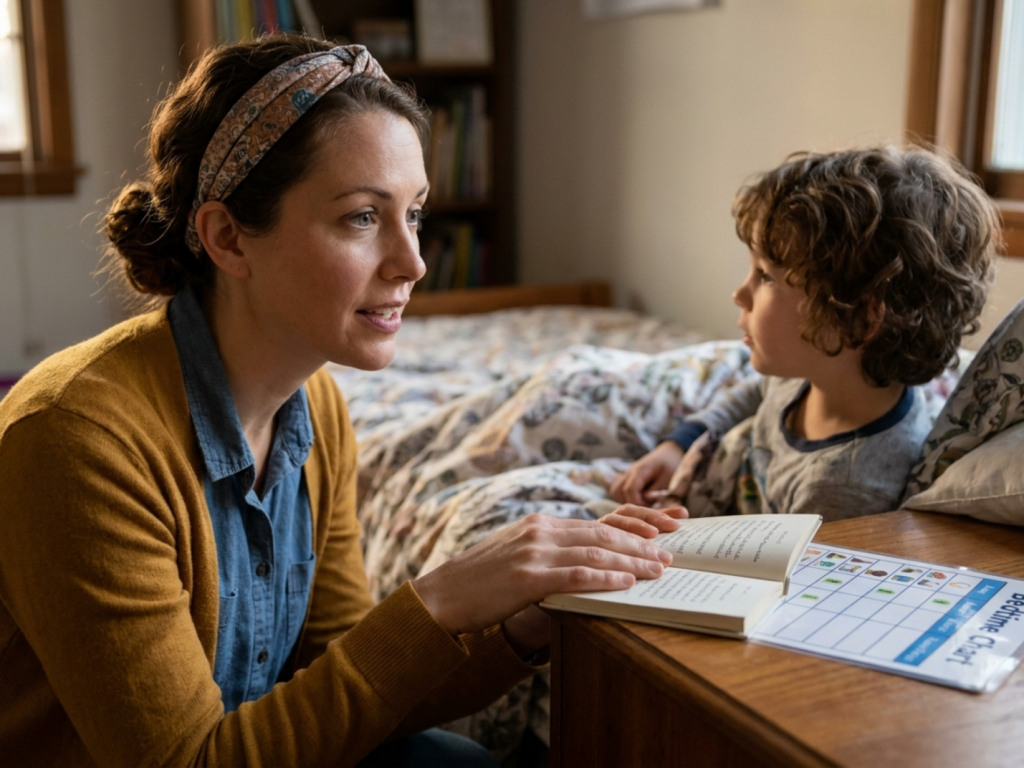
A workable plan is usually simple enough to repeat every night. The most useful elements are a stable bedtime, a consistent wake time, and a calm routine that starts before the child is overtired. In practice, that may mean the same sequence each evening: wash up, pajamas, brief reading or quiet conversation, lights out, and a clear expectation that sleep happens in bed rather than through repeated calls for new comforts.
For many families, the key behavior change is not a dramatic technique but a gradual shift in parental response. Instead of long negotiations, repeated resets, or staying beside the child until sleep is complete, caregivers may use shorter check-ins, a predictable script, or a planned step-down in support. This is one reason older children can sometimes make real progress with gentle structure rather than force.
Good sleep hygiene for school-age children also matters. That includes protecting enough sleep opportunity, keeping the bedroom dark and quiet, and limiting stimulating activities close to bedtime. If the child is rewarded for staying in bed and the family is consistent about the routine, the sleep association often changes over time. Many children need days to weeks, not one night, to adjust.
When sleep training is not the whole answer
If a child snores loudly, gasps, mouth-breathes, sweats at night, kicks frequently, wakes unrefreshed, or seems excessively sleepy during the day, the problem may not be behavioral insomnia. These features can suggest sleep-disordered breathing, restless sleep, restless legs symptoms, pain, medication effects, or another medical issue. In those situations, a sleep-training plan alone may miss the real cause.
Persistent anxiety, trauma symptoms, depression, neurodevelopmental conditions, epilepsy, reflux, eczema itching, or chronic pain can also fragment sleep. The child may appear to resist sleep, but the underlying driver is discomfort, arousal, or fear. That is why a careful history matters. If sleep problems are severe, longstanding, or associated with habitual loud snoring, it is reasonable to ask about a pediatric sleep specialist evaluation.
This is especially important when the child is not just hard to settle but also has daytime impairment from poor sleep: attention problems, irritability, school difficulty, morning headaches, or unsafe behavior. Those are clues that a broader assessment is needed before assuming the issue is simply a habit that can be trained away.
How to keep the process humane and realistic
Families sometimes feel guilty if sleep does not improve quickly. It helps to remember that sleep training is not a moral test. A child who struggles at bedtime is not being difficult on purpose, and a parent who feels overwhelmed is not failing. The best plan is one that is consistent, developmentally appropriate, and emotionally tolerable for the household.
Many clinicians recommend thinking in terms of small, measurable goals: falling asleep with less help, fewer bedtime negotiations, or fewer disruptive awakenings over time. If the child’s distress is severe, if the parents are exhausted, or if the response is becoming more conflict-driven, the plan should be reassessed rather than pushed harder. Sometimes a brief period of coaching, a sleep diary, or a referral can save months of struggle.
In short, sleep training can be effective in older children, but it works best when the problem is behavioral, the family can stay consistent, and medical causes have been considered. The goal is not to win a bedtime battle; it is to help the child sleep well enough to function, grow, and feel better the next day.
When to seek medical advice
- Loud snoring, gasping, mouth-breathing, or pauses in breathing during sleep.
- Daytime sleepiness, falling asleep in class, or clear school or behavior changes.
- Frequent leg kicking, restless sleep, or repeated night waking that does not improve.
- Bedtime anxiety, trauma symptoms, depression, or intense family conflict around sleep.
- Pain, reflux, itching, seizures, or medication side effects that seem to disrupt sleep.
Tools & Assistance
- Keep a 1-2 week sleep diary with bedtime, wake time, night waking, and daytime tiredness.
- Use a consistent bedtime routine and a stable wake time every day.
- Ask the pediatrician whether snoring, restless sleep, or daytime impairment needs further assessment.
- Request referral to pediatric sleep medicine if sleep problems are persistent or complicated.
- Coordinate with teachers or school staff if sleep loss is affecting learning or behavior.
FAQ
Is sleep training effective for school-age children?
It can be, especially when the main issue is bedtime resistance, irregular routines, or learned dependence on parent help. Results are usually better when the family uses a consistent, age-appropriate behavioral plan.
Is the cry-it-out method appropriate for older children?
Not as a default approach. Older children often do better with gradual, collaborative behavioral strategies and clear limits than with a rigid one-size-fits-all method.
How long does it take to work?
Some families see improvement in several nights, while others need a few weeks of consistent practice. The timeline depends on the cause of the sleep problem and how consistent the plan is.
When should I worry that this is not just a sleep habit?
If there is snoring, gasping, daytime sleepiness, pain, anxiety, restless movement, or major school impact, it is worth asking a clinician to evaluate for another sleep or medical cause.
Sources
- PubMed — Sleep Training
- Scientific Reports — Effectiveness of behavioral sleep interventions on children's sleep problems: a meta-analysis
- Mayo Clinic — Helping Your Infant or Toddler Sleep at Night
Disclaimer
This article is for educational purposes only and does not replace individualized medical advice, diagnosis, or treatment. Please consult a qualified pediatric clinician for persistent, severe, or concerning sleep problems.


















Please log in to leave a comment.