
Intro
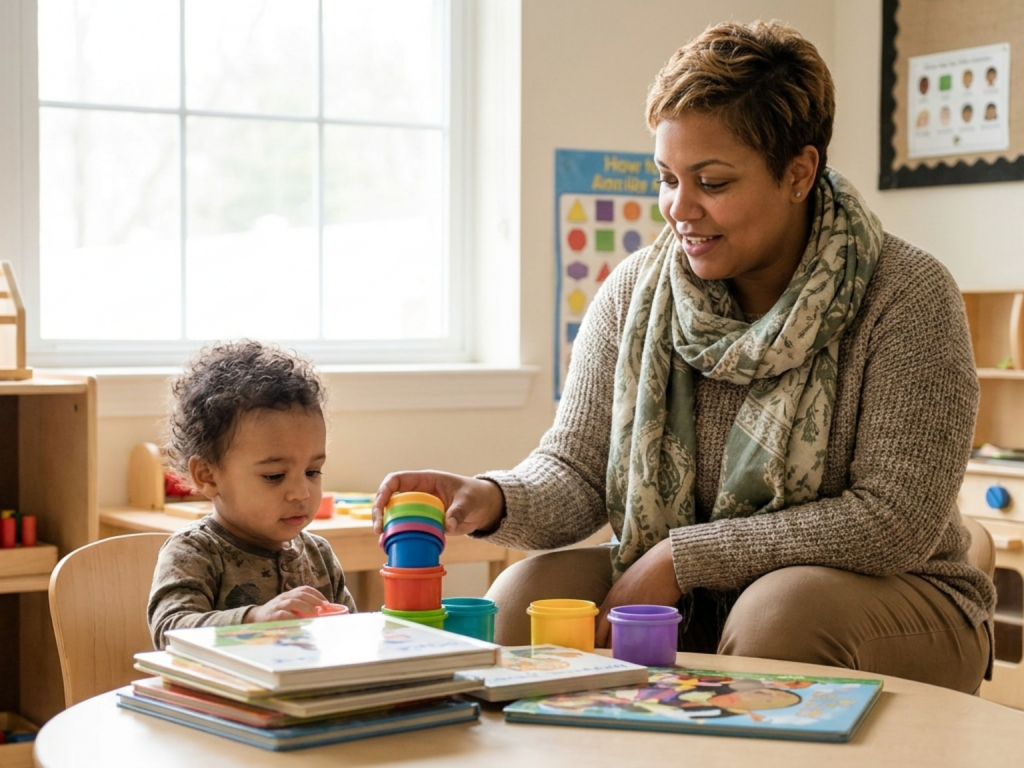
Early learning in toddlers is not a race to memorize letters, numbers, or facts. It is the rapid, everyday growth of attention, language, movement, memory, curiosity, self-control, and social understanding that happens while a young child plays, explores, imitates, asks for help, and tests what happens next.
Highlights
Toddlers learn through repeated, emotionally safe interactions with people and objects, not through formal instruction alone.
Early learning includes agency, language, early literacy, numeracy, motor exploration, and self-regulation.
Sleep, nutrition, predictable routines, responsive caregiving, and a low-stress environment support brain development.
Variation is normal, but loss of skills, persistent lack of communication, or major developmental concerns should be discussed with a pediatric professional.
What early learning means in toddlerhood
Early learning refers to the cognitive, language, motor, emotional, and social foundations that develop before and during the toddler years. In a 1- to 3-year-old, learning is rarely separated into school-like subjects. A toddler stacking blocks is experimenting with spatial relationships and gravity. A child naming a dog in a picture book is strengthening vocabulary, symbolic thinking, attention, and shared communication. A toddler who insists on trying to put on shoes alone is practicing agency: the emerging ability to set a goal, act on it, monitor the result, and persist.
Medically and developmentally, toddler learning is supported by neuroplasticity, the brain’s capacity to form and refine neural connections in response to experience. Repetition matters because frequently used pathways become more efficient. Emotional context also matters because stress physiology, sleep quality, and caregiver responsiveness influence attention, memory consolidation, and willingness to explore.
Importantly, early learning is not the same as early academic pressure. Toddlers benefit from rich language, responsive conversation, books, songs, counting during daily routines, safe movement, and problem-solving play. They do not need performance demands that exceed their developmental capacity. A supportive approach respects both competence and immaturity: toddlers are powerful learners, but their inhibitory control, working memory, and attention shifting are still developing.
How toddlers learn: prediction, imitation, and exploration
Toddlers are natural scientists. They form expectations about what objects do, how people respond, and which actions produce which outcomes. When a cup falls from a high chair repeatedly, the behavior may feel like mischief, but it also reflects causal learning: the child is observing gravity, sound, adult reaction, and repetition. Over time, toddlers use patterns in events to make predictions and guide exploration.
Research on child development shows that young children are sensitive to statistical regularities. In language, they detect patterns in speech sounds and word sequences before they can explain them. In social life, they notice that a caregiver’s facial expression, tone, and actions predict what may happen next. In physical play, they learn that some objects roll, some stack, some break, and some disappear under a blanket but still exist.
Imitation is another major learning route. Toddlers copy gestures, household routines, emotional reactions, and problem-solving strategies. This is why everyday modeling is so influential. A child watching an adult pause, try again, and say, “That was tricky, but I can keep working,” is exposed to persistence and self-talk. A child hearing respectful language during conflict begins to build scripts for social communication, even though toddler emotional regulation is still immature.
Exploration works best when safety and autonomy are balanced. The child needs enough freedom to test ideas, but also boundaries that prevent injury and reduce chaos. A safe kitchen drawer, a water table, nesting cups, sidewalk chalk, and supervised climbing can all become meaningful learning laboratories.
The role of relationships, attachment, and emotional safety
Early learning is deeply relational. Toddlers learn more effectively when they feel safe enough to explore and connected enough to return for reassurance. This pattern is sometimes described as a secure base: the caregiver provides comfort, regulation, and encouragement while the child moves between independence and closeness.
Responsive caregiving is not about perfect parenting. It means noticing the child’s cues, responding predictably often enough, and adapting support to the situation. When a toddler points to a bird and an adult says, “Yes, that is a bird. It is flying high,” the adult is following the child’s attention and expanding language. This kind of contingent response strengthens communication and shows the child that their signals matter.
Emotional safety also supports executive functions, including inhibitory control, cognitive flexibility, and working memory. These are early self-regulation skills that help a child wait briefly, shift from one activity to another, remember a simple instruction, and persist after frustration. These skills are biologically immature in toddlers, so adults often need to act as an external regulatory system: slowing the pace, naming feelings, offering choices, and reducing overstimulation.
Tantrums, clinginess, possessiveness, and rapid mood shifts can coexist with healthy learning. A toddler may understand far more than they can express and may want independence before they have the motor or language skills to manage it. Supportive responses, such as acknowledging distress while maintaining a safe limit, help integrate emotional development with learning. If distress is extreme, persistent, or associated with developmental regression, professional advice is appropriate.
Language, early literacy, and communication
Language growth in toddlerhood is one of the most visible forms of early learning. It includes receptive language, which is what the child understands, and expressive language, which is what the child communicates through sounds, words, gestures, signs, facial expressions, and eventually sentences. Many toddlers understand more than they can say, and communication often develops through a combination of speech, pointing, showing, nodding, and shared attention.
Families can support language by talking during ordinary routines. Describing objects, actions, body parts, emotions, and sequences gives toddlers meaningful vocabulary. For example: “We are washing your hands. First water, then soap, then rinse.” This pairs words with sensory experience and predictable order.
Reading is especially powerful when it is interactive rather than passive. A toddler may chew a book, skip pages, name one picture repeatedly, or request the same story every night. These behaviors still support early literacy. Adults can point to pictures, pause for the child’s response, label emotions, make animal sounds, and connect the story to real life. Repetition builds memory, phonological awareness, vocabulary, and narrative expectations.
Helpful strategies include:
- Follow the child’s focus before adding language.
- Use short, grammatically correct phrases and expand the child’s attempt.
- Offer choices, such as “apple or banana,” to encourage communication.
- Sing songs and rhymes to build sound awareness and rhythm.
- Limit background noise when possible, because constant competing sound can reduce attention to speech.
If a child is not using gestures, does not respond to their name, has limited shared attention, loses language skills, or seems not to hear, a pediatrician or speech-language professional can help determine the next step.
Early numeracy, problem-solving, and agency
Early numeracy begins long before formal arithmetic. Toddlers encounter quantity, comparison, order, shape, and measurement through daily life. Counting crackers, noticing that one cup is empty and another is full, sorting socks, matching lids, and hearing words such as more, less, big, small, first, and next all contribute to mathematical thinking.
At this age, counting is often partly rhythmic or memorized, and that is normal. A toddler may say “one, two, five” while touching objects randomly. The goal is not immediate accuracy but repeated exposure to one-to-one correspondence, sequence, and quantity. Adults can gently model without turning the moment into a test: “You have two blocks. One block, two blocks.”
Problem-solving develops through trial, error, and feedback. Shape sorters, simple puzzles, stacking toys, containers, pretend play, and obstacle courses all encourage planning and flexible thinking. When a tower falls, the child learns about balance and may also practice frustration tolerance. When a puzzle piece does not fit, the child learns to rotate, compare, and try again.
Agency is central here. Toddlers learn when they can initiate actions and see meaningful results. A child who pours water between cups, chooses a book, helps wipe a table, or carries a small item to another room is practicing goal-directed behavior. Adults can encourage agency with safe choices and scaffolded tasks: “Do you want the red cup or the blue cup?” or “You start the zipper, and I will help finish.” Scaffolding means giving just enough support for the child to succeed while preserving effort and participation.
Body, sleep, nutrition, and the learning environment
Toddler learning is embodied. Movement, sensory input, and physical health influence attention and memory. Running, climbing, dancing, scribbling, spoon use, block play, and finger foods all build motor planning and sensorimotor integration. Fine motor experiences strengthen hand control needed later for drawing, dressing, and writing. Gross motor play supports balance, coordination, confidence, and regulation.
Sleep is a biological requirement for learning. During sleep, the brain supports memory consolidation, emotional regulation, and metabolic recovery. Insufficient or fragmented sleep may appear as irritability, inattention, impulsivity, or reduced frustration tolerance rather than obvious tiredness. Persistent snoring, pauses in breathing, major bedtime resistance, or severe night waking should be discussed with a healthcare professional, because sleep quality can affect daytime learning and behavior.
Nutrition also matters. Regular meals and snacks with adequate energy, iron, protein, essential fats, and micronutrients support growth and neurodevelopment. Severe food selectivity, poor growth, swallowing concerns, chronic diarrhea, or suspected nutrient deficiency deserves clinical evaluation. No article can determine an individual child’s nutritional status; growth charts, medical history, and physical examination are needed.
The environment can either support or compete with learning. Toddlers benefit from predictable routines, safe spaces to explore, minimal distracting noise during language-rich interactions, and limited passive screen exposure. Screens are not equivalent to responsive human interaction, especially for very young children. When digital media is used, co-viewing and discussing what is happening are more supportive than leaving a toddler alone with fast-paced content.
Supporting learning without pressure
Many caregivers worry they are not doing enough. In reality, the most effective early learning practices are often simple, repeated, and relational. A toddler does not need an expensive curriculum to benefit from warm conversation, books, songs, outdoor play, pretend cooking, bath-time pouring, sorting laundry, and naming feelings.
A useful approach is to build learning into care routines. During dressing, talk about body parts, colors, and sequence. During meals, describe texture, temperature, and quantity. During walks, notice sounds, vehicles, leaves, animals, and people. During cleanup, sort objects by type and give simple two-step instructions if the child is ready. These routines create repetition without artificial drilling.
Pressure can backfire when it turns curiosity into performance anxiety or power struggles. Toddlers often learn best in short bursts. They may leave an activity, return later, repeat one action many times, or reject help while still needing it. This inconsistency is developmentally expected. Supportive adults can offer structure while staying flexible: “We can try one more time, then take a break.”
It is also helpful to watch the child’s state. A hungry, overstimulated, tired, ill, or dysregulated toddler is less available for learning. Meeting physiological and emotional needs is not separate from education; it is the foundation of it. If concerns arise about hearing, vision, communication, motor milestones, social engagement, behavior, or developmental regression, families should seek pediatric guidance rather than waiting for the child to simply “grow out of it.” Early support can be valuable, and consultation does not mean something is necessarily wrong.
When to seek professional guidance
- Loss of previously acquired language, motor, social, or play skills should be discussed promptly with a pediatric professional.
- Concerns about hearing, vision, feeding, growth, sleep-disordered breathing, or persistent developmental delays warrant evaluation.
- Limited eye contact, lack of gestures, not responding to name, or minimal shared attention should be raised with a clinician.
- Extreme irritability, prolonged inconsolable distress, or safety-threatening behavior may need medical or developmental assessment.
- Caregiver concern is valid; you do not need to wait for a scheduled visit to ask for developmental screening.
Tools & Assistance
- Bring a written list of developmental questions to the child’s pediatric visit.
- Use everyday routines for talking, counting, singing, reading, and turn-taking.
- Ask about hearing and vision screening if communication or attention concerns arise.
- Contact early intervention or local child development services if advised by a clinician.
- Keep a simple sleep, feeding, and behavior log when patterns are hard to explain.
FAQ
Should toddlers have formal lessons to learn early academic skills?
Usually no. Most toddlers learn best through responsive play, conversation, books, songs, movement, and daily routines rather than formal instruction or testing.
Is repeating the same book or game useful?
Yes. Repetition strengthens memory, vocabulary, prediction, attention, and confidence. A repeated story can be highly valuable learning.
What if my toddler seems advanced in one area but delayed in another?
Uneven development is common. However, significant delays, regression, or caregiver concern should be discussed with a pediatrician or developmental specialist.
Do screens help toddlers learn language?
Human interaction is generally more powerful for toddlers. If screens are used, co-viewing, talking about the content, and choosing calm, age-appropriate media are preferable.
How can I support learning when I am exhausted?
Small moments count. Naming objects during meals, singing during diaper changes, reading one short book, or offering a simple choice can all support learning.
Sources
- Deans for Impact — The Science of Early Learning
- Eunice Kennedy Shriver National Institute of Child Health and Human Development — Early Learning
- National Academies of Sciences, Engineering, and Medicine — Chapter 4: Child Development and Early Learning
Disclaimer
This article is for general educational purposes only and does not diagnose, treat, or replace care from a qualified healthcare professional. Consult a pediatrician or developmental specialist for concerns about an individual child.
















Please log in to leave a comment.