
Intro
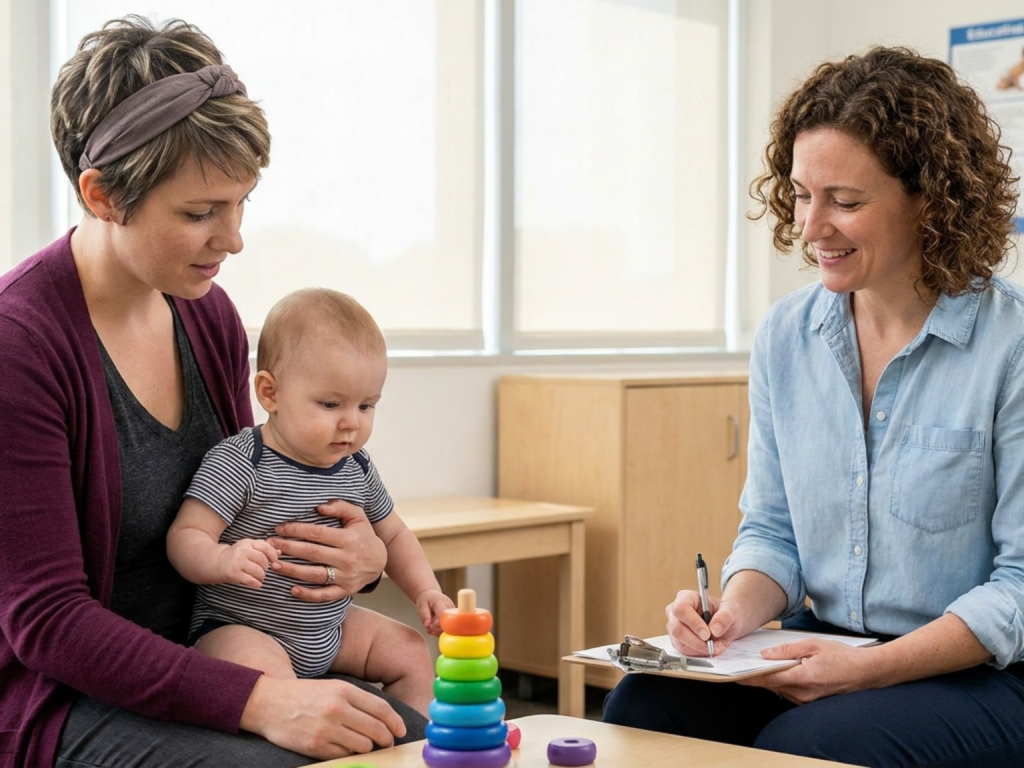
Memory development during the first year is rapid, uneven, and closely connected to perception, attention, movement, language, and relationships. Although infants cannot describe what they remember, researchers can identify memory through changes in looking, reaching, imitation, anticipation, and responses to familiar people or events.
Caregivers may notice that a baby recognizes a familiar voice, expects a repeated part of a routine, or remembers how to activate an interesting toy. These observations are meaningful, but development varies widely. Prematurity, health conditions, sleep, sensory access, temperament, and opportunities for interaction can all influence how memory is expressed.
Highlights
Infants show forms of recognition memory from early in life, even before they can communicate with words.
During the second half of the first year, babies generally become better at retaining information across longer delays and distractions.
Memory is supported by repeated, emotionally meaningful experiences and responsive interaction rather than formal teaching.
A single behavior rarely establishes whether development is typical; clinicians interpret patterns over time and in context.
What Memory Means in an Infant
Memory is not one single ability. It includes several related processes: encoding information, retaining it, and retrieving it later. In infancy, researchers commonly distinguish recognition memory, recall, working memory, and procedural or implicit learning.
Recognition memory is the ability to respond differently to something familiar than to something new. A baby may look longer at a novel face or show relaxed attention toward a familiar caregiver. Recall involves retrieving information when the original stimulus is no longer present, such as remembering where a toy was hidden or reproducing an action after a delay. Working memory briefly holds information while a baby uses it, for example while tracking an object that moves behind a barrier. Procedural memory supports learned actions and routines, including how to shake a rattle or participate in a familiar social game.
These forms of memory develop at different rates. A young infant may recognize a repeated voice or visual pattern while having limited ability to recall a complex event after a long delay. This distinction helps explain why a baby can appear to remember a routine one day but not demonstrate the same skill when tired, hungry, ill, or distracted.
Early Foundations: Birth to About Three Months
Newborns are already processing regularities in their environment. They become familiar with voices, smells, touch patterns, and visual features through repeated exposure. Recognition is often easiest when the experience is highly salient and occurs in a calm, predictable setting. A newborn may orient toward a familiar voice, settle with a known caregiver, or show interest in a repeated pattern without being able to retrieve the experience deliberately.
During the first three months, attention is brief and strongly influenced by arousal. Babies have limited control over where they look and how long they remain engaged. Nevertheless, repeated experiences can produce measurable learning. A baby may look less at a stimulus after repeated exposure, a phenomenon called habituation. A renewed increase in looking when something changes is called dishabituation and suggests that the infant detected a difference.
Memory at this stage is closely tied to sensory and emotional regulation. Comfortable physical contact, an appropriate level of stimulation, and predictable caregiving can make it easier for an infant to attend and encode information. This is not a requirement for perfect routines; ordinary responsive care provides many repeated opportunities for learning.
The Middle of the First Year: More Durable Learning
From roughly three to six months, many infants show more sustained attention and increasingly reliable recognition. They may anticipate a familiar sequence, such as preparation for feeding or the beginning of a social game. They also become more efficient at learning relationships between actions and outcomes. For example, an infant may discover that moving a hand changes the position or sound of a toy.
Researchers study these abilities with tasks such as visual habituation, paired comparison, conjugate reinforcement, and imitation. In a conjugate reinforcement task, an infant’s movement produces an interesting consequence, allowing investigators to assess whether the baby later remembers the relationship. In imitation studies, a researcher observes whether an infant reproduces an action after a delay rather than immediately.
Memory remains sensitive to interference. New experiences can make an earlier event harder to retrieve, particularly when the events are similar. A baby may learn a new way to use a toy and temporarily stop showing an older action. This does not necessarily represent loss of memory; retrieval may depend on context, motivation, and the amount of time between learning and testing.
Attention and memory also influence one another. Babies who can sustain attention have more opportunity to encode information, while successful learning can make an activity more engaging. Caregivers can support this cycle by pausing during interaction, following the infant’s gaze, and allowing time for a response.
The Last Half of the First Year: Retrieval and Flexibility
Research indicates that memory capacity changes substantially during the last half of the first year. Older infants generally retrieve past events more effectively, tolerate longer delays, and show greater resistance to interference than younger infants. These gains are not a sudden switch from no memory to memory. They reflect gradual improvements in attention, encoding efficiency, retrieval strategies, motor planning, and the neural networks that support learning.
Between approximately six and nine months, babies often become more active explorers. They may search for a partially hidden object, repeat an action that previously produced an interesting result, or recognize a person after a separation. Their increasing mobility gives them more opportunities to form memories that include location, sequence, and consequences. At the same time, the demands of new motor skills can temporarily alter behavior. A baby concentrating on sitting, crawling, or pulling to stand may appear less available for other activities.
By nine to 12 months, many infants show stronger evidence of event memory and early explicit memory, meaning memory that can guide flexible behavior even though it cannot yet be verbally reported. Brain-based research and behavioral studies continue to examine how late-infancy memory relates to developing hippocampal and cortical networks. These findings should be interpreted carefully: a laboratory task measures a specific capacity under controlled conditions and does not directly predict later intelligence, academic performance, or personality.
How Relationships and Daily Routines Support Memory
Memory grows through ordinary experiences that are repeated, meaningful, and matched to the infant’s developmental level. Responsive caregiving in infancy can support attention and learning because the caregiver notices the baby’s signals and adjusts timing, stimulation, and interaction. Eye contact is not required in every exchange; vocal turn-taking, touch, facial expression, and shared attention can all contribute.
Useful approaches include naming familiar objects, repeating short songs, playing simple games such as peekaboo, and placing an interesting toy within safe reach. When a baby acts, the caregiver can wait briefly before helping, giving the infant an opportunity to observe the result of an action. Repetition is helpful, but variation also matters. Seeing a familiar object in a new location or using it in a slightly different way can encourage flexible retrieval.
Predictable routines may help infants anticipate what comes next, particularly around sleep, feeding, bathing, and departure or reunion. Predictability does not mean that every day must follow an exact schedule. A calm explanation and consistent sequence can provide structure even when timing changes.
Sleep is also relevant to memory consolidation, the process through which newly encoded information becomes more stable. Infant sleep patterns vary widely, and caregivers should follow current safe-sleep guidance from their healthcare professionals. Efforts to improve memory should never involve unsafe sleep arrangements, overstimulation, or withholding needed feeding and comfort.
Memory, Object Permanence, and Cognitive Development
Memory is intertwined with broader cognitive development in babies. As infants remember objects, people, and event sequences, they can begin to act on information that is not immediately visible. Searching for a toy hidden under a cloth, looking toward a person who has left the room, or anticipating the return of a familiar object reflects emerging understanding of persistence and location.
These behaviors are sometimes discussed under the term object permanence, but they do not emerge all at once. A baby may search successfully in one situation and fail in another because the task requires several abilities at the same time: remembering the object, tracking its movement, controlling the hands, and inhibiting a previously successful search.
Memory also supports early communication. An infant who recognizes a frequently used word may orient toward the associated object or person before speaking. Repeated social exchanges help connect sounds with actions and emotional outcomes. Caregivers can encourage this learning by using clear, natural language and responding to the baby’s vocalizations rather than turning interaction into a test.
For a broader view of related abilities, cognitive development in babies includes attention, learning, problem-solving, early communication, and memory. These domains overlap, but progress in one area may temporarily outpace progress in another.
What Can Influence Individual Differences
There is substantial normal variation in when and how infants demonstrate memory. Temperament affects attention and novelty responses. Hearing or vision differences can change how a baby expresses recognition without necessarily indicating a memory problem. Illness, discomfort, hunger, fatigue, medication exposure, and environmental stress can reduce performance on a particular day.
Gestational age also matters. For infants born prematurely, clinicians may interpret some developmental observations using corrected age, especially during the early months. A medical history involving neurologic injury, seizures, significant infection, genetic conditions, or prolonged hospitalization may warrant more individualized monitoring, but only a qualified clinician can interpret its implications.
Caregivers should focus on patterns rather than comparisons with social-media milestones or another child. A baby does not need to demonstrate every example in this article. Developmental surveillance considers multiple domains, including social interaction, language, motor skills, sensory responses, and adaptive behavior. Pediatric developmental screening can help identify whether additional assessment or early intervention services for infants may be appropriate.
When to Discuss Concerns With a Clinician
Questions about memory are best considered as part of the whole developmental picture. Discuss concerns with a pediatrician, family physician, or other qualified healthcare professional if an infant rarely responds to familiar voices or faces, shows little interest in interaction, does not appear to learn from repeated experiences, or has persistent difficulty using vision or hearing to engage with the environment. These observations are not diagnoses, but they deserve thoughtful assessment.
Seek prompt medical advice for a loss of previously acquired skills, new abnormal movements, episodes of unresponsiveness, marked changes in alertness, or other acute neurologic concerns. Urgent services may be appropriate when a baby is difficult to wake, has trouble breathing, has a prolonged seizure, or appears seriously ill.
A clinician may review the baby’s birth and medical history, hearing and vision, sleep and feeding, developmental trajectory, and behavior across settings. Standardized screening tools and referral to developmental specialists can clarify whether support is needed. Early evaluation is not a prediction of a child’s future; it is a way to understand strengths and provide timely assistance when appropriate.
When Medical Advice Is Needed
- A single missed response or inconsistent behavior does not diagnose a memory disorder.
- Contact a healthcare professional about persistent concerns across settings or developmental domains.
- Discuss any loss of previously acquired skills promptly.
- Seek urgent care for unresponsiveness, prolonged seizures, breathing difficulty, or severe illness.
- Do not use memory-training products, supplements, or sleep practices without professional guidance.
Tools & Assistance
- Keep a brief dated record of new skills, familiar routines, and concerns to discuss at visits.
- Use routine pediatric appointments for developmental surveillance and screening.
- Ask about hearing and vision assessment when recognition or response seems inconsistent.
- Use supervised, age-appropriate play and responsive interaction during ordinary caregiving.
- Contact local early intervention services for infants when a clinician recommends evaluation or support.
FAQ
Can newborns remember their parents?
Newborns can learn and recognize familiar sensory features, including voices, smells, touch, and aspects of a caregiver's face. Recognition may be subtle and varies with alertness and context.
When does a baby start remembering objects?
Object recognition develops gradually from early infancy. During the second half of the first year, many babies show stronger recognition, retrieval, and searching for partially hidden objects, although performance remains variable.
Does peekaboo improve memory?
Peekaboo provides repeated practice with anticipation, attention, social timing, and the return of a familiar person. It can support learning through enjoyable interaction, but it is not a required exercise or a clinical treatment.
Why does my baby sometimes seem to forget a skill?
Performance can change with fatigue, illness, hunger, distraction, motivation, or new motor demands. A persistent decline or loss of previously acquired skills should be discussed with a healthcare professional.
Can early memory predict later intelligence?
Infant memory tasks measure specific abilities under particular conditions. They do not by themselves predict later intelligence, academic achievement, or personality.
Sources
- PubMed — Infant memory
- PubMed — The growth of memory during infancy
- PubMed Central — Infant long-term memory: The last quarter century and the next
Disclaimer
This article is for general educational purposes and does not diagnose, treat, or replace advice from a qualified healthcare professional. Contact your child's clinician for individualized guidance or urgent medical concerns.

















Please log in to leave a comment.