
Intro
Flying with a baby can feel logistically demanding, especially when you are balancing feeding, sleep, hygiene, movement, and the reactions of other passengers. Most healthy, full-term infants can usually travel by air after the first few weeks of life, but the appropriate timing depends on the baby's age, medical history, and the destination.
Highlights
Confirm travel readiness with a healthcare professional when the baby was premature or has cardiac, pulmonary, or other significant medical conditions.
Use a government-approved child safety restraint system whenever possible and keep the baby properly restrained throughout the flight.
Offer breast milk, formula, or another age-appropriate fluid during ascent and descent to encourage swallowing and reduce pressure-related ear discomfort.
Pack for delays, diaper changes, feeding interruptions, and changes in sleep rather than planning around a perfectly predictable routine.
Assess whether your baby is ready to fly
Air travel is generally safe for most healthy newborns, infants, and children, but the safest plan is individualized. A young baby’s immune system, respiratory reserve, feeding pattern, and ability to regulate temperature may make travel more demanding than it appears. Before booking or departing, consider the baby’s gestational age at birth, current age, recent illnesses, vaccination status, feeding method, and any history of breathing difficulty or poor weight gain.
Premature infants and babies with heart or lung disease may need medical clearance before flying. A clinician may want to assess oxygenation, respiratory stability, anemia risk, or the need for specialized equipment. Delay travel and seek professional advice if the baby has a significant acute illness, fever, respiratory symptoms, persistent vomiting, or reduced feeding. Do not use air travel as an opportunity to test an uncertain medical situation without guidance.
Airline policies also matter. Carriers can set their own minimum age requirements, documentation rules, bassinette availability, and procedures for traveling with a lap infant. Review these requirements early, and ask the baby’s clinician whether a written note or medical documentation is appropriate. The principles in Travel safety with baby explained can also help you organize a broader risk assessment for the journey.
Prepare the baby and the travel plan
Preparation should reduce the number of decisions you must make in a crowded airport or during an unexpected delay. Keep essential supplies in a small personal bag that remains accessible under the seat. Include more diapers and wipes than the scheduled journey requires, several changes of clothing, a disposable changing pad, burp cloths, a light blanket, and any familiar comfort item that is safe for the baby’s age and developmental stage.
For feeding, bring sufficient breast milk, formula, feeding bottles, nipples, and cleaning supplies for the entire journey plus a reserve. Breast milk and formula are handled differently from ordinary liquids during security screening, so check the airport’s current procedures before departure and allow extra time. Use safe preparation and storage practices, and bring potable water when it is needed for formula preparation. Avoid introducing a new food, bottle, or feeding technique immediately before travel if it could make it difficult to distinguish a reaction from ordinary travel-related fussiness.
Choose practical clothing that permits rapid diaper access and layering. Cabin air can feel cool, while carrying and crying can make a baby warm. Check the baby’s chest or back rather than relying only on hands and feet to judge temperature. Keep identification and medical information available, including the baby’s name, date of birth, clinician contact details, allergies if applicable, and prescribed treatment instructions.
Plan the airport workflow: allow time for check-in, security, feeding, diaper changes, and boarding. Aisle access can make movement easier, but a window seat may offer more privacy for feeding. If traveling with another adult, divide responsibilities in advance so one person can manage documents and bags while the other attends to the baby.
Use the safest available restraint
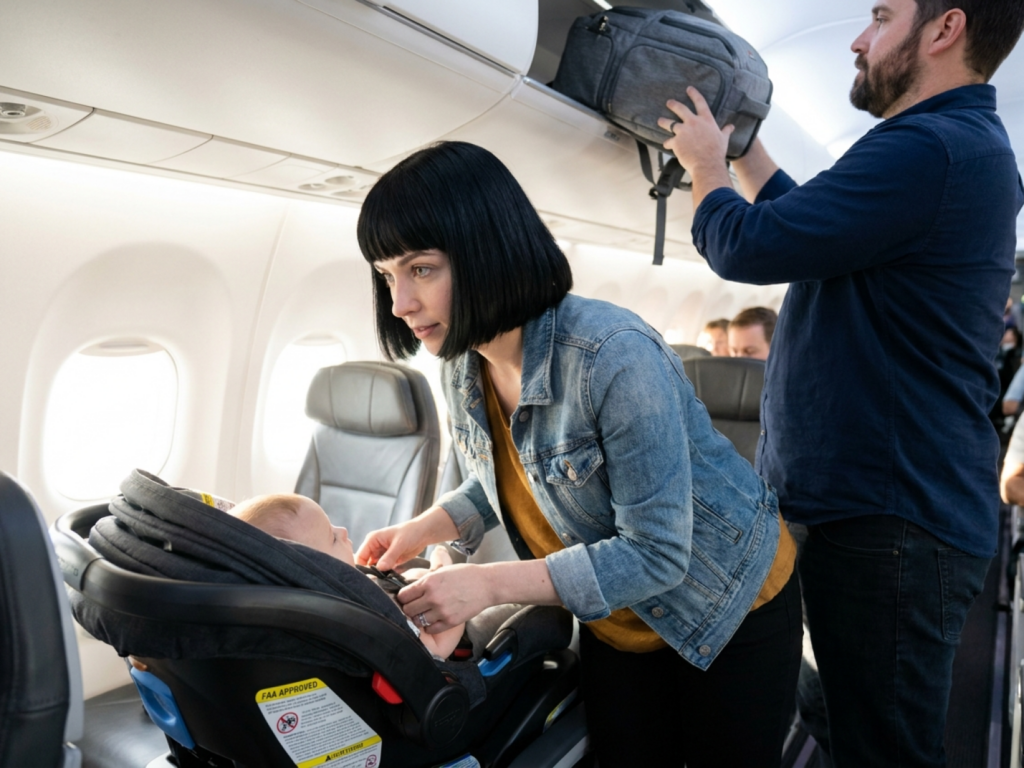
The safest place for a baby on an airplane is a government-approved child safety restraint system rather than an adult’s lap. The restraint should be approved for use on aircraft and compatible with the baby’s size and weight. Follow both the manufacturer’s instructions and the airline’s requirements. A properly installed rear-facing car seat can provide protection during turbulence, abrupt deceleration, and other unexpected events.
Reserve a separate seat when feasible and install the restraint according to its labels. Keep the harness snug, with the baby’s back and pelvis positioned correctly and no bulky coat beneath the straps. Do not alter the restraint, place it in an unapproved seating position, or allow nearby luggage to interfere with installation. Ask cabin crew for assistance if you are uncertain about an airline-specific requirement, but do not assume that a car seat approved for a vehicle is automatically approved for aircraft use unless its labeling confirms this.
During taxi, takeoff, landing, and periods of turbulence, the baby should remain secured as directed by the airline. Holding a baby may feel reassuring, but an adult cannot reliably maintain a protective hold during sudden movement. A sling or carrier may be useful while walking through the terminal if it permits an open airway and appropriate support, but it does not replace an approved infant restraint during the flight.
Never place the baby in an overhead compartment, on a tray table, or on an unrestrained surface. Keep the baby’s face and airway visible, and avoid loose blankets or objects that could cover the nose and mouth. Safe infant restraint in transit is a central part of flight planning, not an optional comfort measure.
Manage takeoff, landing, and ear pressure
Changes in cabin pressure during ascent and descent can cause discomfort because the middle ear must equalize pressure through the eustachian tubes. Babies cannot intentionally perform pressure-equalizing maneuvers, so swallowing and sucking may help. Offer breastfeeding, a bottle, or a pacifier during takeoff and landing if the baby is developmentally able to use it safely. Timing the feed so that the baby is awake and interested during these phases may be useful, but do not force feeding.
Keep the baby in the approved restraint whenever required by the airline. If feeding in the restraint is awkward, ask cabin crew about the permitted procedure and follow their instructions. Do not prop a bottle, leave the baby unattended while feeding, or place a bottle where it could obstruct breathing. Burp the baby afterward if needed and monitor for coughing, choking, or unusual breathing.
Ear discomfort usually improves as pressure stabilizes. Crying alone does not establish an ear infection or another diagnosis. Seek medical advice before travel if the baby has a recent ear procedure, significant ear disease, severe nasal congestion, or a condition for which pressure changes may be relevant. Do not give decongestants, sedating medicines, or other medication to prevent flight discomfort unless a qualified healthcare professional has specifically advised it for this baby.
Handle feeding, diapering, and hygiene in the cabin
Feed responsively and watch the baby’s usual hunger and satiety cues rather than trying to maintain an exact clock-based schedule. Cabin travel can alter sleep and feeding timing, and a baby may feed more frequently for comfort. Breast milk or correctly prepared formula should remain the primary nutrition for young infants. If complementary foods are already established, use familiar foods in manageable portions and keep utensils clean.
During feeding, support the baby’s head and neck and maintain a position that keeps the airway open. Pause if the baby becomes breathless, unusually pale, sweaty, or difficult to rouse. Spit-up is common, but repeated forceful vomiting, inability to retain feeds, or markedly reduced wet diapers warrants medical attention. Do not dilute formula or substitute unsafe liquids in response to travel difficulties.
Change diapers before boarding when possible and use the aircraft lavatory changing table rather than a seat or tray table. Clean your hands before and after the change, dispose of waste appropriately, and keep the baby’s skin dry. Carry barrier cream if it is part of the baby’s established care routine. Wipe high-touch surfaces, but avoid applying disinfectants directly to the baby’s skin or feeding equipment unless the product is specifically suitable and used according to its instructions.
Pacifiers, bottle nipples, and pump parts can fall easily in a confined space. Bring clean spares and store used equipment separately. When safe water or cleaning facilities are unavailable, use feeding supplies according to their preparation instructions and discard items that cannot be cleaned safely. These practical habits complement guidance on cleaning feeding equipment safely during travel.
Support sleep, comfort, and safe movement
Babies may sleep less, cry more, or become overstimulated during a flight. Use familiar cues such as feeding, quiet holding before boarding, a consistent lullaby, or a small approved comfort object. Keep stimulation low when the baby shows signs of fatigue: turning away, yawning, jerky movements, fussing, or difficulty settling. A short walk in the terminal before boarding may help some babies, but conserve your energy and prioritize safe handling.
When the baby sleeps in the aircraft, follow the restraint instructions and airline rules. A car seat or approved restraint is designed to protect the baby, but the baby’s head should not slump forward in a way that compromises the airway. Reposition only within the manufacturer’s permitted guidance. Do not place loose pillows, thick blankets, or soft items around the baby’s face. Safe sleep during travel still requires an unobstructed airway and careful supervision.
If you need to stand, use the lavatory, or retrieve an item, ask the accompanying adult or cabin crew for help. Never leave the baby unattended on a seat, changing table, or in a carrier. When carrying the baby through the aisle, move slowly and maintain support of the head, neck, and trunk. Turbulence can occur without warning, so return the baby to the approved restraint promptly when instructed.
Expect some disruption to the usual routine after arrival. Offer regular feeds, provide opportunities for rest, and expose the baby to normal day and night cues at the destination. A flexible approach is usually more realistic than trying to force the preflight schedule immediately.
Recognize warning signs and seek help
Most in-flight distress is related to hunger, fatigue, discomfort, pressure changes, or overstimulation. Nevertheless, caregivers should know which findings require prompt attention. Notify cabin crew immediately if the baby has difficulty breathing, blue or gray discoloration, severe choking, a seizure, markedly reduced responsiveness, or sudden collapse. Cabin crew can initiate emergency procedures and coordinate medical assistance.
After landing, contact a healthcare professional urgently for persistent breathing difficulty, repeated vomiting with inability to feed, signs of dehydration, unusual lethargy, or a fever in an infant for whom fever evaluation is medically important. Concerning dehydration indicators may include substantially fewer wet diapers than usual, a very dry mouth, absence of tears when expected, or unusual sleepiness, although interpretation depends on age and baseline patterns.
Do not rely on internet advice or another passenger’s medication. Avoid diagnosing ear infection, altitude illness, allergy, or dehydration based on crying alone. Record what happened, when it began, feeding and diaper information, and any relevant medical history. This information can help a clinician assess the situation accurately after the flight.
When to get medical advice
- Seek preflight clearance for a premature baby or a baby with heart, lung, or other significant medical conditions.
- Get urgent help for breathing difficulty, blue or gray color, severe choking, seizure, collapse, or markedly reduced responsiveness.
- Contact a clinician for persistent vomiting, inability to feed, substantially reduced wet diapers, or unusual lethargy.
- Do not give sedating medicines, decongestants, or other medication for flight discomfort without professional advice.
- Keep the baby's airway visible and unobstructed during feeding, carrying, and sleep.
Tools & Assistance
- Airline infant-travel and approved-car-seat policy
- Government-approved child safety restraint system
- Feeding and diaper supply checklist
- Airport security guidance for breast milk and formula
- Baby's healthcare professional and emergency contact information
FAQ
Is it safe for a newborn to fly?
Air travel is usually safe for most healthy, full-term infants after the first few weeks, but airlines may set minimum age limits. Premature babies and infants with heart or lung problems may need medical clearance.
Should a baby drink during takeoff and landing?
Breastfeeding, bottle-feeding, or safe pacifier use can encourage swallowing and may ease pressure-related ear discomfort. Never force a feed, prop a bottle, or compromise the required restraint.
Can I hold my baby on my lap during the flight?
A separate seat with a government-approved child safety restraint is the safest option. Lap-infant rules vary by airline, but holding a baby cannot provide the same protection during turbulence or sudden deceleration.
Can I give my baby medicine before flying?
Do not give medication to sedate a baby or prevent ear discomfort unless the baby's healthcare professional has specifically recommended it. Medication can cause adverse effects and may mask important symptoms.
What should I do if my baby cries throughout the flight?
Check hunger, diaper needs, temperature, positioning, fatigue, and pressure-related discomfort. Use calm, familiar soothing measures, keep the airway clear, and ask an accompanying adult or cabin crew for practical help.
Sources
- Mayo Clinic — Air travel with infant: Is it safe?
- Centers for Disease Control and Prevention — Traveling Safely with Infants and Children
- MedlinePlus — Traveling with children: MedlinePlus Medical Encyclopedia
Disclaimer
This article provides general educational information and does not diagnose, treat, or replace advice from a qualified healthcare professional. Seek individualized medical guidance before flying with a premature baby or an infant with significant health conditions, and obtain urgent help for concerning symptoms.
















Please log in to leave a comment.