
Intro
Choosing a high chair can feel more consequential than choosing ordinary nursery furniture. Your baby will be elevated, restrained, and eating in it while coordination, trunk control, and feeding skills are still developing. The right chair supports everyday family meals while reducing avoidable fall, entrapment, and tip-over hazards.
Focus first on safety, fit, and realistic use in your home. Features such as a washable tray or compact fold can be useful, but they should never compensate for an unstable frame, an inadequate restraint system, or a chair that does not suit your child's current developmental abilities.
Highlights
A stable base, intact locking mechanisms, and a properly used harness with a crotch strap are central high-chair safety features.
Choose a chair based on your baby's sitting ability, body size, and the manufacturer's stated age, weight, and use limits.
The safest chair is one that caregivers can use correctly every meal, keep clean, and position away from household hazards.
Secondhand and travel chairs require a particularly careful inspection for missing parts, damage, recalls, and secure attachment.
Start with readiness and a supportive fit
A high chair is not simply a place to contain a baby during meals. It is a feeding support device, so the fit should match the child’s motor development and the manufacturer’s instructions. Many babies begin using a high chair when they can sit with reliable head and trunk control, but readiness varies. A baby who slumps, leans markedly to one side, or cannot maintain a stable seated posture may not yet be ready for that chair or may need an individualized feeding-position assessment.
Look for a seat that supports an upright, well-aligned posture without forcing the child into an awkward position. The hips should be seated back in the chair, the back supported, and the feet ideally able to rest on an adjustable footrest as the child grows. Foot support can improve stability during eating and may help the child participate more comfortably in self-feeding. It is not a substitute for close supervision or for a harness.
Check the stated age, weight, height, and developmental criteria in the product manual. These limits differ between products, particularly for convertible chairs that later become toddler chairs. Avoid assuming that a baby is ready just because they are interested in food or can briefly sit on the floor. If your baby was born prematurely, has hypotonia, cerebral palsy, dysphagia, reflux-related feeding difficulty, or another condition affecting posture or feeding, ask the pediatrician, occupational therapist, speech-language pathologist, or feeding specialist which seating features are appropriate.
Make stability and fall prevention the first test
Falls are a major preventable concern with high chairs. Before buying, examine the footprint from every angle. A broad, well-balanced base is generally more resistant to tipping than a narrow, top-heavy design. Place the display model on a level surface if possible and gently apply pressure to the tray, seat back, and sides. It should not rock, shift, or feel unstable. This is not a substitute for using it correctly, but it can reveal poor assembly or a design that is impractical for your space.
Assess all moving components. Folding models should have clear locking mechanisms that engage fully and are not easy for a child to release. Wheels should either lock securely or be limited to a design that remains stable during normal feeding use. Check the tray attachment, recline mechanism, height adjustment, and removable seat components. Hinges, joints, screws, and plastic connections should feel solid, with no cracks, looseness, or sharp edges.
A freestanding high chair should sit on the floor, never on a table, counter, chair, or other elevated surface. Do not allow siblings to climb it, push it, or hang bags from it; added weight can alter stability. Keep the chair away from walls, windows, cords, blinds, tables, ovens, and other surfaces your baby might push against. Babies can generate surprising force with their feet or hands, and reaching for nearby items can contribute to a tip-over event.
- Choose a chair with a stable base and leg design suited to your floor space.
- Confirm that every lock engages before each use.
- Do not rely on a tray to prevent falls or sliding.
- Reinspect fasteners and joints regularly as the chair is used and cleaned.
Choose a complete, usable restraint system
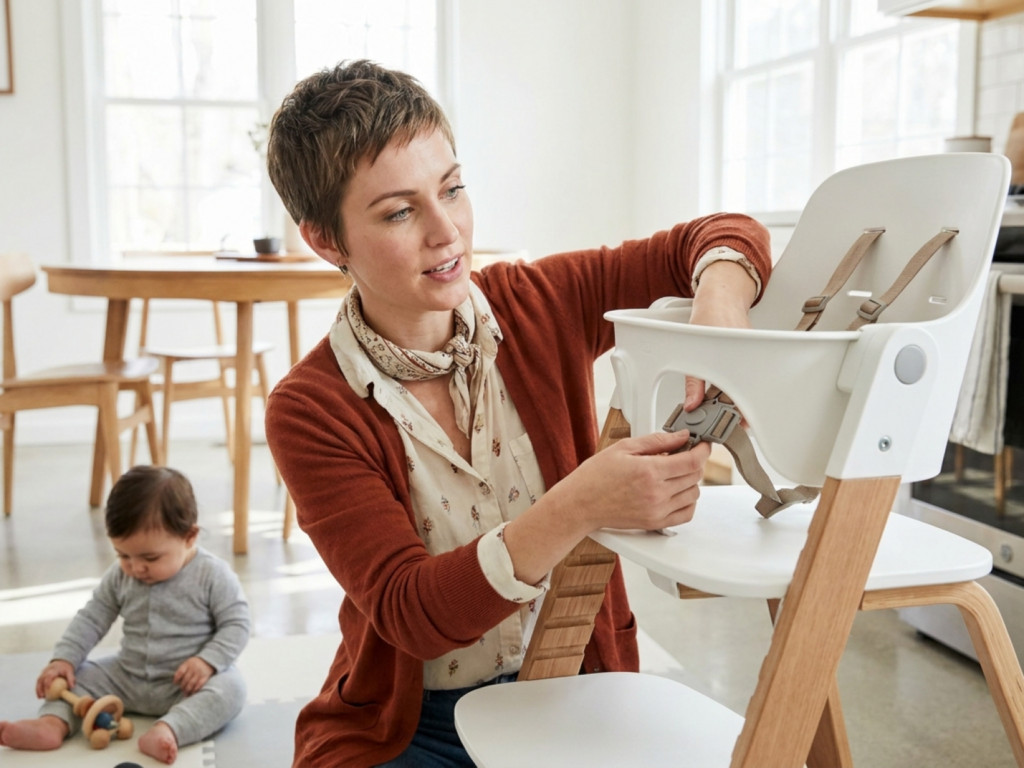
A secure restraint system is essential even for a baby who appears calm or cannot yet stand. Development changes quickly, and a baby may twist, slide, push up, or attempt to climb with little warning. Select a high chair with a safety harness and a crotch strap. The crotch strap helps prevent the child from sliding beneath the tray, a dangerous pathway for entrapment or strangulation. Use the harness every time your baby is in the chair, including for a quick snack or while you step within arm’s reach.
Evaluate whether the straps are straightforward to buckle, tighten, and clean. A system that is difficult to operate is more likely to be used inconsistently. The buckle should latch securely, and the straps should adjust close enough to limit excessive movement while remaining comfortable. Inspect the anchor points where straps attach to the seat. They should be intact and firmly connected, without fraying fabric, cracks, or missing hardware.
Do not treat a tray as a restraint. Trays can be removed, may leave space around the child’s body, and are not designed to replace the harness. Similarly, aftermarket cushions, strap covers, or inserts can interfere with the intended restraint fit unless the manufacturer specifically approves them. Avoid makeshift modifications, including added pillows behind the baby, tied-on cushions, or replacement straps not designed for that model.
Supervision remains necessary despite a good harness. A high chair is not a safe place for unattended play, sleep, or waiting while a caregiver leaves the room. If a child falls, is found hanging or partially suspended, has breathing difficulty, seems unusually sleepy, vomits repeatedly, or has any concerning head injury symptoms, seek urgent medical assessment according to local emergency guidance.
Compare chair types against your daily routine
Freestanding full-size chairs are often the most versatile option because they can provide an integrated harness, tray, adjustable seat, and footrest. They take more floor space, however, and some models are cumbersome to move or clean. Measure the feeding area, nearby pathways, and the table height before choosing. A chair that blocks a busy route may be bumped often, while one that cannot pull close to the table may be less useful as your child joins family meals.
Folding high chairs can work well in smaller homes, but their fold lock deserves particularly close attention. Test whether you can open, lock, and store it reliably while holding a baby only after the baby is safely elsewhere. Never fold or unfold a chair with a child seated in it. Confirm that stored placement does not create a risk of the chair falling onto a child.
Hook-on high chairs and portable seats may be convenient for travel, but they are only appropriate when the manufacturer permits attachment to the specific table or surface. Not every table is structurally suitable. Avoid tables with glass tops, pedestal bases, loose leaves, unstable construction, or lips that do not match the seat’s attachment requirements. Verify that clamps or locking parts are fully engaged every use. A travel seat also needs a harness and a secure, undamaged attachment system.
Booster seats can suit an older child who has the developmental control and size specified by the manufacturer. They must attach securely to both the adult chair and the child, where required. The adult chair itself must be stable and unable to tip. Think of portability as a secondary benefit: a compact product that is poorly matched to the table, chair, or child’s abilities is not a practical safe choice.
Prioritize cleaning without compromising construction
Feeding is messy by nature, and an easy-to-clean high chair helps caregivers maintain hygiene without skipping safety checks. Look for smooth, accessible surfaces with few deep seams where food can become trapped. A removable tray can be helpful if it locks securely. Check whether the tray, straps, seat cover, and crevices can be cleaned according to the manufacturer’s instructions. Food residue can harbor microorganisms and may make buckles or adjustment mechanisms sticky over time.
Do not assume that a padded seat is always more practical. Fabric padding can be comfortable but may retain food and moisture, require more drying time, and conceal wear. If choosing padding, make sure it is removable, washable as directed, and does not interfere with harness routing. Examine the underside of the tray, the seat-to-frame junction, and the buckle area; these are common locations for accumulated debris.
Durability matters because daily wiping, repeated adjustment, and a growing child’s movement place stress on the chair. Choose materials that feel robust and are free from visible cracking, splintering, corrosion, or peeling finishes. Review the manual’s maintenance schedule. Tighten or replace only components the manufacturer identifies as user-serviceable. For damaged structural parts, missing harnesses, faulty locks, or uncertain replacement pieces, discontinue use and contact the manufacturer or retailer for guidance.
Consider how the chair will be cleaned after allergen-containing foods. Wiping high-touch surfaces, straps, and tray edges carefully can reduce transfer to the next meal. Families managing medically diagnosed food allergy should follow their clinician’s individualized advice about allergen avoidance and emergency planning; a high chair’s cleanability is supportive, not a complete allergen-control strategy.
Use secondhand options and recalls carefully
A secondhand high chair can be reasonable only when its history, model identification, and condition can be verified. Start by locating the manufacturer label and model number, then check the product’s current recall status through the relevant national consumer-product safety authority or manufacturer. Do not use a recalled chair unless the remedy has been completed exactly as instructed. Avoid products with unknown origins, missing labels, missing manuals, or improvised replacement parts.
Inspect the entire chair before each period of use, not only at purchase. Look for cracked plastic, bent metal, loose screws, worn straps, broken buckles, damaged locking mechanisms, unstable legs, and tray latches that do not engage reliably. Confirm that all original parts are present, especially the harness, crotch strap, tray restraint components, and any pins or locks needed for safe assembly. Cosmetic wear may be manageable, but structural damage or a missing safety component is a reason not to use the chair.
Older chairs may not meet current safety expectations, even when they look sturdy. Be cautious of designs with large gaps, tray-only restraint systems, no crotch strap, or potentially hazardous hardware. The lowest purchase price does not represent a saving if you later need to replace missing components or if the chair cannot be used safely. A current model with available instructions and replacement support is often easier to maintain across infancy and toddlerhood.
Finally, build a brief pre-meal routine: place the chair on level ground, lock moving parts, clear nearby hazards, seat the child, secure the harness and crotch strap, and remain present throughout the meal. This routine protects against the common tendency to become less vigilant as feeding becomes familiar. High chair safety is a combination of product design, correct setup, and attentive use.
Safety warnings
- Always use the harness and crotch strap; a tray does not prevent falls or sliding.
- Never leave a baby unattended in a high chair, even briefly.
- Do not place a high chair on a table, countertop, chair, or other elevated surface.
- Keep the chair away from cords, windows, hot surfaces, tables, and objects a child can push against.
- Stop using a chair with damaged straps, loose parts, cracked components, or unreliable locks.
- Check recalls and use only manufacturer-approved parts and accessories.
Tools & Assistance
- Read the full manufacturer manual before first use
- Check the national consumer-product recall database
- Measure the feeding area and table height at home
- Ask a pediatric feeding or rehabilitation professional about individualized seating needs
FAQ
When can my baby start using a high chair?
Follow the product instructions and consider developmental readiness, especially reliable head and trunk control. Ask a healthcare professional when posture, prematurity, or feeding concerns affect sitting.
Do I need a five-point harness?
Choose a chair with a secure harness and crotch strap, then use them every time. The exact harness configuration should meet the product's safety requirements and fit your child correctly.
Is a footrest necessary on a high chair?
An adjustable footrest can support a more stable, comfortable feeding posture as a child grows. It does not replace the harness, supervision, or a properly fitting seat.
Can I use a secondhand high chair?
Only use one with an identifiable model, complete original safety components, no damage, available instructions, and no unresolved recall. Do not use chairs with missing straps, locks, or structural parts.
Sources
- Consumer Reports — High Chair Buying Guide: Types, Safety, Expert Tips
- Product Safety Australia — High chairs guide
- HealthyChildren.org / American Academy of Pediatrics — 6 Quick High Chair Safety Tips
Disclaimer
This article provides general educational information and does not replace individualized medical, feeding, or safety advice. Consult a qualified healthcare professional for concerns about your child's posture, development, swallowing, or feeding safety.














Please log in to leave a comment.