
Intro
Children’s feet can seem to outgrow shoes almost as soon as you buy them. That can be frustrating for families, especially when shoes are expensive or when a child has strong preferences about what they will wear. The good news is that there are practical, evidence-informed intervals that can help you plan shoe checks and replacements without guessing.
Highlights
Foot growth is fastest in infancy and toddlerhood, so shoe fit should be checked frequently in the first few years.
Many toddlers need a new shoe size every 2 to 4 months, while preschool and early school-age children often slow to every 4 to 6 months or longer.
Shoe replacement should be based on fit, comfort, gait, and wear pattern, not the calendar alone.
A well-fitting child’s shoe protects the foot while allowing normal movement, toe splay, and musculoskeletal development.
Why children outgrow shoes so quickly
Children’s feet are not simply smaller adult feet. In early life, the bones are still developing, the arches are maturing, and the soft tissues are highly adaptable. The foot contains multiple growth centers, and the shape of the forefoot, heel, and arch changes as standing, walking, running, and balance skills evolve. Because of this, a shoe that fit well a few weeks ago may become restrictive before it looks visibly small from the outside.
Rapid foot growth is especially noticeable from infancy through the preschool years. During this period, the child’s overall linear growth and motor development are accelerating. Feet may lengthen, widen, and change volume. Some children grow steadily; others have spurts. This is why relying on a child’s age alone is imperfect, but age remains a helpful planning tool.
It is also common for children not to report tight shoes. Young children may lack the vocabulary to describe pressure, numbness, toe crowding, or heel rubbing. Others may be attached to a favorite pair and deny discomfort. For caregivers, scheduled fit checks are a practical safeguard.
Age-based timelines for new shoe sizes
Research and pediatric guidance give useful benchmarks. A study of children from 1 to 6 years found that children aged 12 to 30 months may need new shoe sizes about every 2 to 3 months. After that, the interval often lengthens to about every 4 months until age 4, and then about every 6 months from ages 4 to 6. These are averages, not rules; individual variation is expected.
The Canadian Paediatric Society notes that before 18 months, feet may grow by more than half a shoe size every 2 months. Toddlers may average about half a shoe size every 3 months, and by around age 3, many children grow roughly one shoe size per year. Orthopedic education sources similarly suggest that children may require new shoes every 3 to 4 months, depending on age, activity, and growth rate.
A practical schedule many families can use is:
- Infants and early walkers: check fit every 6 to 8 weeks, especially if the child wears structured shoes outdoors.
- 12 to 30 months: expect possible size changes every 2 to 3 months.
- 2.5 to 4 years: check every 2 to 3 months; many children need new shoes about every 4 months.
- 4 to 6 years: check every 3 to 4 months; new sizes may be needed about every 6 months.
- Older children: check at least every season, and more often during growth spurts or high sports activity.
These intervals should be adapted for the child. A very active child may wear out shoes before outgrowing them. A child with rapid growth velocity in children may need size checks more often than a sibling of the same age.
How to check whether shoes still fit
A shoe should allow the foot to move naturally while protecting it from injury, weather, and rough surfaces. Fit is not only about length; width, toe box height, heel stability, and flexibility all matter. The check is best done at the end of the day, when feet may be slightly larger from normal fluid shifts and activity.
Ask the child to stand in both shoes with the socks they usually wear. Standing matters because weight-bearing spreads the foot. There should usually be a small amount of growing room at the longest toe, often described as roughly a thumb’s width or about 1 to 1.5 cm, depending on the shoe style and child. Too much extra length can cause tripping, while too little crowds the toes.
Check these areas:
- Toe box: toes should lie flat and be able to wiggle. The upper should not press down on the nails.
- Width: the sides of the foot should not bulge over the sole or be squeezed by the upper.
- Heel: the heel should feel secure without rubbing or slipping excessively.
- Flex point: the shoe should bend near the ball of the foot, not in the middle of the arch.
- Walking pattern: watch for limping, frequent tripping, toe walking that is new or worsening, or reluctance to run.
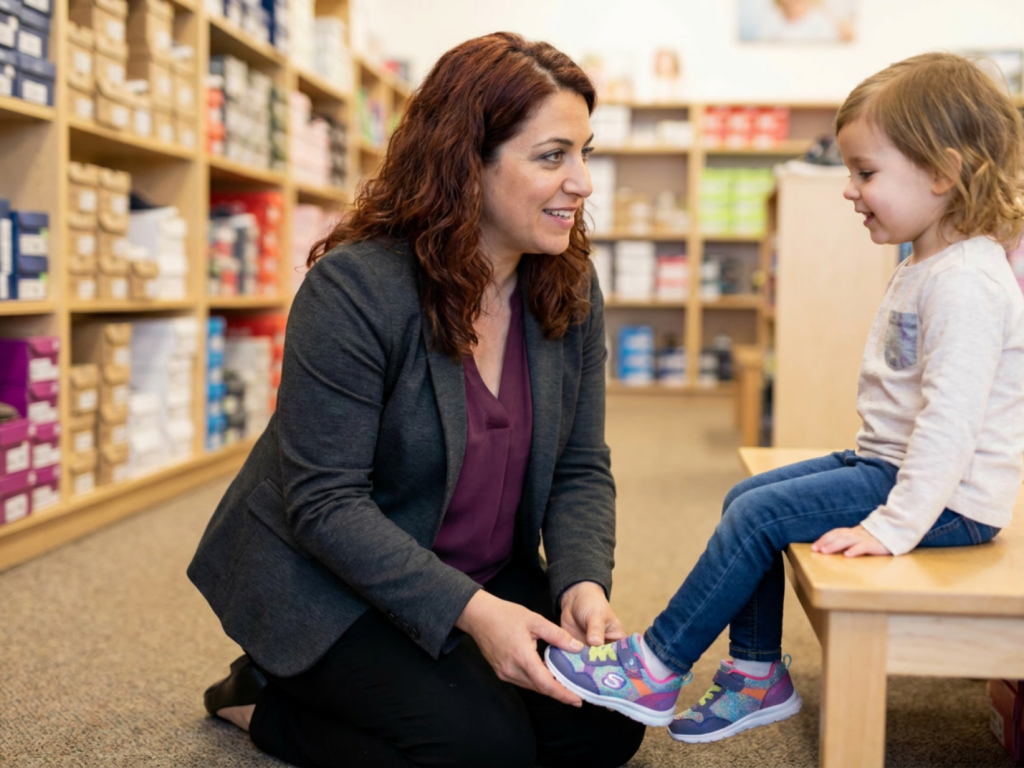
If possible, remove the insole and have the child stand on it. This can make toe crowding easier to see, although it does not assess shoe volume or upper pressure. Professional measurement in a shoe store or clinic can be helpful, especially for children between sizes, children with very narrow or wide feet, or children who cannot reliably describe discomfort.
Signs your child needs new shoes now
Calendar reminders are useful, but symptoms and visible changes should override the schedule. Shoes may be too small, too worn, or poorly matched to the child’s activity even before the expected replacement date.
Consider replacing or reassessing shoes if you notice:
- Red marks, blisters, calluses, nail pressure, or skin irritation after normal wear.
- Toes pressing against the front or curling inside the shoe.
- The child frequently removes shoes, complains of pain, or avoids walking or running.
- Uneven wear on the sole that changes balance or traction.
- A compressed heel counter, torn lining, holes, or a sole that no longer grips.
- New tripping, limping, or an altered gait that appears related to footwear.
Some wear patterns are normal, especially in active children. However, pronounced asymmetry between left and right shoes, persistent pain, swelling, or a consistent limp should not be attributed to shoes alone. In those situations, caregivers should consult a pediatric healthcare professional. Footwear can aggravate problems, but it should not be used to diagnose musculoskeletal, neurologic, inflammatory, or developmental conditions.
Choosing shoes that support growing feet
For most healthy children, the goal is not a rigid corrective shoe. It is a comfortable, flexible, well-fitting shoe that protects the foot and permits normal motion. Overly stiff footwear can interfere with natural foot mechanics, while shoes that are too flimsy for the setting may fail to protect against impact, slipping, or sharp surfaces.
Look for a broad toe box, secure fastening, breathable materials, and a sole that bends at the forefoot. Laces, hook-and-loop straps, or adjustable closures can help accommodate small differences in foot volume during growth. Shoes should match the child’s activity: playground shoes need traction and stability; sports shoes should be appropriate for the sport; occasional dress shoes should not become daily footwear if they crowd the toes.
Hand-me-down shoes require caution. Even if the size is correct, the previous child’s wear pattern may alter support and alignment. A lightly used pair may be fine for short-term or occasional use, but shoes with compressed soles, distorted heels, or worn tread should be avoided.
Like clothing for children, shoe choices also involve comfort, weather, budget, and independence. The most expensive shoe is not necessarily the best. Fit, function, and condition matter more than brand. If a child has prescribed orthoses, neuromuscular conditions, significant hypermobility, diabetes, inflammatory disease, or a history of foot surgery, shoe selection should be individualized with clinical guidance.
When to seek professional advice
Most shoe-fit questions can be handled with careful measurement and observation. Still, some situations deserve a pediatrician, podiatrist, physiotherapist, or pediatric orthopedic assessment. Seek advice if your child has persistent foot, ankle, knee, hip, or back pain; recurrent blisters despite correct sizing; significant asymmetry; swelling; reduced activity tolerance; or a limp that does not quickly resolve.
Professional input is also reasonable if caregivers are concerned about flat feet, in-toeing, out-toeing, toe walking, frequent falls, or unusual shoe wear. Many of these findings are benign and improve with maturation, but a clinician can determine whether monitoring, reassurance, imaging, therapy, or referral is appropriate. Avoid using over-the-counter inserts or corrective footwear as a substitute for assessment when symptoms are persistent or function is affected.
Growth should also be considered in the broader pediatric context. Serial pediatric growth measurements at preventive visits help clinicians identify patterns that may need follow-up. Foot size alone is rarely a medical signal, but unexpectedly rapid or slow overall growth, pain, fatigue, or developmental concerns should be discussed with the child’s healthcare team.
Budget-conscious planning without compromising fit
Frequent shoe replacement can be financially stressful. Planning ahead may help. Because many young children need new sizes several times per year, it can be useful to check shoes before seasonal weather changes, school starts, holidays, or sports registration. Buying one well-fitting everyday pair is often more useful than buying several pairs that fit poorly.
Avoid buying shoes that are several sizes too large in an attempt to extend wear. Excess length can increase tripping, alter gait, and cause friction as the foot slides. A modest amount of growing room is appropriate; excessive room is not. If cost is a concern, look for sales, outlet options, community clothing programs, or gently used shoes that show minimal wear and no structural distortion.
Children may resist replacing beloved shoes. Empathy helps: acknowledge the attachment, explain that growing feet need space, and offer limited choices between acceptable options. For sensory-sensitive children, transitions may be easier if new shoes are introduced gradually at home before long school days or outings.
When shoe fit may need medical attention
- Persistent limping, swelling, or pain should be assessed by a healthcare professional.
- Do not use tight shoes, inserts, or corrective footwear to treat a suspected foot problem without clinical guidance.
- Seek advice for recurrent blisters, skin breakdown, numbness, or pressure marks that keep returning.
- A sudden change in walking, running, or balance deserves evaluation, especially after injury.
- Children with neurologic, orthopedic, rheumatologic, or metabolic conditions may need individualized footwear advice.
Tools & Assistance
- Set a calendar reminder to check shoe fit every 6 to 12 weeks in toddlers
- Measure both feet while the child is standing and wearing usual socks
- Inspect soles, heel counters, linings, and toe boxes for wear or distortion
- Ask a trained shoe fitter, pediatrician, podiatrist, or orthopedic clinician for help when fit is difficult
FAQ
How often do toddlers usually need new shoes?
Many toddlers need a new size about every 2 to 4 months, depending on age and growth rate. Fit should be checked more often than shoes are replaced.
Is it safe to buy shoes one or two sizes too big?
A little growing room is helpful, but shoes that are much too large can cause slipping, friction, and tripping. Fit should be secure at the heel and roomy at the toes.
Do children need arch support shoes?
Most healthy children do not need rigid arch support. Flat feet are often normal in young children, but pain, stiffness, asymmetry, or functional problems should be discussed with a clinician.
Should both feet be measured?
Yes. One foot is often slightly larger. Shoes should fit the larger foot without excessive looseness on the smaller side.
Are hand-me-down shoes okay?
Lightly used shoes may be acceptable if they fit well and are not misshapen. Avoid shoes with worn soles, collapsed heels, or a previous wear pattern that changes support.
Sources
- PubMed — Foot growth rate in children age one to six years
- Canadian Paediatric Society — Footwear for children
- FootCareMD — How to Select Toddler & Children's Shoes
Disclaimer
This article is for general educational information only and does not replace medical evaluation. Consult a qualified healthcare professional for persistent pain, gait changes, injury, or individualized footwear needs.













Please log in to leave a comment.