
Intro
An overnight flight with a baby can feel like a high-stakes test of everyone’s stamina. Cabin noise, altered routines, feeding logistics, and the understandable wish for your baby to rest can make the journey feel unpredictable. A realistic goal is not a perfect night of sleep, but a safe, flexible plan that protects breathing, feeding, and caregiver alertness.
Babies may sleep at unusual times while traveling, and a temporary disruption does not mean their usual sleep habits have been lost. Preparing for the flight, using the safest available sleep arrangement, and responding calmly to your baby’s needs can make the experience more manageable.
Highlights
The safest place for an infant during turbulence or an emergency is a government-approved child restraint system used according to airline instructions.
If a baby sleeps on a caregiver’s lap, the caregiver should remain awake, keep the face uncovered, and check that breathing is unobstructed.
An overnight flight may disrupt sleep temporarily, so prioritize safety, hydration, feeding, and realistic expectations over preserving an exact schedule.
Feeding or sucking during takeoff and landing may help some babies equalize ear pressure.
Set a realistic goal for the flight
Overnight travel asks a baby to sleep in a setting that differs sharply from home: there is bright airport lighting, boarding activity, engine noise, vibration, unfamiliar handling, and possible delays. Even babies who normally sleep predictably may take shorter naps, wake more often, or need more feeding and holding. Treat the flight as a temporary exception rather than a test of your routine.
If you have flexibility, Baby Sleep Science suggests avoiding a redeye when possible. When an overnight itinerary is necessary, the latest feasible departure may better align with a baby’s usual evening sleep pressure. That said, a delayed departure, missed nap, or unexpectedly alert baby is common. Trying to force sleep can increase stress for both caregiver and child.
Keep pre-flight timing simple. Offer ordinary feeds and opportunities for rest rather than deliberately keeping a baby awake to make them sleep on the aircraft. Significant overtiredness can make settling harder and may lead to more fragmented sleep. A brief, familiar sequence before boarding or after takeoff, such as a feed, diaper change, sleep clothing, and quiet holding, can provide recognizable cues without demanding an exact bedtime.
For families crossing time zones, the first night need not establish the new schedule perfectly. The more useful aim is to meet immediate needs safely and then return gradually to a local time bedtime routine after arrival. One difficult night does not erase a baby’s established sleep patterns.
Choose the safest available sleep arrangement
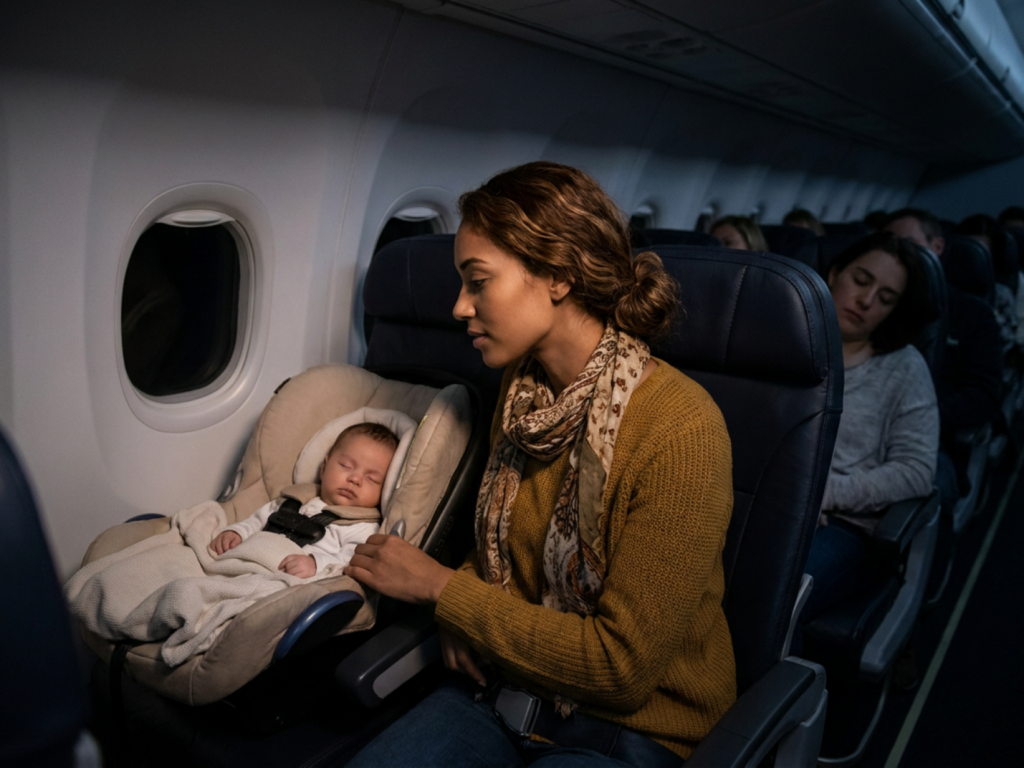
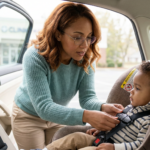
Safety should guide every sleep decision in the cabin. The American Academy of Pediatrics notes that a government-approved child restraint system is the safest place for an infant during turbulence or emergencies. If you have purchased a seat for your baby and plan to use a restraint, confirm airline policies and the device’s aircraft-use labeling before travel. UCLA Health also notes that seat-position restrictions may apply, so airline staff can help identify an appropriate seat.
An airline bassinet can be helpful for eligible infants, but availability, size limits, and installation rules vary. When a bassinet is used, the sleep surface should be firm and flat, without loose bedding, pillows, soft toys, positioning products, or other soft items. Follow the crew’s instructions about when the bassinet may be used; babies may need to be removed and secured for takeoff, landing, or turbulence.
Lap sleep is sometimes unavoidable, especially when a bassinet is unavailable or a baby will not settle elsewhere. It carries added risk when the adult becomes sleepy. If a baby falls asleep on your lap, stay awake, keep their face fully visible and uncovered, and check that their airway is clear. Avoid arrangements in which a baby can become wedged against an armrest, adult body, blanket, or seat structure. Do not assume that a quiet baby is necessarily positioned safely.
- Use the approved restraint or bassinet whenever it is available and permitted.
- Keep soft bedding and loose items away from a sleeping baby’s face.
- Ask the crew for guidance when the seatbelt sign comes on.
- Plan for the possibility that a baby may need to be held or fed while awake, rather than sleeping continuously.
Use feeding and comfort strategies thoughtfully
For many babies, feeding is both nutritional and regulatory: it can reduce distress, support settling, and provide a familiar cue amid a stimulating environment. UCLA Health advises that nursing or bottle-feeding during takeoff and landing can help relieve ear pressure. Sucking may assist pressure equalization through the eustachian tubes, which connect the middle ear to the back of the throat. A pacifier may be useful for a baby who already uses one, but avoid introducing a new strategy under pressure if it causes frustration.
Offer feeds responsively rather than trying to adhere rigidly to a home timetable. Cabin air is dry, journeys can be prolonged, and a baby may seek smaller or more frequent feeds. For breastfed babies, this may mean more nursing opportunities; for formula-fed babies, it means planning supplies and safe preparation arrangements in advance. Ask your pediatric clinician for individualized advice if your baby has feeding difficulties, reflux symptoms, poor weight gain, a swallowing concern, or a medical condition affecting travel plans.
Use calm, low-stimulation comfort measures when possible. Dim the immediate area if permitted, reduce conversation, use a familiar sleep sack only when it does not interfere with the approved restraint or airline rules, and keep diaper changes efficient. Some babies settle with a slow aisle walk while the seatbelt sign is off. Baby Sleep Science identifies walking and flexible sleep timing as useful coping strategies, but the caregiver should stop and return to the seat promptly when instructed by crew.
Avoid using medications or sedating products solely to make a baby sleep during a flight unless a qualified healthcare professional who knows the child has specifically advised it. Sedation can affect arousal and breathing, and an unfamiliar setting makes monitoring more difficult.
Protect breathing and respond to wakefulness
In a dark, crowded cabin, it is easy to focus on whether a baby is asleep rather than how they are sleeping. Breathing safety deserves more attention. Check that the nose and mouth are uncovered, the neck is not sharply flexed forward, and no blanket, adult clothing, nursing cover, or soft item is near the face. This is especially relevant for young infants, whose head control and ability to reposition are limited.
Do not sleep while holding a baby. Overnight flights can create profound fatigue, especially for a caregiver who has been managing airport travel, feeds, and luggage. If you notice yourself nodding off, transfer the baby to an approved restraint or bassinet if available, or ask a traveling companion to take over while remaining awake. When traveling alone, call a flight attendant for practical assistance and reset expectations: an awake baby in a safe position is preferable to an unsafe attempt to preserve sleep.
Babies can wake repeatedly because of noise, pressure changes, hunger, temperature shifts, or normal developmental sleep cycling. Respond in a measured sequence: briefly assess diaper, hunger, temperature, and position; offer familiar soothing; then allow time for resettling. Repeatedly changing strategies, passing the baby between adults, or turning on bright screens may become more stimulating than helpful.
Seek urgent help from the crew if your baby has breathing difficulty, blue or gray color, unusual limpness, repeated vomiting with concerning symptoms, a seizure-like episode, or behavior that is markedly different from their usual state. These signs require assessment and should not be attributed simply to travel fatigue.
Prepare the cabin routine and caregiver plan
A practical carry-on setup reduces decision fatigue at 2 a.m. Pack more diapers, wipes, feeding supplies, and spare clothing than you expect to use, since delays and diversions happen. Keep the immediate sleep items easy to reach rather than packed beneath other bags. A small familiar item used only while awake for comfort may be useful, but it should not be placed loose in a bassinet or near a sleeping baby’s face.
Before departure, divide responsibilities if another adult is traveling. Decide who handles boarding bags, who watches the baby during bathroom trips, and how you will manage a handoff if one person becomes too tired to safely hold the baby. Agree that either caregiver can say, “I need you awake now,” without debate. This matters more than achieving a certain number of uninterrupted sleep hours.
Dress the baby in removable layers. Aircraft cabin temperature can change, and overheating or chilling can make sleep less comfortable. Check the baby’s chest or back rather than relying on hands and feet, which may feel cool even when core temperature is comfortable. Avoid bulky outerwear that can affect harness fit in a child restraint.
For an uncomplicated trip, you do not need an elaborate sleep toolkit. The most useful resources are a safe place to secure the baby, enough feeding supplies, a simple routine, and a caregiver plan for fatigue. Families who anticipate several travel disruptions may also benefit from planning a portable sleep environment for the destination before leaving home.
Reset gently after arrival
After an overnight flight, the first day may involve irregular naps, extra feeding, and a much earlier or later bedtime than usual. This is expected. Focus first on recovery: daylight exposure at appropriate local times, ordinary feeds, calm activity, and a safe separate sleep surface at the destination. Avoid extending wake periods solely to force alignment with the local clock; overtiredness can worsen sleep fragmentation.
For short trips, many families find it easier to preserve some familiar rhythms rather than fully shifting the schedule. For longer stays, gradual sleep schedule adjustment is generally more sustainable. Anchor the day around morning light, regular daytime activity, and a consistent wind-down period. Light is one of the strongest circadian cues, meaning it helps signal to the body when day and night occur.
At the hotel, relatives’ home, or other accommodation, inspect the sleep arrangement before a tired baby needs it. Use a firm, flat sleep surface intended for infant sleep, and keep the area free of loose bedding and soft items. Room-sharing without bed-sharing can make nighttime feeding and monitoring more practical while preserving a separate sleep space for the baby.
Contact your pediatric clinician before travel or after arrival if your baby has a significant underlying condition, was born prematurely, has current respiratory symptoms, or has sleep-related breathing concerns. Individual factors can change what is appropriate for air travel and overnight sleep planning.
Safety reminders
- Do not sleep while holding a baby on your lap during the flight.
- Keep a sleeping baby’s face uncovered and airway unobstructed.
- Use an approved child restraint system or airline bassinet according to crew instructions whenever available.
- Do not use sedating medicines or products to induce sleep without individualized advice from a qualified clinician.
- Alert the crew immediately for breathing difficulty, blue or gray color, unusual limpness, or seizure-like activity.
Tools & Assistance
- Confirm bassinet eligibility, child restraint policies, and seating restrictions with the airline before departure.
- Ask a pediatric clinician for travel advice when a baby has prematurity, respiratory disease, feeding problems, or another medical condition.
- Pack an organized overnight carry-on with feeding supplies, diapers, spare clothing, and approved sleep essentials.
- Request crew assistance when turbulence, fatigue, or seating constraints affect safe baby care.
FAQ
Is it safe for my baby to sleep on my lap during an overnight flight?
It is safer to use an approved child restraint system or airline bassinet when available and permitted. If a baby sleeps on your lap, stay awake, keep the face uncovered, and ensure breathing is unobstructed.
Should I keep my baby awake before a redeye flight?
Usually, no. Excessive wakefulness can lead to overtiredness and more difficulty settling. Offer normal opportunities for sleep and use a simple, familiar routine around the flight.
Can feeding help with ear discomfort on a flight?
Nursing or bottle-feeding during takeoff and landing may help some babies equalize ear pressure through sucking. Follow your baby’s usual feeding needs and ask a clinician about individual concerns.
Can I give my baby medicine to help them sleep on the plane?
Do not use sedating medication or sleep products just for travel sleep without specific guidance from a qualified healthcare professional who knows your baby.
Sources
- HealthyChildren.org (American Academy of Pediatrics) — Flying With Baby: Parent FAQs & Tips for Safer, Easier Air Travel
- UCLA Health — Home & Travel
- Baby Sleep Science — Navigating sleep on an Airplane with a Baby
Disclaimer
This article is for general educational purposes and is not a substitute for individualized medical advice. Consult a qualified healthcare professional about your baby’s specific health and travel needs.














Please log in to leave a comment.