
Intro
A toddler bedtime routine is more than a sequence of evening tasks. It is a predictable, emotionally regulating transition from the stimulation of the day into sleep, and it can support the child, the caregiver, and the whole household. Many families struggle with bedtime resistance, repeated requests, separation distress, or late-night waking; these challenges are common and do not mean a parent has failed.
Research suggests that consistent routines in early childhood are associated with better sleep outcomes and healthier social-emotional development. The goal is not perfection or a rigid script, but a repeatable pattern that helps a toddler’s circadian rhythm, autonomic nervous system, and developing self-regulation skills settle into rest.
Highlights
A consistent bedtime routine can shorten sleep onset latency, reduce night waking, and support longer sleep duration in young children.
Effective routines usually combine timing consistency, hygiene, calming connection, reading, and reduced evening stimulation.
Toddlers often resist bedtime because of normal developmental factors such as autonomy seeking, separation sensitivity, and immature impulse control.
Medical issues such as pain, reflux, eczema, snoring, or obstructive sleep apnea symptoms should be discussed with a healthcare professional.
The best routine is sustainable for the family; small, repeated steps usually work better than dramatic changes.
Why a bedtime routine matters
Toddlers are neurologically immature sleepers. Their circadian rhythm is developing, their homeostatic sleep drive can be disrupted by late naps or overstimulation, and their emotional regulation is still heavily dependent on caregiver co-regulation. A bedtime routine works partly because it gives the brain repeated cues: the day is ending, stimulation is decreasing, and sleep is safe.
Evidence supports this practical observation. Studies of young children describe bedtime routines as a multidimensional intervention that may improve sleep duration, reduce sleep onset latency, decrease night awakenings, and improve mood and behavioral regulation. Research in toddlers has also found that consistent routines in the second year of life predict fewer internalizing and externalizing behavior problems later, suggesting that bedtime predictability may support broader toddler emotional regulation.
This does not mean one missed bath or a late family event is harmful. The developmental benefit appears to come from repetition over time. Routines reduce decision fatigue for caregivers and limit negotiation opportunities for toddlers. When the order is familiar, a toddler does not need to continually reprocess what happens next, which can lower arousal and conflict.
The core elements of an effective toddler bedtime routine
A strong routine is usually simple, brief, and repeatable. Many experts emphasize several recurring elements: consistent timing, toothbrushing, a calm hygiene step such as a bath or wash-up, reading, avoiding screens, and avoiding heavy food or stimulating drinks close to bed. The sequence matters less than the consistency and emotional tone.
A practical 30- to 45-minute routine may look like this:
- Begin at roughly the same time each evening, allowing for realistic family variation.
- Offer a final predictable snack or drink earlier in the evening if needed, then avoid repeated food requests after toothbrushing.
- Move through hygiene: toilet or diaper change, toothbrushing with age-appropriate supervision, pajamas, and any skin care or medical routines already recommended by a clinician.
- Dim lights and reduce noise to support melatonin signaling and parasympathetic settling.
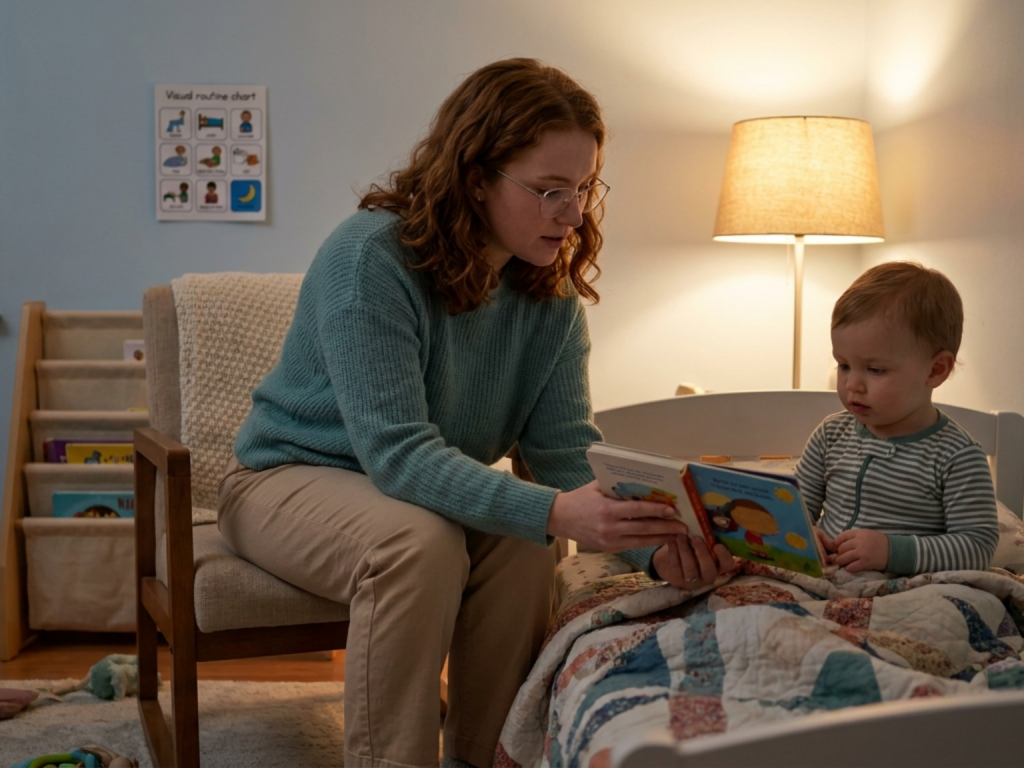
- Read one or two books, sing a short song, say goodnight in the same way, and place the child in the sleep space drowsy or calm when possible.
For many families, predictable bedtime routines also reduce power struggles. A visual chart can help toddlers understand the order without relying on repeated verbal reminders. The caregiver can point to the next step and calmly say, “The chart says pajamas, then books.”
Timing, naps, and the physiology of sleep pressure
Bedtime success often depends on the whole day. Toddlers need enough wake time to build sleep pressure, but not so much that they become overtired and hyperaroused. An overtired toddler may look energetic, silly, defiant, or emotionally volatile because cortisol and sympathetic activation can temporarily mask sleepiness. This is one reason sleep disruption and toddler mood can feel tightly linked.
Most toddlers still nap, but nap timing varies by age and individual need. A late or long nap can reduce sleep pressure at bedtime, while an absent nap in a child who still needs one can produce evening dysregulation. Rather than changing everything at once, caregivers can observe patterns over one to two weeks: bedtime, sleep onset time, night waking, morning wake time, nap timing, and daytime mood.
Time consistency does not require a military schedule. A bedtime window, such as 7:30 to 8:00 p.m., is often more realistic than an exact minute. Shift schedules, shared custody, siblings, and cultural routines may all influence what is sustainable. The goal is a repeated biological and relational cue, not a perfect household performance.
Managing bedtime resistance without escalating conflict
Bedtime resistance is developmentally common. Toddlers are practicing autonomy, testing cause and effect, and coping with separation from caregivers. Refusal may not be manipulative in the adult sense; it often reflects limited inhibitory control, language capacity, and distress tolerance. Responding with calm structure helps more than prolonged debate.
Useful strategies include offering controlled choices: “Blue pajamas or striped pajamas?” “One book or two short books?” Choices should be real but limited. Too many options increase cognitive load and may worsen stalling. A consistent phrase can also help: “It is sleep time. I love you. I will check on you.”
Repeated requests for water, another story, or another hug can be handled with a “bedtime pass” or a final-call routine. For example, before lights out, ask, “Is there anything you need before sleep?” After that, keep responses brief, warm, and boring. This protects connection while reducing reinforcement of endless exits.
If toddler tantrums appear at bedtime, focus first on safety and nervous-system downshifting. Keep language minimal, reduce stimulation, and avoid trying to teach a lesson during peak distress. Later, during the day, practice the bedtime sequence through play, dolls, or picture cards. Rehearsal outside the stressful moment often works better than correction inside it.
Screens, food, drinks, and sensory load
Evening screens can interfere with bedtime through multiple mechanisms: bright light exposure, rapid visual stimulation, emotionally activating content, and difficulty transitioning away from preferred media. For toddlers, the transition itself may be more disruptive than the light exposure alone. A screen-free buffer before bed is usually helpful, especially for children with high reactivity.
Food and drinks also need thoughtful handling. A hungry toddler may not settle well, but frequent snacks after toothbrushing can undermine dental hygiene and create behavioral loops. If a child regularly seems hungry at bedtime, consider a planned evening snack earlier, with protein, fat, or fiber as appropriate for the child’s diet. Avoid caffeine-containing foods or drinks; caregivers may not always realize that some teas, chocolate-containing items, or shared beverages can be stimulating.
Sensory factors matter. Tags, tight pajamas, room temperature, noise, light, nasal congestion, eczema itch, and wet diapers can all increase arousal. Some toddlers settle with a warm bath; others become energized by water play. The right routine is the one that lowers that child’s activation. Families can adjust sensory input while preserving the same overall sequence.
Connection, separation, and emotional security
For many toddlers, bedtime is not mainly about sleep; it is about separation. The child is being asked to stop moving, stop interacting, and tolerate being apart from the caregiver. A short period of focused connection can prevent a long period of protest. This may be a book, quiet talking, a song, a prayer, or a ritual phrase that stays the same every night.
Caregiver affect is clinically meaningful. A rushed, tense, or unpredictable bedtime can increase arousal even when the steps are technically correct. This is not a reason for parents to feel guilty; evenings are hard, especially after work, caregiving, and household demands. It does suggest that making the routine simpler may be better than making it ideal. A five-step routine performed calmly is often more effective than a ten-step routine performed with mounting frustration.
Children who have experienced disruptions, major transitions, hospitalization, parental separation, or trauma may need extra reassurance and a slower approach. In these situations, consult a pediatrician, child psychologist, or appropriately qualified clinician if sleep problems are severe, persistent, or associated with daytime impairment.
When bedtime problems may signal a medical issue
Not all bedtime difficulty is behavioral. Pain, constipation, gastroesophageal reflux symptoms, otitis media, allergic rhinitis, asthma symptoms, eczema, restless sleep, medication effects, and sleep-disordered breathing can all affect sleep. Snoring, gasping, witnessed pauses in breathing, persistent mouth breathing, unusual sweating during sleep, or significant daytime sleepiness should prompt medical evaluation.
Iron deficiency can be associated with restless legs symptoms or periodic limb movements in some children, but caregivers should not start supplements without professional guidance because dosing and indications matter. Similarly, melatonin should not be treated as a harmless routine shortcut. It may be appropriate in select cases under clinician guidance, but behavioral and environmental sleep foundations remain important.
Seek professional support if bedtime battles are escalating, caregivers feel unsafe or overwhelmed, the child’s sleep is severely insufficient, or there are concerns about developmental delay, anxiety, neurodevelopmental differences, or persistent toddler irritability. Pediatric sleep problems are common and treatable, and families deserve support rather than blame.
Making the routine sustainable for real families
The best toddler bedtime routine is one that can survive ordinary life: late dinners, siblings, travel, illness, and caregiver exhaustion. Start by choosing three non-negotiables, such as toothbrushing, pajamas, and one book. Then add optional elements only if they genuinely help. Consistency is more important than complexity.
For families with variable schedules, use an “anchor routine” rather than a fixed clock time. The anchor might be: wash, brush teeth, pajamas, book, song, goodnight. Even if bedtime is later than usual, the sequence remains familiar. In shared-care arrangements, caregivers can agree on a few common steps while allowing each household its own style.
Progress is often uneven. A routine may work for two weeks and then falter during teething, illness, travel, a new sibling, or a developmental leap. Return to the basics without interpreting regression as failure. Toddlers learn through repetition, and caregivers build confidence the same way. A supportive, predictable bedtime is not about controlling a child perfectly; it is about giving their developing brain a reliable path toward sleep.
When to seek medical advice
- Consult a pediatrician if your toddler snores loudly, gasps, pauses breathing, or has persistent mouth breathing during sleep.
- Seek help if sleep loss is severe, worsening, or associated with daytime sleepiness, growth concerns, or behavioral deterioration.
- Discuss pain, reflux symptoms, eczema itching, constipation, asthma, allergies, or medication effects with a healthcare professional.
- Do not start melatonin, iron, sedating antihistamines, or herbal sleep products without clinician guidance.
- If bedtime conflict feels unsafe or unmanageable, ask for pediatric, behavioral health, or family support promptly.
Tools & Assistance
- A simple bedtime visual schedule with 4 to 6 steps
- A one-week sleep diary tracking bedtime, sleep onset, night waking, naps, and mood
- A pediatric visit for snoring, pain, reflux, eczema, or persistent sleep disruption
- A calm-down basket with books, soft music, and quiet sensory items
- Family agreement on a consistent goodnight phrase and response to repeated requests
FAQ
How long should a toddler bedtime routine take?
Many toddlers do well with 30 to 45 minutes. Shorter can work if it is calm and predictable; very long routines may create more opportunities for stalling.
Is a bath necessary every night?
No. A bath helps some toddlers relax but energizes others. Hygiene can be a wash-up, toothbrushing, diaper or toilet routine, and pajamas.
What if my toddler cries when I leave?
Some separation distress is common. Use a consistent, warm goodbye and brief check-ins if needed. If distress is intense, persistent, or linked with trauma or major transitions, seek professional guidance.
Should toddlers fall asleep alone?
Families vary. Independent sleep can reduce some night waking patterns, but changes should be gradual, safe, and developmentally appropriate. Discuss concerns with your pediatrician if sleep is severely disrupted.
Can I use melatonin for my toddler?
Only with clinician guidance. Melatonin may be considered in selected situations, but it is not a substitute for evaluating medical causes and building consistent sleep routines.
Sources
- Frontiers in Sleep — Bedtime routines, development, and caregiver educational attainment in toddlers
- PubMed Central (NIH) — Benefits of a bedtime routine in young children: Sleep, development, and family functioning
- University of Manchester — Study defines ideal children's bedtime routine
Disclaimer
This article is for general educational purposes and does not replace medical care. Consult a qualified healthcare professional for concerns about your child’s sleep, breathing, behavior, medications, or development.















Please log in to leave a comment.