
Intro
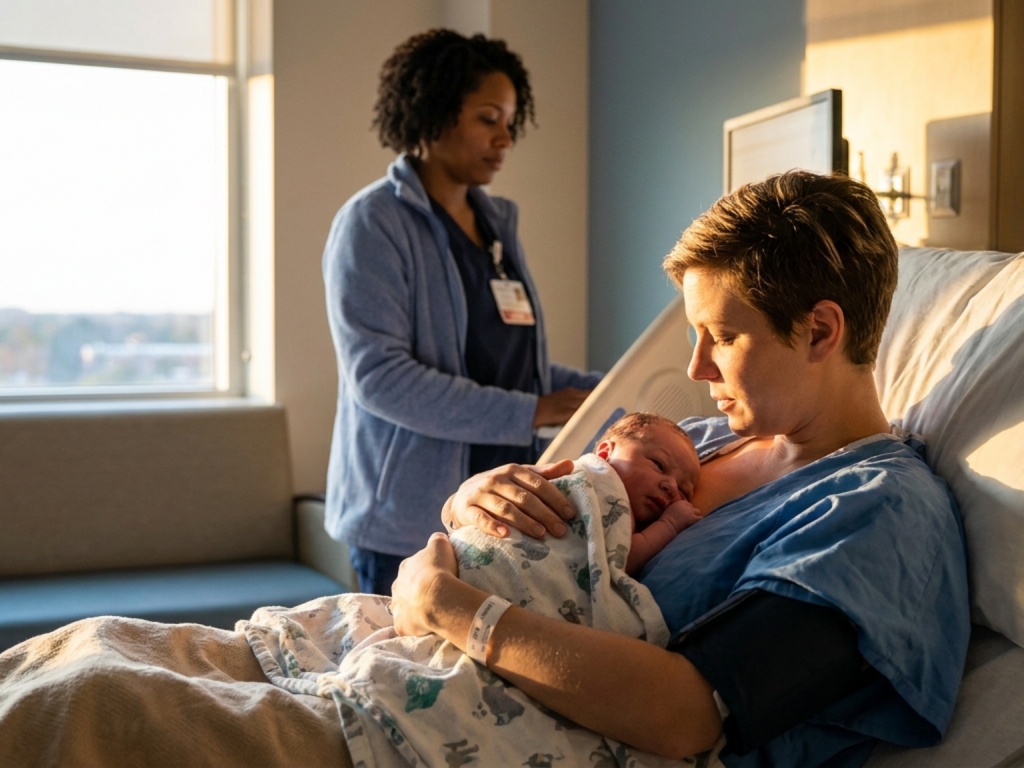
The first hour after birth is a period of rapid physiological adaptation, close clinical observation, and the beginning of the relationship between a mother and her newborn. Often called the golden hour, it can support temperature regulation, early feeding, hormonal responses, and bonding when both are medically stable.
This hour is important, but it is not a rigid deadline or a test of parenting. Urgent treatment must always take priority, and meaningful skin-to-skin contact and feeding support can begin later if birth complications or necessary medical care cause separation.
Highlights
Skin-to-skin contact helps a stable newborn conserve heat and adapt to life outside the uterus.
Breastfeeding within the first hour gives the baby access to colostrum and is associated with improved infant survival.
Early contact may support maternal oxytocin release, uterine contraction, and the beginning of emotional bonding.
Routine care can often be performed while the baby remains with the mother, but medical needs always take priority.
A major physiological transition for the newborn
Birth requires a newborn to move rapidly from placental support to independent breathing and circulation. With the first effective breaths, the lungs expand, fetal lung fluid begins to clear, and pulmonary blood flow increases. Circulatory pathways used before birth start to change as the baby adapts to receiving oxygen through the lungs. This newborn cardiopulmonary transition is usually smooth, but it requires observation because difficulty may become apparent soon after delivery.
The care team assesses breathing effort, heart rate, muscle tone, color, and responsiveness. These observations may be made while a stable baby rests on the mother’s chest. If breathing is ineffective, the heart rate is low, or tone is poor, clinicians may need to move the baby to a warmer for stabilization or resuscitation. Such action should not be delayed to preserve the golden hour.
Newborn thermoregulation is also critical. Babies lose heat quickly through wet skin and exposure to cooler air. Drying the baby, removing wet linens, using warm blankets, and placing the baby skin to skin can reduce heat loss. A hat may be used according to local practice and the baby’s circumstances.
Why skin-to-skin contact matters
For a medically stable mother and baby, uninterrupted skin-to-skin contact means placing the diapered or naked newborn prone on the mother’s bare chest and covering both with a warm blanket. A clinician should ensure that the baby’s face remains visible, the head is turned to one side, the neck is not sharply flexed, and the nose and mouth are unobstructed.
Skin-to-skin contact after birth supports warmth and may help stabilize the newborn’s respiratory rate, heart rate, and blood glucose. It also exposes the baby to the mother’s familiar voice, smell, and heartbeat during an unfamiliar transition. Many newborns progress through alertness, quiet rest, hand-to-mouth movements, rooting, and attempts to reach the breast.
Close supervision remains essential. Maternal exhaustion, sedating medication, anesthesia, significant bleeding, or reduced alertness can make unsupported positioning unsafe. A support person cannot replace clinical observation when either patient is unstable. After a cesarean birth, skin-to-skin contact may still be possible in the operating or recovery area if staffing, positioning, sterility, and maternal condition allow. If the mother cannot safely participate, another parent may sometimes provide supervised skin-to-skin care.
Early breastfeeding and the value of colostrum
The World Health Organization supports initiating breastfeeding within the first hour when mother and baby are able. Early feeding gives the newborn access to colostrum, the concentrated first milk containing immunological components and nutrients. Research has found that delayed breastfeeding initiation is associated with poorer neonatal survival outcomes, although individual circumstances and underlying illness can influence both feeding timing and outcomes.
During the first breastfeed after birth, the baby may lick, nuzzle, root, attach, and suck. This does not need to follow a strict timetable. Some newborns feed promptly, while others need more time, particularly after analgesia, assisted birth, cesarean delivery, prematurity, or a medically complicated labor.
Support should be practical and respectful. A trained professional can assess positioning, latch, swallowing, maternal comfort, and the baby’s alertness. Painful attachment, persistent sleepiness, weak sucking, or inability to maintain a latch warrants a newborn feeding assessment rather than blame or pressure. When direct breastfeeding is temporarily impossible, the care team may discuss hand expression, safe milk collection, donor milk, or formula according to clinical need and family preferences. Early difficulty does not predict long-term failure.
Benefits for the mother during the first hour
The mother is also undergoing a substantial transition. After the placenta is delivered, the uterus should contract firmly to compress blood vessels at the placental site. Oxytocin, released during skin-to-skin contact and nipple stimulation, contributes to uterine contraction and milk ejection. However, contact or breastfeeding is not a substitute for standard prevention, assessment, or treatment of postpartum hemorrhage.
Immediate postpartum monitoring commonly includes uterine tone, vaginal bleeding, blood pressure, pulse, pain, placental completeness, and examination of any perineal injury or surgical incision. Clinicians may provide uterotonic medication and other evidence-based care according to the clinical situation and local protocol. Rapidly increasing bleeding, a persistently poorly contracted uterus, dizziness, altered consciousness, or cardiovascular instability requires urgent management.
The first hour may also provide emotional reassurance. Seeing, touching, and speaking to the baby can support connection after an intense birth experience. Nevertheless, bonding is a continuing relationship rather than a single event. A mother who is frightened, numb, nauseated, exhausted, in pain, or separated for treatment has not missed her opportunity to bond. Trauma-informed care should offer explanations, consent where possible, privacy, and realistic choices without creating guilt.
Assessment and procedures without unnecessary disruption
Many routine newborn procedures can be delayed briefly or completed while the baby remains skin to skin when both patients are stable. Initial observation, identification procedures, and some measurements or medications may be coordinated to protect early contact. Weighing and bathing are generally not more important than stabilization, warmth, observation, and an early feeding opportunity.
Clinical circumstances determine what can safely wait. Vitamin K administration, eye prophylaxis where recommended, physical examination, and other routine newborn procedures should be discussed with the care team. Blood glucose monitoring in newborns may be advised for babies with specific risk factors, such as prematurity, growth restriction, being large for gestational age, or maternal diabetes. Screening should be paired with a plan that supports warmth and feeding whenever possible.
Parents can ask whether non-urgent care may be performed at the bedside, whether skin-to-skin contact can continue during observation, and when separated family members can reunite. These requests should remain flexible because clinical findings can change quickly. Good family-centered care does not mean avoiding medical assessment; it means integrating necessary care with closeness, communication, and respect whenever safety permits.
When temporary separation is necessary
Temporary newborn separation may be necessary when the baby needs resuscitation, respiratory support, treatment for significant hypothermia or hypoglycemia, evaluation of possible infection, or neonatal intensive care. Maternal reasons include uncontrolled bleeding, severe hypertension, loss of consciousness, emergency surgery, or post-anesthesia recovery after cesarean birth. In these situations, prompt medical treatment provides the strongest protection for future contact and recovery.
If separation occurs, families can ask for clear updates, photographs when permitted, and opportunities for the other parent to accompany the baby. The mother may request help with hand expression when lactation is desired and medically appropriate. Even small amounts of colostrum can be collected according to hospital procedures, but production varies and should not become another source of pressure.
Reconnection can begin as soon as both patients are stable. Later skin-to-skin care, responsive holding, feeding assistance, and quiet time together remain valuable. There is no evidence-based reason to regard a disrupted first hour as irreversible harm. The golden hour is best understood as a care priority when feasible, not as a guarantee of a particular medical, feeding, or emotional outcome.
Preparing for a safe and supported first hour
Before labor, discuss preferences with the obstetric, midwifery, pediatric, and anesthesia teams. Families may request immediate skin-to-skin care, delayed non-urgent measurements, lactation support, and rapid reunification after necessary treatment. These preferences can be included in a birth plan, but the plan should acknowledge that maternal and newborn conditions may require changes.
During the first hour, ask what clinicians are monitoring and why. Immediate postpartum monitoring protects the mother while newborn observation evaluates breathing, warmth, tone, and feeding readiness. Parents should speak up if the baby’s face becomes covered, breathing appears labored, color seems blue or gray, the baby becomes unusually limp, or the mother feels faint or notices heavy bleeding.
Families planning birth outside a hospital need qualified attendants, appropriate newborn resuscitation equipment, medications and protocols for maternal emergencies, and a clear transfer pathway. They should know newborn danger signs and postpartum hemorrhage warning signs and have reliable emergency transport. Wherever birth occurs, the safest first hour combines closeness with skilled observation, rapid access to treatment, and compassionate communication.
Seek immediate clinical help
- The baby is not breathing normally, has persistent grunting or chest retractions, or appears blue, gray, very pale, or unusually limp.
- The baby is difficult to wake, cannot feed, has abnormal movements, or feels persistently cold despite warming measures.
- The mother has heavy or rapidly increasing bleeding, large clots, faintness, confusion, chest pain, or difficulty breathing.
- The mother develops severe headache, visual disturbance, marked weakness, or sudden severe abdominal or pelvic pain.
- Never continue skin-to-skin positioning without supervision if the mother is drowsy, sedated, unwell, or unable to observe the baby's airway.
Tools & Assistance
- Discuss a flexible golden-hour plan with the maternity team before labor.
- Request bedside lactation support for positioning, latch, hand expression, or alternative feeding.
- Ask the care team which assessments are urgent and which procedures can safely wait.
- Use the hospital call system or local emergency service immediately for maternal or newborn danger signs.
- Arrange qualified birth attendance and an emergency transfer plan for any planned out-of-hospital birth.
FAQ
Is the golden hour exactly 60 minutes?
No. It describes a protected early period for adaptation, observation, contact, and feeding rather than a rigid deadline.
What if my baby does not breastfeed in the first hour?
Continue skin-to-skin care if safe and ask for feeding assessment and lactation support. Some babies need extra time or medical help, and a delayed first feed does not mean breastfeeding cannot succeed.
Can skin-to-skin contact happen after a cesarean birth?
Often yes, if mother and baby are stable and the operating or recovery team can position and monitor them safely. If it must be delayed, contact can begin later.
Should routine procedures always be postponed?
No. Non-urgent care may often wait or occur at the bedside, but assessment and treatment should proceed immediately when there is a medical concern.
Does separation during the first hour damage bonding?
No. Bonding develops over time through repeated care and interaction. Necessary separation does not prevent a secure relationship or eliminate the value of later skin-to-skin contact.
Sources
- World Health Organization — Support for mothers to initiate and establish breastfeeding
- PubMed — Timing of initiation, patterns of breastfeeding, and infant survival
- Office on Women's Health — Your baby's first hours of life
Disclaimer
This article provides general medical information and is not a substitute for individualized care. Consult qualified maternity and neonatal professionals about your circumstances, and seek emergency help for urgent warning signs.

















Please log in to leave a comment.