
Intro
Moving a baby from one activity to another can feel surprisingly intense: play to diaper change, feeding to sleep, stroller to car seat, bath to pajamas, or floor time to leaving the house. Babies do not yet understand time, sequence, or adult priorities the way older children do. They rely on sensory cues, caregiver co-regulation, and repeated routines to know what is happening next.
A smoother transition is not about making a baby perfectly compliant. It is about reducing uncertainty, protecting physiologic needs such as feeding and sleep, and helping the nervous system shift states. With predictable signals, simple language, and enough time, many babies and toddlers can learn that endings are safe and that the next activity will be supported.
Highlights
Babies transition best when caregivers pair predictable routines with warm, responsive support.
Visual cues, brief verbal warnings, songs, clapping rhythms, and consistent order can reduce distress during activity changes.
A difficult transition may reflect hunger, fatigue, overstimulation, pain, separation anxiety, or a mismatch with age-appropriate wake windows.
Transitions should be flexible: the goal is not rigid scheduling but a cue-based baby routine that respects your child’s signals.
Why activity transitions can be hard for babies
For a baby, an activity is not just an item on a schedule. It is a whole sensory state: body position, lighting, sound, caregiver proximity, temperature, hunger level, and emotional tone. Moving from one state to another asks the infant brain to process new sensory input while also tolerating the loss of something familiar or enjoyable.
Young infants have limited self-regulation. Their autonomic nervous system, which helps shift between alertness, calm, feeding, and sleep, is still maturing. Toddlers have more mobility and preference, but their executive function is immature; they may understand a routine in fragments but still struggle with impulse control and frustration tolerance.
This is why a baby may cry when play ends, arch during a diaper change, resist being placed in a car seat, or melt down when leaving the park. These reactions are not necessarily misbehavior. Often they are communication: “I was not ready,” “I am tired,” “That was too abrupt,” “I need help organizing my body,” or “I do not know what comes next.”
Build predictable cues before you need them
The easiest transition is the one your baby has learned to anticipate. Predictability lowers cognitive load and gives the child’s nervous system a pattern to recognize. This does not mean every day must be identical. It means important routines have repeated cues, such as the same words before diapering, the same song before cleanup, or the same sequence before sleep.
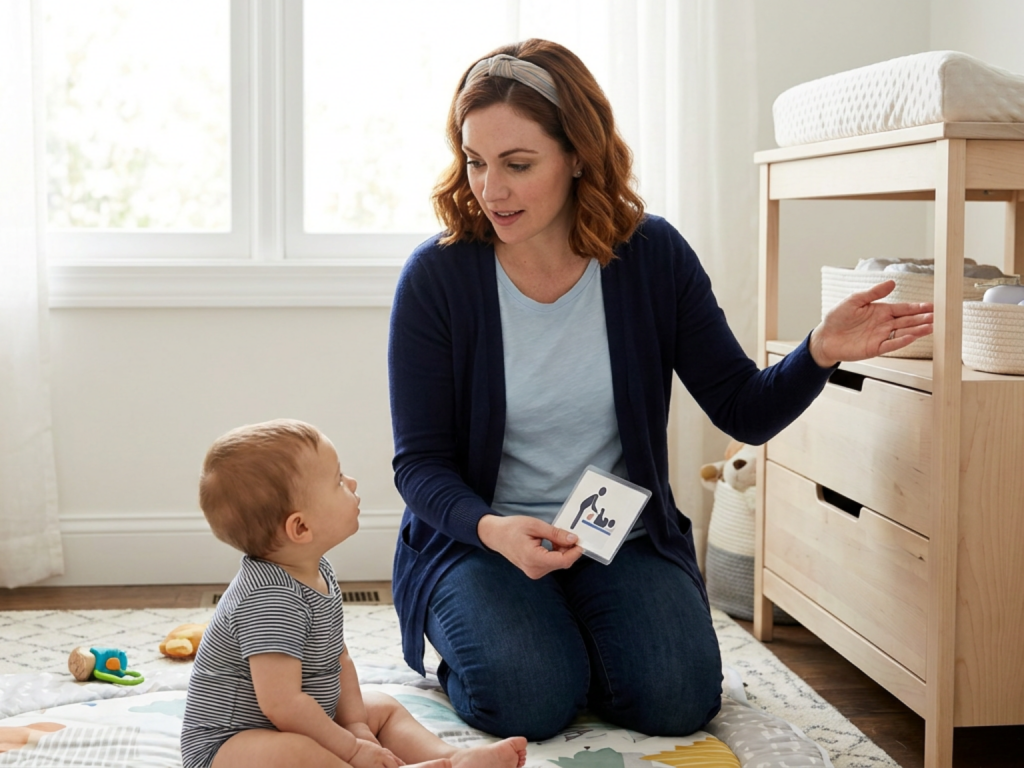
A useful framework is a cue-based baby routine: observe your baby’s signals, then respond with a repeated rhythm. For example, after floor play you might say, “All done playing. Diaper time, then milk,” while showing the diaper. Over time, the words, object, and caregiver movement become a transition map.
For babies and toddlers, cues work best when they are multisensory:
- Auditory cues: a short song, a gentle bell, a clapping rhythm, or the same calm phrase.
- Visual cues: showing a diaper, sleep sack, bottle, spoon, shoes, or a simple picture schedule.
- Tactile cues: a hand on the shoulder, a cuddle, or helping the baby hold a transitional object when safe and age-appropriate.
- Environmental cues: dimming lights before sleep, putting toys in a bin before leaving, or moving to the feeding chair.
Head Start guidance emphasizes simple picture schedules, warnings before changes, engaging signals such as clapping rhythms, and consistent routines between home and care settings. These strategies help infants and toddlers feel secure because the next step is not a surprise.
Use clear, specific transition language
During transitions, long explanations can overwhelm a baby or toddler. Short, concrete language is more effective. Occupational therapy guidance often recommends pairing the child’s name with the action, reason, and next step. For example: “Maya, shoes on. We are going outside. Then stroller.” Or: “Leo, diaper change now. Clean body. Then blocks.”
The structure matters because it reduces ambiguity. The baby hears their name, the required action, why it is happening, and what comes next. Your voice tone is part of the intervention: calm, low, and confident tends to be more regulating than urgent repetition.
Try phrases such as:
- “All done bath. Towel now. Pajamas next.”
- “Two more turns. Then stroller.”
- “Clean diaper first. Then cuddle.”
- “Milk is finished. We burp, then book.”
- “Blocks in basket. Then snack.”
For toddlers, adding a very small choice can preserve autonomy without making the transition optional: “Do you want to hop to the changing mat or be carried?” “Do you want the red cup or blue cup after cleanup?” Avoid choices you cannot honor, such as “Are you ready to leave?” if leaving must happen immediately. Instead, you can say, “It is time to leave. Wave bye-bye to the swings.”
Give warnings, but keep them developmentally realistic
Warnings help because they soften the boundary between activities. The OT Toolbox recommends advance notice, such as 5-minute and 2-minute warnings, often paired with audio or visual cues. For older toddlers, this can work well. For babies and younger toddlers, time is abstract, so pair the warning with something observable: “Two more songs,” “One more page,” or “After this diaper, we go to the car.”
Useful transition warnings include:
- Countdown by event: “One more block tower, then lunch.”
- Countdown by body action: “Three more pushes on the swing, then all done.”
- Countdown by song: “When the cleanup song ends, we wash hands.”
- Countdown by picture: point to “play,” then “diaper,” then “nap” on a simple visual schedule.
If warnings seem to make your toddler more distressed, shorten the lead time. Some children become anxious when told too early. Others need extra processing time. Watch your child’s response and adjust. A transition plan should be individualized, not a test of obedience.
Support the body: hunger, fatigue, pain, and sensory load
A baby’s ability to transition is strongly affected by physiologic state. Hunger, reflux discomfort, constipation, teething pain, fever, overtiredness, or overstimulation can make an ordinary change feel intolerable. Before assuming a behavioral problem, consider whether the transition is colliding with a body need.
Feeding-related transitions are a common example. Moving from play to feeding, or feeding to sleep, may be smoother when caregivers notice hunger cues and fullness cues rather than relying only on the clock. A baby who is already frantic with hunger may not tolerate a diaper change first; a baby who is full and drowsy may need a slower burp-and-cuddle transition before being placed down.
Sleep transitions also depend on timing. If a baby is far beyond age-appropriate wake windows, even gentle cues may not prevent crying. Conversely, if a baby is not sleepy enough, a nap routine may become a prolonged struggle. A predictable bedtime routine can help by repeating the same low-stimulation sequence: feed if appropriate, diaper, pajamas, dim light, book or song, safe sleep space.
Sensory load matters as well. Some babies are sensitive to abrupt changes in sound, temperature, touch, or movement. For these babies, reduce the number of simultaneous changes. For instance, before a diaper change, warm your hands, narrate the step, keep lighting soft, and offer a safe toy. Before leaving a loud gathering, spend a minute in a quieter hallway before placing the baby in the car seat.
Make transitions playful without losing the boundary
Play can help a baby’s brain bridge from one activity to the next. The goal is not distraction at all costs; it is engagement that keeps the child connected while the transition happens. The OT Toolbox describes creative transition activities such as “I Spy” and transition songs. For babies, these can be simplified into rhythmic language, imitation, or object-based play.
Examples include:
- Transition song: use the same short melody for cleanup, diapering, or going outside.
- Movement cue: “Wiggle, wiggle, stop. Now arms in sleeves.”
- I Spy for toddlers: “I spy your shoes. Shoes mean outside.”
- Object handoff: let the baby carry a safe small item from play area to changing area.
- Bye-bye ritual: wave to the bath, the blocks, the park, or the high chair before leaving.
Keep the boundary clear. If diaper time has started, do not restart play repeatedly to avoid tears. Instead, validate and proceed gently: “You wanted more blocks. That is hard. Diaper now, blocks later.” This teaches that feelings are accepted while routines remain dependable.
Coordinate transitions across caregivers and settings
Babies often transition better when the adults use similar cues. If home, childcare, and grandparents all use completely different routines, the child has to relearn expectations in each setting. Consistency does not require identical parenting styles, but shared signals can help.
Consider writing down a simple transition plan: the words used before nap, the song for cleanup, how much warning the child needs, comfort items that are safe for the situation, and what tends to escalate distress. Head Start recommends maintaining consistent routines between home and care and using family photos to help children feel secure. A photo of caregivers in a cubby or bag can support a toddler during separations or changes in location.
If your baby has developmental differences, prematurity, sensory processing challenges, feeding concerns, or a medical condition, transitions may need more individualized support. An occupational therapist, pediatrician, developmental specialist, lactation professional, or feeding therapist may help identify whether the issue is sensory modulation, motor discomfort, oral-motor fatigue, sleep timing, separation anxiety, or another factor. Seek professional guidance rather than trying to diagnose the cause yourself.
When to seek medical or developmental advice
- Contact a pediatrician promptly if transition distress is accompanied by fever, lethargy, poor feeding, dehydration signs, breathing difficulty, or persistent vomiting.
- Ask for guidance if crying during position changes seems pain-related, especially with back arching, limb guarding, or sudden worsening.
- Discuss concerns if your baby consistently cannot settle after routine transitions despite responsive support and adequate sleep and feeding.
- Seek urgent help if you are afraid you might shake, hit, or otherwise harm your baby; place the baby safely in the crib and call for support.
- Consider referral to early intervention or occupational therapy if sensory distress, motor delays, feeding difficulties, or developmental regression are present.
Tools & Assistance
- Create a two- or three-picture visual schedule for common routines such as play, diaper, and nap.
- Use a consistent transition song or clapping rhythm before recurring changes.
- Keep a brief log of difficult transitions, noting sleep, feeding, environment, and timing.
- Share the same transition phrases with childcare providers or relatives.
- Consult a pediatrician, occupational therapist, or early intervention program if transitions remain persistently overwhelming.
FAQ
How much warning does a baby need before changing activities?
Young babies usually need immediate sensory cues rather than clock-based warnings. Older toddlers may benefit from 2-minute or 5-minute warnings, especially when paired with a song, picture, or concrete event such as “one more book.”
Should I avoid transitions that make my baby cry?
Not always. Some necessary transitions, such as diapering, car seats, bathing, and sleep routines, may cause protest. The aim is to keep the boundary gentle, predictable, and safe while validating your baby’s distress.
Are visual schedules useful for infants?
Simple visual cues can help, especially for older infants and toddlers. Use real photos or clear pictures for familiar steps, such as eating, diapering, stroller, bath, and bed.
What if my toddler runs away during every transition?
Reduce the number of words, move closer before giving the cue, offer a small controlled choice, and use a playful movement prompt. If running creates safety risks or is part of broader developmental concerns, discuss it with a professional.
Can a routine be too rigid?
Yes. Routines should provide predictability without ignoring illness, hunger, fatigue, travel, or family needs. Flexible consistency is usually more helpful than strict scheduling.
Sources
- The OT Toolbox — Transitions for Children
- HeadStart.gov — Support Transitions for Infants and Toddlers
- The OT Toolbox — Transitions for Children
Disclaimer
This article is for general educational purposes only and does not replace medical, developmental, or mental health advice. Consult your child’s healthcare professional for concerns about feeding, sleep, pain, development, or persistent distress.

















Please log in to leave a comment.