
Intro
School routines are meant to help children feel safe, learn efficiently, and move through the day with less uncertainty. Yet for many children and families, the same routines can become sources of stress: early mornings, rushed transitions, homework overload, social pressure, fatigue, and difficulty shifting between home and school expectations.
These challenges are not a sign that a child is “bad” or that caregivers are failing. Often, they reflect a mismatch between a child’s developmental needs, neurobiology, health status, and the structure of the school day. A supportive approach looks for patterns, reduces unnecessary friction, and involves educators and healthcare professionals when concerns persist.
Highlights
School routine challenges often arise when rigid schedules collide with children’s sleep needs, executive function limits, emotional regulation, or health conditions.
Early start times, rushed mornings, and excessive homework can contribute to fatigue, stress, reduced engagement, and family conflict.
Children usually do better when routines are predictable but flexible, with planned supports for transitions, meals, movement, rest, and communication.
Persistent school refusal, severe anxiety, sleep disruption, headaches, abdominal pain, or major mood changes should prompt consultation with appropriate professionals.
Why school routines can become difficult
A school routine is more than a timetable. It is a sequence of behavioral expectations: waking, dressing, eating, commuting, entering a classroom, following instructions, shifting between subjects, managing peers, completing homework, and preparing for sleep. For some children, this structure is calming. For others, especially during illness, family stress, developmental transitions, or learning demands, the routine can feel like a continuous series of high-pressure transitions.
Research on school routines during challenging situations describes an important tension: established routines provide order, but rigid routines can fail when circumstances change. Schools may need to regulate behavior, maintain safety, and continue instruction while also adapting to unexpected needs. This balance between consistency and flexibility is central to understanding school routine challenges. A child who struggles may not be rejecting structure; they may be showing that the current structure does not fit their capacity that day.
Children rely heavily on developing executive functions, including working memory, inhibition, planning, time awareness, and cognitive flexibility. These skills mature gradually. A routine that appears simple to an adult may require a child to coordinate multiple steps under time pressure. When the demand exceeds the child’s available capacity, the result may look like procrastination, oppositional behavior, crying, shutting down, or repeated “forgetting.”
Morning pressure and sleep timing
Mornings are one of the most common flashpoints. Early school start times can conflict with biological sleep patterns, particularly in adolescents, whose circadian rhythm tends to shift later. Even younger children may struggle if they have insufficient sleep, inconsistent bedtimes, sleep-disordered breathing, nighttime anxiety, pain, or excessive evening screen stimulation.
Evidence summarized by the Brookings Institution indicates that later school start times can improve academic outcomes and reduce absences and disciplinary problems, especially for older students. This does not mean every family can change the school schedule, but it highlights that morning difficulty is not always a motivation problem. Fatigue affects attention, emotional regulation, processing speed, appetite, and frustration tolerance.
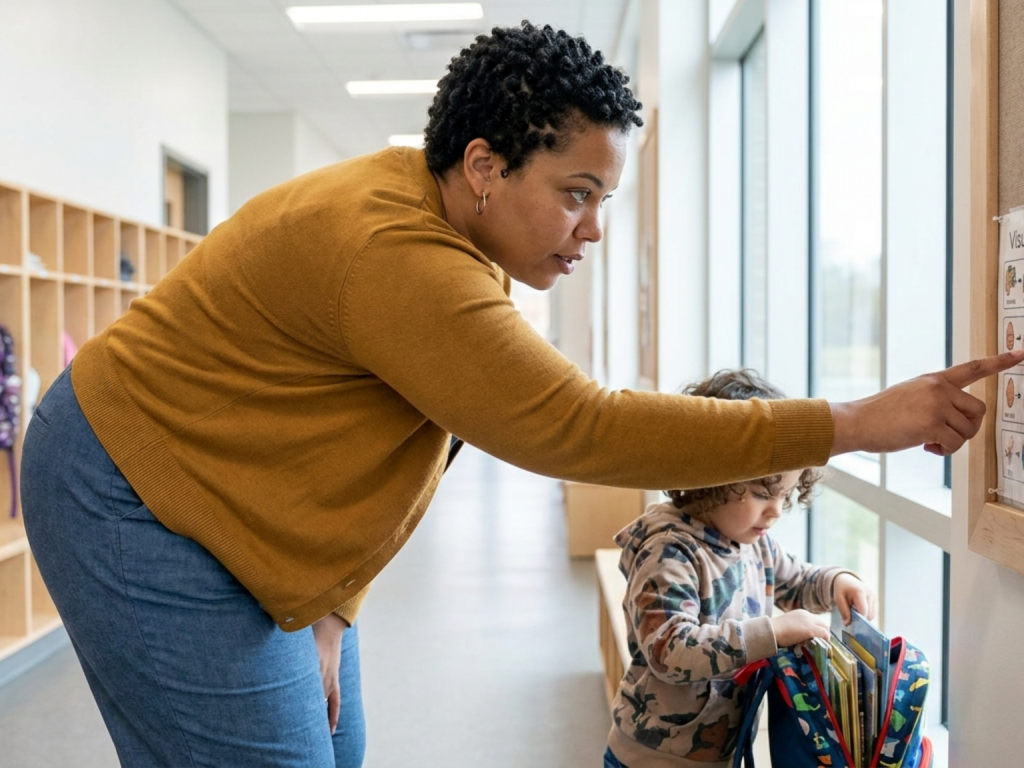
Families can often reduce morning overload by moving decisions and tasks to the evening: packing bags, choosing clothes, preparing lunch components, checking school forms, and setting out medications if prescribed by a clinician. A visual schedule can help younger children because it externalizes the sequence rather than relying on memory. For older children, a collaborative checklist may feel more respectful than repeated verbal reminders.
If a child consistently wakes unrefreshed, snores, has morning headaches, falls asleep in class, or has marked mood changes linked to sleep, caregivers should discuss this with a pediatrician or qualified healthcare professional. Sleep problems are common and treatable, but they require careful assessment rather than assumptions.
Transitions, sensory load, and classroom demands
The school day contains many transitions: arrival, lining up, moving between rooms, changing activities, lunch, recess, assemblies, and dismissal. For children with anxiety, attention differences, autism spectrum traits, sensory processing sensitivities, developmental coordination difficulties, or trauma histories, transitions can be disproportionately demanding. Noise, crowding, bright lights, unpredictable peer behavior, and rapid instructions can increase physiological arousal.
A child under high arousal may enter a fight, flight, freeze, or fawn pattern. In school, this can appear as arguing, bolting, refusal, excessive compliance followed by collapse, or inability to start work. The behavior is real, but the interpretation matters. Punishment alone may not teach the missing skill or reduce the underlying load.
Helpful school-based supports may include advance warnings before transitions, a consistent arrival routine, written instructions, seating adjustments, movement breaks, reduced sensory exposure when feasible, and a trusted adult check-in. These supports are not “special treatment” in the everyday sense; they are environmental modifications that can help a child access learning.
For some children, formal evaluation may be appropriate through the school system or healthcare services. Caregivers can request discussion with teachers, school counselors, special education teams, occupational therapists, psychologists, or pediatric clinicians depending on the concern. The goal is not to label every difficulty, but to understand whether there are modifiable barriers to participation.
Homework overload and the after-school crash
After school, many children appear more dysregulated at home than they did in class. This can happen because they have spent the day inhibiting impulses, tolerating sensory input, navigating social rules, and meeting academic expectations. Once home, the nervous system may release accumulated stress. Caregivers may see tears, irritability, hunger, withdrawal, or refusal to begin homework.
Homework can be useful when it reinforces learning and is developmentally appropriate. However, research reported by Stanford University found that more than two hours of homework may be counterproductive for many students, with links to stress, sleep deprivation, headaches, exhaustion, and reduced time for developmental needs. The issue is not simply the amount of work, but the total daily load: school hours, commuting, extracurricular activities, chores, meals, hygiene, family time, and sleep.
An after-school homework routine is usually more effective when it begins with decompression. This may include a snack, hydration, movement, quiet time, or a brief connection with a caregiver before academic demands resume. A distraction-reduced homework area can help some children, while others need an adult nearby to co-regulate and break work into short intervals.
If homework routinely takes far longer than expected, produces panic, or requires extensive adult reteaching, it is worth communicating with the teacher. The child may need clearer instructions, reduced volume, assistive technology, assessment for learning differences, or a better match between workload and developmental capacity.
Health, emotions, and school avoidance signals
School routine challenges can be intensified by medical and psychological factors. Recurrent abdominal pain, headaches, fatigue, dizziness, appetite changes, toileting issues, chronic pain, medication side effects, allergies, asthma symptoms, or menstrual symptoms can all interfere with attendance and participation. Emotional factors such as separation anxiety, generalized anxiety, depression, bullying, social exclusion, perfectionism, or fear of failure may also show up as routine resistance.
School avoidance exists on a spectrum. A child may complain each morning, repeatedly visit the nurse, miss certain classes, or become distressed on Sunday evenings. These patterns deserve curiosity rather than immediate blame. Ask when the distress starts, what situations make it worse, what helps, and whether there are specific triggers such as tests, lunch, a bus ride, a peer group, or a particular classroom.
Caregivers should avoid making a diagnosis based only on behavior at home. Instead, gather information from multiple settings. Teachers may observe academic struggles, peer conflict, inattention, or fatigue that is not visible to the family. Healthcare professionals can evaluate symptoms, sleep, growth, nutrition, medication effects, mood, anxiety, and other medical contributors.
When a child is distressed, a gradual and supported plan is often more helpful than either forcing full participation without support or allowing complete avoidance indefinitely. Plans should be individualized and may involve school staff, pediatricians, mental health professionals, and, when relevant, learning support teams.
Building routines that are predictable but flexible
The most sustainable routines combine consistency with adaptability. Predictability reduces cognitive load because the child knows what comes next. Flexibility prevents the routine from becoming brittle when illness, poor sleep, family disruption, or school changes occur. This principle is especially important during crises or unexpected events, when schools and families may need to modify standard practices quickly.
A useful approach is the “minimum viable routine”: identify the few non-negotiable steps needed for health, safety, and attendance, then add optional steps only when capacity allows. For example, a morning minimum might be toileting, medication if prescribed, clothing, food, and school materials. Extras such as elaborate breakfasts, perfect hair, or extended discussions may need to wait on difficult days.
Children are more likely to cooperate when routines are visible, practiced, and emotionally neutral. Use short instructions, calm repetition, timers if tolerated, and specific praise for effort. For preteens and teens, collaborative teen routines often work better than adult-designed schedules imposed without discussion. A child can help choose the order of tasks, decide where reminders should appear, and identify what makes transitions easier.
Schools can support flexibility by reviewing whether policies unintentionally increase distress: very early start times, crowded arrival procedures, limited bathroom access, abrupt transitions, excessive homework, or punitive responses to fatigue-related behavior. Families can support schools by sharing relevant information concisely and respectfully, focusing on patterns and solutions rather than blame.
Working with the school and knowing when to seek help
When routine challenges persist, documentation helps. Track sleep duration, morning behavior, attendance, physical symptoms, homework time, emotional triggers, and recovery time after school. Patterns often become clearer after one or two weeks. Bring this information to teacher meetings or healthcare appointments.
Communication with school should be specific. Instead of saying, “Mornings are impossible,” try: “On four of five school days, my child cried before leaving and reported stomach pain; the distress was worse on days with math tests.” Specific data makes it easier to identify whether the issue is academic, social, sensory, medical, sleep-related, or a combination.
Seek professional support promptly if a child has escalating school refusal, significant weight change, persistent insomnia, self-harm talk, panic symptoms, frequent unexplained pain, bullying concerns, regression, or major loss of functioning. A pediatrician may be a good first point of contact, with referral to mental health, developmental-behavioral, sleep, neurology, gastroenterology, or educational specialists as appropriate.
Most importantly, children need to feel that adults are on their team. Support does not mean removing all expectations. It means adjusting the pathway so the child can meet expectations with dignity, safety, and realistic developmental support.
When to take school routine problems seriously
- Seek urgent help if a child talks about self-harm, suicide, or not wanting to live.
- Consult a healthcare professional for persistent headaches, abdominal pain, fatigue, dizziness, sleep problems, or weight changes.
- Act quickly if school distress is linked to bullying, harassment, violence, or fear of a specific person or place.
- Do not start, stop, or change medication to manage school behavior without guidance from a prescribing clinician.
- Request professional input if attendance drops, family conflict escalates, or the child’s functioning declines across home and school.
Tools & Assistance
- One-week routine log tracking sleep, symptoms, homework time, and distress triggers
- Teacher or school counselor meeting focused on patterns and practical accommodations
- Pediatric appointment for persistent physical symptoms, fatigue, or sleep concerns
- Visual schedule, checklist, or timer chosen according to the child’s developmental level
- Brief after-school decompression plan before homework or chores
FAQ
Is it normal for children to resist school routines?
Some resistance is common, especially during transitions, after poor sleep, or during developmental changes. Persistent distress, physical symptoms, or declining attendance deserves closer attention.
How much homework is too much?
There is no single number for every child, but research suggests that more than two hours may become counterproductive for many students. If homework regularly disrupts sleep, health, or family life, discuss it with the school.
Should I let my child stay home when school causes anxiety?
This depends on severity and safety. Avoidance can sometimes worsen anxiety, but forcing attendance without support can also be harmful. Consult the school and a qualified health or mental health professional for an individualized plan.
What if my child behaves well at school but melts down at home?
This can happen when a child uses significant self-control during the school day and releases stress afterward. Food, rest, movement, and a low-demand transition period may help.
When should learning differences be considered?
Consider evaluation if homework takes unusually long, instructions are often misunderstood, reading or writing causes distress, grades decline, or the child avoids specific subjects despite effort.
Sources
- National Center for Biotechnology Information (NCBI) / PubMed Central — Adapting routines in schools when facing challenging situations
- Brookings Institution — What new research tells us about elementary and middle school start times
- Stanford University — More than two hours of homework may be counterproductive, research suggests
Disclaimer
This article is for informational purposes only and does not replace medical, mental health, or educational evaluation. Consult qualified professionals for concerns about a child’s symptoms, development, learning, behavior, or safety.

















Please log in to leave a comment.