
Intro
Alcohol use in pregnancy is a sensitive topic. Many people have had a drink before they knew they were pregnant, while others may find stopping difficult because alcohol is part of social life, stress coping, or an alcohol use disorder. The goal of this article is not to judge, but to explain the medical evidence clearly and to encourage timely, compassionate support.
Major public-health and obstetric organizations advise avoiding alcohol throughout pregnancy because no known safe amount, safe type, or safe timing has been established. Alcohol exposure can affect fetal growth, pregnancy outcomes, and long-term neurodevelopment, including fetal alcohol spectrum disorders, of which fetal alcohol syndrome is the most clinically recognizable form.
Highlights
There is no established safe level of alcohol consumption in pregnancy; abstinence is the safest recommendation.
Alcohol can cross the placenta and expose the fetus to concentrations that may impair organ development, brain maturation, and growth.
Pregnancy risks linked to alcohol include miscarriage, preterm birth, stillbirth, low birthweight, and fetal alcohol spectrum disorders.
Unintentional drinking before a positive pregnancy test is common and is not a reason to panic; stopping now and discussing concerns with a clinician is the best next step.
If stopping alcohol feels difficult, medical and behavioral support can help, and asking for help early is a protective step for both parent and baby.
Why alcohol is risky in pregnancy
Ethanol crosses the placenta readily. This means that when a pregnant person drinks alcohol, the fetus is exposed too. Unlike an adult, the fetus has immature metabolic pathways and limited ability to clear alcohol and its byproducts. Exposure can therefore interfere with cellular signaling, oxidative balance, placental function, nutrient transport, and the tightly timed processes of organogenesis and brain development.
The fetal brain is vulnerable throughout pregnancy. Early exposure may affect neural tube and craniofacial development, while later exposure can disrupt neuronal migration, synapse formation, myelination, and growth of brain structures involved in attention, learning, memory, impulse control, and adaptive behavior. Because development is continuous, there is no point in pregnancy that is considered completely risk-free for alcohol exposure.
Medical guidance from the CDC, NHS, and published reviews is consistent: no known safe amount of alcohol during pregnancy has been established. This includes wine, beer, spirits, cocktails, and lower-alcohol drinks. The safest approach is to avoid alcohol when pregnant, when trying to conceive, or when pregnancy is possible and alcohol use is not reliably separated from early pregnancy.
Pregnancy outcomes linked to alcohol exposure
Alcohol exposure is associated with several adverse pregnancy outcomes. Research summarized in medical reviews and public-health guidance links alcohol use during pregnancy with impaired fetal growth, miscarriage, preterm labor or preterm birth, stillbirth, and low birthweight. These outcomes are multifactorial, and alcohol is rarely the only variable in real life, but its potential contribution is clinically important because it is modifiable.
Possible pregnancy-related risks include:
- Miscarriage, particularly with heavier or repeated exposure.
- Preterm birth, which can lead to respiratory, feeding, temperature regulation, and neurodevelopmental complications.
- Stillbirth, a rare but devastating outcome associated with multiple maternal, placental, and fetal risk factors.
- Fetal growth restriction and low birthweight, which may affect newborn adaptation and long-term cardiometabolic health.
- Neurodevelopmental injury that may not be obvious at birth but can emerge later in childhood.
Risk generally increases with greater total alcohol exposure, frequent use, and binge drinking. However, because individual susceptibility varies and because studies cannot ethically define a guaranteed safe threshold, medical bodies do not recommend trying to calculate a “safe” number of drinks.
Fetal alcohol spectrum disorders and fetal alcohol syndrome
Fetal alcohol spectrum disorders, often abbreviated FASD, describe a range of lifelong physical, cognitive, behavioral, and learning effects caused by prenatal alcohol exposure. Fetal alcohol syndrome, or FAS, is one diagnosis within this spectrum and is typically associated with a characteristic pattern of growth deficiency, central nervous system abnormalities, and certain facial features. Not every child affected by prenatal alcohol exposure has the full facial or growth pattern, which is why the broader spectrum concept is important.
Potential features of FASD can include:
- Prenatal or postnatal growth impairment.
- Microcephaly or other evidence of altered brain development.
- Learning difficulties, especially with memory, mathematics, and executive function.
- Attention problems, impulsivity, emotional dysregulation, and difficulty with social judgment.
- Speech, language, motor coordination, or sensory processing challenges.
- Problems with adaptive functioning, such as planning, time management, safety awareness, and independent living skills.
FASD is not a matter of willpower or poor parenting. It reflects neurodevelopmental injury. Early recognition, structured environments, educational accommodations, occupational or speech therapy, mental-health support, and family-centered care can improve function and quality of life. A diagnostic evaluation should be performed by qualified clinicians familiar with developmental assessment and prenatal exposure history.
Does timing or type of alcohol matter?
Timing does matter biologically because different organs and brain systems develop at different stages. Heavy exposure in early pregnancy may coincide with organ formation and craniofacial development. Exposure later in pregnancy may affect growth and brain maturation. However, timing does not translate into a medically endorsed safe window. The CDC states there is no known safe time to drink alcohol during pregnancy.
The type of alcohol does not make exposure safe. A standard drink of beer, wine, or spirits contains ethanol, and ethanol is the substance of concern. The pattern of drinking is also important. Binge drinking can produce higher peak blood alcohol concentrations, which may be especially harmful to the developing fetus. Still, lower-level regular drinking has not been proven safe.
It is also worth noting that early pregnancy can be unrecognized for several weeks. For people trying to conceive, or not using reliable contraception and open to pregnancy, discussing alcohol use with a healthcare professional can be useful. The aim is not to impose blame but to make prevention realistic and supportive.
If you drank before knowing you were pregnant
Many pregnancies are discovered after some alcohol exposure has already occurred. If this happened to you, the most important message is: do not panic, and do not assume harm has occurred. The NHS specifically acknowledges that drinking in early pregnancy before awareness is common and advises stopping once pregnancy is known and seeking advice if concerned.
Useful next steps include:
- Stop drinking alcohol from now on, if you can do so safely.
- Tell your midwife, obstetrician, family doctor, or prenatal care clinician what happened, including approximate timing, amount, and pattern of drinking.
- Attend routine prenatal visits and recommended ultrasound or screening appointments.
- Avoid replacing alcohol with non-prescribed sedatives, recreational drugs, or other substances without medical advice.
- Ask for help promptly if cravings, withdrawal symptoms, anxiety, depression, or social pressure make stopping difficult.
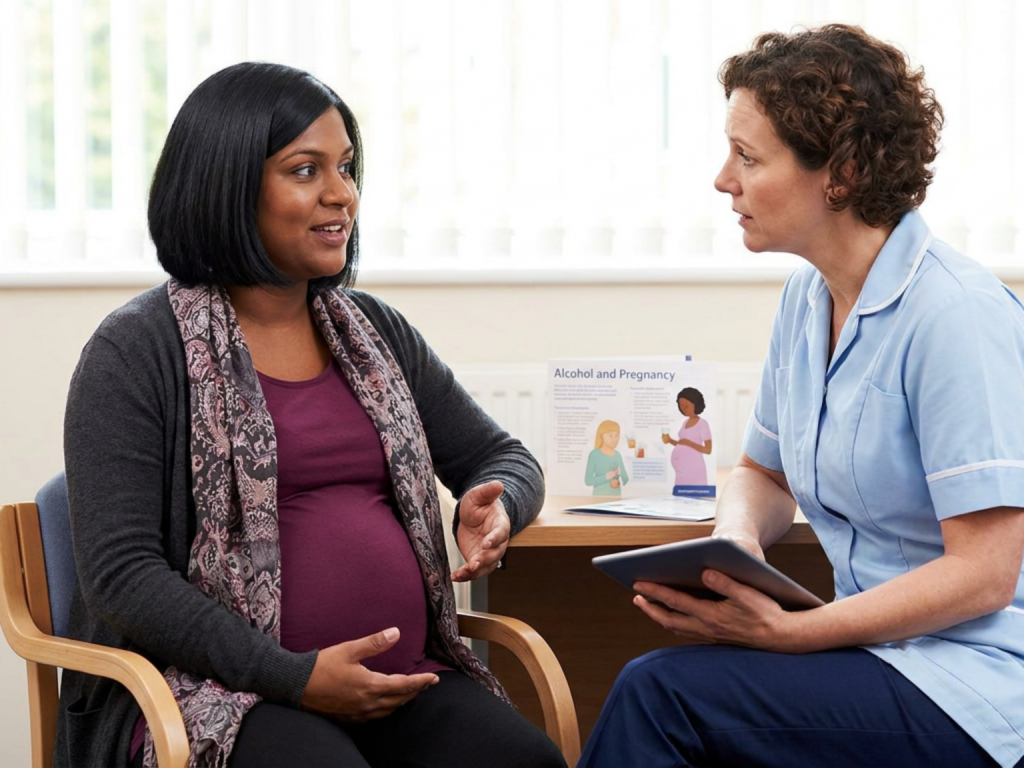
Healthcare professionals are used to discussing alcohol exposure in pregnancy. Honest information helps them tailor care, assess other health needs, and connect you with support. It is better to disclose exposure than to carry worry alone.
When stopping alcohol is difficult
Some people can stop drinking immediately once pregnancy is known. Others cannot, especially if they have alcohol dependence, trauma-related drinking, severe stress, depression, or a partner or household environment where alcohol use is heavy. Difficulty stopping is a health issue, not a moral failure.
If you may be physically dependent on alcohol, abrupt cessation can sometimes cause withdrawal symptoms such as tremor, sweating, agitation, vomiting, fast heart rate, high blood pressure, seizures, or delirium. Withdrawal can be medically serious. Do not attempt an unsafe detox alone. Contact a healthcare professional, maternity service, addiction medicine clinician, or urgent care service for individualized guidance.
Support may include brief counseling, motivational interviewing, perinatal mental-health care, addiction treatment, social work support, peer groups, and safety planning. Some people also need help with housing instability, intimate partner violence, or food insecurity, all of which can affect substance use and pregnancy health. A compassionate, integrated approach is usually more effective than shame-based advice.
Prevention, prenatal care, and support after birth
Prevention is clearest when the message is simple: avoid alcohol during pregnancy. At the same time, effective prevention must be practical. Clinicians can ask about alcohol use in a nonjudgmental way, screen for risky drinking, discuss contraception and pregnancy intentions, and offer support before and during pregnancy.
During prenatal care, disclose alcohol exposure if it occurred. A clinician may consider growth monitoring, review other risk factors, and ensure that routine prenatal screening is up to date. There is no single prenatal test that can rule out all effects of alcohol exposure on later neurodevelopment, so ongoing pediatric observation may be important when exposure was significant.
After birth, tell the pediatrician if there was prenatal alcohol exposure, especially repeated or heavy exposure. Developmental surveillance can help identify feeding difficulties, growth concerns, sleep problems, language delays, attention difficulties, or learning needs early. Early intervention services are most useful when started promptly and framed around the child’s strengths as well as challenges.
When to seek medical help urgently
- Seek urgent care for heavy bleeding, severe abdominal pain, reduced fetal movements, or signs of preterm labor.
- Get medical help immediately for alcohol withdrawal symptoms such as seizures, confusion, severe tremor, or hallucinations.
- Contact a clinician promptly if you are pregnant and unable to stop drinking despite trying.
- Do not stop prescribed medications or start detox products without professional advice.
- If alcohol use is linked to violence, coercion, or unsafe housing, ask a healthcare professional or local support service for confidential help.
Tools & Assistance
- Speak with your midwife, obstetrician, family doctor, or prenatal care clinic about alcohol exposure.
- Ask for referral to perinatal mental-health or addiction medicine services if stopping alcohol is difficult.
- Use a written alcohol-free pregnancy plan that identifies triggers, alternatives, and supportive contacts.
- Attend all routine prenatal appointments and recommended fetal growth or screening assessments.
- After birth, discuss prenatal exposure with the pediatrician and ask about developmental surveillance or early intervention if needed.
FAQ
Is any amount of alcohol safe during pregnancy?
No known safe amount has been established. Public-health guidance recommends avoiding alcohol completely during pregnancy.
I drank before I knew I was pregnant. What should I do?
Stop drinking now and tell your prenatal care clinician. Unintentional early exposure is common and is not a reason to panic, but honest discussion helps guide care.
Is wine or beer safer than spirits?
No. Beer, wine, and spirits all contain ethanol, which crosses the placenta. The type of drink does not make alcohol safe in pregnancy.
Can fetal alcohol syndrome be diagnosed before birth?
There is no single prenatal test that diagnoses fetal alcohol syndrome. Growth and anatomy may be monitored, but neurodevelopmental effects often become clearer after birth and during childhood.
What if I cannot stop drinking?
Contact a healthcare professional as soon as possible. Treatment and support are available, and if dependence is present, stopping may need medical supervision.
Sources
- NIH / PubMed Central — Alcohol Use in Pregnancy
- Centers for Disease Control and Prevention — About Alcohol Use During Pregnancy
- NHS — Drinking alcohol while pregnant
Disclaimer
This article is for general medical information and does not replace individualized care. If you are pregnant and have concerns about alcohol exposure or stopping alcohol, consult a qualified healthcare professional promptly.
















Please log in to leave a comment.