
Intro
Headphones can help children participate in schoolwork, enjoy music, travel more comfortably, or focus on audio content. They can also expose the ears to potentially harmful sound when the volume is too high, listening lasts too long, or headphones are used in a noisy environment.
Choosing a safer model is only part of hearing protection. The most effective approach combines appropriate equipment with sensible volume limits, regular breaks, a good fit, and active adult guidance. The recommendations below are practical risk-reduction measures, not a substitute for individualized medical advice.
Highlights
Keep the listening level around half of the device's maximum, or approximately 70 dBA when that measurement is available.
Use listening breaks at least every hour and consider the 60-60 rule as an easy family reminder.
In noisy settings, close-fitting over-ear or noise-cancelling headphones may reduce the need to increase volume.
Choose child-specific headphones with built-in volume limiting, but continue to supervise use because product limits are not always equivalent to a safe sound level.
Seek professional advice if a child has persistent hearing concerns, ear symptoms, or difficulty understanding speech.
Why headphone safety matters
Headphones deliver sound directly near the ear, so the listening level can become much higher than it feels in a quiet room. Risk depends on both intensity and duration: louder sound can become hazardous more quickly, while moderately loud sound may also be problematic when exposure is prolonged or repeated. Children may not recognize that their volume is excessive, particularly when they are absorbed in a game, video, or song.
Hearing protection is especially important because children may use headphones frequently across several settings, including home, school, public transport, and extracurricular activities. A device that seems comfortable during a short session may still contribute to excessive cumulative exposure over a day. Parents and caregivers can reduce this risk by treating volume and listening time as routine settings to monitor, much like screen time or device charging.
The goal is not to eliminate headphone use. It is to make ordinary listening habits less likely to expose the auditory system to unnecessarily high sound levels. Simple household rules are often more effective than relying on a child to judge volume independently.
Set a conservative listening level
A practical starting point is to keep the device volume around 50% or lower. Some pediatric hearing guidance also uses approximately 70 dBA as a target when sound-level information is available. These figures are useful reference points, but the actual output varies among phones, tablets, computers, headphones, applications, and recordings. A volume percentage is therefore not a universal measurement of sound exposure.
Families can make the setting more reliable by activating the device’s volume limit or parental audio control and protecting the setting with a passcode when appropriate. Check the limit after software updates, when a child changes devices, and when a different pair of headphones is connected. A built-in volume limiter is helpful, but it should be viewed as one layer of protection rather than proof that every listening situation is safe.
Teach children to notice practical warning signs. If another person nearby can clearly hear the audio, or if the child must raise their voice to be heard while wearing headphones, the level may be too high. Encourage children to remove the headphones before changing the volume so an abrupt increase is less likely to startle or expose them to an unexpectedly loud signal.
The commonly used 60-60 rule provides another memorable framework: keep volume at about 60% or less and limit continuous listening to roughly 60 minutes before taking a break. For younger children, shorter sessions and closer adult supervision may be more appropriate.
Choose the right style and fit
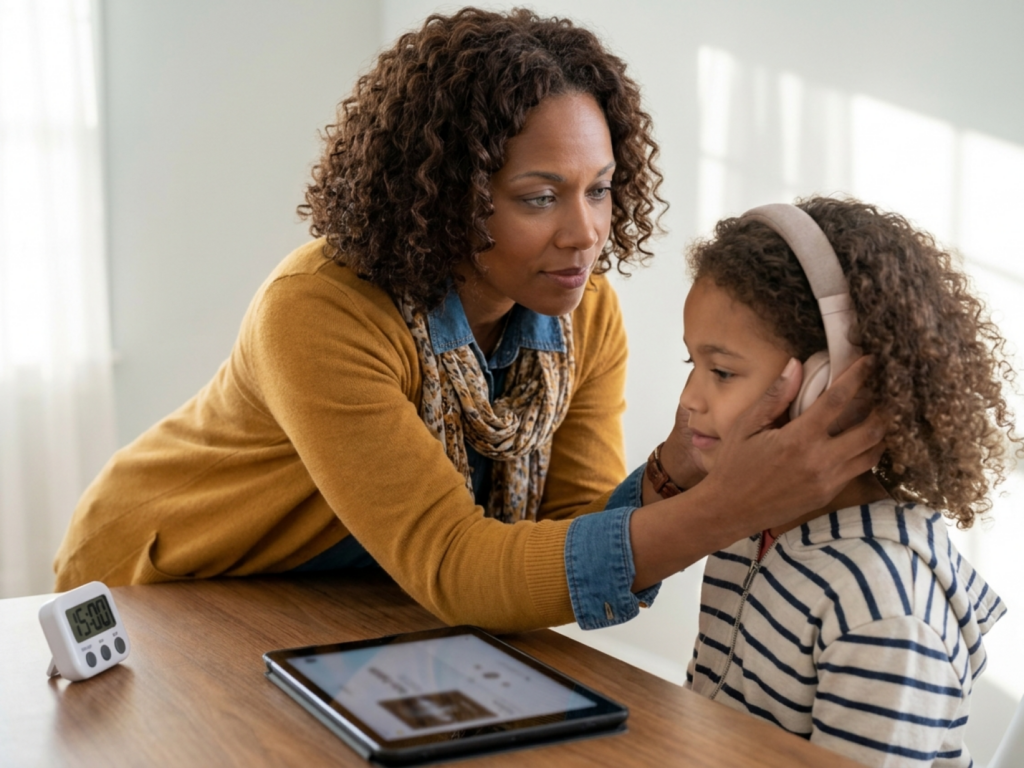
Fit affects both comfort and listening behavior. Headphones that are too tight may cause discomfort and may be rejected, while loose headphones can leak sound and encourage a child to increase the volume. Look for an adjustable headband, soft ear cushions, and a size suitable for the child’s head. The headphones should stay in place without requiring force or causing pressure.
In-ear earbuds deserve particular caution. They can be comfortable and portable, but their position close to the ear canal makes it easy for a child to listen at a high level without appreciating how intense the sound is. For many children, close-fitting over-ear headphones are easier for an adult to inspect and may be preferable, particularly during longer sessions.
Noise-cancelling headphones can be useful in a noisy environment because they reduce competing background sound. A child may then be less likely to increase the volume to overcome traffic, aircraft noise, classroom activity, or other distractions. Noise cancellation does not make unlimited volume safe, however; the listening limit and break schedule still apply.
Do not use headphones as a way to block all environmental awareness when a child needs to hear safety signals, instructions, or nearby people. Consider the location and activity before allowing use, especially near roads, around bicycles, in crowded public areas, or during supervision-sensitive play.
Manage listening time and recovery breaks
Duration matters because the ears are exposed for as long as the sound is playing. Build predictable pauses into the routine rather than waiting for a child to report discomfort. A break at least every hour is a commonly recommended minimum for headphone use, and shorter intervals may be sensible for preschool children or when the listening level is difficult to verify.
During a break, remove the headphones completely and move to a quieter activity. A pause is not the same as switching from headphones to a loud speaker, because the ears still receive sound. Families can use natural transitions, such as the end of an episode, a school lesson, a car journey, or a game level, to make breaks easier to remember.
Keep track of cumulative exposure across the day. A child may use headphones for school, entertainment, and communication without recognizing that these sessions add together. Establish a family routine that includes a maximum listening period, volume checks, and device-free quiet time. Adults should model the same behavior, since children are more likely to accept limits that apply consistently across the household.
If a child reports muffled hearing, ringing, or unusual sensitivity after listening, stop headphone use and allow quiet time. Persistent or recurrent symptoms warrant discussion with a healthcare professional rather than continued exposure to determine whether the issue is related to sound or another cause.
Features to assess before buying
Marketing terms such as safe, child-friendly, or hearing protection should not replace a close review of the product’s specifications and the child’s likely use. Before purchasing, check whether the model has a clearly described volume limiter, whether the limit can be overridden, and whether it operates consistently across wired and wireless modes. Examine the instructions for the maximum output or sound-level information when provided.
- Choose an appropriately sized over-ear model with a stable, comfortable fit.
- Prefer a dependable volume-limiting function that an adult can configure or monitor.
- Consider noise cancellation or good passive isolation for noisy environments, while preserving awareness when safety requires it.
- Look for simple controls that reduce accidental volume changes.
- Check the cable, hinges, ear cushions, and charging components for durability and secure construction.
- Make sure the design is comfortable enough that the child will not compensate by increasing the volume.
Test the headphones with the child present. Ask whether the fit is comfortable, observe whether the child can hear a normal conversation, and verify the device’s settings yourself. A product is not automatically suitable because it is marketed for children; age labeling, comfort, sound limits, and the listening environment all matter.
When buying used equipment, inspect it carefully and confirm that the volume-limiting feature still functions. Missing instructions, damaged controls, or an unknown modification make it harder to judge the actual exposure. Replace worn ear cushions or damaged headphones when they no longer maintain a reliable fit.
Create a supervision and monitoring routine
Young children generally need direct supervision, while older children can gradually take more responsibility once they understand the rules. At the start of each listening session, confirm the volume limit, check that the headphones fit, and set a timer or agree on a stopping point. Periodically listen briefly to the content yourself and observe whether the child is turning the level upward.
Explain hearing safety in concrete language. Tell children that ears need quiet periods, that louder is not always better, and that they should tell an adult if sound feels uncomfortable or if they notice ringing, muffled hearing, pain, dizziness, or unusual sound sensitivity. Avoid presenting symptoms as a diagnosis; they are signals to stop listening and seek appropriate advice if they persist.
Pay attention to broader communication concerns, such as frequently misunderstanding speech, asking for repetition, seeming not to hear ordinary conversation, or struggling to follow instructions in a quiet setting. These observations do not establish a hearing disorder, but they justify discussing a hearing assessment for communication concerns with the child’s clinician. Depending on the situation, the clinician may recommend age-appropriate hearing testing or referral to an audiologist.
For children with known hearing conditions, ear disease, developmental differences, or prescribed hearing technology, ask the audiologist or medical team for individualized headphone guidance. The safest volume and equipment choice may differ according to the child’s clinical circumstances.
Adapt the approach to age and setting
There is no single headphone rule that fits every child. Preschool children may have difficulty judging loudness, remembering breaks, or reporting subtle hearing changes, so adults should control settings and remain nearby. School-age children can participate in checking the volume and timer. Adolescents may need collaborative rules that acknowledge their independence while retaining device limits and regular conversations about exposure.
The setting should guide the decision. In a quiet room, a lower volume may be sufficient. In a busy vehicle or crowded public space, noise-cancelling over-ear headphones may reduce the temptation to turn up the sound, but children still need breaks and appropriate environmental awareness. During travel, school activities, or public events, follow the supervising adult’s instructions and remove headphones when a child needs to hear announcements or safety directions.
Consider avoiding headphones when a child is tired, unwell, or unable to communicate clearly about discomfort. If a child repeatedly resists a comfortable fit, keeps increasing the volume, or cannot follow the agreed listening routine, pause use and reassess the equipment and context. A healthcare professional can help address persistent hearing or communication concerns without assuming that headphones are the sole cause.
When to stop and seek advice
- Stop headphone use if the child experiences ear pain, ringing, muffled hearing, dizziness, or marked sound sensitivity.
- Arrange medical or audiological advice for symptoms that persist, recur, or interfere with communication.
- Do not assume that a child is ignoring instructions when they may have difficulty hearing; discuss persistent listening problems with a clinician.
- Do not rely solely on a volume-limiting label, especially when the product's specifications or settings are unclear.
- Remove headphones when the child needs to hear traffic, alarms, announcements, or direct safety instructions.
Tools & Assistance
- Device-level volume limit and parental control settings
- A timer for hourly or shorter listening breaks
- A quiet listening area for homework and entertainment
- An audiologist or pediatric healthcare professional
- Age-appropriate hearing testing when communication concerns persist
FAQ
Are volume-limiting headphones completely safe for children?
No. They can reduce risk, but the actual sound level depends on the device, connection, recording, and product design. Continue to use conservative settings, breaks, supervision, and a suitable fit.
Should children use earbuds or over-ear headphones?
Close-fitting over-ear headphones are often easier to monitor and may be preferable, especially in noisy settings. The most suitable choice depends on fit, comfort, volume control, the environment, and the child's individual needs.
What is the 60-60 rule?
It is a simple reminder to keep volume around 60% or lower and take a break after about 60 minutes. Younger children or louder environments may require shorter sessions and stricter supervision.
What should I do if my child says their ears are ringing after listening?
Stop headphone use and move to a quiet setting. If ringing, muffled hearing, pain, dizziness, or sound sensitivity persists or happens repeatedly, contact the child's healthcare professional for advice.
Can noise-cancelling headphones protect hearing?
They may reduce the need to increase volume in noisy environments, which can support safer listening. They do not make high volume safe and should not prevent a child from hearing necessary environmental warnings.
Sources
- Rady Children's Health — Headphone Use Guidelines
- Children's Wisconsin — Ear buds and headphones: Safe listening tips for kids and teens
- Hearing Conservation Association — Could headphones be damaging your children's hearing?
Disclaimer
This article provides general educational information and is not a diagnosis or a substitute for individualized medical advice. Consult a qualified healthcare professional or audiologist about persistent symptoms, hearing concerns, or a child's specific medical needs.














Please log in to leave a comment.