
Intro
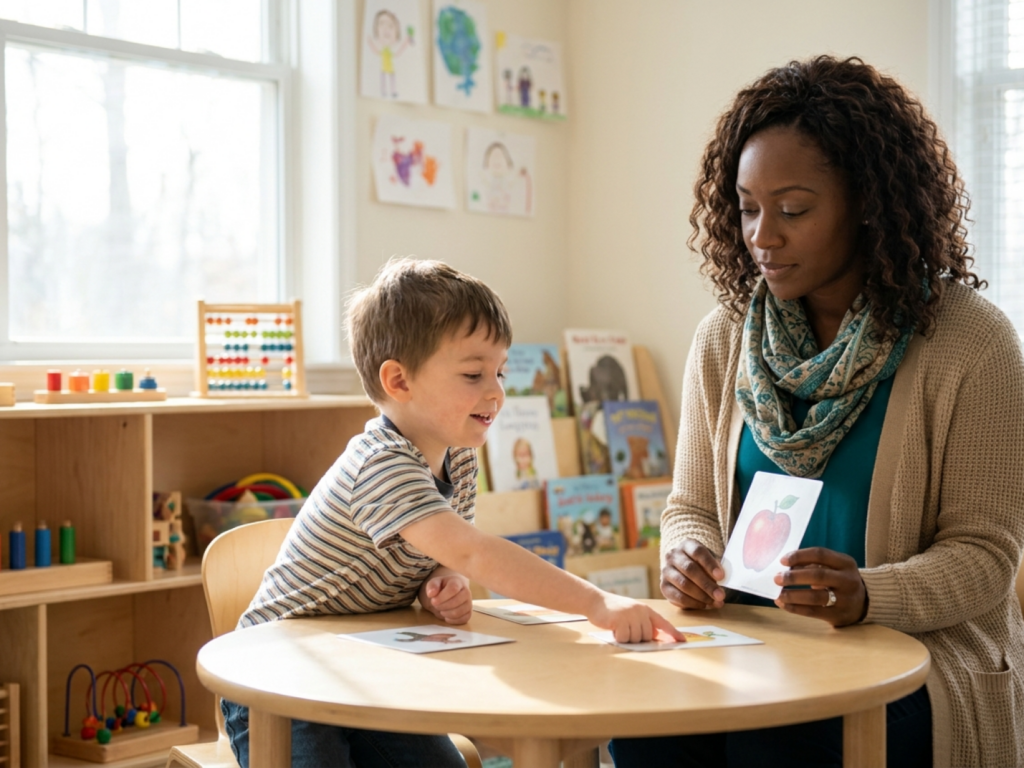
Communication skills grow best in relationships. For children, that means everyday moments at home, in school, and during play are not just conversation practice; they are the setting where language, social reciprocity, and emotional expression begin to take shape. A calm voice, responsive listening, and clear back-and-forth exchanges help children learn how to ask for help, explain a need, join a group, and recover from misunderstandings.
Research from the NIH also supports what many families notice in daily life: the amount and quality of talk directed to children is associated with vocabulary growth and early literacy. That does not mean every child must speak early or constantly. It means communication-rich interactions, matched to a child’s developmental level, can support language acquisition, pragmatic language, and confidence. If concerns arise, it is always appropriate to talk with a pediatrician or speech-language professional.
Highlights
Children learn communication best through repeated, warm interaction, not pressure or perfection.
Responsive talk, shared reading, and play can support vocabulary, turn-taking, and early literacy.
Clear directions and active listening help children understand what is expected and feel respected.
Emotional vocabulary and repair after misunderstandings are part of healthy communication growth.
Why communication grows through everyday talk
Children do not learn communication from a single lesson. They build it through thousands of small exchanges: a parent naming an object, a caregiver waiting for a response, a sibling negotiating a turn, or a teacher inviting an opinion. These exchanges support receptive language, expressive language, and pragmatic skills, which are the social rules of conversation such as turn-taking, staying on topic, and using gestures appropriately.
One of the strongest findings in child development is that talk itself matters. The amount of language a child hears, and the quality of that language, are linked with vocabulary growth and later literacy. Rich conversation gives children more than words. It gives them models for grammar, sentence structure, tone, and flexible thinking. It also teaches that communication is reciprocal: someone speaks, someone listens, and the message changes based on the response.
Social communication in children also depends on emotional context. A child who feels rushed, corrected harshly, or ignored may speak less or communicate through behavior instead of words. A child who feels noticed and safe is more likely to experiment with language, ask questions, and recover after errors. That is why improving communication skills kids need is less about scripts and more about steady, responsive relationships.
Create a communication climate that feels safe
Children communicate more openly when adults use a calm tone, kind words, and respectful dialogue. This does not mean allowing every behavior. It means separating the message from the emotion behind it. A child who is upset may need structure, but they also need to feel that the adults around them are listening rather than competing to be heard.
One practical strategy is regular one-on-one time. Even ten focused minutes can make a difference if the adult is fully present. During that time, avoid multitasking and let the child choose the topic or activity when possible. This helps build trust and gives the child a sense of control, which often supports more spontaneous speech.
Positive reinforcement is also powerful. Specific praise such as “You explained that very clearly” or “I noticed how you waited for my answer” is more useful than broad praise alone. It tells the child exactly which behavior to repeat. Clear directions for children work best when they are brief, concrete, and developmentally appropriate. Instead of long explanations, try one idea at a time and check for understanding.
When disagreements happen, aim for repair rather than winning. Children learn a great deal from seeing adults apologize, restate, and try again. That model teaches that communication is a skill that can recover after tension.
Use active listening and clear language
Active listening with children means more than hearing their words. It includes turning toward them, making eye contact when appropriate, pausing long enough for a response, and reflecting back what you heard. For example, “You are frustrated because the blocks fell over” shows the child that the message was understood. This type of response builds both language and emotional regulation.
Children also need language that matches their developmental level. Long explanations can overwhelm a younger child, especially when they are tired or upset. Short sentences, concrete nouns, and one-step instructions are often easier to process. Over time, children can handle more complex language, but clear instructions for children reduce confusion and help them succeed.
Another useful habit is to give wait time. Many children need a few extra seconds to organize thoughts, find words, or decide whether they want to answer. Jumping in too quickly can interrupt that process. If a child searches for a word, offer a gentle cue instead of finishing the entire sentence for them. This respects their effort and supports expressive language without pressure.
Listening is also reciprocal. Ask open questions when the child is ready, but do not turn every interaction into a quiz. A conversation about a drawing, a snack, or a trip to the park can be more valuable than repeated testing. The goal is not perfect answers. The goal is a steady pattern of turn-taking, shared attention, and mutual understanding.
Build language through play, reading, and routines
Shared reading for communication skills is one of the simplest and most effective tools families can use. Reading aloud gives children repeated exposure to vocabulary, sentence patterns, narrative structure, and new concepts. Pausing to label pictures, predict what happens next, or connect the story to a child’s experience turns reading into conversation. It also supports early literacy by linking spoken language with print.
Play adds a different kind of practice. Pretend play, building games, board games, and cooperative tasks all create natural moments for negotiation and explanation. Children learn to request help, explain rules, wait their turn, and tolerate minor frustration. This is why play-based social communication practice is so valuable: it is engaging, repeated, and low-stakes. The child is learning communication while focused on a shared goal.
Daily routines also matter. Meals, dressing, shopping, and bedtime all contain predictable language patterns that children can anticipate and join. Naming objects, describing actions, and offering choices during these routines expands vocabulary without making the interaction feel like a lesson. For example, “Would you like the red cup or the blue cup?” invites a response while reinforcing language structure.
When adults narrate what is happening, they give children a bridge between action and language. A simple description such as “You stacked the blocks higher” or “We are waiting for the bus” helps a child connect words with events. Over time, those small moments accumulate into stronger communication skills.
Support emotional communication and repair breakdowns
Emotional communication in children develops alongside language. Many children can feel something before they can explain it. That is normal. Adults can help by naming feelings, pointing out facial expressions, and connecting emotions to situations: “You look disappointed because playtime ended.” This gives the child a vocabulary for inner experience and reduces the need to express distress only through behavior.
It also helps to normalize mixed emotions. Children do not need to be cheerful all the time to communicate well. They need permission to express frustration, sadness, excitement, and uncertainty in safe ways. Offering simple phrases such as “I need help,” “I do not like that,” or “Can you say it again?” can improve confidence and reduce misunderstandings.
Breakdowns will happen. Children may mishear, speak too quickly, use the wrong word, or withdraw when they feel overwhelmed. Repairing communication breakdowns with children is an important teaching moment. Slow down, restate the message, and check whether the child understood. If needed, ask them to show, point, or rephrase rather than insisting on a perfect verbal answer. Repair is not a failure; it is part of learning how conversation works.
When adults respond calmly to mistakes, children learn that communication is flexible. That lesson supports self-advocacy, peer interaction, and later problem-solving. It also protects confidence, which is a major part of communication growth.
Know when to seek professional support
Most children develop communication skills at different rates, and variation is common. Still, persistent concern deserves attention. If a child rarely responds to speech, seems not to understand simple directions, has very limited spoken language for their age, or becomes increasingly frustrated when trying to communicate, a pediatrician can help decide whether further evaluation is needed. Hearing should also be considered, because reduced hearing can look like a language problem.
Professional support may include a speech-language pathologist, a hearing assessment for communication concerns, or school-based services if the child is struggling in the classroom. School communication skills children rely on every day include asking for help, understanding group instructions, sharing ideas, and managing peer conflict. If those abilities seem difficult, early support can make school feel safer and more successful.
Parents sometimes worry that seeking help means labeling a child too soon. In reality, evaluation is simply a way to understand how a child communicates and what support would be most useful. A professional can differentiate between expressive language delay, pragmatic difficulties, hearing issues, and broader developmental concerns. That guidance is far more helpful than guessing.
If communication seems to regress, if a child loses words they used to have, or if concerns are affecting daily life, do not wait and hope it resolves on its own. Reach out to a healthcare professional. Early attention does not replace normal development; it supports it.
When to seek help
- A child is not responding to sound or speech consistently.
- Spoken language is very limited or stops progressing over time.
- The child becomes very frustrated because they cannot make themselves understood.
- Speech is hard to understand well past expected age ranges.
- Communication problems are affecting learning, friendships, or daily routines.
Tools & Assistance
- Pediatrician or family doctor
- Speech-language pathologist
- School counselor or special education team
- Hearing assessment services
- Library story time or shared reading programs
FAQ
What is the best way to improve communication skills in kids?
Use frequent, calm, responsive conversation. Shared reading, play, and clear daily routines are often more effective than formal drills.
How can I help a child who shuts down during conversation?
Reduce pressure, give extra wait time, use short statements, and respond with empathy. If the pattern is persistent, consult a professional.
Does talking more to a child really help language development?
Yes. The amount and quality of adult talk are associated with vocabulary growth and early literacy outcomes.
When should I ask for professional help?
Ask for help if communication seems delayed, regresses, or affects home, school, or peer relationships.
Sources
- HealthyChildren.org (American Academy of Pediatrics) — Communication Skills Start at Home
- HealthyChildren.org (American Academy of Pediatrics) — Improving Family Communications
- National Center for Biotechnology Information / National Institutes of Health — Communicating and Learning
Disclaimer
This article is for educational purposes only and does not replace individualized medical, developmental, or speech-language evaluation. If you have concerns about a child’s communication, hearing, or development, consult a qualified healthcare professional.


















Please log in to leave a comment.