
Intro
Many children want to join other children at play, but the moment of approach can feel surprisingly hard. A group that is already busy has its own rhythm, rules, and social cues. For a young child, especially in preschool and early school years, reading that rhythm is a real developmental task, not a simple matter of confidence or politeness.
Adults can help by treating group entry as a teachable social communication skill. With calm coaching, repeated practice, and realistic expectations, children can learn how to watch first, move closer, use a simple phrase, and try again if the group is not ready yet. This article explains what helps, what usually gets in the way, and when it may be wise to ask a healthcare or developmental professional for advice.
Highlights
Joining play that is already underway is a social communication skill, not just a matter of being brave.
Children often succeed when they first observe the group, then move nearby before speaking or offering an idea.
Simple entry phrases and gentle adult prompting can lower the social load for children who freeze or overtalk.
A child who is not included right away may need a second try, a different group, or more practice rather than correction.
Persistent difficulty across settings may justify discussion with a pediatrician or child development specialist.
Why joining a group can be difficult for children
In social play for children, the game is not only about toys or movement. It also involves timing, shared attention, turn taking, and reading unspoken cues. A child who walks into a group may need to notice who is leading, whether the game is open to newcomers, and how to fit in without interrupting the flow. That is a complex set of tasks for a young nervous system.
Research on peer-group entry shows that successful entry often depends on specific social behaviors, such as proximity, eye contact, imitation, gestures, and offering a related toy or idea. Children do not have to use all of these at once, but they often need at least a few of them to make their approach feel natural. Some children are shy, some are impulsive, and some simply need more explicit teaching because social signals are easy to miss.
It helps to remember that refusal from other children is not always rejection of the child. The group may be in the middle of an intense storyline, protecting a turn, or still learning how to include someone new. When adults understand this, they can respond with less pressure and more skill-building.
What children can do before they ask to join
One of the most useful supports is to slow the approach down. Michigan State University Extension recommends that children first watch what the others are doing, then move nearby, and only after that try a simple entry phrase. This sequence gives the child time to gather information and reduces the chance of a sudden, awkward interruption.
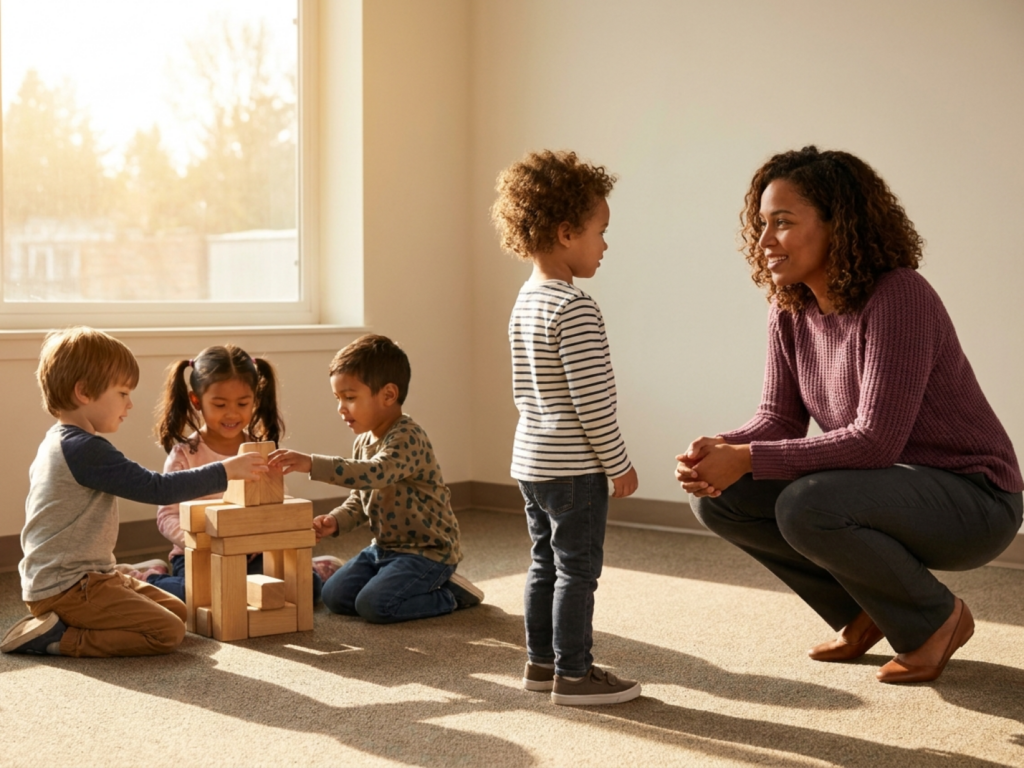
A helpful first step is to stand or sit close enough to observe. The child can notice the game theme, the materials in use, and whether the children are talking, building, chasing, or pretending. Next, the child can do something related: imitate a motion, hold a similar toy, or comment on what is happening. These small actions are social bids. They signal interest before a direct request is made.
Simple entry phrases work best when they are short and concrete. For example: “Can I play?” “What are you building?” or “I have a car like that.” If the child is very young, an adult can rehearse the phrase ahead of time. The point is not perfect wording; it is giving the child a workable script that fits the moment.
How adults can coach without taking over
Support works best when it is brief, warm, and specific. The goal is to help the child practice peer interaction, not to replace the child in the interaction. In studies of cooperative play and group entry, structured prompting and modeling can improve participation because they reduce the child’s cognitive and social load. A child who is unsure of what to do next may benefit from one clear suggestion at a time.
One useful approach is adult coaching during preschool play. The adult stays nearby, observes, and offers just enough help to get the child started. For example, the adult might say, “Stand beside them first,” “Try watching one turn,” or “Ask if there is room for one more.” If the child does well, the adult can quietly reinforce the effort: “You waited, watched, and then asked. That was a good way to join.”
It can also help to practice at easier moments, not only when the child is already upset. Role play at home, small-group activities, and predictable playdates give children repetitions. The more often a child experiences successful entry, the less mysterious the process becomes. Over time, the child is not just being told how to join; the child is learning a sequence the body and brain can remember.
- Model the phrase first, then let the child try it.
- Prompt one step at a time rather than giving a long explanation.
- Praise the attempt, not only a perfect outcome.
- Keep your tone calm so the child does not feel exposed.
What to do if the group is not ready
Sometimes the answer is no, and that is not a failure. Other children may say, “Not now,” ignore the child, or continue their game without pausing. Adults can prepare children for this possibility ahead of time so the moment feels less personal. A child who expects every entry attempt to work may become discouraged quickly.
If a group is not ready, the adult can help the child respond gracefully: “Okay, maybe later,” “I’ll watch for a minute,” or “I can play over here for now.” This teaches flexibility and protects self-esteem. It also reduces the chance that the child will escalate by grabbing, interrupting, or repeatedly asking in a way that irritates the group.
If the play remains closed, it may be better to try a different group or a different activity rather than forcing entry. Some groups are simply too settled for a newcomer in that moment. A calm reset teaches a valuable lesson: social access is often about timing, not worth. Children who learn this early are less likely to interpret every setback as a personal rejection.
When adults remain steady, children learn that rejection can be managed, not feared. That emotional steadiness is often as important as the social script itself.
Practicing group entry in everyday routines
Children do not need only formal social lessons. They benefit from many small practice opportunities across the day. Small-group preschool activities, neighborhood play, sibling games, and even shared tasks like building, cooking, or sorting can support the same skills used in playground entry. The more varied the setting, the more flexible the skill becomes.
Try to look for moments that already resemble peer interaction. At the park, the child can stand near a sand game before asking for a scoop. In a classroom, the child can sit by the block area and observe before adding a piece. At home, two children can practice joining a game by taking turns inviting a third child or using a shared prop. These low-stakes opportunities build confidence without pressure.
It is also useful to notice whether a child tends to use one strategy only. Some children rely on talking but forget to watch. Others hover without ever speaking. Others hand over toys too quickly. Gentle coaching can broaden the child’s toolkit so the child can adapt to different groups. Over time, this supports group play skills in preschoolers and older children alike, because the underlying task is the same: noticing, approaching, and participating with flexibility.
When to ask for extra support
Most children need practice, not a label. Even so, persistent difficulty with joining peers can sometimes reflect broader concerns about language, social communication, attention, or emotional regulation. If a child struggles to enter play across many settings, rarely uses gestures or eye contact to connect, becomes very distressed around peers, or seems unable to learn from repeated coaching, it is reasonable to seek professional input.
A pediatrician can help decide whether a referral makes sense. Depending on the child’s profile, a speech-language pathologist, occupational therapist, early childhood specialist, or developmental professional may be helpful. This does not mean something is wrong in a fixed sense. It means the child may need a more tailored approach, especially if everyday participation is being affected.
Families should also pay attention to the child’s emotional experience. If a child begins avoiding play entirely, seems sad after repeated failed attempts, or starts saying that no one likes them, that deserves attention even if the child is otherwise developing well. Early support can prevent a small social difficulty from turning into a larger pattern of avoidance. The most helpful message is usually not “try harder,” but “we can practice this together, and we can get help if needed.”
When to slow down and seek help
- Do not force a child to enter a group physically or emotionally.
- Do not frame a peer group refusal as proof that the child is disliked.
- Do not assume shyness alone explains repeated difficulty in many settings.
- Seek professional advice if concerns are persistent, severe, or affecting daily participation.
- If the child shows distress, language delays, or social communication concerns, ask for an evaluation.
Tools & Assistance
- Practice a simple entry script at home, such as "Can I play?"
- Use short role-play sessions with dolls, blocks, or pretend games
- Ask preschool teachers or caregivers what phrases work best in that setting
- Arrange small, predictable play opportunities before expecting larger groups
- Talk with a pediatrician or speech-language pathologist if concerns persist
FAQ
What is the best first step when a child wants to join play?
Encourage the child to watch first, then move nearby, and then use a simple entry phrase.
Should I speak for my child if they are nervous?
A brief model can help, but aim to let the child try the phrase so the skill belongs to them.
What if the other children say no?
Coach a calm response, such as trying later or choosing another group, instead of treating it as a failure.
When should I ask for professional help?
If the difficulty is persistent across settings or comes with distress, language concerns, or limited social cues, speak with a clinician.
Sources
- Michigan State University Extension — Parenting the Preschooler: What does your child do to join in with others?
- PubMed — Social communication interventions for preschoolers: targeting peer interactions during peer group entry and cooperative play
- University of Washington / Center on Human Development and Disability — Social Competence with Peers: Outcome and Process in Early Childhood Interventions
Disclaimer
This article is for general educational purposes only and is not a substitute for individualized medical, developmental, or mental health advice. If you have concerns about a child’s social communication or development, consult a qualified healthcare professional.














Please log in to leave a comment.