
Intro
Some children seem perfectly fine all day, then become upset, restless, or unusually hard to settle once they lie down at night. For a family, that pattern can be confusing and exhausting. When the main complaint is an uncomfortable urge to move the legs, especially in the evening or at bedtime, one possibility clinicians consider is restless legs syndrome, a sensory-motor sleep disorder that can present differently in children than in adults.
This article explains how bedtime restless legs symptoms may show up in children, why the problem often becomes more obvious at night, how it can overlap with other sleep movement disorders, and what families can discuss with a pediatric clinician. It is not meant to diagnose a child, but to help parents understand the pattern and seek the right support.
Highlights
Bedtime is often when leg discomfort becomes most noticeable because symptoms tend to worsen during rest and improve with movement.
Children may not describe the classic adult sensation; they may simply say their legs feel funny, jumpy, ticklish, itchy, or hard to keep still.
Sleep disruption can affect the whole family and may lead to daytime impairment from poor sleep, including irritability, tiredness, or reduced attention.
Restless legs syndrome in children can overlap with restless sleep and movement symptoms, so a careful sleep history matters.
Iron status is commonly reviewed in pediatric assessment, and iron supplementation is a common treatment approach under medical guidance.
What restless legs symptoms can look like at bedtime
Restless legs symptoms usually involve an urge to move the legs, often with uncomfortable sensations that are hard to describe precisely. In children, the experience may be reported as crawling, pulling, tingling, aching, tickling, or a need to kick or stretch. The key pattern is that the discomfort is worse when the child is sitting or lying still and improves, at least briefly, when they move.
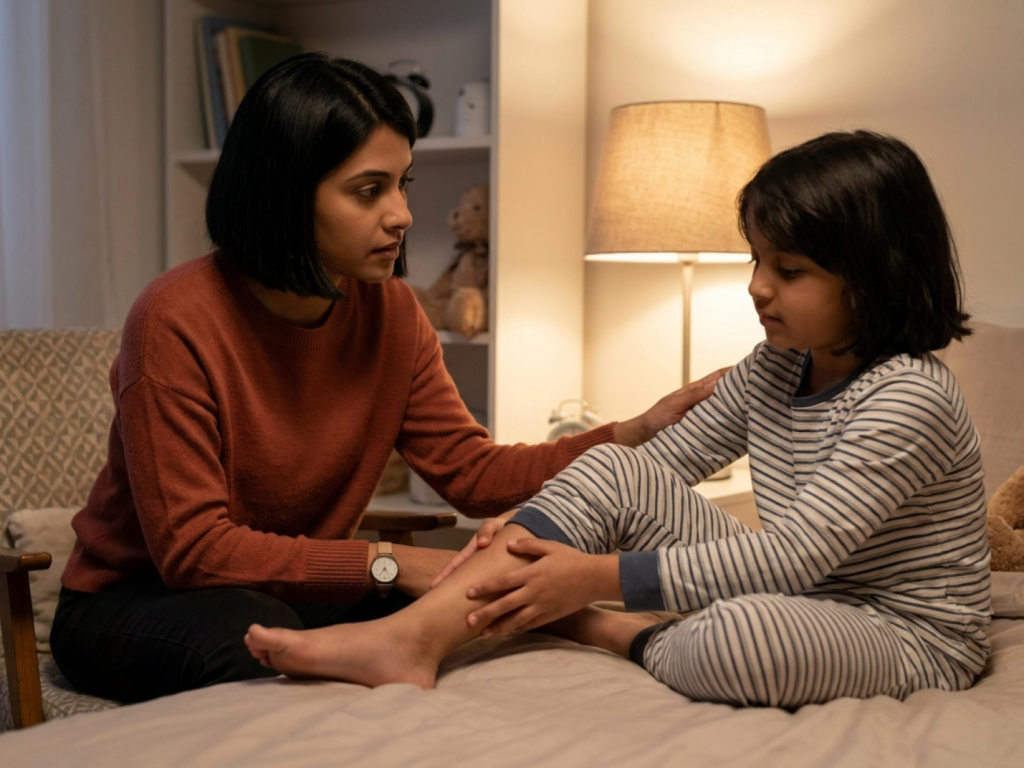
At bedtime, that pattern becomes easier to see. A child who was calm during dinner may suddenly start rubbing their legs, wiggling, asking to get up, or repeatedly changing position once lights are out. Some children try to walk around the room or ask for a massage because movement gives temporary relief. Others do not complain about the legs directly; instead, they appear unable to settle, keep getting out of bed, or seem frustrated by a sensation they cannot fully explain.
Because children may not have the words for the feeling, the bedtime behavior can matter as much as the description. A clinician will usually pay close attention to the timing, the relief with movement, and whether the problem has been present for some time.
Why the symptoms often stand out at night
Restless legs symptoms are often most obvious in the evening because the body is finally still. During the day, movement, play, and distraction may mask discomfort. Bedtime removes those distractions and leaves the child alone with the sensation. Long car rides, movie nights, homework in a chair, or quiet reading time can bring out the same pattern, but parents often notice it first when the child is trying to fall asleep.
This is one reason sleep onset can become prolonged. A child may be tired but unable to relax, and the family may interpret that as bedtime resistance. In reality, the child may want sleep but feel unable to remain still long enough to drift off. Over time, the pattern can lead to repeated delays, frustration, and more bedtime conflict.
Children with broader restless sleep and movement symptoms may also move a great deal in the night, kick the covers off, or appear unrefreshed in the morning. That overlap is important because it can blur the line between a specific leg sensation problem and a more general sleep movement disorder. Either way, the effect can be disrupted sleep.
How the picture changes with age
Age strongly influences how a child describes the problem. Preschoolers may have only behavioral clues: they cannot settle, ask to be held, or repeatedly get up after being put to bed. School-age children may start to explain that their legs feel weird, uncomfortable, or “too jumpy.” Adolescents can often give a more classic description of an urge to move that gets worse at rest and is temporarily relieved by walking or stretching.
Because of this variation, a normal-looking bedtime routine does not always mean the child is simply stalling. A child may truly want to sleep but cannot ignore the sensations long enough to fall asleep. This can create tension in families, especially when everyone is tired and the problem has been going on for weeks or months.
The sleep consequences can extend beyond the bedroom. Repeated loss of sleep may show up the next day as irritability, lower frustration tolerance, morning grogginess, or difficulty concentrating. In practical terms, the child may seem “tired but wired,” and the household may feel the impact of bedtime uncertainty long before anyone recognizes the underlying pattern.
What clinicians think about during evaluation
A pediatric clinician will usually start with the story: when the symptoms happen, what the child feels, whether movement helps, and whether the pattern is worse in the evening. That history matters because pediatric restless legs syndrome is a clinical diagnosis supported by symptom pattern and sleep impact. In younger children, the description may be incomplete, so careful questioning is essential.
Clinicians also consider overlap with other causes of restless sleep, leg discomfort, or nighttime movement. Leg cramps, growing pains, eczema, anxiety-related restlessness, or habitually insufficient sleep can all complicate the picture. In some children, restless legs syndrome in children may coexist with other sleep concerns rather than appear in isolation.
Iron status is especially important to discuss. The pediatric literature notes that iron supplementation is a common treatment approach, and many clinicians check ferritin or related iron studies when the history fits. That does not mean every child needs iron, but it does mean low iron stores are part of the conversation. Any supplementation should be guided by a healthcare professional, because the right dose and follow-up depend on the child’s age, lab results, and overall health.
Simple comfort strategies that may help at bedtime
Families often want something practical to try while waiting for assessment. Although no home strategy replaces medical evaluation, gentle measures may make bedtime easier for some children. A warm bath, light massage, or brief stretching routine before bed can reduce the sense of muscle tension or discomfort. Some children benefit from a predictable winding-down sequence that starts earlier in the evening so they are not suddenly asked to lie still after a busy day.
Regular physical activity during the day may also help sleep, though very intense exercise close to bedtime can be stimulating for some children. Good sleep habits matter as well: keeping a consistent bedtime, limiting evening screens, and creating a calm, low-stimulation bedroom environment can reduce the overall burden on sleep onset. These steps do not treat the underlying disorder, but they can lower the number of competing sleep disruptors.
It can also help to keep a simple child sleep diary for one to two weeks. Note bedtime, how long it takes to fall asleep, when the leg discomfort starts, what relieves it, and whether there are night wakings or morning tiredness. That record can be very useful during a pediatric visit because sleep symptoms are often easier to interpret when seen over time rather than from one difficult night.
When to seek medical advice
Medical review is appropriate when bedtime leg discomfort is persistent, frequent, or clearly interfering with sleep. Families should seek advice sooner if the child has daytime sleepiness, mood changes, attention problems, school difficulty, or if the bedtime routine has become a nightly source of distress. Because sleep disruption can accumulate, it is worth addressing even when the symptoms seem mild in isolation.
It is also important to seek prompt evaluation if the pattern does not fit restless legs well. For example, one-sided swelling, redness, fever, weakness, limp, injury, or severe pain suggests another cause and should not be assumed to be a sleep movement problem. A child who wakes repeatedly with pain, or whose symptoms are getting rapidly worse, also deserves assessment.
Parents sometimes worry about “making a big deal” out of bedtime complaints. In reality, consistent symptoms deserve attention, especially when they affect rest, learning, or family functioning. A pediatrician, sleep specialist, or other qualified clinician can help decide whether the pattern is consistent with a sleep movement disorder, iron deficiency, another medical issue, or a combination of factors.
Seek medical review sooner if you notice
- The child has persistent bedtime leg discomfort that regularly delays sleep.
- The child cannot describe the problem well but keeps getting out of bed, rubbing the legs, or asking to walk.
- There is daytime sleepiness, irritability, school trouble, or reduced attention from poor sleep.
- There is swelling, redness, weakness, fever, a limp, or severe pain in one leg.
- You are considering iron supplements and want guidance on whether testing or treatment is appropriate.
Tools & Assistance
- A one- to two-week child sleep diary
- A pediatric appointment to review sleep timing and leg symptoms
- Sleep specialist referral if symptoms are persistent or unclear
- Laboratory testing for iron status if a clinician recommends it
- A calm bedtime routine with warm bath, stretching, or gentle massage
FAQ
How is bedtime restless legs in children different from normal bedtime restlessness?
Typical bedtime resistance is usually behavioral, while restless legs symptoms are driven by an uncomfortable urge to move that gets worse at rest and improves with movement.
Can young children have restless legs syndrome?
Yes. Children can have it, but they may describe it indirectly through behavior, not with the classic adult wording.
Does poor sleep from these symptoms affect daytime functioning?
It can. Repeated sleep disruption may lead to fatigue, irritability, and trouble concentrating the next day.
Will iron help every child?
Not necessarily. Iron supplementation is a common approach when indicated, but it should be guided by a clinician after appropriate evaluation.
What should parents bring to the appointment?
A symptom timeline, a child sleep diary if available, and notes about when the discomfort starts, what relieves it, and how it affects sleep.
Sources
- PubMed — Restless Legs Syndrome and Restless Sleep Disorder in Children
- PubMed — Pediatric Restless Legs Syndrome
- Mayo Clinic — Mayo Clinic Q and A: Restless legs syndrome in children
Disclaimer
This article is for general educational purposes only and is not a diagnosis or treatment plan. If a child has persistent leg discomfort at bedtime or disrupted sleep, please consult a qualified healthcare professional.

















Please log in to leave a comment.