
Intro
Emotional control, or emotion regulation, is the ability to notice a feeling, tolerate the body’s arousal, and choose a response that fits the situation. In children, that skill develops gradually. It is shaped by brain maturation, language growth, sleep, stress, temperament, and the steady support of adults.
Teaching emotional control is not about making children suppress feelings. The goal is to help them recognize emotion early, recover more quickly, and use safer, more flexible behavior when they are upset. Parents, teachers, and caregivers can teach those skills directly, by modeling them, and by practicing them during ordinary routines.
Highlights
Children learn emotional control best when adults treat it as a teachable skill, not a character trait. The process is gradual and strongly influenced by repeated practice.
Calm moments are the best time to teach. Once a child is highly distressed, support shifts from instruction to co-regulation and safety.
Adults shape regulation through their own behavior. Predictable, steady responses help children organize their own emotional state.
School and home strategies work best when they are simple, repeated, and embedded in daily routines such as transitions, meals, and conflict repair.
What emotional control really means
Children are often told to “calm down” before they have the skills to do it. A more useful frame is to teach emotional control as a sequence: notice the feeling, name it, understand what the body is doing, and choose a response. That sequence depends on executive function, especially inhibition, working memory, and cognitive flexibility. In younger children those systems are still developing, so strong feelings can quickly outpace reasoning.
Emotion regulation also includes recovery. A child does not need to stay calm at all times to be emotionally healthy. They need the capacity to return to baseline after disappointment, conflict, frustration, or fear. That is why adults should pay attention not only to outbursts, but also to how long it takes a child to settle, repair, and re-engage.
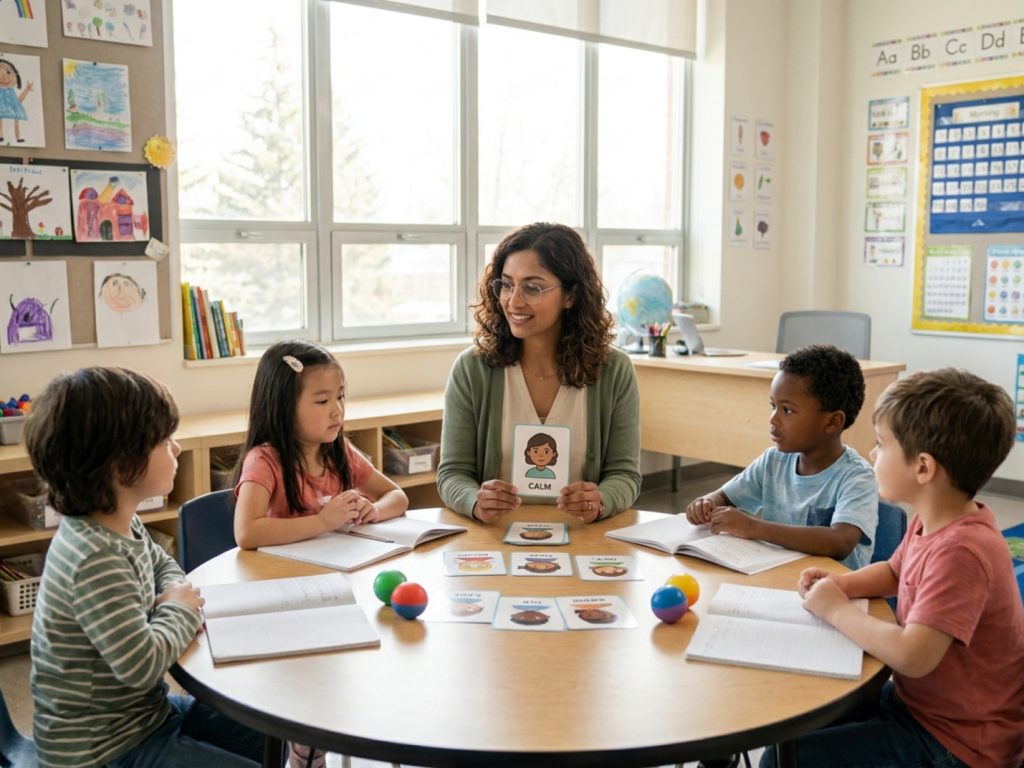
For many children, especially in school settings, emotional control improves when feelings are named clearly and linked to simple action steps. A child who can say “I am getting frustrated” has more room to pause than a child who only feels a vague surge of distress.
Why children struggle with regulation
Emotional control is hardest when the child is tired, hungry, overstimulated, anxious, or trying to manage a new demand. At those times the nervous system is already closer to its threshold, so even a small frustration can trigger a large reaction. This is not a moral failure. It is a predictable interaction between development and stress.
Caregivers sometimes expect a child to use words or reasoning that are not yet available under pressure. A child may know the right strategy when calm and still lose access to it during conflict. That is normal. The skill has to be practiced when the child is regulated, not only after a meltdown has started.
Adults also matter because children learn by observation. If the surrounding adult responds with yelling, sarcasm, or panic, the child receives a strong model of dysregulated behavior. In contrast, a regulated adult helps lower the child’s arousal and gives the child a pattern to copy.
How to teach it directly
Research on school-based emotion regulation shows that children benefit when instruction is explicit. That means adults say what the skill is, demonstrate it, and practice it with the child. A brief lesson on identifying body cues, for example, can be followed by repeated rehearsal during calm moments. This is more effective than expecting children to infer the lesson from discipline alone.
Good teaching often includes a short script: “I notice my shoulders are tight, I am getting frustrated, I can breathe, and then I can ask for help.” That kind of language links internal sensation to behavior. Over time, children can personalize the script with words that feel natural to them.
Practice should be brief and frequent. In classrooms, that can happen during morning meetings, transitions, read-alouds, or conflict repair. At home, it can happen before homework, before leaving the house, or after a sibling disagreement. The point is repetition in ordinary life, not special exercises that never connect to real stress.
co-regulation before self-regulation is the right order for many younger children. Adults first lend calm, structure, and language. As children mature, they can take on more of the process themselves.
What co-regulation looks like
Co-regulation is the adult process of helping a child borrow steadiness from someone else’s nervous system. It can sound simple, but it is clinically important. A child cannot build self-regulation in an environment that feels chaotic or rejecting. They need repeated experiences of being helped through distress without being shamed for having it.
In practice, co-regulation may mean lowering your voice, using fewer words, giving a brief choice, or making the next step concrete. It may also mean staying physically nearby, especially when the child is very young. The goal is not to solve every problem immediately. The goal is to keep the child connected enough to recover.
This is especially relevant in early childhood. Adults who want to support Helping preschoolers express emotions should remember that expression and control are related but different skills. A child first needs a way to show what is happening, then a way to manage it. If expression is punished, children often become less communicative, not more regulated.
Parenting research also shows that caregiver emotion regulation matters. When adults can manage their own frustration, they are better able to respond consistently, which reduces escalation and supports safer attachment-based learning.
Age-appropriate strategies that actually fit children
Strategies should match developmental stage. Toddlers usually need simple language, predictable routines, and a lot of adult support. Preschoolers can begin to learn feeling words, body cues, and short coping sequences, but they still need repetition and reminders. Older children can handle more reflection, planning, and problem solving.
One useful way to think about the early years is through social-emotional competence in preschool children. That includes recognizing emotion, taking turns, tolerating frustration, and using basic repair after conflict. It is broader than quiet behavior. A child may still be loud or disappointed and yet be learning the core skills that matter.
For some children, especially those who are easily overwhelmed, self-management skills in preschoolers are built through structure rather than verbal explanation. Visual routines, short transitions, and advance notice of changes can reduce the cognitive load that often triggers dysregulation. If a child has to spend too much mental energy figuring out what comes next, there is less capacity left for regulation.
Teachers may also use calm-down spaces, feeling charts, and supervised practice after the child has recovered. These tools work best when they are framed as supports, not punishments.
At home, the same logic applies. A brief bedtime routine, a predictable way to request help, and a consistent repair step after conflict can do more for regulation than long lectures in the middle of a crisis.
When emotional control needs extra help
Some children need more than routine teaching. If emotional outbursts are frequent, severe, persistent, or tied to sleep problems, school refusal, aggressive behavior, shutdowns, or repeated physical symptoms, it is reasonable to ask for professional guidance. A pediatrician, child psychologist, school counselor, or child psychiatrist can help distinguish ordinary developmental struggle from a pattern that needs closer assessment.
Professional support does not mean something is “wrong” with the child. It means the child may need a more tailored plan. That plan might focus on anxiety, trauma exposure, attention problems, language delay, sensory overload, or family stress. The right next step depends on the full context, not on a single behavior.
It is also important to seek help promptly if a child talks about self-harm, seems unable to recover for long periods, or becomes unsafe toward themselves or others. In those situations, urgent evaluation is appropriate.
Most children do better when adults treat emotional control as a long-term teaching task. With steady modeling, predictable routines, and calm support, children can learn to recognize feeling states earlier and respond with more flexibility over time.
When to seek help
- Seek prompt evaluation if emotional outbursts are severe, frequent, or worsening over time.
- Get help if the child is hurting themselves, threatening self-harm, or becoming unsafe toward others.
- Consult a clinician if school, sleep, appetite, or daily functioning is clearly affected.
- Ask about assessment if anxiety, trauma, attention problems, language delay, or sensory overload may be contributing.
Tools & Assistance
- Pediatrician or family doctor
- Child psychologist or child psychiatrist
- School counselor, school psychologist, or special education team
- Parent coaching or family therapy services
- Written routine charts and feeling labels used consistently at home and school
FAQ
What is the difference between emotional control and suppressing feelings?
Emotional control means noticing and managing feelings safely. Suppressing feelings means pushing them away, which usually does not teach a child what to do with them.
Should adults wait until a child is calm before teaching coping skills?
Yes. Practice works best when the child is already regulated. During distress, the adult’s role is mostly co-regulation and safety.
Do children grow out of emotional dysregulation on their own?
Some improvement comes with development, but most children benefit from active teaching, modeling, and predictable routines.
When is professional help a good idea?
When symptoms are severe, persistent, unsafe, or clearly interfering with sleep, school, relationships, or daily life.
Sources
- PubMed — Teaching emotion regulation in schools: Translating research into practice
- EdCan Network — How can K-12 students learn to regulate their emotions?
- PubMed Central / NIH — Emotion Regulation in Parenthood
Disclaimer
This article is for general educational purposes only and does not replace individualized medical or mental health advice. If a child’s emotional or behavioral difficulties are severe, persistent, or unsafe, consult a qualified healthcare professional.
















Please log in to leave a comment.