
Intro
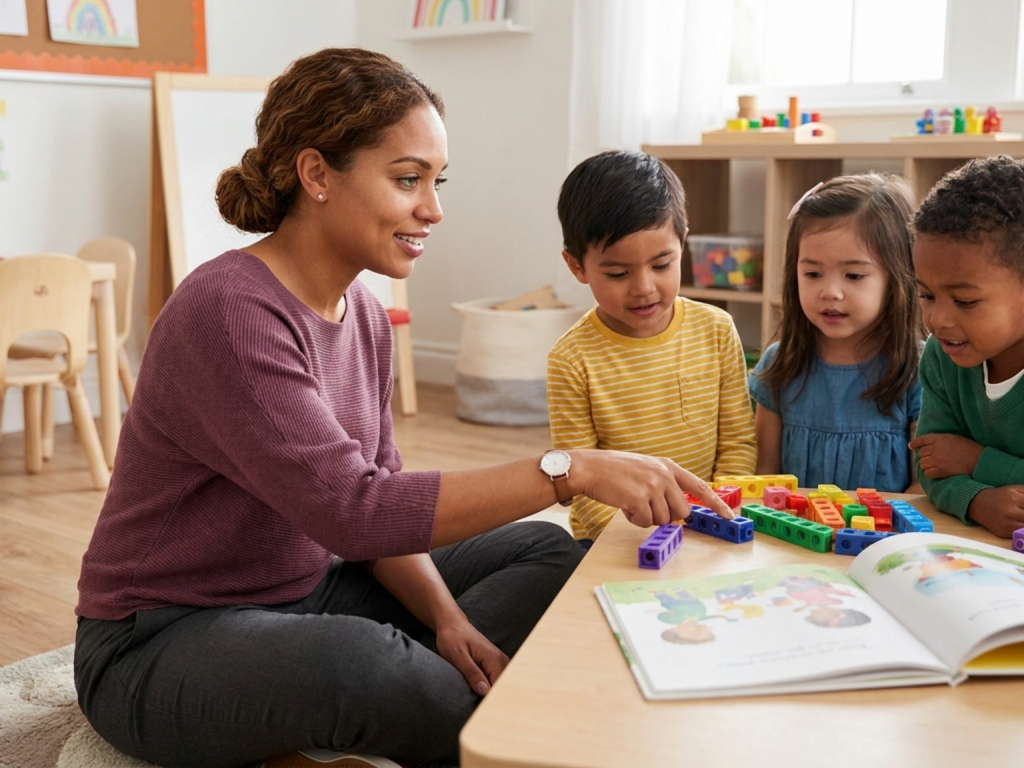
Preschool children learn words, stories, counting, quantity, and symbols in deeply connected ways. A child who points to a stop sign, counts crackers, compares two towers, or retells a favorite story is building early academic foundations through everyday interaction, not formal schooling.
Families often worry when a preschooler mixes up numbers, skips counting words, resists books, or cannot yet recognize letters. Many variations are typical, but persistent concerns deserve thoughtful developmental surveillance and, when needed, support from pediatric, educational, hearing, vision, or speech-language professionals.
Highlights
Early literacy and early numeracy share core developmental systems, especially oral language, attention, working memory, and symbolic thinking.
Counting, number identification, and comparing quantities are strong predictors of later mathematics learning, but they develop gradually and through play.
Vocabulary and print knowledge appear to contribute uniquely to early numeracy, so talking, reading, and using precise words can support number learning.
Support should be warm, brief, repetitive, and responsive; pressure or drilling can reduce motivation and does not replace developmental evaluation when concerns persist.
Why literacy and numbers grow together
Early literacy and numbers in preschool children are not separate tracks in the brain. They rely on overlapping neurodevelopmental capacities: receptive language, expressive language, attention regulation, working memory, processing speed, visuospatial reasoning, and executive function. When a child hears “put three blue blocks under the big bridge,” they must understand vocabulary, hold instructions in mind, identify quantity, compare attributes, and act on a spatial concept.
Research on early numeracy shows that learning to count, identify numerals, and compare quantities predicts later mathematics achievement. These are not simply “math facts”; they are symbolic and language-based skills. A written numeral, like the word “four,” is a symbol that maps onto a quantity. This overlaps with early print awareness, where letters and words are understood as symbols that carry meaning.
Literacy also contributes to number learning through vocabulary. Words such as more, fewer, same, before, after, first, last, between, bigger, smaller, equal, add, take away, and half give children mental tools for reasoning. A preschooler may be able to see that one pile has more crackers than another, but the word “more” helps them discuss, remember, and generalize that concept. This is why speech and language development is closely tied to early learning across domains.
Parents may notice uneven profiles. A child may love books but resist counting, or count confidently but struggle to answer story questions. Unevenness is common. The goal is not to make every four-year-old perform like a school-aged child, but to notice patterns, provide rich experiences, and seek help if a child’s communication, attention, hearing, vision, or learning skills seem to be limiting participation.
Core early literacy skills before kindergarten
Early literacy begins long before independent reading. Preschoolers are developing oral language, narrative understanding, print knowledge, phonological sensitivity, and motivation to engage with books. Oral language includes both receptive language, what the child understands, and expressive language, what the child can say or otherwise communicate. Strong vocabulary supports comprehension, social interaction, and mathematical language.
Print knowledge means recognizing that books have a front and back, pages turn in order, print carries meaning, words are separated by spaces, and letters have names and sounds. A child does not need to read in preschool to be on a healthy path. However, noticing environmental print, recognizing their name, pretending to read, and asking about letters are useful signs of emerging print awareness.
Phonological awareness refers to hearing and manipulating sounds in spoken language, such as recognizing rhymes, clapping syllables, or noticing that “ball” and “baby” start with the same sound. This skill supports later decoding, but it should be playful. Rhyming songs, silly alliteration, and clapping names are more appropriate than long worksheet sessions.
Narrative skills are equally important. When children retell what happened at the park, describe a picture, or predict what comes next in a story, they practice sequencing, causality, memory, and perspective-taking. These skills later support reading comprehension and problem solving. They also support numeracy because math often depends on understanding sequences, changes, and relationships over time.
Families using more than one language should be reassured that bilingual or multilingual exposure does not cause language disorder. Children may distribute vocabulary across languages, and code-switching can be typical. If concerns arise, evaluation should consider all languages used by the child, not only the dominant community language.
Core early number skills in preschool
Early numeracy includes several related but distinct abilities. Rote counting is reciting number words in order, such as “one, two, three, four.” One-to-one correspondence is matching one number word to one object while counting. Cardinality is understanding that the last number counted represents the total quantity. A child may recite to 20 but still miscount objects or not yet understand cardinality, and that can be developmentally typical.
Number identification is recognizing written numerals, such as 2 or 5. Quantity comparison is deciding which group has more, fewer, or the same number. Subitizing is quickly recognizing small quantities, such as seeing three dots without counting. Patterning, sorting, measuring, spatial language, and sequencing also contribute to mathematical thinking.
Preschool number knowledge grows best when it is connected to meaningful routines. Counting steps while climbing, comparing apple slices, setting one cup for each person, finding the “number 3” on an elevator, or sorting socks by size and color all create concrete experiences. Children learn that numbers are useful, not just words adults ask them to repeat.
Working memory and language are especially important. To count accurately, a child must remember the counting sequence, coordinate pointing with speech, inhibit double-counting, and understand the task. This explains why tired, hungry, overstimulated, or anxious children may show inconsistent performance. It also explains why children with language delays, attention difficulties, hearing loss, or broader developmental differences may need individualized support rather than more pressure.
Symbolic thinking in preschool children is a bridge between literacy and numeracy. A block can become a phone in pretend play, a scribble can stand for a shopping list, and a numeral can stand for a set of objects. Pretend play, drawing, storytelling, and counting games all strengthen this symbolic flexibility.
Everyday ways to support both domains
The most effective preschool learning opportunities are usually brief, warm, and embedded in daily life. Children learn through repetition, shared attention, emotional safety, and active participation. A five-minute playful exchange repeated often can be more powerful than a 30-minute lesson that creates frustration.
- Read interactively. Pause to ask what might happen next, label emotions, count animals on a page, compare sizes, and connect the story to the child’s life.
- Use mathematical language naturally. Say “You have fewer grapes than your sister,” “Let’s put the biggest cup behind the small cup,” or “This tower is taller by two blocks.”
- Count with purpose. Count plates for dinner, fingers in a glove, steps to the door, or toys going into a bin. Touch or move each object once to model one-to-one correspondence.
- Make print meaningful. Point out labels, menus, signs, calendars, and the child’s name. Let children see adults write lists, notes, and reminders.
- Sing and rhyme. Songs with counting down, clapping syllables, or rhyming words support sequencing, sound awareness, and memory.
Follow the child’s lead whenever possible. If they are building a road, introduce “longer,” “shorter,” “next,” and “how many cars?” If they are playing restaurant, write a pretend order and count cups. If they love movement, place numbered paper circles on the floor and jump in sequence. For some children, visual schedules can reduce anxiety around transitions and make room for learning because the child can predict what comes next.
A supportive tone matters. Instead of saying “No, that’s wrong,” try “Let’s check together” or “You counted that one twice; I’ll move each block as we count.” This preserves confidence while providing accurate feedback. Praise effort, strategy, and curiosity, not only correct answers.
Adapting for different developmental profiles
Preschoolers vary widely in temperament, sensory processing, language exposure, motor skills, and attention span. A child who avoids table activities may learn best through movement. A child with fine motor delays may understand letters and numbers but struggle to demonstrate knowledge with pencils or worksheets. A child with speech sound difficulties may know a word but be hard to understand. Support should meet the child where they are developmentally.
For children with limited expressive speech, adults can model language without demanding repetition. Offer choices, use gestures, point to pictures, and accept communication attempts. Augmentative and alternative communication, when recommended by professionals, can support language and learning rather than prevent speech. If speech clarity, comprehension, or social communication is a concern, a speech-language pathologist evaluation can help clarify strengths and needs.
Hearing and vision deserve attention because they directly affect literacy and number learning. Recurrent otitis media with effusion, undetected hearing loss, or visual acuity problems can make it harder to hear sound differences, follow oral directions, see print, or identify numerals. Families should discuss concerns such as frequent “What?”, unclear speech, sitting very close to books or screens, eye squinting, or inconsistent response to name with a pediatric clinician.
Executive function also shapes learning. Some preschoolers need shorter instructions, fewer materials at once, movement breaks, or predictable routines. Children who are impulsive may know how to count but rush and skip items. Children who are anxious may freeze when asked direct questions. Observing performance during relaxed play can be more informative than quizzing.
If a child has a diagnosed neurodevelopmental condition or suspected delay, early intervention or preschool special education services may offer assessment and therapy. Families do not need to wait until kindergarten if concerns are persistent, functionally significant, or accompanied by regression.
When to seek professional guidance
Because development is variable, a single missed skill is rarely enough to define a problem. More concerning patterns include loss of previously acquired skills, limited response to language, persistent inability to follow simple directions, very limited pretend play, minimal interest in interaction, or substantial difficulty participating in preschool routines. Developmental screening for cognitive delay may be appropriate when learning concerns occur across several domains.
Consider discussing concerns with a pediatrician, health visitor, family physician, early childhood educator, psychologist, or speech-language professional if a preschooler has persistent difficulty understanding everyday language, uses very few words compared with peers, cannot engage with simple picture books, does not notice print or symbols at all, cannot compare obvious quantities such as one versus many by age four, or becomes extremely distressed by ordinary learning play.
Mathematical learning difficulties can have early signs, but clinicians and educators generally avoid definitive labels too early without comprehensive assessment. Early evaluation may include number knowledge tasks, language testing, working memory measures, attention observation, hearing and vision checks, and review of developmental history. This broad view is important because early numeracy is influenced by both specific number understanding and general neurocognitive abilities.
Families should also seek timely medical advice if there are neurological red flags, such as developmental regression, seizures, significant motor changes, persistent headaches with vomiting, or loss of coordination. These signs do not point specifically to literacy or numeracy problems, but they require medical assessment.
Most children benefit from a calm, collaborative plan: enrich language at home, coordinate with preschool staff, check hearing and vision, monitor progress over several months, and refer when concerns persist. Early support is not a sign of failure. It is a protective step that can reduce frustration and help children experience themselves as capable learners.
Seek guidance promptly if you notice
- Loss of previously acquired speech, play, social, or learning skills.
- Persistent lack of response to name, everyday sounds, or spoken directions.
- Marked difficulty seeing books, pictures, or numerals, or frequent squinting.
- Very limited communication, pretend play, or shared attention compared with peers.
- Seizures, new coordination problems, or other neurological symptoms.
Tools & Assistance
- Discuss developmental concerns with the child’s pediatrician or primary care clinician.
- Request hearing and vision screening if learning, speech, or attention concerns appear.
- Ask the preschool teacher for specific observations across play, group time, books, and counting activities.
- Consider a speech-language pathologist evaluation for communication or comprehension concerns.
- Use brief daily routines: shared reading, counting real objects, sorting, rhyming, and comparison language.
FAQ
Should my preschooler be reading before kindergarten?
Not necessarily. Many typically developing preschoolers are not reading yet. More important foundations include oral language, enjoyment of books, print awareness, rhyming play, and curiosity about symbols.
Is it a problem if my child can count to 20 but miscounts objects?
Often no. Reciting number words and counting objects accurately are different skills. Model touching or moving one object for each number word and keep practice playful.
Can literacy activities help number skills?
Yes. Vocabulary and print knowledge are linked with early numeracy. Shared reading that includes number words, size comparisons, sequences, and spatial language can support both areas.
When should I worry about number learning?
Seek advice if difficulties are persistent, occur across settings, interfere with participation, or appear with language, attention, hearing, vision, social, or motor concerns.
Do bilingual children learn early literacy and numbers more slowly?
Bilingual children may distribute words across languages, but bilingualism itself does not cause language disorder. Concerns should be evaluated across all languages the child uses.
Sources
- PMC (PubMed Central) — Early numeracy skills in preschool-aged children: A review of neurocognitive findings and implications for assessment
- Journal of Experimental Child Psychology via ScienceDirect — The value of including early literacy skills in the prediction of early numeracy skills development
- Renaissance — Connecting Literacy and Numeracy Skills in Preschool
Disclaimer
This article is for informational purposes only and does not diagnose or treat developmental, medical, vision, hearing, or learning conditions. Consult a qualified healthcare or developmental professional for individualized advice.















Please log in to leave a comment.