
Intro
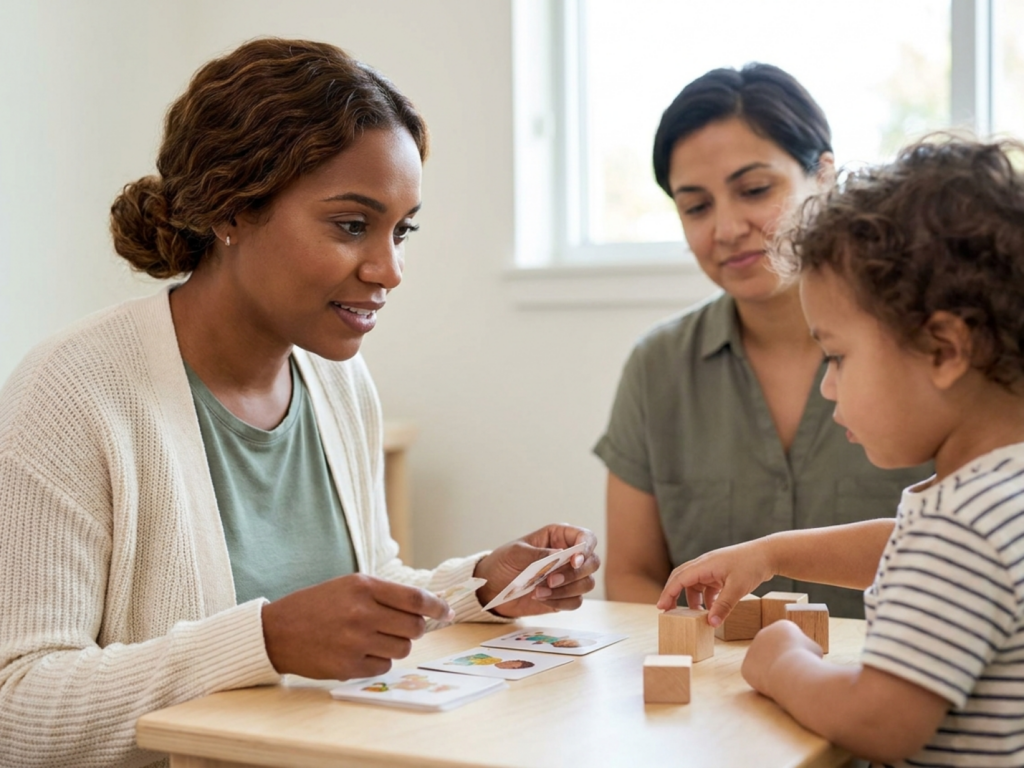
Communication skills development in childhood is a gradual, relationship-based process. Children learn to understand spoken language, express needs and ideas, use gestures and facial expressions, listen, take turns, interpret social cues, and repair misunderstandings. These abilities support learning, friendships, emotional regulation, independence, and participation in family and community life.
Communication does not develop in exactly the same way or at the same pace for every child. Temperament, neurodevelopment, hearing, language exposure, health, relationships, and opportunities for interaction can all influence progress. Supportive practice is helpful, but persistent concerns deserve discussion with a pediatrician, family doctor, speech-language pathologist, audiologist, or another qualified professional.
Highlights
Communication includes receptive language, expressive language, speech, nonverbal communication, and social-pragmatic skills.
Warm, responsive interactions give children frequent opportunities to practice communication without turning everyday life into a test.
Structured instruction, modeling, feedback, and repeated practice can improve communication competence.
A child can have strong abilities in one area, such as vocabulary, and need support in another, such as conversation or understanding implied language.
What communication skills include
Communication is broader than clear pronunciation or the number of words a child uses. Receptive language refers to understanding words, sentences, questions, gestures, and increasingly complex instructions. Expressive language refers to communicating meanings through speech, sign language, symbols, writing, or an augmentative and alternative communication system. Speech production is the physical ability to coordinate the sounds of spoken language, while voice concerns qualities such as loudness, pitch, and resonance.
Social communication, sometimes called pragmatic language, involves using communication appropriately in relationships and different settings. It includes joint attention, initiating interaction, responding to another person, taking conversational turns, staying on topic, adjusting language to the listener, recognizing nonliteral meanings, and repairing a breakdown. A child may communicate effectively in a familiar home routine but find group conversations, noisy classrooms, or unfamiliar adults more difficult.
Nonverbal communication also matters. Eye gaze, facial expression, body orientation, pointing, posture, gesture, and prosody can add meaning to words. These behaviors vary across children and cultures, and no single behavior should be treated as a universal measure of social connection. The goal is functional, mutually understandable communication rather than conformity to one communication style.
How skills emerge over time
Infants begin by communicating through crying, movement, gaze, vocalization, and changes in attention. Responsive caregivers notice these signals, interpret them carefully, and respond consistently. Back-and-forth exchanges, including imitation of sounds and shared smiles, help establish the foundations of turn-taking and social reciprocity.
During the toddler and preschool years, many children develop more words, combine ideas, ask questions, and use language in pretend play. They gradually learn to describe experiences, negotiate, express disagreement, and talk about feelings. Vocabulary growth is important, but communication quality also depends on comprehension, attention, flexibility, and the ability to use language with another person.
In the school years, communication becomes more cognitively and socially demanding. Children may need to follow multistep instructions, explain reasoning, understand classroom discourse, tell organized narratives, infer another person’s perspective, and participate in collaborative problem-solving. Written language increasingly interacts with oral language, although a child’s writing and spoken language abilities may not develop evenly.
Developmental expectations are useful for surveillance, not for labeling a child from a single observation. Consider the child’s overall trajectory, communication across settings, access to language, and strengths. Bilingual or multilingual children may distribute vocabulary across languages; assessment should consider the full linguistic environment rather than judging ability through only one language.
Everyday ways to strengthen communication
The most effective practice is usually embedded in ordinary interactions. Follow the child’s interest, get physically close enough to share attention, and comment on what the child is doing. Expand rather than repeatedly correct: if a child says, “car go,” an adult might respond, “Yes, the blue car is going fast.” This provides an accurate model while preserving the child’s motivation to communicate.
Offer choices that require a meaningful response, such as choosing between two foods or activities. Pause after speaking so the child has time to process and respond. Use clear, concrete language when a task is unfamiliar, and pair spoken directions with gestures, pictures, written words, or demonstrations when useful. Visual supports for classroom communication can also help children understand schedules, routines, transitions, and expectations.
Shared reading is a particularly flexible activity. Ask open questions, but do not turn every page into an interrogation. Point out characters’ actions, predict what might happen, connect the story to the child’s experience, and invite the child to retell part of the narrative. Songs, cooking, errands, building projects, and bedtime routines provide similar opportunities for sequencing, descriptive language, requesting, and conversation.
Adults can model emotional communication by naming their own feelings in a calm and proportionate way: “I am frustrated, so I am taking a short pause.” Help the child identify a need and choose a repair phrase, such as “Please say that again,” “I meant something different,” or “Can I have a turn when you are finished?” These parent-child communication skills support self-advocacy and reduce the pressure to communicate perfectly on the first attempt.
Play, peers, and communication practice
Play creates a low-pressure context for practicing social communication. In cooperative activities, children can learn to invite another person, share materials, negotiate rules, tolerate a change in plan, and repair conflict. Adults can support these skills by narrating the interaction briefly, modeling a phrase, or arranging the environment so that children have a genuine reason to communicate.
For younger children, simple turn-taking games, imitation, pretend play, and shared sensory activities may be appropriate. Older children may benefit from collaborative construction, board games, drama, clubs, sports, or projects organized around a common goal. The activity should match the child’s interests and abilities. Excessive adult prompting can make interaction feel artificial, so gradually reduce support as the child becomes more independent.
Games may need adaptation for children with motor, sensory, attention, language, or social communication differences. Possible adaptations include shorter turns, visual rules, predictable routines, fewer competing sounds, alternative response methods, and explicit teaching of how to join or leave an activity. Digital games can offer opportunities for cooperation, but online interaction should be supervised according to the child’s age, safety needs, and communication profile.
Peer success is not measured only by how often a child speaks. Pointing, signing, typing, drawing, selecting symbols, listening, and responding through movement can all be meaningful. Respecting a child’s reliable communication method can increase participation and reduce frustration.
When to seek an assessment
Consider professional advice when communication difficulties are persistent, interfere with participation, cause significant frustration, or appear across more than one setting. Examples include difficulty understanding everyday language, limited progress in expressive communication, frequent inability to make needs understood, speech that is consistently difficult for familiar listeners to understand, unusual voice symptoms, or marked difficulty participating in reciprocal interaction.
Regression, meaning loss of previously acquired communication abilities, should be discussed promptly with a healthcare professional. Hearing concerns also warrant attention because fluctuating or permanent hearing loss can affect speech, language, attention, and classroom access. A clinician may recommend a hearing evaluation even when a child appears to respond to some sounds.
Assessment is not a judgment of parenting or a prediction of a child’s future. A speech-language pathologist may examine receptive and expressive language, speech sound production, fluency, voice, literacy-related language, and pragmatics. Depending on the presentation, evaluation may also involve audiology, developmental pediatrics, psychology, occupational therapy, education professionals, or specialists in a child’s preferred communication modality.
Professionals should gather information from caregivers and educators and observe communication in relevant contexts. For bilingual or multilingual children, assessment by appropriately trained professionals or interpreters should consider all languages used by the child. A useful evaluation identifies strengths, functional goals, environmental supports, and barriers rather than focusing only on test scores.
What intervention and support may involve
Communication intervention is individualized. It may involve direct sessions with a speech-language pathologist, caregiver coaching, classroom accommodations, peer-supported activities, or coordinated support across settings. Goals might include following instructions, expanding functional vocabulary, producing clearer speech, using an AAC system, telling a coherent story, understanding conversational cues, or communicating distress safely.
Evidence from professional education shows that communication competence can improve through dedicated instruction, structured practice, feedback, and reflection. Systematic review evidence also supports the potential for training to improve communication and empathy, while noting that outcomes depend on training design, implementation, and study quality. In healthcare, the World Health Organization describes communication training as a way to strengthen clear, persuasive communication capacity in real-world public health practice. These findings support a practical principle for children: skills are teachable, but progress is more likely when practice is purposeful, repeated, respectful, and connected to daily participation.
Augmentative and alternative communication should not be viewed as giving up on speech. For children who need it, AAC can provide an immediate and reliable way to express choices, comments, questions, and emotions. Systems may include gestures, sign language, communication boards, picture-based tools, or speech-generating devices. Selection and implementation should be guided by qualified professionals and reviewed as the child’s abilities and environments change.
Caregivers can ask providers how progress will be measured functionally. Useful outcomes include whether the child can communicate with more people, in more settings, with less distress, and with greater autonomy. Collaboration is strongest when the child’s preferences, culture, language, sensory needs, and right to refuse are respected.
Creating a supportive communication environment
Children communicate best when adults make interaction emotionally safe. Give the child time to respond, avoid finishing every sentence, and acknowledge the message even when the form is unclear. Confirm what you understood and offer a model without demanding imitation. During conflict, regulate your own tone first; a child who is overwhelmed may temporarily lose access to language and need co-regulation before problem-solving is possible.
Coordinate expectations across home, school, childcare, and therapy when possible. A shared set of functional phrases, visual supports, or response options can reduce cognitive load. Teachers may support access by previewing vocabulary, checking understanding privately, allowing additional processing time, and accepting multiple ways to demonstrate knowledge. Communication accommodations should preserve the child’s dignity and educational participation.
Progress is often uneven. Illness, fatigue, sensory overload, transitions, anxiety, and unfamiliar environments can affect performance on a particular day. Track patterns rather than demanding constant success. Notice attempts, self-advocacy, humor, listening, repair, and independent use of communication, not only perfect speech or compliance.
When to get professional help
- Seek prompt medical advice if a child loses previously acquired communication abilities.
- Arrange hearing assessment when there is concern about hearing, inconsistent responses, recurrent ear problems, or unclear speech.
- Discuss persistent communication difficulties that limit learning, friendships, safety, or daily participation.
- Do not rely on online milestones or informal tests to diagnose a developmental or communication condition.
- Use qualified professionals for assessment, therapy recommendations, and selection of augmentative and alternative communication.
Tools & Assistance
- Keep a brief record of communication strengths, difficult situations, and strategies that help.
- Use shared books, visual schedules, choice boards, and predictable routines during daily activities.
- Ask the child’s teacher or childcare provider for observations across group and one-to-one settings.
- Request a hearing evaluation and speech-language pathology assessment when concerns persist.
- Practice one functional goal at a time and review progress with the child’s care and education team.
FAQ
Is communication development only about learning to speak?
No. It includes understanding language, speech, gestures, facial expression, signing, writing, AAC, listening, turn-taking, social inference, and communication repair.
Can a child have good vocabulary but still struggle to communicate?
Yes. Some children know many words but have difficulty with conversation, narratives, interpreting social cues, flexible language, or understanding implied meaning.
Does using AAC prevent speech development?
AAC provides an additional communication route and does not mean speech should be abandoned. A qualified speech-language professional can help select and use an appropriate system.
What should caregivers do when a child refuses to talk?
Reduce pressure, acknowledge other communication methods, check for distress or sensory overload, and seek professional guidance if refusal is persistent or limits participation.
Who can assess a child’s communication?
Depending on the concern, assessment may involve a pediatric clinician, speech-language pathologist, audiologist, developmental specialist, psychologist, occupational therapist, and education professionals.
Sources
- PubMed — Communication skills training for improving the communication skills of social work students
- PubMed — Enhancing medical students' communication skills
- World Health Organization — Communications training for health
Disclaimer
This article provides general educational information and is not a diagnosis or a substitute for individualized medical, developmental, speech-language, or educational advice. Consult a qualified healthcare professional about concerns regarding a child’s communication.
















Please log in to leave a comment.