
Intro
Preteens, often ages 9 to 12, are in a powerful learning window. They are becoming more independent, more socially aware, and more capable of abstract reasoning, yet they still need structure, reassurance, and adult coaching. Study skills and critical thinking grow best when caregivers and teachers treat them as teachable skills rather than fixed traits.
This article offers practical, developmentally sensitive ways to help preteens plan schoolwork, evaluate information, ask better questions, and recover from mistakes. It is written for medically literate readers while avoiding diagnosis or treatment advice; if attention, mood, sleep, learning, or behavior concerns interfere with daily functioning, consultation with a qualified health or education professional is appropriate.
Highlights
Preteens benefit from explicit coaching in planning, prioritizing, memory strategies, and reflective thinking.
Critical thinking begins with curiosity, source evaluation, and the ability to ask how and why rather than simply accepting answers.
Sleep, emotional stress, puberty, neurodevelopmental differences, and family routines can strongly influence study performance.
Adults can support learning by modeling calm problem-solving, analyzing mistakes without shame, and building predictable routines.
Why study skills change during the preteen years
The preteen years are not simply a smaller version of adolescence. Children in this stage are expanding working memory, metacognition, and cognitive flexibility, but these capacities are still inconsistent. A child may reason maturely during a calm conversation and then forget a routine assignment an hour later. This unevenness is normal and reflects ongoing maturation of frontostriatal and prefrontal networks that support executive function, planning, impulse control, and error monitoring.
Study skills are the outward expression of these developing systems. A preteen who “does not care” may actually be overwhelmed by task initiation, time estimation, or organizing materials. Another child may memorize facts easily but struggle to infer, compare, or explain why an answer is reasonable. For this reason, study coaching should include both academic strategies and preteen executive function skills, such as breaking tasks into steps, using checklists, and reviewing what worked.
Critical thinking also becomes more visible at this age. Research on children’s learning from others suggests that even young children can distinguish between more and less reliable informants. By the preteen years, adults can build on this foundation by helping children notice expertise, bias, self-interest, consistency, and evidence quality. The goal is not cynicism; it is thoughtful trust.
Building a study routine that supports the brain
A useful study routine reduces the number of decisions a preteen must make before learning can begin. Predictability lowers cognitive load and helps the child move from avoidance to action. The routine should be visible, brief, and adjustable rather than elaborate. Many preteens do best with a consistent study time, a prepared workspace, and a clear sequence: review assignments, choose priorities, work in short blocks, check completion, and pack materials for the next day.
Short work intervals often fit this developmental stage better than long sessions. For example, 20 to 30 minutes of focused work followed by a brief movement or hydration break can be more effective than an unfocused two-hour homework period. Caregivers can help by asking, “What is the first small step?” instead of “Why haven’t you finished?” This shifts the interaction from blame to problem-solving.
- Externalize tasks: Use a planner, whiteboard, or digital assignment list so the child does not have to hold everything in working memory.
- Prioritize by urgency and effort: Teach the difference between “due tomorrow,” “takes a long time,” and “easy but still necessary.”
- Use active recall: Instead of rereading notes repeatedly, have the preteen close the book and explain the idea, draw a diagram, or answer practice questions.
- Space practice: Reviewing material over several shorter sessions supports memory consolidation better than last-minute cramming.
- End with a reset: Packing the bag, charging devices, and placing materials by the door reduces morning stress.
When a routine fails, treat it as data. Was the child hungry, tired, distracted, confused, or embarrassed to ask for help? Study problems often improve when the environment is adjusted before the child is criticized.
Teaching critical thinking without turning every conversation into a debate
Critical thinking is the ability to evaluate claims, compare explanations, and revise beliefs when better evidence appears. Preteens can learn these habits in everyday moments: a surprising social media claim, a science homework question, a disagreement with a sibling, or an advertisement for a product. Adults can model curiosity by saying, “Let’s check how we know that,” rather than “That’s wrong.”
One practical framework is to teach preteens to pause before accepting information. They can ask: Who is making the claim? What evidence is offered? Could the speaker benefit if I believe it? Is there another explanation? What would change my mind? These questions are especially important in digital environments where algorithms reward emotional intensity and repetition, not necessarily accuracy.
Research on children’s critical thinking when learning from others highlights that children can use cues about reliability. Adults can strengthen this by discussing expertise and motive in age-appropriate language. A veterinarian may be a better source about a dog’s illness than a celebrity; a game company may not be neutral when claiming that more screen time is always harmless. This does not mean experts are never wrong. It means evidence, training, transparency, and willingness to correct errors matter.
To avoid constant arguing, separate critical thinking from oppositional behavior. A preteen can be encouraged to ask questions respectfully while still following family or classroom expectations. Phrases such as “Make your case with evidence” and “Disagree without attacking” preserve both reasoning and connection.
Memory, attention, and learning strategies that actually help
Many preteens equate studying with staring at a textbook, highlighting large sections, or copying notes. These methods may feel productive but often create passive familiarity rather than durable learning. More effective strategies require the brain to retrieve, organize, and apply information.
Active recall is one of the most useful habits. After reading a section, the child should try to explain the main idea without looking. If they cannot, they can return to the material, identify the missing point, and try again. This strengthens retrieval pathways and reveals gaps early. Elaboration is another powerful method: the preteen connects new information to something already known. For example, when learning about ecosystems, they might compare a food web to a school community where roles are interconnected.
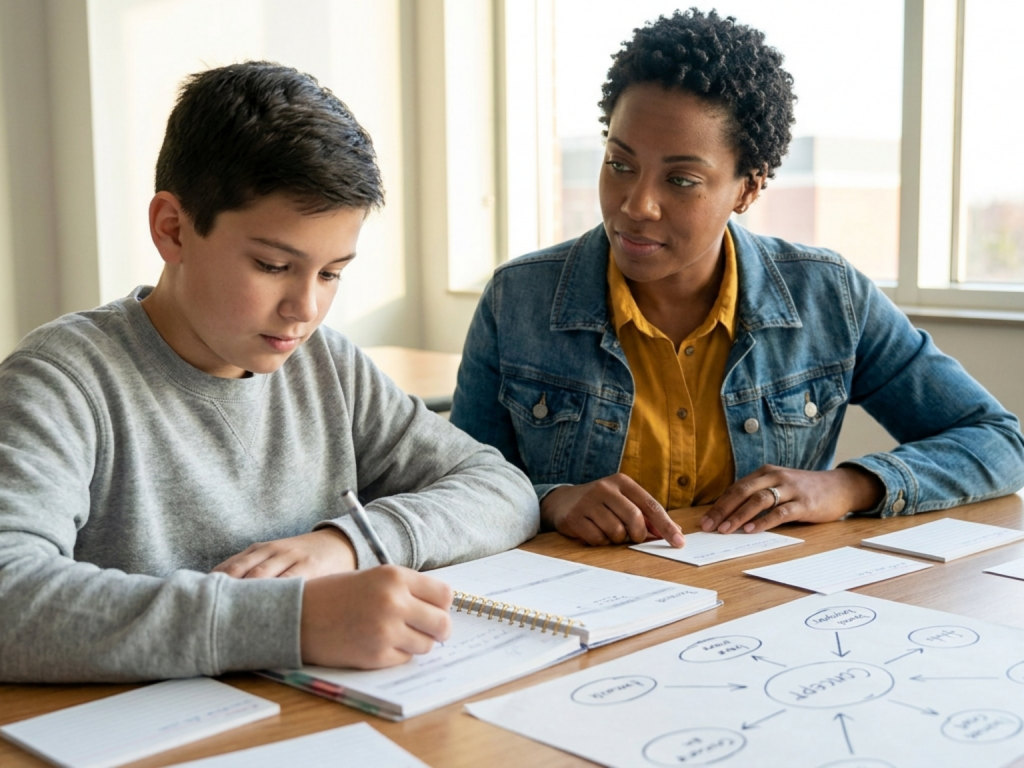
Visual organization can help children who struggle with linear notes. Concept maps, timelines, flowcharts, and compare-and-contrast tables make relationships visible. For math and science, worked examples followed by independent practice can reduce frustration. For writing, sentence starters and outlines can help a child move from vague ideas to structured paragraphs.
Attention should be treated as a limited neurocognitive resource. Notifications, background videos, and multitasking compete for working memory. A preteen may insist they can study while messaging friends, but performance often declines when the brain must switch tasks repeatedly. Families can create a “focus container”: devices outside the room unless required, one assignment visible at a time, and a timer that defines the work period. This approach is not punitive; it protects attention.
The emotional side of homework and mistakes
Learning is emotionally loaded. A preteen who crumples a worksheet or says, “I’m stupid,” may be showing shame, anxiety, fatigue, or fear of disappointing adults. Emotional arousal activates stress physiology and can reduce access to flexible reasoning. In that state, more lecturing rarely helps. A calm response supports preteen emotional regulation and keeps the learning relationship intact.
Adults can validate without removing expectations: “This feels hard right now, and we can take it one step at a time.” After the child is calmer, analyze the problem together. Was the assignment unclear? Did the child start too late? Was there a missing prerequisite skill? Did perfectionism make the task feel unsafe? This kind of repair conversation teaches that mistakes are information, not identity.
A “mistake review” can be especially useful. Instead of only marking answers wrong, ask the preteen to sort errors into categories: careless slip, misunderstood direction, missing concept, or rushed work. Each category suggests a different solution. A careless slip may need checking routines; a missing concept may require reteaching; rushed work may need time management. This reduces global self-criticism and builds metacognition.
Caregivers should also watch for patterns. Occasional frustration is expected. Persistent tearfulness, school refusal, sleep disturbance, panic symptoms, loss of interest, major irritability, or declining grades across subjects may warrant discussion with a pediatrician, school psychologist, counselor, or educational specialist. These signs do not prove a diagnosis, but they indicate that the child may need additional support.
Helping preteens evaluate online information
Preteens often encounter information through videos, search results, chats, and short posts before they learn formal media literacy. Because online content can look polished regardless of accuracy, children need explicit instruction in digital reasoning. This is a health and safety issue as well as an academic one, particularly when claims involve nutrition, exercise, body image, mental health, or risky challenges.
Teach a simple source-checking routine. First, identify the original source, not only the person who reposted it. Second, look for evidence: data, expert consensus, direct observation, or transparent methods. Third, compare with more than one credible source. Fourth, notice emotional manipulation, such as claims that everyone is hiding the truth or that only “smart people” believe the post. Fifth, ask whether the claim is trying to sell something, gain followers, or provoke fear.
Preteens also need permission to change their minds. Many children defend a claim because they feel embarrassed, not because they are convinced. Adults can model intellectual humility: “I used to think that too, then I learned more.” This supports executive function in adolescence by linking reasoning with self-monitoring and flexible updating.
Family digital boundaries matter. A child who is exhausted from late-night scrolling will have less attention and emotional bandwidth for school. Clear limits around device storage, bedtime, and homework use are not just discipline strategies; they are cognitive health supports.
Partnering with school and knowing when to seek help
Study skills improve most when home and school communicate respectfully. If a preteen is struggling, caregivers can ask teachers which part of the learning chain is breaking down: understanding instruction, recording assignments, starting work, sustaining attention, completing tasks, turning in finished work, or preparing for tests. Each problem requires a different intervention.
School supports may include assignment planners, check-ins, reduced-distraction testing spaces, tutoring, organizational coaching, or evaluation for learning differences when appropriate. A comprehensive educational assessment may be considered if difficulties are persistent, impairing, and not explained by limited instruction or temporary stress. Medical consultation may be helpful when sleep problems, headaches, visual difficulties, anxiety symptoms, attention concerns, medication effects, or chronic illness interfere with learning. The aim is not to label a child unnecessarily, but to understand barriers and match support to need.
Parents and caregivers can protect motivation by emphasizing growth, effort, and strategy rather than grades alone. Celebrate the child who used a planner for a week, asked for clarification, corrected errors, or studied over several days. These behaviors are the foundation of lifelong learning. When adults combine warmth with structure, preteens are more likely to internalize both discipline and curiosity.
When extra support may be needed
- A sudden or sustained drop in grades, school attendance, or motivation deserves careful attention.
- Persistent headaches, vision complaints, sleep problems, or fatigue can interfere with learning and should be discussed with a healthcare professional.
- Frequent panic, tearfulness, irritability, or statements of worthlessness are reasons to seek professional guidance.
- Homework battles that escalate to aggression or severe family distress may require coordinated school and behavioral support.
- Do not assume laziness when a preteen consistently cannot organize, start, or complete work despite reasonable support.
Tools & Assistance
- A weekly family study planning meeting lasting 10 to 15 minutes
- A visible homework checklist with due dates and first steps
- Teacher or school counselor check-ins for persistent academic barriers
- Active recall tools such as flashcards, practice questions, and teach-back
- Pediatric, psychological, or educational evaluation when learning difficulties are persistent and impairing
FAQ
How long should a preteen study each day?
There is no single ideal amount. Many preteens do best with short, focused blocks of 20 to 30 minutes, adjusted for workload, fatigue, and individual learning needs.
Is it normal for a preteen to resist homework?
Some resistance is common, especially when tasks feel confusing, boring, or overwhelming. Persistent avoidance should prompt adults to look for barriers such as poor planning, anxiety, sleep debt, attention difficulties, or missing academic skills.
How can I teach critical thinking without encouraging disrespect?
Set the expectation that questions are welcome but must be respectful. Ask the preteen to use evidence, listen to other views, and separate disagreement from personal attacks.
Are digital study tools helpful?
They can be helpful when they support organization, retrieval practice, or accessibility. They become less helpful when notifications, messaging, or multitasking compete with focused attention.
When should I ask for professional help?
Seek guidance if academic struggles are persistent, worsening, or associated with emotional distress, sleep problems, school refusal, attention concerns, or suspected learning differences.
Sources
- National Institutes of Health (NIH) / PubMed Central — Children's Critical Thinking When Learning From Others
- ScienceDirect / Elsevier — Critical thinking in the preschool classroom - A systematic literature review
- Strategies for Learning — Ways to Build Critical Thinking Skills in Children and Teens
Disclaimer
This article is for informational and educational purposes only and does not replace medical, psychological, or educational evaluation. Consult qualified healthcare or school professionals for concerns about a child’s learning, behavior, mood, sleep, or development.


















Please log in to leave a comment.