
Intro
Problem solving skills development in childhood is the gradual strengthening of a child’s ability to notice a challenge, think about possible actions, try a strategy, learn from feedback, and adapt. These skills are not only academic; they support play, peer relationships, emotional regulation, daily routines, safety awareness, and later independence.
Highlights
Problem solving begins early, long before formal schooling, through exploration, cause-and-effect learning, imitation, and guided play.
Children develop these skills best when adults provide warmth, structure, language, time to try, and help with frustration tolerance.
Evidence from early childhood STEM interventions suggests that intentional teaching can improve problem-solving performance.
Delays or sudden regression in thinking, language, motor planning, or adaptive skills should be discussed with a qualified healthcare or developmental professional.
What problem solving means in childhood
In children, problem solving is the coordinated use of attention, memory, language, motor planning, emotional control, and flexible thinking to reach a goal. A toddler turning a box into a step, a preschooler deciding how to share blocks, and a school-age child checking a math answer are all using related cognitive systems at different levels of maturity.
Researchers describe early problem solving through behaviors such as planning, goal-directed action, tool use, trial-and-error learning, and the ability to change strategy when the first attempt fails. These abilities emerge in infancy and early childhood, but they do not develop in a straight line. A child may solve a puzzle calmly one day and melt down over a shoe buckle the next, especially when tired, hungry, overstimulated, anxious, or unwell.
Problem solving also depends on the child’s developmental context. Language helps children label the problem and compare options. Motor coordination helps them carry out a plan. Social understanding helps them negotiate with peers. Executive function supports inhibition, working memory, and cognitive flexibility, which are essential for pausing, remembering a goal, and trying a different approach.
How skills develop by age
During the toddler years, problem solving is mostly sensory-motor and action based. Children learn by touching, moving, repeating, dropping, stacking, opening, closing, and watching adult reactions. This is why play-based toddler learning activities are not trivial; they are the laboratory in which early reasoning is built. Toddlers often need physical demonstrations and simple words such as “try turning it” or “what happens if it goes here?”
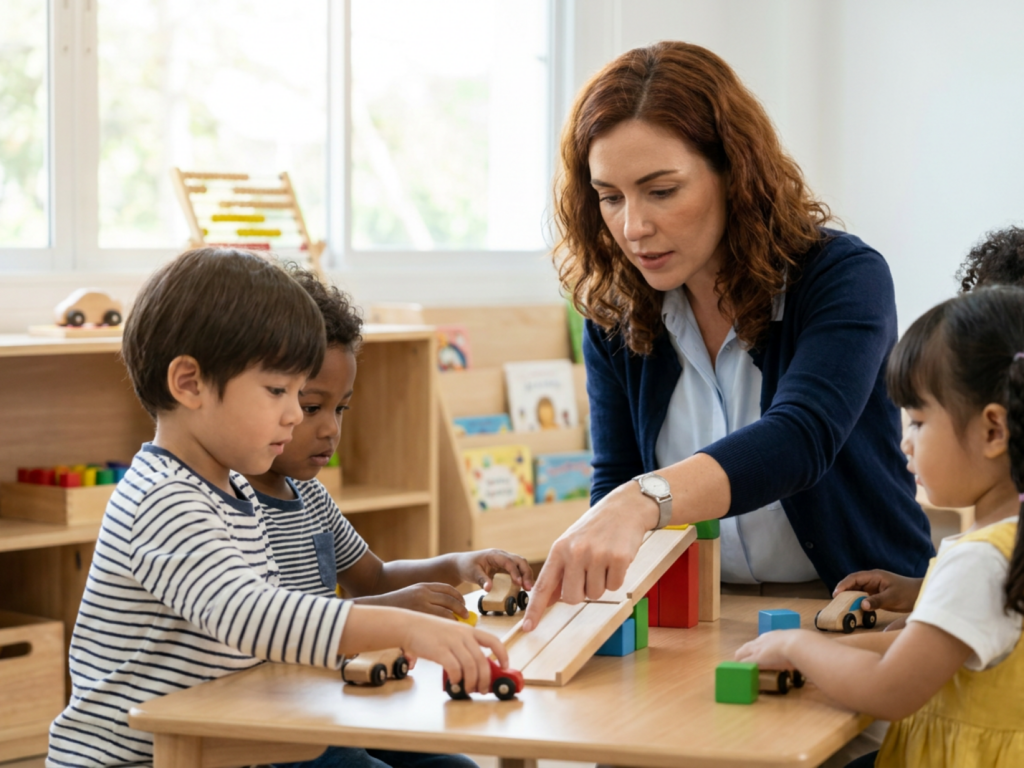
In the preschool period, children begin to use more symbolic thought. They can pretend, sort, match, build, ask “why,” and follow simple multi-step plans. Preschool learning skills development often includes the growth of attention span, early memory strategies, turn-taking, and the ability to explain what happened. Group problem solving activities, such as building a bridge together or deciding roles in pretend play, add social reasoning and negotiation.
School-age children gradually become more strategic. They can compare approaches, use rules, check work, and reflect on mistakes. Academic tasks increasingly rely on working memory, processing speed, planning, and flexible thinking. Reading, math, science, sports, music, and friendships all ask the child to identify obstacles and adapt. Even at this stage, children still benefit from adult scaffolding, especially when tasks are emotionally charged or unusually complex.
The brain systems behind problem solving
Problem solving is strongly linked to executive function, a group of higher-order cognitive processes supported by developing frontoparietal and limbic networks. These processes include inhibitory control, working memory, sustained attention, planning, and mental flexibility. In practical terms, executive function helps a child stop an impulsive response, hold the goal in mind, and shift to a new strategy.
Emotion regulation is equally important. When a child becomes overwhelmed, the stress response can narrow attention and reduce access to flexible thinking. This is not simply “bad behavior.” A child with limited frustration tolerance may need co-regulation before reasoning is possible: a calmer adult voice, reduced sensory load, a brief break, or a smaller next step.
Language and social cognition also shape problem solving. Children who can describe a problem, ask for help, understand another person’s perspective, and use words to negotiate have more tools available. Children with speech-language delays, hearing concerns, neurodevelopmental differences, anxiety, trauma exposure, sleep problems, or chronic medical conditions may need more individualized support. These factors do not define a child’s potential, but they can change the kind of help that is most useful.
Adult coaching that builds real skill
Effective coaching is usually neither rescuing nor leaving the child alone with a task that is too hard. The useful middle ground is scaffolding: offering just enough support for the child to stay engaged while still doing meaningful thinking. This may mean asking a question, narrowing choices, modeling one step, or helping the child notice cause and effect.
A practical sequence is: define the problem, name the goal, brainstorm options, choose one, try it, observe the result, and revise. This mirrors process-oriented problem solving used in research and professional settings, but it can be simplified for children. For example: “The tower keeps falling. What do we want it to do? What could make the bottom stronger?”
- Use open-ended prompts: “What could you try next?” rather than “Do it this way.”
- Normalize mistakes: “That told us something. The small block did not hold the big one.”
- Offer limited choices when a child is stuck: “Would you like to try the wider piece or turn this one around?”
- Think aloud briefly: “I’m checking whether the wheels can move before I add more blocks.”
- Protect time for persistence, but step in if frustration becomes dysregulation.
The goal is not to make every activity educational. It is to help the child experience themselves as an active thinker who can pause, try, repair, and learn.
Play, STEM, and everyday routines
Play is one of the most powerful settings for problem solving because it combines motivation, sensory feedback, imagination, and social interaction. Blocks, water play, pretend kitchens, ramps, puzzles, simple board games, art materials, and outdoor exploration all invite children to test hypotheses. “Will it float?” “How can we make the road longer?” “What happens if we mix these colors?” These are early forms of scientific reasoning.
Evidence from early childhood STEM education suggests that interventions focused on problem solving can improve children’s problem-solving skills. Helpful methods often include guided discovery, hands-on exploration, teacher questioning, collaborative tasks, and opportunities to explain thinking. The important point is not advanced content; it is the habit of inquiry.
Everyday routines matter too. Getting dressed, packing a school bag, setting the table, planning a route through the supermarket, or deciding how to repair a torn drawing are ordinary chances to practice sequencing, prediction, and adaptation. Adults can reduce pressure by using small, concrete goals: “First find both shoes, then we will decide which foot.” This is especially useful for children who become anxious when faced with broad instructions.
Supporting children who struggle
Some children need more support with problem solving because of differences in attention, language, motor planning, sensory processing, learning, emotional regulation, or social communication. Others struggle temporarily during illness, poor sleep, family stress, transitions, grief, bullying, or academic mismatch. A supportive approach starts with curiosity: what part of the task is hard?
Watch for patterns. Does the child understand the instructions but cannot start? That may point toward initiation or planning difficulty. Do they forget the goal midway? Working memory may be overloaded. Do they know what to do but become upset quickly? Frustration tolerance and co-regulation may need attention. Do they avoid puzzles, drawing, writing, or construction tasks? Fine motor or visual-motor demands may be part of the problem.
Developmental variation is common, but some signs deserve professional guidance. These include loss of previously acquired skills, marked language delay, persistent inability to follow simple directions compared with peers, extreme distress with ordinary problem-solving tasks, significant school decline, frequent unsafe impulsivity, or concerns raised by teachers. Families can discuss these observations with a pediatrician, developmental-behavioral pediatrician, psychologist, speech-language pathologist, occupational therapist, or school evaluation team, depending on the concern.
Creating a home and school environment that helps
Children build problem solving best in environments that are predictable enough to feel safe and flexible enough to invite exploration. At home, this may mean accessible materials, routines with visual supports, enough sleep, regular meals, and time away from constant adult correction. At school, it may mean developmentally appropriate preschool education, hands-on tasks, peer collaboration, and teachers who value reasoning as much as correct answers.
Adults can make thinking visible by using short reflective language: “What did you notice?” “What changed?” “Which part worked?” “What might we try tomorrow?” These questions support metacognition, the ability to think about one’s own thinking. For children with anxiety or low confidence, it can help to praise the specific strategy rather than the child’s intelligence: “You checked the shape before choosing the piece” is more useful than “You’re so smart.”
Screen-based games and apps may offer practice, but they should not replace hands-on exploration, movement, social play, or real-world tasks. Young children especially need physical feedback and responsive adults. A balanced environment gives the child repeated experiences of manageable challenge: hard enough to require thought, not so hard that the nervous system shifts into panic or shutdown.
When to seek guidance
- Consult a healthcare professional if a child loses previously acquired language, motor, social, or problem-solving skills.
- Ask for developmental or educational evaluation if struggles are persistent, impair daily life, or are reported across home and school.
- Seek urgent support if problem-solving difficulties occur with self-harm talk, unsafe impulsivity, severe aggression, or major behavioral change.
- Consider vision, hearing, sleep, pain, medication effects, and chronic illness as possible contributors to learning or attention changes.
- Avoid labeling a child as lazy or defiant before considering developmental, emotional, sensory, and medical factors.
Tools & Assistance
- Pediatric developmental screening and well-child visits
- School-based academic evaluation or individualized learning support
- Speech-language pathology evaluation for communication-related problem solving
- Occupational therapy evaluation for motor planning, sensory processing, and daily routines
- Parent-teacher problem-solving log to track triggers, supports, and progress
FAQ
At what age do problem solving skills begin?
They begin in infancy through exploration, cause-and-effect learning, and goal-directed action. The skills become more verbal, social, and strategic through preschool and school age.
Should adults let children struggle with problems?
Some productive struggle is helpful, but prolonged distress is not. The best support is usually gentle scaffolding: enough help to keep the child engaged while still allowing independent thinking.
Are puzzles necessary for problem solving development?
Puzzles can help, but they are only one tool. Building, pretend play, cooking, dressing, group play, outdoor exploration, and classroom projects also develop problem-solving abilities.
Can difficulty with problem solving be a sign of a developmental concern?
Sometimes. Persistent difficulties, regression, major frustration, or problems across several settings should be discussed with a pediatrician or relevant developmental professional.
Sources
- ERIC — A systematic review and meta-analysis of interventions to teach problem-solving skills in early childhood STEM education
- PubMed — The development of problem solving in young children
- Vitae — Using problem solving in research
Disclaimer
This article is for general educational information and does not diagnose, treat, or replace medical, developmental, psychological, or educational advice. Consult a qualified healthcare or developmental professional for concerns about an individual child.















Please log in to leave a comment.