
Intro
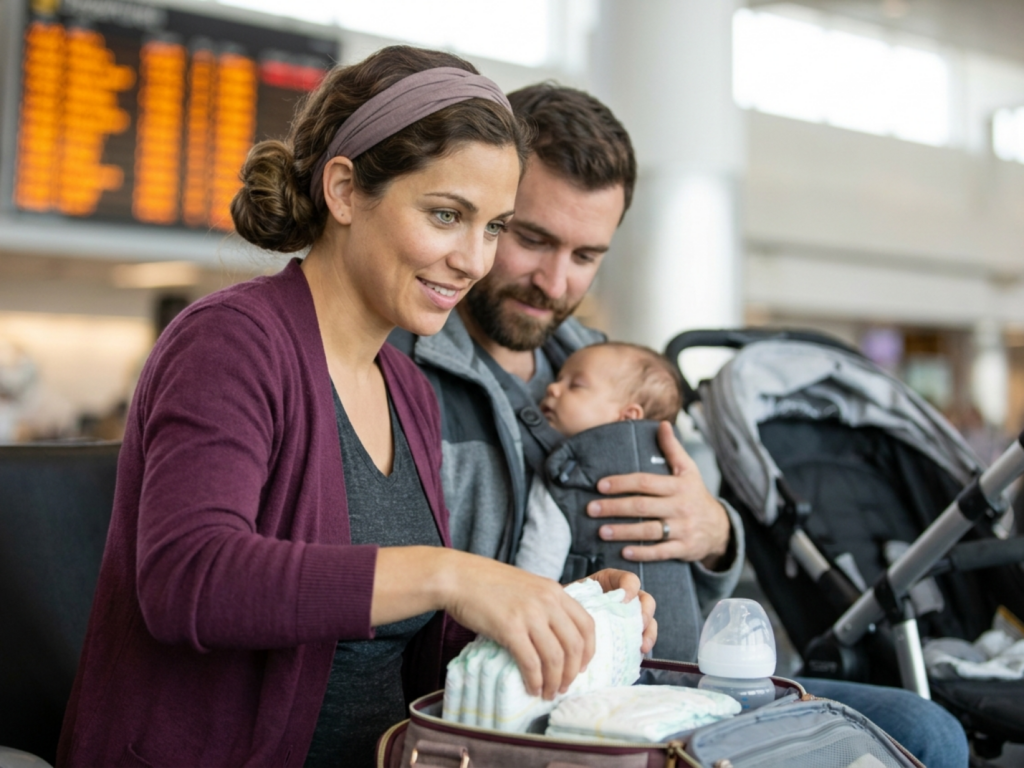
Travel with a baby rarely follows the itinerary exactly. A delayed flight, missed connection, traffic jam, lost luggage, unexpected illness, or sudden change in feeding and sleep times can make an ordinary journey feel medically and emotionally demanding. When plans unravel, the goal is not to restore a perfect routine immediately. It is to protect basic needs, reduce avoidable stress, and make the next safe decision.
A disrupted travel day can also affect caregiver mental health. Fatigue, uncertainty, sensory overload, and responsibility for an infant may intensify anxiety or impair concentration. A simple contingency plan, early communication with transport staff, and attention to hydration, food, medication timing, and safe sleep can help you move through the disruption one step at a time.
Highlights
A disrupted itinerary does not automatically mean that a baby is unsafe or that you have failed as a caregiver.
Prioritize immediate needs: feeding, hydration, temperature, medication timing, diapering, rest, and safe transport.
Use a flexible care plan with minimum essentials rather than trying to reproduce every detail of the home routine.
Contact healthcare professionals promptly when an infant has concerning symptoms or when prescribed medication cannot be given as directed.
Support for the caregiver is part of travel safety, especially when anxiety, exhaustion, or disorientation is affecting decision-making.
Start With a Practical Triage
When an itinerary changes, pause before trying to solve every problem at once. Take a brief inventory of the baby, the caregiver, and the environment. Ask: Is the baby breathing comfortably and responsive? Is the baby appropriately warm or cool? When was the last feed and diaper change? Are essential medicines, expressed milk, formula, clean water, and changing supplies accessible? Is the current location safe for holding, feeding, and transport?
This is a form of situational triage, not a diagnosis. It separates immediate safety concerns from logistical inconveniences. A cancelled reservation is important, but it generally comes after a baby who needs feeding, a caregiver who needs water, or medication that must be given at a scheduled time. If several adults are traveling, assign specific roles: one person contacts the carrier, another prepares a feed, and another watches the baby. Dividing tasks reduces cognitive load.
Use a short sequence: stabilize basic care, identify the next safe destination, communicate the constraint, and reassess. A written note or phone checklist can be useful when fatigue makes it difficult to remember details. Keep the plan flexible; infants may need responsive care rather than strict clock-based scheduling during an unusually long day.
Protect Feeding and Hydration
Travel disruption can lengthen the interval between feeds, interfere with pumping, or make preparation and storage more complicated. Continue to follow the baby’s usual feeding approach as closely as circumstances allow, while recognizing that one irregular day does not need to be corrected by forcing a larger feed or rigidly extending the next interval. Responsive feeding means attending to hunger and satiety cues within the infant’s established clinical guidance.
For breastfeeding, identify a reasonably private and safe place if desired, and consider how delays may affect pumping frequency, breast comfort, and milk storage. For expressed milk or formula, follow established handling and preparation guidance. Do not dilute formula to make supplies last longer, use unsafe water, or keep prepared feeds at an uncertain temperature. When a delay creates uncertainty about whether a feed remains safe, ask a healthcare professional or an appropriately trained service rather than guessing.
Carry more essentials than the planned journey requires when feasible: feeding supplies, clean containers, diapers, wipes, and a way to maintain the required temperature. An airport, station, hotel, pharmacy, or transport provider may be able to identify a family room, accessible sink, refrigeration, or a place to purchase supplies. A detailed guide to Managing feeding schedule travel can help families plan for formula preparation during transit, safe milk handling during travel, and a feeding rhythm after travel.
Monitor the baby in context. Fewer wet diapers, unusual sleepiness, persistent vomiting, inability to feed, or a markedly dry mouth may warrant prompt medical advice, particularly in young infants or babies with underlying conditions. Do not rely on thirst alone as a measure of infant hydration.
Keep Sleep and Safe Transport in View
A baby may nap in a carrier, stroller, car seat, or noisy terminal, but an unplanned nap is not automatically a safe sleep arrangement. During long delays, look for an approved, flat, firm sleep surface when the baby needs sleep, and follow established safe-sleep recommendations. Car seats and other restraint systems are designed for travel, not routine unsupervised sleep outside their intended use. Ask transport or accommodation staff where a suitable space is available.
Do not attempt to compensate for a missed nap by using sedating medicines unless a clinician has specifically prescribed and explained their use for that baby. Alcohol, cannabis, and other substances can impair a caregiver’s ability to respond safely and should not be used as stress-management tools. If the baby is overtired, lower stimulation where possible: dim the surroundings, reduce handling, use familiar soothing practices, and accept that sleep may be fragmented.
After a time-zone change or very late arrival, aim first for a safe place to rest and a manageable next feed. Gradual adjustment is usually more realistic than forcing a complete schedule change overnight. Families who need a structured approach can review Adjusting baby sleep schedule travel, including local time bedtime routine, morning light for jet lag, and safe sleep practices during travel.
During ground travel, maintain the correct infant restraint and take breaks as appropriate for the baby’s age, health, and journey conditions. Never improvise a restraint, leave an infant unattended in a vehicle, or allow a caregiver’s exhaustion to make driving unsafe. If necessary, stop the journey and arrange a safer alternative.
Manage Medication and Medical Information
Schedule disruption becomes more consequential when a baby or caregiver takes prescribed medication. Keep medicines in carry-on luggage, in original labeled containers, with dosing instructions and the prescribing clinician’s contact details. A written feeding and medication log can help prevent duplicate doses or missed doses when different adults share responsibility. Record the medication name, strength, amount given, and time, using the local time zone consistently while traveling.
Do not change dose, frequency, route, or formulation because a journey is late unless the prescribing healthcare professional advises you to do so. If a dose is delayed, vomited, lost, or unavailable, contact the prescriber, pharmacist, travel clinic, or local medical service for individualized guidance. The correct response can depend on the medication, age, indication, formulation, and time elapsed.
Before departure, consider carrying a concise medical summary for travel. It may include diagnoses, allergies, immunization information where relevant, current medicines, important baseline observations, emergency contacts, and the baby’s clinician details. This is especially useful if care is needed in an unfamiliar location. Medication reconciliation is the process of comparing what the patient is actually taking with the intended treatment plan; it becomes particularly valuable after a rushed transfer, lost bag, or emergency visit.
Ask a healthcare professional in advance about travel-specific issues if the baby was premature, has cardiopulmonary disease, requires oxygen or feeding equipment, has a seizure disorder, or has another condition that may make delays higher risk. General travel advice cannot replace an individualized plan.
Reduce Anxiety and Share the Load
Travel anxiety can involve anticipatory worry, physical arousal, irritability, difficulty concentrating, and repeated checking for threats. A schedule failure can amplify these responses because the caregiver loses the sense of predictability that normally supports infant care. These reactions are understandable, but severe distress can interfere with safe decisions. Slow the situation down by identifying only the next action: find a quiet place, offer a feed, call the carrier, or ask a trusted person to take over for ten minutes.
Use concrete language when requesting help. Tell staff that you are traveling with an infant and state the specific need: a private feeding area, assistance rebooking a connection, access to water, help locating a pharmacy, or a safe place to wait. Ask for the name and location of the next service rather than relying on a vague promise that someone will help. Keep a trusted support person informed by phone if you are traveling alone.
Basic physiological needs matter for caregivers too. Drink water, eat something tolerable, sit down when possible, and take slow breaths with a longer exhalation if panic is building. Avoid using alcohol or recreational drugs to blunt anxiety, and be cautious about any medicine that could cause sedation while you are responsible for an infant. If anxiety becomes persistent, causes panic, prevents sleep, or leads to thoughts of self-harm or harming the baby, seek urgent professional help through local emergency services or a healthcare professional.
Evidence about anxiety associated with air travel describes several coping behaviors, but people differ in what helps. A strategy is useful when it improves attention and functioning without creating additional risk. Professional mental-health support may be appropriate when travel anxiety is recurrent or disabling.
Communicate During Delays and Missed Connections
When a flight, train, bus, or transfer is delayed, gather reliable information before making a chain of rushed decisions. Confirm the revised departure time, baggage status, accommodation options, and whether the infant’s ticket or restraint arrangement remains valid. Ask about priority rebooking, family facilities, accessible transport, and the nearest medical service. Save confirmation numbers and photograph important documents if a phone battery or internet access is unreliable.
Build a small contingency hierarchy. The first option may be continuing the original route with adequate supplies. The second may be an overnight stay near the terminal. The third may be changing the destination or arranging local clinical care. Consider the baby’s health, the caregiver’s alertness, weather, access to food and medicines, and the safety of any proposed transport. The cheapest or fastest option is not necessarily the safest option for an exhausted family.
At a hotel or temporary accommodation, check the room for a safe sleep surface, temperature control, clean water access, and a way to obtain needed supplies. If luggage is missing, request essential infant items specifically rather than waiting for the whole bag. Keep high-priority supplies together so they are not repeatedly repacked during transfers.
Recover After an Unusually Long Day
Once you arrive, resist the urge to repair every disruption immediately. First restore a safe sleep environment, offer the usual feeding approach, change the baby, and allow the caregiver to rest. A baby may be more irritable or wakeful after prolonged stimulation, but behavior alone does not explain the cause. Consider the entire context, including intake, wet diapers, temperature, breathing, alertness, and any known medical condition.
Return to familiar routines gradually. Re-establish predictable cues around feeds, naps, bedtime, and morning wake time without treating a single difficult night as a permanent setback. After a missed or delayed medication dose, follow the individualized advice obtained from the prescribing clinician or pharmacist. Write down what occurred while it is fresh, including doses, feeds, vomiting, unusual symptoms, and travel conditions.
Seek medical advice if the baby cannot feed, has repeated vomiting or diarrhea, shows signs of dehydration, develops breathing difficulty, is unusually difficult to wake, has a seizure, has a concerning fever according to age-specific guidance, or simply seems significantly different from baseline. Caregivers should also seek help for severe anxiety, confusion, fainting, chest pain, or inability to safely supervise the baby. Local emergency services may be the appropriate first contact when symptoms are urgent.
The purpose of recovery is not to prove that the journey caused no disruption. It is to identify what the baby and caregiver need now, obtain help when needed, and make the next travel decision from a more stable position.
Seek Prompt Medical Help
- Breathing difficulty, blue or gray color, seizure, collapse, or unresponsiveness requires emergency evaluation.
- Seek urgent advice for an infant who cannot feed, has repeated vomiting, or shows possible dehydration.
- A baby who is unusually difficult to wake or markedly different from baseline should be assessed promptly.
- Do not guess about missed, repeated, or vomited doses of prescribed medication.
- Do not use sedating medicines, alcohol, or recreational drugs to manage travel stress or infant sleep.
Tools & Assistance
- A written baby travel care plan with feeding, medication, allergy, and emergency contact details
- A feeding and medication log that records amounts and times in one consistent time zone
- Carry-on supplies for feeds, diapers, prescribed medicines, changing, and temperature control
- Airline, rail, hotel, pharmacy, travel clinic, and local emergency services
- A charged phone, backup battery, offline documents, and a trusted support contact
FAQ
Should I force my baby back onto the usual schedule after a delay?
Usually, focus on responsive feeding, safe sleep, and familiar calming cues rather than forcing a complete reset. Gradual return to the usual routine is often more manageable, but ask the baby's healthcare professional for advice when there is a medical condition or feeding concern.
What should I do if a prescribed dose is late during travel?
Do not automatically double the next dose or change the schedule. Contact the prescribing clinician, pharmacist, travel clinic, or local medical service and provide the medicine name, strength, prescribed schedule, and time of the last dose.
Can my baby sleep in a car seat during a long delay?
A restraint may be necessary for travel, but it is not generally a substitute for a safe, flat sleep surface once you reach a suitable location. Follow current safe-sleep guidance and ask staff to help you find an appropriate place for rest.
When does travel stress become a mental-health concern?
Seek professional support when anxiety is persistent, causes repeated panic, prevents sleep or eating, impairs safe caregiving, or leads to thoughts of self-harm or harming the baby. In an immediate crisis, contact local emergency services.
Sources
- NHS Fit for Travel — Mental Health and Travel
- PubMed — Anxiety and health problems related to air travel
- Cleveland Clinic — How to manage travel anxiety
Disclaimer
This article provides general educational information and does not diagnose, treat, or replace advice from a qualified healthcare professional. Seek urgent local medical care for emergency symptoms or individualized infant-feeding, medication, or travel guidance.


















Please log in to leave a comment.