
Intro
Talking with a baby is a simple form of responsive caregiving that can begin from birth. Infants learn through repeated social exchanges: they hear the rhythm of speech, observe facial expressions and gestures, notice pauses, and gradually connect sounds with people, objects, and routines. A baby does not need to understand every word for these interactions to be valuable.
These activities are not lessons or tests of performance. They are brief, enjoyable opportunities to share attention and respond to your baby's signals. Everyday conversation, singing, reading, and playful sound exchanges can support early communication while also strengthening connection and emotional security.
Highlights
Ordinary routines such as feeding, bathing, dressing, and nappy changes provide frequent opportunities for meaningful conversation.
Responsive turn-taking helps babies learn that communication is reciprocal: one person makes a sound or gesture, and another person responds.
Child-directed speech, including expressive intonation and clear pauses, can support attention to speech without requiring exaggerated or artificial language.
Singing, shared book reading, gestures, and peek-a-boo offer varied ways to communicate when a baby is not yet using words.
Each baby develops at an individual pace; persistent concerns about hearing, communication, or social responsiveness should be discussed with a healthcare professional.
Why talking with a baby matters
Babies begin learning about communication long before they say recognizable words. During an interaction, they process prosody, the rhythm and pitch patterns of speech, as well as pauses, repetition, volume, and emotional tone. They also integrate auditory information with visual and social cues, such as a caregiver’s gaze, facial expression, and movement. These experiences help create the foundation for later receptive language, which means understanding language, and expressive language, which means communicating through sounds, gestures, and words.
Research published in the Proceedings of the National Academy of Sciences found that greater exposure to child-directed speech was associated with more efficient real-time word processing and larger expressive vocabularies by 24 months. The findings support the value of frequent, direct speech, although they do not mean that parents must talk constantly or that vocabulary outcomes can be predicted from one activity alone. Language development is influenced by many factors, including hearing, neurodevelopment, relationships, health, and the wider communication environment.
The most useful interaction is generally contingent: the adult notices what the baby is doing and responds in a related way. If the baby looks toward a lamp, you might say, “You see the light.” If the baby vocalizes, you can pause, imitate the sound, and wait for another response. This creates a conversational structure even when the baby is communicating through gaze, movement, facial expression, or babbling rather than words.
Talk through everyday routines
Routine care is predictable, repeated, and close to the baby, making it an ideal setting for talking. During feeding, describe what is happening in a calm voice: “You are ready for your milk,” or “We are taking a short pause.” During dressing, name body parts and clothing: “Here is your sleeve,” or “Your feet are going into the socks.” During bathing, describe sensations, movements, and objects, while keeping safety the priority.
Nappy changes can become brief face-to-face conversations. Position yourself where the baby can see you when practical, use a warm tone, and narrate the sequence: “First we clean, then we put on a fresh nappy.” You can name the baby’s expressions and movements without demanding a response. A baby who turns away may be communicating a need for a break, so pause and resume later rather than trying to maintain eye contact.
Household tasks also provide useful language exposure. While preparing food, folding laundry, or tidying, describe a few relevant actions and objects. Use ordinary words rather than replacing all language with simplified sounds. Repetition is helpful because babies benefit from hearing key words in meaningful contexts: “The cup is on the table. Here is the cup.” The goal is not a continuous monologue. A few attentive sentences, followed by space for the baby to look, move, or vocalize, are enough.
For safety, avoid placing a baby on an elevated or unstable surface while you talk during a routine. Never let conversation distract you from supervision around water, hot liquids, feeding, or changing equipment.
Build sound exchanges and turn-taking
Sound exchanges are among the earliest talking to baby activities. When your baby coos, squeals, babbles, or makes another vocal sound, imitate it once or twice, then add a simple variation. You might answer “ba-ba” with “ba-ba, baby,” or echo a vowel sound and then pause. The pause matters: it gives the baby time to process your response and attempt another turn.
Try changing one feature at a time. Make a sound slightly higher or lower, extend it briefly, or pair it with a facial expression. Keep the volume comfortable and avoid sudden loud noises close to the baby’s ears. If the baby smiles, watches, or vocalizes, continue for a few turns. If the baby becomes fussy, looks away repeatedly, stiffens, or seems overwhelmed, reduce stimulation and offer quiet contact.
These exchanges support early pragmatic communication, the social use of communication. The baby experiences that sounds can attract attention, express interest, and participate in a sequence. You can also respond to nonvocal signals. A kick, arm movement, smile, or change in gaze can become a conversational cue: “You kicked your legs,” or “You are looking at the teddy.” This validates communication in its many early forms.
Peek-a-boo is another useful activity because it combines anticipation, visual attention, vocal expression, and social reciprocity. Use a gentle version with your face or a cloth, announce what is happening, and allow the baby to see you again quickly. Watch the baby’s response and stop if the game is not enjoyable. The purpose is shared engagement, not making the baby tolerate stimulation.
Use singing, rhythm, and gestures
Singing offers a natural variation in pitch, timing, and repetition. Choose a familiar song or make up a short one about the baby’s current activity. Sing during a calm moment, such as while cuddling, walking, or washing hands. Repeated songs can create predictable pauses that invite participation, even if the baby’s contribution is a movement, smile, or vocalization rather than a word.
Rhythmic speech can help maintain attention, but babies differ in their sensory preferences. Keep the sound moderate and observe the baby’s arousal level. Some infants enjoy lively singing; others engage more readily with a quiet voice and slower tempo. There is no developmental requirement to perform a particular song or use a special musical method.
Pair words with simple gestures. Wave when saying “bye-bye,” open and close your hands for “all gone,” point to a nearby object, or use a consistent gesture for “more” during an appropriate routine. Gestures provide an additional channel for meaning and may help a baby communicate before spoken words emerge. Always treat the baby’s own movements as communication clues rather than insisting on imitation.
Music and gesture activities work best when they remain interactive. Pause at the end of a line, wait for the baby to look or move, and respond to that signal. A caregiver’s responsive singing and facial expression can make the activity socially meaningful, while the shared rhythm can support attention and regulation.
Read books and talk about pictures
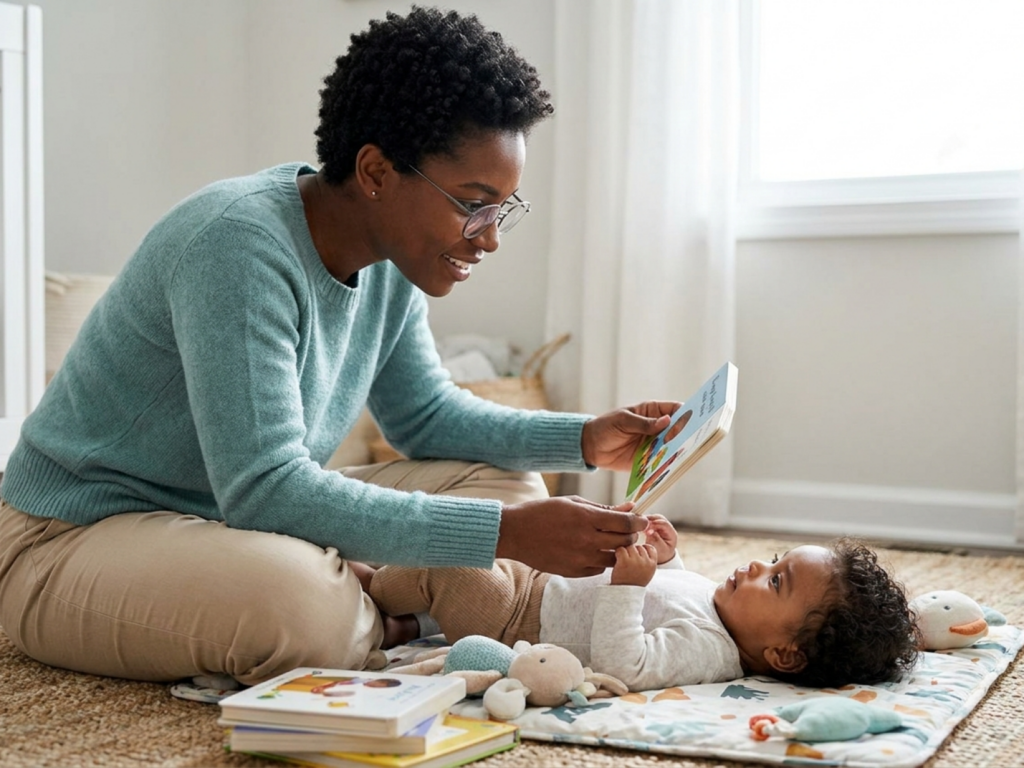
Shared book reading can begin with very young babies. Choose a sturdy book with clear images, high-contrast shapes, or simple photographs. Hold it so the baby can see the pages, but do not worry about finishing the story. Point to one picture, name it, and describe a relevant feature: “This is a dog. The dog is running.” Then pause so the baby can look, touch, vocalize, or turn away.
For infants, the social exchange is more important than reading every printed word. You can follow the baby’s gaze and talk about the page that has attracted attention. Repetition is welcome; hearing the same label many times in context helps build associations. Use expressive but natural intonation, and ask simple questions without expecting a verbal answer: “Where is the ball?” A look, reach, or change in attention can be a response.
Books also support joint attention, the ability to focus on an object or event together with another person. This skill is relevant to later vocabulary learning because the caregiver’s words can be connected to the same object the baby is seeing. Keep sessions short if needed. A few minutes of relaxed reading repeated regularly may be more sustainable than trying to create a formal reading period.
Let the baby handle books only when the material and supervision are appropriate. Avoid small detachable parts and supervise around paper that could tear. If a baby shows little interest on one day, return to the activity at another time; attention varies with sleep, hunger, illness, and sensory state.
Follow cues and adapt to the baby
Responsive interaction depends on noticing both engagement and the need for a pause. Signs of engagement may include looking toward your face, relaxing the body, smiling, moving closer, vocalizing, or repeating an action. Signs of reduced readiness may include turning away, closing the eyes, fussing, arching, becoming unusually still, or shifting attention elsewhere. These signals are not a diagnosis, but they are useful information about the baby’s state in that moment.
Use the baby’s cue to guide the pace. When the baby looks at you, make a brief comment. When the baby vocalizes, answer and wait. When the baby looks at an object, name it. This pattern of observation, response, and pause is often called serve-and-return interaction. It does not require special equipment, uninterrupted availability, or a perfectly quiet home.
Caregivers can also protect the quality of interaction by reducing competing media during face-to-face time. A television or phone in the background may interrupt attention, although occasional distractions are a normal part of family life. Aim for manageable moments rather than perfection. Talking while tired, feeding safely, or completing essential care may be difficult, and quiet presence is also valuable.
Families who use more than one language can speak naturally in the languages that are meaningful to them. Consistent, emotionally rich communication is more important than forcing one language during every interaction. Songs, stories, gestures, and everyday descriptions can all be shared across languages. A multilingual environment does not by itself indicate a language problem; concerns should be considered in the context of all languages the child hears and uses.
When to seek professional guidance
Variation in early communication is broad, and a single missed behavior does not establish a disorder. However, caregivers should discuss concerns with a pediatrician, family doctor, health visitor, or other qualified clinician when a baby seems not to hear everyday sounds, shows limited response to voices, loses a previously acquired communication skill, or consistently appears unable to engage in expected social exchanges. A hearing evaluation for language concerns may be appropriate because hearing contributes directly to access to speech sounds.
Bring concrete observations to an appointment. Note what sounds, gestures, gaze shifts, or responses you observe; whether the behavior occurs across settings; and whether there have been changes over time. Ask which developmental screening procedures are recommended and whether referral to audiology, speech-language pathology, or an early intervention service is indicated. Professional assessment is more useful than trying to interpret a checklist in isolation.
Continue offering warm, responsive communication while seeking advice. Do not attempt to diagnose a speech, hearing, or neurodevelopmental condition from online information, and do not delay care because a baby is still young or because relatives offer reassurance. At the same time, avoid turning activities into drills. A healthcare professional can help distinguish normal variation from a pattern that merits further assessment and can tailor guidance to the baby’s medical and developmental context.
Safety and medical guidance
- Stop or reduce stimulation when the baby shows signs of distress, fatigue, or sensory overload.
- Keep full attention on supervision during feeding, bathing, changing, and any activity involving water or elevated surfaces.
- Do not use talking activities to diagnose, treat, or rule out hearing, speech, or developmental conditions.
- Seek prompt professional advice about loss of communication skills, suspected hearing difficulty, or persistent concerns about responsiveness.
- Avoid loud sounds close to a baby's ears and follow age-appropriate safety guidance for books, toys, and household objects.
Tools & Assistance
- A small notebook or phone note for recording communication observations and questions for appointments
- Board books with clear pictures and no detachable small parts
- A short list of familiar songs, rhymes, and gesture games
- Routine care moments such as feeding, bathing, dressing, and nappy changes
- Pediatric, primary-care, health-visiting, audiology, and speech-language services when concerns arise
FAQ
How much should I talk to my baby each day?
There is no required number of minutes. Use brief, frequent interactions during routines and play, with pauses that allow your baby to respond. Quality and responsiveness matter more than delivering a continuous stream of speech.
What if my baby does not babble yet?
Babies vary in the timing and form of early vocal behavior. Continue responding to sounds, movements, gaze, and facial expressions, and discuss persistent concerns, limited responses to voices, or regression with a healthcare professional.
Is baby talk helpful?
Child-directed speech with a warm tone, clear pronunciation, repetition, and expressive intonation can help attract attention to speech. It is also useful to include ordinary words and sentences so the baby hears natural language.
Can I speak two or more languages to my baby?
Yes. Families can communicate naturally in the languages they know and use. Songs, books, gestures, and routines can be shared across languages. If concerns arise, describe the baby's communication across all languages to the clinician.
When should I ask about a hearing evaluation?
Ask a qualified healthcare professional if your baby seems not to respond to voices or sounds, has inconsistent responses, or loses communication abilities. The clinician can advise whether formal audiological assessment is appropriate.
Sources
- Proceedings of the National Academy of Sciences — Talking to children matters: Early language experience strengthens processing and builds vocabulary
- NHS — Help your baby learn to talk
- Raising Children Network — Play ideas for baby language & talking
Disclaimer
This article is for general educational information and does not diagnose, treat, or replace advice from a qualified healthcare professional. Contact your baby's clinician with individual concerns about hearing, communication, development, or safety.

















Please log in to leave a comment.