
Intro
Babies learn by acting on the world and noticing what happens next. When a baby shakes a rattle, presses a button, kicks a hanging toy, or drops an object, the resulting sound or movement provides immediate feedback. These simple interactions are early experiments in cause and effect: the developing brain begins to connect an action with a predictable outcome.
Cause-and-effect games can support sensory exploration, motor planning, attention, early problem-solving, and social communication. They do not need to be elaborate or expensive. A responsive caregiver, a safe object, and time for repeated discovery are often enough. Activities should be adapted to the baby's developmental stage, temperament, physical abilities, and medical needs.
Highlights
Cause-and-effect play links a baby's actions with observable results such as sound, movement, light, or caregiver response.
Repetition is useful: babies often need many opportunities to discover that an outcome is predictable.
The best games are brief, supervised, developmentally appropriate, and enjoyable for both baby and caregiver.
Caregiver narration and turn-taking add social and early language learning to physical exploration.
What cause-and-effect play means
Cause-and-effect play occurs when an infant performs an action and experiences a consequence. The action may be intentional or accidental at first. A baby may swipe at a soft toy and see it move, vocalize and hear a caregiver imitate the sound, or kick during floor play and make a suspended toy jiggle. With repetition, the baby can begin to anticipate the outcome and repeat the action deliberately.
This learning involves several overlapping domains. Visual, auditory, and tactile feedback helps the infant integrate sensory information. Reaching, grasping, pushing, and kicking provide practice in motor control and motor planning. The pause between action and result also creates a small problem-solving opportunity: the baby can adjust force, direction, or timing to produce the desired effect.
Cause-and-effect play is not a formal lesson and does not require a correct performance. The adult’s role is to create safe opportunities, observe closely, and respond warmly. The value lies in active exploration and shared attention, rather than in how quickly a baby masters a toy.
How the skill develops
Development is variable, but broad age ranges can help caregivers choose reasonable challenges. In the earlier months, babies mainly notice immediate sensory consequences. They may look toward a sound, follow a moving object, or accidentally move a toy while reaching. At approximately 8 months, many infants are increasingly interested in repeating actions that produce an effect, such as shaking, banging, or dropping objects.
By around 18 months, children commonly show a more established understanding that actions can produce changes in objects and people. They may intentionally activate a simple mechanism, seek an object that was moved, or vary an action to see whether the result changes. By approximately 36 months, cause-and-effect reasoning can become more flexible and may include predicting outcomes, using several steps, and explaining what happened. These milestones are general observations, not diagnostic thresholds.
For infants born preterm, clinicians may recommend considering corrected age when interpreting some developmental expectations. A baby’s opportunity for practice, sensory preferences, muscle tone, vision, hearing, and overall health can all affect how play looks. Compare a baby primarily with their own previous abilities and discuss persistent concerns with a pediatrician or other qualified professional.
Simple games for younger babies
For a young infant, choose effects that are immediate, gentle, and easy to see or hear. Place a lightweight, age-appropriate toy within reach during supervised floor play. When the baby touches it, pause before returning it so the baby can observe the movement. You can also slowly move a soft object from one side to the other, allowing time for visual tracking and an attempted reach.
A caregiver’s response is another powerful cause-and-effect game. When the baby coos, smile, imitate the sound, and wait. When the baby kicks or waves, describe the action and respond with a corresponding movement. This type of serve-and-return interaction helps the infant learn that their behavior can influence another person, while also supporting shared attention and early communication.
Other suitable ideas include:
- Offer a soft rattle that makes a quiet sound when moved.
- Let the baby pat a crinkly fabric panel while you hold it securely.
- Place a soft ball near the baby’s feet so a kick creates a small rolling movement.
- Use a caregiver’s face and voice: pause, respond to a vocalization, and pause again.
Keep the pace slow. Young babies may need several seconds to process a sound or movement before attempting another action.
Games for babies who can sit or reach
Once a baby can sit with appropriate support or reach more accurately, games can involve a clearer action and a more noticeable result. A large, stable container can be used for placing and removing safe objects. Let the baby drop a large soft block into the container, then show that tipping the container can make the block come out. This introduces the relationship between position, movement, and an object’s location.
Shaking rattles, tapping two large objects together, and banging a soft block on a tray can demonstrate that different actions create different sounds. These activities are often described in practical guidance on cause-and-effect play because they allow babies to control the timing of the result. Use objects that are too large to swallow and supervise continuously.
Try a simple hide-and-reveal game with a lightweight cloth. Partly cover a familiar toy, then allow the baby to pull or lift the cloth. The baby is not only producing an effect but also participating in a sequence: notice the hidden object, act on the cloth, and discover the result. Avoid placing fabric over the baby’s face or using materials that could wrap around the neck.
During each game, use concise language such as “You shook it, and it made a sound” or “You pulled the cloth, and the toy appeared.” This narration links words to actions without turning play into a test.
Games involving caregiver interaction
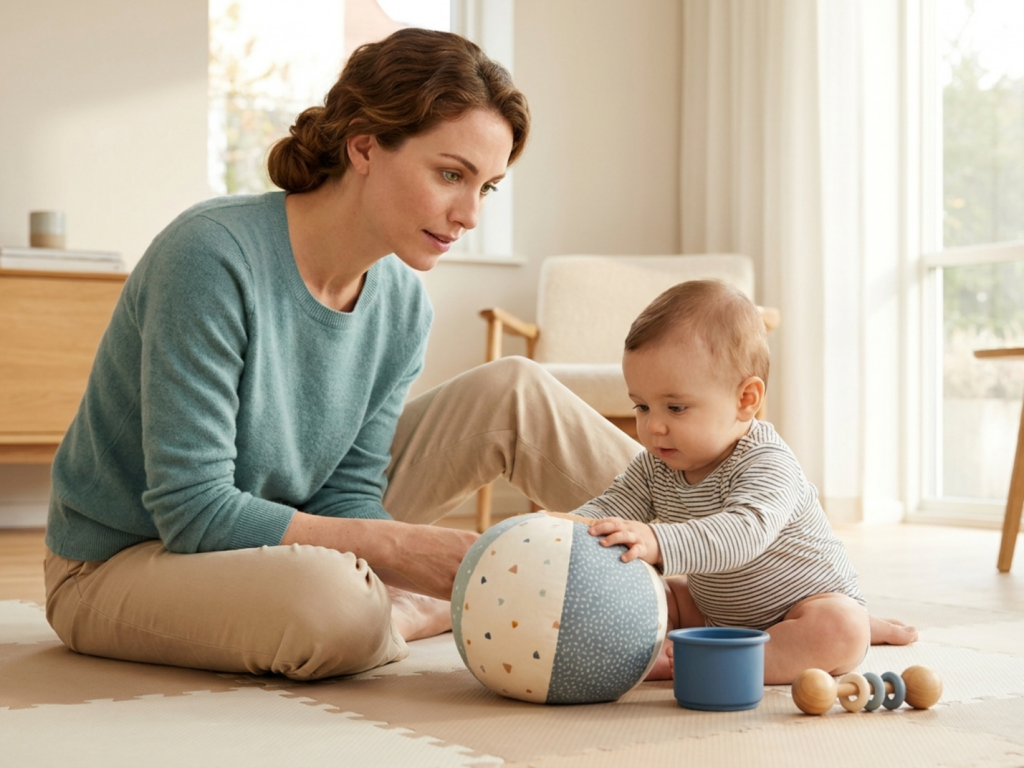
Many of the most meaningful cause-and-effect games involve another person rather than a mechanical toy. A caregiver can gently roll a large ball toward the baby, wait for a touch or push, and roll it back. For a baby who is not yet mobile, the adult can position the ball within comfortable reach and respond to any purposeful contact.
Simple sound exchanges are also effective. Make one quiet sound, wait for the baby’s response, and imitate or answer it. Responsive singing, pauses in a familiar song, and alternating vocal turns can show that the baby’s sound changes what happens next. These interactions combine auditory feedback with early reciprocity and can be especially useful for babies who prefer people to objects.
For babies who enjoy movement, a caregiver may hold a soft toy and allow the infant to pull it a short distance, then gently return it. Never pull against forcefully or place a joint in an awkward position. The objective is shared control, not strengthening or physical training.
Follow the baby’s cues. Turning away, arching, fussing, frantic movements, or loss of interest may indicate that the activity is too stimulating or that the baby needs a break. Calm observation is more helpful than continually adding novelty.
Choosing and adapting materials
Safe materials should be large enough to prevent choking, intact, washable when appropriate, and free from detachable parts, sharp edges, accessible batteries, magnets, and long cords. Inspect toys regularly because chewing, dropping, and repeated handling can create damage. Follow the manufacturer’s age guidance, but also consider the individual baby’s abilities and behavior.
Examples include large fabric balls, sturdy stacking cups, soft blocks, well-constructed rattles, and simple activity toys that respond to pressing, turning, or pulling. Age-appropriate toys should produce a modest, predictable effect rather than flashing intensely, startling the baby, or rewarding every random movement with excessive stimulation.
Household objects can work when used directly by an alert caregiver. A metal spoon and a large plastic bowl may create contrasting sounds, but the adult should control the materials and avoid loud impacts near the baby’s ears. A cardboard box can provide a place to put and retrieve large objects, provided it is clean, stable, and free of staples or loose pieces.
Adapt the position and difficulty. A toy may be placed closer, farther away, or slightly to one side according to the baby’s comfort and ability. Stop when fatigue or frustration appears. Cause-and-effect games should remain a low-pressure opportunity for exploration.
Safety and medical considerations
Active supervision means staying close enough to intervene immediately, rather than checking on the baby periodically from another room. Use floor-based play on a clear, stable surface whenever possible. Do not use cause-and-effect toys in a cot or other sleep space, and do not leave a baby unattended with objects that could become a suffocation or choking hazard.
Keep sounds at a comfortable volume. A toy that seems moderate to an adult may be unpleasant or potentially harmful when held close to an infant’s ear. Avoid toys with small high-powered magnets, loose button batteries, detachable strings, water beads, or parts that can break off. Any suspected battery or magnet ingestion requires urgent medical advice or emergency evaluation according to local services.
Do not use play to force a movement, correct an asymmetry, or test a suspected developmental delay. If a baby appears to have pain, unusual fatigue, difficulty seeing or hearing, marked feeding difficulty, loss of a previously acquired skill, or a persistent difference in movement, contact a pediatric healthcare professional. A clinician can consider the baby’s history and examination and determine whether developmental screening, hearing or vision assessment, or referral is appropriate.
For babies with neurologic, musculoskeletal, sensory, or other medical conditions, ask the treating team how to adapt positioning and materials. Individualized guidance is preferable to generalized exercises found online.
How caregivers can support discovery
Start with one object and one effect. Give the baby time to act before demonstrating, correcting, or moving the toy. If the baby repeats an action, repeat the outcome consistently so the relationship remains understandable. If the result is not occurring, simplify the task: use a lighter object, bring it closer, reduce background noise, or stabilize the item.
Use descriptive language rather than frequent questions. Phrases such as “You pushed the button,” “The cup fell,” and “I heard that tap” help connect action, outcome, and vocabulary. Match the baby’s attention and energy. A short exchange repeated across ordinary routines can be more useful than a long, highly stimulating play session.
Observe what the baby is learning. Are they looking toward the result, anticipating a familiar sound, changing their grip, repeating an action, or seeking the caregiver’s reaction? These observations can help adults select the next manageable challenge. Keep a flexible attitude: some babies prefer movement, some prefer sound, and others engage most readily through social interaction.
Cause-and-effect activities are one part of a broader developmental environment that also includes sleep, feeding, responsive care, safe movement, communication, and opportunities to explore. There is no requirement to fill every period of wakefulness with structured play.
Safety reminders
- Supervise babies continuously during object-based play.
- Keep small parts, magnets, button batteries, cords, and water beads away from infants.
- Avoid loud sounds and do not place stimulating toys in a sleep space.
- Stop if the baby shows distress, pain, fatigue, or sensory overload.
- Seek professional advice for skill loss or persistent developmental concerns.
Tools & Assistance
- A clear floor area for supervised play
- Large washable balls, soft blocks, and sturdy cups
- A quiet rattle or securely constructed activity toy
- A pediatrician or child-health nurse for developmental questions
- Local poison control or emergency services for suspected ingestion
FAQ
What is the easiest cause-and-effect game for a young baby?
Place a lightweight, safe toy within reach and let the baby touch, kick, or swipe at it. Pause and allow time for the baby to notice the movement or sound before responding.
Do babies need electronic toys to learn cause and effect?
No. A caregiver's voice, a soft rattle, a large cup, or a ball can provide clear feedback. Simple materials often allow the baby to control the timing and repetition of the outcome.
How long should a cause-and-effect play session last?
There is no fixed duration. Follow the baby's attention and stop when they turn away, fuss, become tired, or appear overstimulated. Several brief interactions may be appropriate.
When should I ask a healthcare professional about development?
Discuss concerns about persistent difficulty seeing, hearing, moving, engaging, or repeating actions, as well as any loss of previously acquired skills. A healthcare professional can interpret concerns in context.
Sources
- California Department of Education — Foundation: Cause-and-Effect - Child Development
- OTFC Group — Supporting Cause & Effect Play in Babies - Why…
- Lovevery — How to deepen your toddler's understanding of cause and effect
Disclaimer
This article provides general educational information and is not a diagnosis or a substitute for individualized medical advice. Consult a qualified healthcare professional with concerns about your baby's development, safety, or health.














Please log in to leave a comment.