
Intro
Babies are not passive observers of the world. From the first weeks of life, they use sight, hearing, touch, smell, taste, posture, movement, and social feedback to test what their surroundings mean. Exploration may look simple, such as staring at a ceiling fan, mouthing a soft toy, kicking during diaper changes, or turning toward a familiar voice, but these behaviors reflect rapid coordination among the sensory systems, motor control, attention, memory, and early communication.
For caregivers, understanding exploration can make ordinary moments feel more purposeful and less stressful. Babies learn through repetition, safe novelty, and responsive adults who notice cues without overstimulating them. This article explains how babies explore surroundings across infancy, why movement changes learning, how object play supports development, and when to ask a healthcare professional about concerns.
Highlights
Babies explore with their whole body, including eyes, mouth, hands, posture, movement, and social attention.
New motor skills such as reaching, sitting, crawling, and cruising expand what infants can perceive and learn from the environment.
Mouthing, banging, rotating, transferring, and visually inspecting objects are typical ways infants study shape, texture, weight, sound, and cause and effect.
Responsive caregiving helps babies regulate arousal, feel secure, and return to exploration after uncertainty or frustration.
Safety matters because curiosity develops faster than judgment; supervision and a prepared environment protect learning.
Exploration starts before mobility
Babies begin exploring long before they can crawl across a room. A newborn studies surroundings through close-range vision, smell, voice recognition, touch, vestibular input from being held and moved, and proprioception, the body’s internal sense of position. These early sensory channels help the infant learn what is familiar, what is soothing, and what deserves attention.
In the first months, exploration is often organized around faces, feeding, caregiver voice, light-dark contrast, and repeated body sensations. A baby may pause sucking to listen, widen the eyes toward movement, turn the head toward a sound, or calm when held in a predictable rhythm. These responses are part of sensory development in babies, because the brain is learning to filter, prioritize, and link information from multiple systems.
Exploration is also constrained by immature motor control. A young infant may want to look at something but lack stable head control, or may swipe toward a toy without being able to grasp it. This limitation is not a failure; it is the developmental starting point. As posture, head control, and visual tracking improve, the baby can gather more information with greater precision.
The body becomes a learning tool
Motor development changes what babies can discover. When an infant learns to hold the head steadier, visual exploration becomes easier. When rolling begins, the baby can alter viewpoint independently. Sitting frees the hands for play. Reaching brings objects closer. Crawling expands the infant’s perceptual field, allowing the baby to compare distances, surfaces, slopes, obstacles, and caregiver responses. How babies learn to move is therefore inseparable from how they learn about space.
Researchers describe infant exploration as perceptual-motor activity: perception guides action, and action changes perception. A baby who reaches for a rattle receives feedback about distance, grip, weight, sound, and success or failure. The next reach is modified by that information. Over many repetitions, the nervous system refines motor planning, balance, attention, and expectation.
This is why safe floor time matters. A baby lying freely on a firm surface can kick, rotate, push through the arms, shift weight, and experiment with gravity. These small movements build postural control in infancy, which later supports sitting, crawling, pulling to stand, and walking. Devices that hold babies in fixed positions can be useful briefly for specific situations, but they do not replace supervised movement opportunities on the floor.
Hands, mouth, and eyes work together
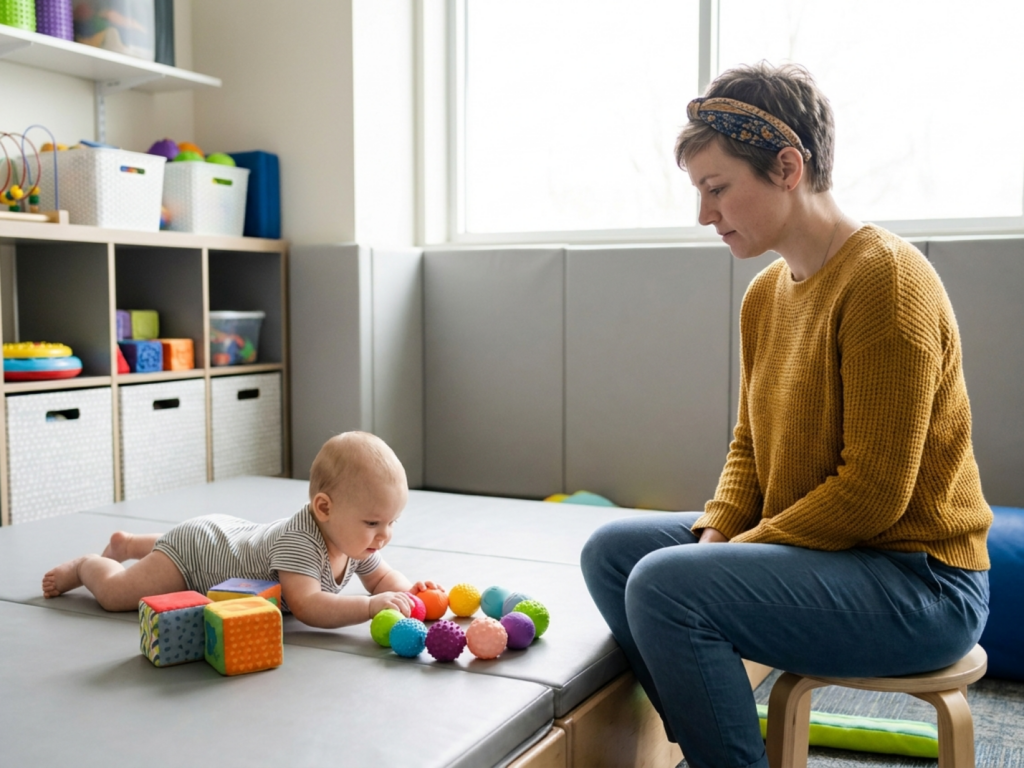
Object exploration becomes especially visible around the middle of the first year. Babies inspect objects visually, bring them to the mouth, bang them, shake them, rotate them, transfer them from hand to hand, and compare one object with another. These behaviors are not random mischief. They are experiments in sensory physics.
The mouth is densely innervated and gives detailed information about texture, temperature, firmness, and shape. Mouthing is common and developmentally meaningful, but it requires careful safety because choking, poisoning, and infection risks are real. Objects should be large enough not to fit fully into the mouth, free of small detachable parts, clean enough for infant use, and appropriate for the baby’s developmental stage.
Hands add another layer. Grasping helps a baby learn size and resistance. Banging reveals sound and force. Dropping teaches gravity and caregiver response. Rotating an object allows the baby to see that it remains the same thing from different angles, a foundation for later object concepts. Visual attention guides these actions, and the results of the actions reshape attention. This cycle supports early problem solving, memory, and the cognitive foundations of language, including learning that objects have names and predictable properties.
Exploration is social as well as physical
Babies rarely explore in isolation, even when they are playing with objects. They monitor caregivers for facial expression, tone of voice, body tension, and timing. A baby may crawl toward a new toy, look back at a parent, then continue if the parent’s face and voice feel reassuring. This social referencing helps the infant decide whether a situation is safe, interesting, or too much.
Responsive caregiving is the adult side of this learning system. When a caregiver notices a baby’s gaze, labels what the baby is touching, waits for a response, and then responds again, the interaction becomes a serve-and-return exchange. These caregiver-infant social interactions support attention, emotional regulation, and early communication. When babies interact with others, exploration often becomes more organized because another person helps pace the experience.
Supportive adults do not need to entertain constantly. In fact, babies benefit from short pauses that allow them to initiate, repeat, and problem-solve. A caregiver can stay nearby, narrate simply, offer one or two safe objects, and step in when the baby becomes distressed, fatigued, hungry, or overstimulated. The goal is not performance; it is a secure base from which curiosity can return.
Mobility changes safety and confidence
Once babies roll, pivot, crawl, pull to stand, cruise, or walk, the environment changes dramatically. A room that seemed safe for a nonmobile infant can become hazardous when the baby can reach cords, climb low furniture, open cabinets, find coins, pull tablecloths, or mouth objects from the floor. Curiosity develops before impulse control and risk judgment, so prevention is essential.
Useful safety steps include anchoring unstable furniture, blocking stairs, securing cords and blinds, keeping medicines and cleaning products locked away, checking floors for small objects, using appropriate gates, and placing hot liquids out of reach. Water safety is critical: infants and toddlers can drown quickly and silently, including in bathtubs, buckets, and toilets. Supervision must be active, close, and continuous around water.
Confidence grows when babies can explore without repeated danger interruptions. A prepared space allows the adult to say yes more often: yes to crawling, yes to pulling up on a stable surface, yes to reaching for a basket of safe household items, and yes to practicing the same action many times. Simple baby activities by age can be built from everyday materials, but the activity should match the baby’s motor abilities and safety needs.
Individual differences are expected
Babies vary in temperament, sensory thresholds, motor timing, medical history, and interest in novelty. Some infants eagerly mouth every object; others prefer to look first. Some tolerate noisy rooms; others become dysregulated quickly. Some babies repeat one action many times before trying something new. These differences can be normal, especially when the baby is otherwise gaining skills, engaging with caregivers, feeding and sleeping reasonably for age, and showing curiosity in some form.
Corrected age matters for babies born preterm. A baby born eight weeks early may be expected to show some developmental behaviors closer to the age calculated from the due date, particularly in the first two years. Medical complexity, visual or hearing differences, muscle tone differences, feeding challenges, and prolonged hospitalization can also influence exploration.
Caregivers should avoid comparing a baby rigidly with another child or a social media milestone chart. Instead, look for a developmental trajectory: increasing alertness, improving control, more purposeful interaction, more varied object use, and growing ability to recover with support after frustration. If progress seems stalled, asymmetric, or regressive, a pediatric clinician, developmental specialist, physical therapist, occupational therapist, or speech-language pathologist can help assess the pattern without blaming the child or family.
When exploration may need professional attention
Most unusual moments are not emergencies, but some patterns deserve timely discussion with a healthcare professional. Examples include persistent loss of previously acquired skills, marked lack of visual tracking or response to sound, very limited use of one side of the body, persistent stiffness or floppiness, feeding difficulties that interfere with growth, minimal social engagement, or absence of curiosity across multiple contexts. These signs do not diagnose a specific condition by themselves, but they may indicate that assessment is appropriate.
It is also worth seeking guidance if a baby consistently cannot tolerate ordinary handling, movement, textures, sounds, or light despite gentle pacing, or if caregivers feel they must avoid most daily routines to prevent distress. Sensory differences in babies can arise for many reasons, including temperament, medical factors, neurodevelopmental differences, pain, fatigue, or environmental overload.
Early support is not about labeling a baby too soon. It is about understanding the infant’s nervous system, protecting health, and giving the family practical strategies. A clinician can check vision, hearing, growth, tone, reflexes, movement quality, feeding, sleep, and social communication. If needed, referral to early intervention services can provide family-centered support during a period when the brain is highly responsive to experience.
Seek medical guidance promptly if
- Your baby loses a skill they previously used consistently.
- Your baby has persistent stiffness, marked floppiness, or strong movement asymmetry.
- Your baby rarely responds to sound, faces, movement, or caregiver interaction.
- Feeding problems, choking episodes, or poor growth affect daily life.
- Exploration stops because ordinary touch, movement, light, or sound causes severe distress.
Tools & Assistance
- Create a supervised floor-play area with age-appropriate objects.
- Use short serve-and-return interactions during routine care.
- Track new skills and concerns with dates before pediatric visits.
- Ask about early intervention if motor, sensory, feeding, or communication concerns persist.
- Review home safety whenever your baby gains a new movement skill.
FAQ
Is mouthing toys normal?
Yes, mouthing is a common way infants explore texture, shape, and firmness. It still requires close supervision and objects that are too large to choke on and appropriate for the baby’s age.
Should I constantly stimulate my baby?
No. Babies need responsive interaction, safe movement, rest, and time to repeat actions. Too much noise, handling, or novelty can overwhelm some infants.
Does crawling matter for exploration?
Crawling can expand spatial learning by letting babies choose where to go and what to inspect. Some babies use different mobility patterns, so concerns are best judged by overall development and a clinician’s assessment.
What toys are best for exploration?
Simple, safe objects with varied textures, shapes, weights, and sounds are often enough. Avoid small parts, button batteries, magnets, sharp edges, and items not designed for infant use.
When should I worry about limited exploration?
Ask a healthcare professional if your baby shows little curiosity across settings, loses skills, has persistent asymmetry, does not respond to sensory cues, or seems unusually distressed by ordinary experiences.
Sources
- PubMed — The ecology of infants' perceptual-motor exploration
- PubMed Central — Object exploration at 6 and 9 months in infants with and without risk for autism spectrum disorder
- PubMed — Infants exploring objects: A cascades perspective
Disclaimer
This article is for general educational purposes and is not a diagnosis or treatment plan. Consult your baby’s pediatrician or another qualified healthcare professional with concerns about development, feeding, movement, safety, or sensory responses.
















Please log in to leave a comment.