
Intro
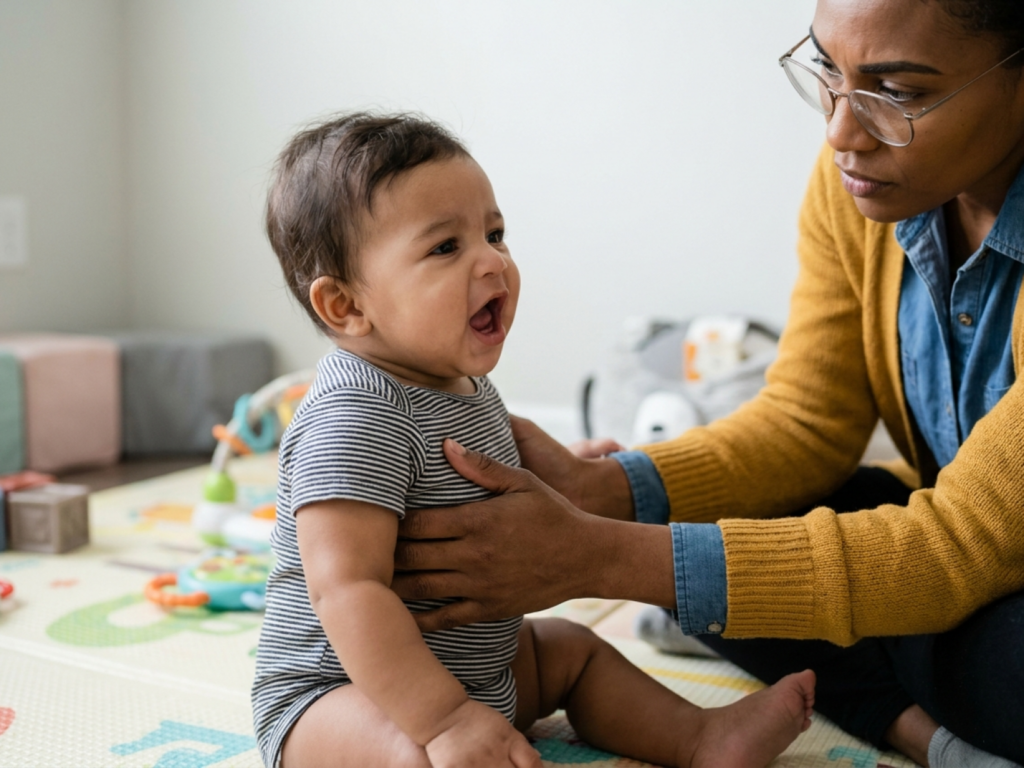
A baby’s sudden squeal can be joyful, surprising, exhausting, or worrying, sometimes all within the same afternoon. For many infants, these high-pitched sounds are part of early communication: a way to explore the voice, attract attention, express emotion, and practice the building blocks that later support babbling and speech.
Highlights
Squealing and brief shrieking are often part of normal vocal exploration in infancy, especially in the middle of the first year.
The communicative meaning depends on context: facial affect, body tone, breathing, feeding, and consolability matter more than volume alone.
Warm back-and-forth responses help babies connect sound, attention, and social meaning.
Seek professional advice if loud vocalizations come with breathing difficulty, feeding problems, developmental regression, hearing concerns, or persistent distress.
What Squeals and Shrieks Mean
To an adult ear, an infant squeal can sound startling, piercing, or even angry. Developmentally, it is often much more nuanced. Squealing and brief shrieking are high-pitched vocal behaviors that sit within the larger family of early infant vocalizations. In developmental speech science, many of these sounds are described as protophone vocalizations: speech-like sounds produced before true words, including vowel-like sounds, squeals, growls, raspberries, and later canonical consonant-vowel syllables.
These noises can communicate pleasure, surprise, frustration, bids for attention, or the sheer discovery that the body can make an interesting sound. A baby may squeal when a caregiver smiles back, when a toy appears, when they are tired of a position, or when the room becomes too stimulating. The key is not the sound alone but the pattern: facial expression, body tone, breathing, feeding, consolability, and whether the baby seems engaged or distressed.
The Developmental Timeline
Many babies begin using a widening range of facial expressions and non-cry sounds across the middle of the first year. Around 4 to 7 months, caregivers often notice more laughing, babbling, imitation of sounds, raspberries, and squeals. By the end of the seventh month, many babies can take turns making sounds with a caregiver, turn toward a familiar voice, squeal or laugh, and imitate simple sounds. These are early communication milestones, not a strict performance checklist.
Timing varies. A baby born preterm may be assessed using corrected age for preterm babies, and temperament also matters: some infants are exuberant vocal experimenters, while others are quieter but still socially attentive. Squeals may appear before, alongside, or after more vowel-like coos. Later in infancy, sound play increasingly includes canonical consonant-vowel syllables such as ba or da. The developmental direction is more important than a single date: increasing variety, more back-and-forth interaction, and more intentional use of gaze, gesture, and sound together.
Vocal Exploration and Brain-Body Practice
Research on infant vocal category exploration supports the idea that squeals are not random noise. In a longitudinal study using all-day home recordings from 130 typically developing infants during the first year of life, investigators found clustering of squeals and growls relative to more vowel-like vocants. In practical terms, babies often produced several sounds from one vocal category within a period, suggesting active practice of that category.
From a physiologic perspective, a squeal requires coordination across respiration, laryngeal control, and the shaping of the vocal tract. A very high-pitched squeal often reflects a higher fundamental frequency, sometimes with falsetto-like phonation. The baby is learning what airflow, vocal fold tension, mouth opening, tongue position, and auditory feedback can do together. This is not speech yet, but it builds sensorimotor maps that later support babbling, syllable timing, and expressive language.
Babies also use these sounds socially. A squeal can test whether a caregiver looks over, smiles, imitates, pauses, or answers. That loop links motor practice with social communication, which is why the caregiver response matters.
How Caregivers Can Respond
A helpful response is warm, brief, and contingent. In a serve-and-return interaction, the baby offers a sound, look, or movement; the adult notices it, responds, and leaves space for another turn. This does not require special equipment. It can happen during diaper changes, feeding pauses, stroller walks, or floor play.
- Imitate one squeal softly, then wait. The pause teaches conversational rhythm.
- Translate the likely meaning without pretending certainty: You sound excited, or That was loud.
- Add real words connected to the moment: toy, up, more, bath, music, all done.
- Use your face and voice together, because babies read prosody, expression, and timing before they understand many words.
- Protect your own nervous system too; if the sound is overwhelming, lower the volume of the environment and respond calmly rather than matching intensity.
Responsive turn-taking with infants gives squeals communicative value. The goal is not to stop all loud sounds, but to help the baby learn that sounds affect people and can become part of interaction.
Reading the Context
The same acoustic behavior can mean different things depending on context. A playful squeal is often brief, variable in pitch, paired with bright facial affect, relaxed movement, eye contact, or a return to play. A distress shriek may be sharper, longer, repetitive, and accompanied by arching, grimacing, breath-holding, feeding refusal, sleepiness, or difficulty settling. Early infant communication cues are multimodal; sound is only one channel.
Consider the immediate trigger. Did the squeal occur during peekaboo, when a sibling entered, during hunger, at the end of a nap, after reflux-like discomfort, or in a noisy supermarket? A medically literate caregiver can think of squealing as a behavioral sign that needs clinical context, not as a symptom with one meaning. Responsive caregiving in infancy means observing the whole infant, reducing obvious stressors, and offering co-regulation before assuming the baby is being difficult. If the baby settles with holding, feeding, repositioning, or a quieter room, the sound may have been an effective request for help.
When to Seek Professional Guidance
Most squealing is benign developmental vocal play, but some patterns deserve prompt professional input. Contact a pediatric clinician urgently if a shriek is associated with respiratory distress, bluish color, abnormal pauses in breathing, choking, a weak or high-pitched cry that seems new, fever in a young infant, poor feeding, dehydration signs, lethargy, injury, or inconsolable pain. These features are about medical status, not communication style.
For developmental questions, discuss concerns if the baby is not responding to voices or other sounds, does not turn toward a caregiver’s voice by the later middle months, rarely makes non-cry sounds, does not engage in back-and-forth vocal play, loses previously acquired vocal or social skills, or seems unusually difficult to soothe. A hearing evaluation for speech delay or communication concern is often a practical first step because infants cannot build stable sound categories if auditory access is reduced.
Also ask for guidance if loud vocalizations are persistently hoarse, strained, breathy, or associated with feeding stress, aspiration concerns, chronic congestion, or poor growth. Pediatricians, audiologists, speech-language pathologists, lactation professionals, and pediatric otolaryngology clinicians may each have a role depending on the pattern. The safest approach is to describe what you observe rather than label it: when it happens, how long it lasts, what helps, and what other signs occur.
Supporting Communication Without Overstimulation
Because squealing can be intense, families often need a balance between encouragement and sensory protection. Babies learn from repetition, so it is appropriate to let them experiment in safe settings. At the same time, a caregiver can shape the environment: move closer and speak softly, reduce background noise, offer a teether or toy, change position, or shift to a calmer activity when the baby seems overloaded.
Try not to punish or shame vocal play. Instead, model a lower-volume alternative and reinforce quieter turns with attention. For example, after a piercing squeal, you might smile, say softly, I hear you, and wait for the next sound. Shared books, songs, and face-to-face play provide lower-intensity routes for the same developmental goals: attention, imitation, rhythm, and meaning.
The larger goal is not a quiet baby. It is a baby whose vocal range, social interest, and caregiver-supported regulation are expanding over time. If that trajectory feels stalled or has reversed, a pediatric check-in is worthwhile.
When Loud Sounds Need Medical Attention
- Seek urgent care for shrieking with breathing trouble, blue or gray color, choking, abnormal pauses, or marked lethargy.
- Call a clinician for inconsolable crying or shrieking that seems painful, sudden, or unlike the baby's usual pattern.
- Ask about hearing if the baby does not respond to voices or sounds, especially if communication progress seems limited.
- Mention persistent hoarseness, strained voice, feeding distress, or poor growth to a pediatric professional.
- Treat loss of previously acquired vocal, social, or motor skills as a reason for prompt evaluation.
Tools & Assistance
- Short daily sound log with time, context, duration, and consolability
- Pediatric visit for breathing, feeding, hearing, voice, or developmental concerns
- Audiology assessment when response to sound is unclear
- Speech-language pathology assessment for persistent communication delay concerns
- Calm play routines that use imitation, pauses, naming, songs, and shared books
FAQ
Is squealing normal in a young baby?
Often, yes. Many babies use squeals, laughs, raspberries, and babbling sounds during the middle of the first year as part of vocal exploration and social communication.
Why does my baby shriek when excited?
A baby may be testing pitch and volume, expressing strong positive emotion, or learning that a sound brings caregiver attention. Context and body cues help distinguish excitement from distress.
Should I discourage loud squealing?
Avoid punishment or shaming. Respond calmly, model a softer sound, reduce overstimulation if needed, and keep using warm back-and-forth interaction.
Can squealing predict speech development?
Squealing alone does not predict a specific outcome. It can be one part of healthy vocal exploration, especially when paired with increasing sound variety, social engagement, imitation, and later babbling.
When should I ask for help?
Ask a pediatric professional about breathing difficulty, feeding problems, persistent hoarseness, hearing concerns, lack of response to voices, loss of skills, or loud vocalizations that seem painful or inconsolable.
Sources
- Nemours KidsHealth — Communication and Your 4- to 7-Month-Old
- PLOS ONE — Infant vocal category exploration as a foundation for speech development
- LibreTexts — Infant Vocal Development
Disclaimer
This article is for general educational purposes and is not a diagnosis or treatment plan. For concerns about breathing, feeding, hearing, development, or voice changes, consult a pediatric healthcare professional.
















Please log in to leave a comment.