
Intro
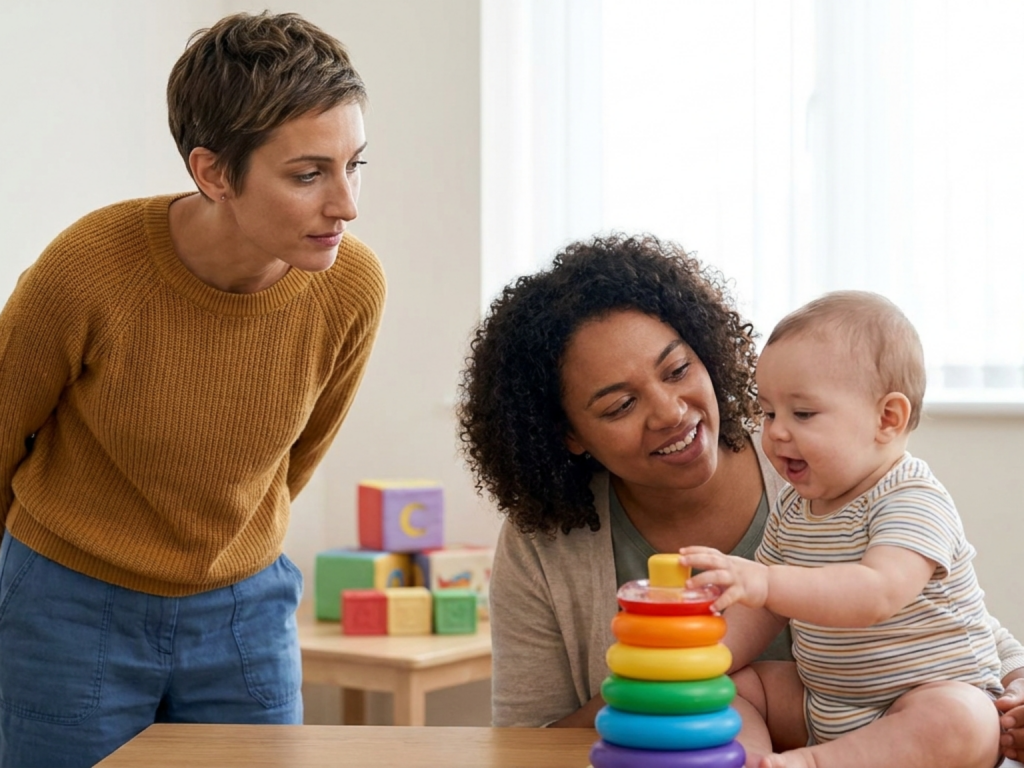
Babbling is one of the earliest ways babies experiment with speech sounds, rhythm, and social communication. It usually develops gradually rather than appearing on one predictable day. Early vocal play may sound like cooing, squealing, or vowel-like noises, followed by repeated consonant-vowel combinations such as “ba-ba” or “da-da.”
Most babies begin speech-like babbling during the second half of the first year, but there is meaningful normal variation. This month-by-month guide explains what babbling may sound like, how it relates to hearing and communication, and when to discuss concerns with a pediatrician or other qualified healthcare professional.
Highlights
Many babies begin speech-like babbling around 4 to 6 months.
Canonical babbling, involving clear consonant-vowel syllables, often emerges around 5 to 6 months.
Babbling commonly becomes longer, more varied, and more conversational between 7 and 12 months.
Babies born prematurely may be assessed using corrected age for preterm babies.
A lack of expected vocal progress, loss of skills, or concerns about hearing warrants professional guidance.
What babbling means in infant communication
Babbling is not simply random noise. It is a developmental stage in which an infant practices controlling the lips, tongue, jaw, vocal folds, airflow, and timing needed for later speech. The earliest sounds may be primarily vowel-like. With maturation of motor control and auditory feedback, babies begin combining consonants and vowels into syllables.
Clinicians and researchers often distinguish canonical babbling from earlier vocalizations. Canonical syllables have a relatively rapid, speech-like transition between a consonant and a vowel, as in “ba,” “da,” or “ma.” Repeated strings may sound like “bababa,” while varied strings may combine different syllables. These vocal behaviors are practice, not necessarily meaningful words, even when a sound resembles a familiar word.
Babbling also has a social function. Babies may vocalize while looking at a caregiver, pause when another person speaks, and resume as though participating in an exchange. These reciprocal vocal turns help build the foundations of later conversation. A baby’s communication profile includes more than sound production: eye contact, facial expression, gestures, response to voices, and shared attention are also relevant.
Babbling by month: 2 to 4 months
At 2 months, many infants are becoming more alert to human voices and faces. They may make brief cooing sounds, open-vowel vocalizations, sighs, or pleasure noises. These sounds are generally not yet canonical babbling. Some babies vocalize frequently, whereas others are quieter observers who communicate more through facial expression and movement.
By around 3 months, vocal play may become more noticeable. A baby might vary pitch, squeal, laugh, or experiment with the duration and loudness of sounds. Caregivers may hear sounds resembling “ooo,” “aaa,” or “eee,” especially when the baby is comfortable and socially engaged. At this stage, responsive caregiving in infancy can encourage communication because the baby learns that vocal behavior produces an attentive human response.
Between 4 and 5 months, many babies begin making more speech-like sounds. The National Institute on Deafness and Other Communication Disorders describes speech-like babbling as a common development around 4 to 6 months. It is normal for the transition to be gradual: a baby may alternate between cooing, squealing, raspberries, and emerging consonant-like sounds rather than babble consistently every day.
Babbling by month: 5 to 6 months
At 5 to 6 months, canonical babbling often begins to emerge. Research synthesized in the National Library of Medicine describes onset commonly around this period, although the timing varies among infants. A baby may produce syllables such as “ba,” “ga,” “da,” or “ma,” sometimes repeating one syllable several times. The sound may be accidental initially, then become more frequent as the infant discovers how to reproduce it.
By the end of 6 months, many babies babble and make a broader range of sounds. Their vocalizations may include changes in pitch, volume, and rhythm. Some babies appear to “sing” or vocalize in long streams; others produce short bursts separated by periods of quiet. Both patterns can occur in healthy development.
Babbling at this age should not be interpreted as proof that a first word is imminent, nor should a particular syllable be assumed to have a stable meaning. Meaningful language usually depends on a combination of sound, context, and consistent use. Continue watching the overall trajectory: increasing vocal variety, responsiveness to voices, and interest in social interaction are more informative than any single sound.
Babbling by month: 7 to 9 months
From approximately 7 to 9 months, babbling often becomes longer and more flexible. The NIDCD notes that babies in this period may use longer strings of sounds, including repeated syllables and sequences with changing consonants. A vocal stream might sound like “bababa,” “dadaga,” or “mamama,” although these forms are not necessarily words directed at a particular person.
Many infants begin using vocalizations in a more clearly social manner. They may call out from another room, vocalize to attract attention, imitate some sounds, or alter their voice when excited, frustrated, or amused. Babbling may increase during face-to-face play, meals, diaper changes, or other predictable routines. Caregivers can support these exchanges by responding, pausing, and allowing the baby time to take another turn.
Communication also expands beyond vocal sound. Babies may use reaching, pointing-like gestures, waving, showing objects, or changes in gaze. Understanding voices, responding to their name, and sharing attention with another person are important complementary skills. A baby who is not yet producing many syllables may still be communicating actively through gestures, expressions, and vocal tone.
Babbling by month: 10 to 12 months
Between 10 and 12 months, many babies produce more varied babbling, sometimes called jargon. Jargon consists of long strings that contain speech-like rhythm and intonation, so the baby may sound as though they are speaking a sentence even though the sequence is not yet composed of conventional words. The infant may use rising pitch for a question-like pattern or emphasize certain syllables.
At this stage, babbling may coexist with emerging recognizable words or word approximations. A sound becomes more language-like when the baby uses it consistently for the same person, object, action, or event. Vocabulary size varies considerably, so the absence of a clearly recognizable word at exactly 12 months does not by itself establish a problem. The quality and progression of communication matter, including gestures, comprehension, imitation, and social engagement.
Research on canonical babbling suggests that its onset is rarely later than 10 months, but population findings cannot replace individual assessment. A baby who has not developed speech-like syllables, has very limited vocal variety, does not respond to sound, or has stopped using previously acquired communication skills should be discussed with a healthcare professional promptly.
How caregivers can encourage healthy babbling
Babies learn language through repeated, meaningful interaction. Speak close to your baby at a comfortable volume, describe what you are doing, and use simple phrases during ordinary routines. When the baby makes a sound, imitate it or answer as though it were a conversational turn. Then pause. This serve-and-return interaction gives the infant time to process the response and initiate another vocalization.
Face-to-face play can make speech sounds easier to observe. Exaggerated but natural changes in pitch and rhythm may hold an infant’s attention, while songs, nursery rhymes, and shared book reading provide repeated patterns. Name familiar people and objects, follow the baby’s gaze, and respond to gestures. These practices support both expressive communication and receptive language.
Do not pressure a baby to repeat a sound or compare their vocalizations with those of another infant. Limit competing background noise when possible, especially during interaction, so the baby can hear speech clearly. Screen exposure should not replace direct communication, because babies benefit from contingent responses that a prerecorded program cannot provide. Multilingual families can speak the languages they use naturally; exposure to more than one language does not cause a speech or language disorder.
When to ask about babbling or hearing
Developmental milestones describe patterns seen in many children, not rigid deadlines. Still, a persistent lack of expected progress deserves attention. Consider contacting a pediatrician if a baby has little or no vocal experimentation by the middle of infancy, does not develop speech-like syllables over time, rarely responds to voices or environmental sounds, or shows limited social reciprocity. A hearing evaluation for speech delay may be appropriate because even a partial or fluctuating hearing loss can affect access to speech sounds.
Seek prompt professional advice if a baby loses previously acquired babbling, gestures, eye contact, or other communication skills. Regression is different from normal day-to-day variability and should be assessed. Also mention concerns about feeding, oral-motor function, frequent ear infections, or unusual responses to sound.
For babies born before term, clinicians may consider corrected age for preterm babies when interpreting early milestones, particularly during the first two years. The appropriate timing of evaluation depends on gestational age, medical history, hearing status, and the full developmental picture. A pediatrician may coordinate assessment with an audiologist, speech-language pathologist, or early intervention service. Evaluation is not a diagnosis by itself; it is a way to understand the child’s communication profile and identify helpful support.
When professional advice matters
- No response to loud sounds or familiar voices should be discussed with a healthcare professional.
- Persistent absence of speech-like babbling after the expected early infancy range merits assessment.
- Loss of previously acquired vocal, social, or gestural skills requires prompt medical attention.
- Frequent ear infections or suspected hearing difficulty can affect access to speech sounds.
- Milestones should be interpreted in context, including prematurity, medical history, and multilingual exposure.
Tools & Assistance
- Keep a brief monthly record of new sounds, gestures, responses to voices, and social interactions.
- Bring developmental observations and questions to routine pediatric visits.
- Ask about formal hearing assessment through an audiologist when hearing is uncertain.
- Contact local early intervention services if a healthcare professional recommends developmental support.
FAQ
What is the earliest age babies usually start babbling?
Many babies begin speech-like babbling between 4 and 6 months. Canonical consonant-vowel syllables often become clearer around 5 to 6 months, but individual timing varies.
Is “mama” at 6 months a first word?
It may be a repeated babbling syllable rather than a word. It is more likely to function as a word when the baby uses it consistently and intentionally for a particular person or context.
Should I worry if my 8-month-old is quieter than other babies?
Not necessarily. Babies differ in temperament and vocal frequency. Discuss the pattern with a pediatrician if there is little vocal variety, poor response to sound, limited social interaction, or no ongoing progress.
Does bilingual exposure delay babbling?
Exposure to two or more languages does not cause a speech or language disorder. Families should communicate naturally in the languages they use, while monitoring the child’s total communication across all languages.
When should hearing be checked?
Hearing should be discussed whenever a baby does not respond consistently to voices or sounds, has risk factors for hearing loss, or shows delayed vocal development. An audiologist can perform age-appropriate testing.
Sources
- National Institute on Deafness and Other Communication Disorders — 7 Months To 1 Year
- Mayo Clinic — Language development: Speech milestones for babies
- National Library of Medicine, National Institutes of Health — Babbling development as seen in canonical babbling ratios
Disclaimer
This article is for general educational purposes and does not diagnose, treat, or replace advice from a pediatrician, audiologist, or other qualified healthcare professional. Seek professional care for concerns about hearing, development, or regression.














Please log in to leave a comment.