
Intro
The pincer grasp is a fine motor milestone that allows a baby to pick up a small object using the thumb and the tip or pad of the index finger. It marks an important transition from broad, whole-hand grasping toward more precise manipulation and is closely connected with later skills such as self-feeding, turning pages, drawing, and using tools.
Many babies begin showing an emerging pincer grasp at about 9 months, although the timing varies. The skill is often more consistent and fully developed near the first birthday. A wide range can be typical, so the most useful approach is to observe the overall pattern of motor progress rather than judge one isolated milestone.
Highlights
An emerging pincer grasp commonly appears around 9 to 10 months.
By approximately 12 months, many babies can use the thumb and index finger more accurately and consistently.
Development is gradual: babies usually progress from whole-hand grasping to raking motions and then to a refined pincer grasp.
Premature babies may need to be assessed using corrected age, and individual variation is expected.
Small objects must be offered only with close supervision because they can present a choking hazard.
What is a pincer grasp?
A pincer grasp is the coordinated use of the thumb and index finger to pick up, hold, and release a small item. In a mature version, the fingertips approach one another with controlled precision. Some babies initially use the sides or pads of the fingers rather than the very tips; this is still part of the normal refinement process.
The grasp depends on several components of fine motor control, including thumb opposition, finger isolation, hand and wrist stability, visual attention, motor planning, and graded force. The baby must locate an object, reach toward it, shape the hand, close the fingers with enough pressure to secure it, and often transfer or release it intentionally. These abilities develop through repeated everyday movement rather than appearing all at once.
The pincer grasp is different from a palmar or whole-hand grasp, in which the fingers close around an object against the palm. It is also different from the earlier raking grasp, where a baby uses several fingers together to pull an item toward the hand. Each pattern represents a step toward increasing dexterity.
When does the pincer grasp develop?
Most developmental references place the beginning of the pincer grasp around 9 months, with some babies showing it earlier or later. WebMD describes the skill as usually appearing around 9 to 10 months and becoming fully developed near the first birthday. Cleveland Clinic similarly explains that babies acquire the grasp over the first year and that it is typically well established at about 1 year. Pathways.org places the milestone around 9 months while noting variation up to 12 months.
These time frames are guides, not deadlines. A baby may first pick up a crumb using a clumsy thumb-and-finger motion, then gradually become more accurate over several weeks. One hand may seem more coordinated during a particular activity, while both hands continue to develop. Fatigue, hunger, interest in the object, body position, and the size or texture of the item can all affect performance.
Developmental surveillance considers a pattern of skills. A baby who is reaching, transferring objects between hands, bringing items to the mouth, using both sides of the body, and gradually improving control may be progressing appropriately even if the grasp is not yet consistent. For babies born prematurely, clinicians may consider corrected age when interpreting milestones. The appropriate method depends on the child’s gestational age at birth and local clinical practice.
The developmental sequence before a pincer grasp
Hand skills typically become more selective and precise over time. In early infancy, grasping is dominated by reflexive and whole-hand patterns. As visual-motor coordination improves, babies begin reaching deliberately and closing the fingers around larger objects. They may hold a toy in the palm, bang it, mouth it, or transfer it from one hand to the other.
Later, babies often use a raking motion. They place the forearm and wrist near a small object and sweep several fingers toward the palm. This strategy can bring food or a toy closer, but it does not require the independent thumb-and-index-finger coordination of a pincer grasp.
An emerging pincer grasp may look variable. A baby might pick up a small piece of food with the thumb and index finger but use a raking motion for another item. The fingers may remain somewhat flexed, the wrist may be supported on the surface, or the object may be held briefly before dropping. With practice, the movement becomes smoother, the fingers separate more effectively, and the baby gains better control over release.
During the same period, other fine motor skills may appear, including pointing, poking with one finger, turning objects, removing items from containers, and bringing two objects together. These related abilities provide useful context when considering hand development as a whole.
How to encourage safe practice
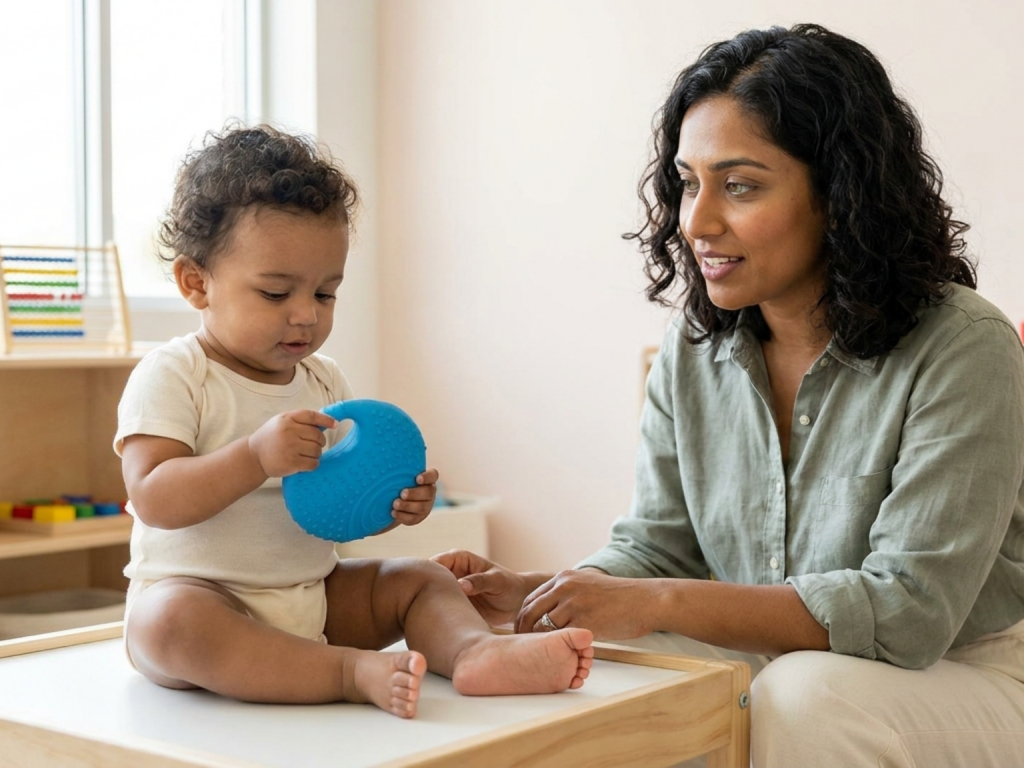
Babies learn fine motor skills through ordinary play and daily routines. Offer opportunities to reach, grasp, transfer, and release objects while the baby is alert and seated in a stable position. Use objects that are large enough to avoid choking risk, easy to clean, and appropriate for the child’s developmental stage.
- Provide soft finger foods that have been prepared according to current infant-feeding guidance and can be handled safely.
- Offer larger blocks, textured balls, stacking cups, thick board books, and baby-safe containers for taking objects in and out.
- Place an interesting toy slightly within reach so the baby can practice purposeful reaching without becoming frustrated.
- Allow time for two-handed exploration, transferring an object from one hand to the other and manipulating it from different angles.
- Use simple household routines, such as picking up large pieces of food or placing an oversized object into a container, to practice controlled release.
Short, frequent opportunities are generally more useful than formal drills. Follow the baby’s cues and stop when the child becomes tired or distressed. Avoid forcing the fingers into a particular position. Adult hands can model a movement, but the baby should be allowed to discover the action independently.
Safety requires continuous, close supervision whenever a baby handles food or objects. Items such as coins, button batteries, beads, small balls, hard nuts, and detachable toy parts can cause choking or other serious injury. A toy marketed for infants is not automatically safe if it contains small removable pieces. Follow age guidance, inspect toys regularly, and keep hazardous objects out of reach.
Signs that development may need discussion
Variation in timing is common, and the absence of a mature pincer grasp just before or just after 12 months does not by itself establish a medical problem. However, it is appropriate to raise concerns with a pediatrician, family physician, or other qualified healthcare professional when hand use appears significantly different from expectations or when progress seems to stop.
Discuss the pattern if a baby rarely reaches for objects, cannot hold or release items, appears unusually stiff or floppy, consistently keeps one hand closed, or shows marked difficulty using one side. Persistent one-sided movement may be relevant, especially if the baby avoids using the other hand during reaching and play. A clinician can assess muscle tone, range of motion, strength, coordination, vision, and the broader developmental profile.
Loss of a skill that was previously present warrants prompt medical attention. Concerns are also more important when fine motor differences occur alongside difficulties with gross motor skills, feeding, communication, social engagement, or sensory responses. These observations do not diagnose a condition, but they provide useful information for developmental surveillance and, when indicated, referral to an occupational or physical therapist.
Parents and caregivers can prepare for an appointment by noting which objects the baby can grasp, whether the movement occurs with both hands, how often the skill appears, and whether the child can intentionally release items. A short home video may help a clinician understand a movement that is not seen during an office visit.
Putting the milestone in context
The pincer grasp is one observable part of a much larger developmental picture. Babies do not progress through motor milestones on an identical schedule, and temporary plateaus can occur during periods when they are concentrating on mobility, communication, sleep changes, or other new abilities. Interest and opportunity also influence what caregivers observe.
Rather than testing the grasp repeatedly, watch how the baby uses the hands during spontaneous play and feeding. Is reaching becoming more purposeful? Can the baby hold a toy securely? Do the hands work together? Can the child bring an object to the mouth, transfer it, or release it into a container? These questions often provide more meaningful information than whether a single small item can be picked up on a particular day.
Healthcare professionals use milestone information together with medical history, birth history, physical examination, and standardized developmental screening when appropriate. If you are worried, seeking advice is reasonable even when the baby is otherwise well. Early guidance can clarify what is typical, suggest safe activities, and identify whether further assessment would be useful.
Safety and medical cautions
- Never leave a baby unattended with food or small objects.
- Keep button batteries, coins, beads, magnets, and detachable toy parts away from infants.
- A missed milestone alone does not provide a diagnosis.
- Seek medical advice for loss of an acquired skill or marked asymmetry in hand use.
- Use corrected age when discussing milestones for some premature infants, with guidance from the child’s clinician.
Tools & Assistance
- A developmental observation log recording reaching, grasping, transferring, and releasing
- Age-appropriate large toys and containers that do not contain detachable small parts
- Current infant-feeding and choking-prevention guidance from a healthcare professional
- A short video of concerning movements to share during a clinical appointment
FAQ
Can a baby develop a pincer grasp before 9 months?
Some babies show an early thumb-and-finger grasp before 9 months, while others develop it later. Timing varies, and clinicians consider the overall pattern of motor progress rather than one isolated age.
Is a pincer grasp expected by 12 months?
Many babies have a more consistent pincer grasp by about 12 months, but individual variation remains normal. If the skill is absent along with other motor concerns, discuss the pattern with a healthcare professional.
What if my baby uses one hand more than the other?
Occasional differences can occur, especially during specific activities. Persistent one-sided movement, avoidance of one hand, or a consistently closed hand should be discussed with a pediatric clinician.
How can I practice the pincer grasp safely?
Offer supervised opportunities to handle appropriately sized toys and safely prepared foods. Avoid choking hazards, do not force the fingers into position, and let practice occur during brief, enjoyable play.
Do premature babies develop the pincer grasp later?
Some premature babies reach milestones according to corrected age rather than chronological age. Ask the child’s healthcare professional how corrected age should be used for individual developmental monitoring.
Sources
- WebMD — What to Know About Pincer Grasp
- Cleveland Clinic — Finger to Thumb: What To Know About the Pincer Grasp
- Pathways.org — Important Fine Motor Skills for Baby: The Pincer Grasp
Disclaimer
This article is for general educational purposes and does not diagnose, treat, or replace individualized medical advice. Consult a qualified healthcare professional about your baby’s development or any safety concern.

















Please log in to leave a comment.