
Intro
A stroller can make daily life with a baby more manageable: it supports mobility, gives caregivers a safe place to transport essentials, and allows infants to rest while families move through parks, shops, clinics, and sidewalks. At the same time, stroller safety is not automatic. Falls, tip-overs, entrapment, thermal stress, airway compromise, and pinch injuries can happen quickly, especially when a tired caregiver is multitasking.
The goal is not to make every outing feel tense. It is to build a calm, repeatable safety routine: choose the right stroller, secure your baby correctly, supervise closely, and adapt to your baby’s age, motor control, medical needs, and environment. If your baby was premature, has hypotonia, reflux, respiratory disease, craniofacial differences, or any condition affecting airway tone or positioning, ask your pediatric clinician for individualized advice.
Highlights
Use a stroller that fits your baby’s age, weight, height, and developmental stage, especially head and neck control.
A five-point harness, engaged brakes, a wide stable base, and secure folding locks are core safety features.
Never hang heavy bags from stroller handles, because this can shift the center of gravity and cause a backward tip-over.
Avoid using a stroller as an unsupervised sleep space; if your baby falls asleep, monitor positioning and move them to a firm, flat infant sleep surface when practical.
Regular checks for recalls, loose parts, damaged wheels, exposed hinges, and worn restraint straps reduce preventable injuries.
Start with a stroller that matches your baby
The safest stroller is not necessarily the most expensive one; it is the one that is appropriate for your baby’s size, developmental stage, and the way you use it. Check the manufacturer’s weight and height limits before purchase and periodically as your baby grows. Limits matter because stroller seats, recline angles, harness geometry, brakes, and wheel stability are tested for specific loads.
For newborns and young infants without reliable head control, look for a stroller that reclines sufficiently or is approved for use with a compatible bassinet or infant car seat attachment. Newborn head and neck support is medically important because infants have proportionally large heads, weaker cervical musculature, and less ability to reposition themselves if the chin falls toward the chest. That flexed posture can narrow the upper airway, particularly in premature infants or babies with low tone.
Prioritize a five-point harness, a wide base, sturdy brakes, and secure locking mechanisms that keep the stroller from collapsing during use. Check that hinges and folding points are not exposed to small fingers, and that the stroller feels stable when you gently press on the handlebar or turn corners. If you buy secondhand, inspect the frame, wheels, brakes, restraint straps, and recall history carefully before using it with your baby.
Buckle every ride, even short ones
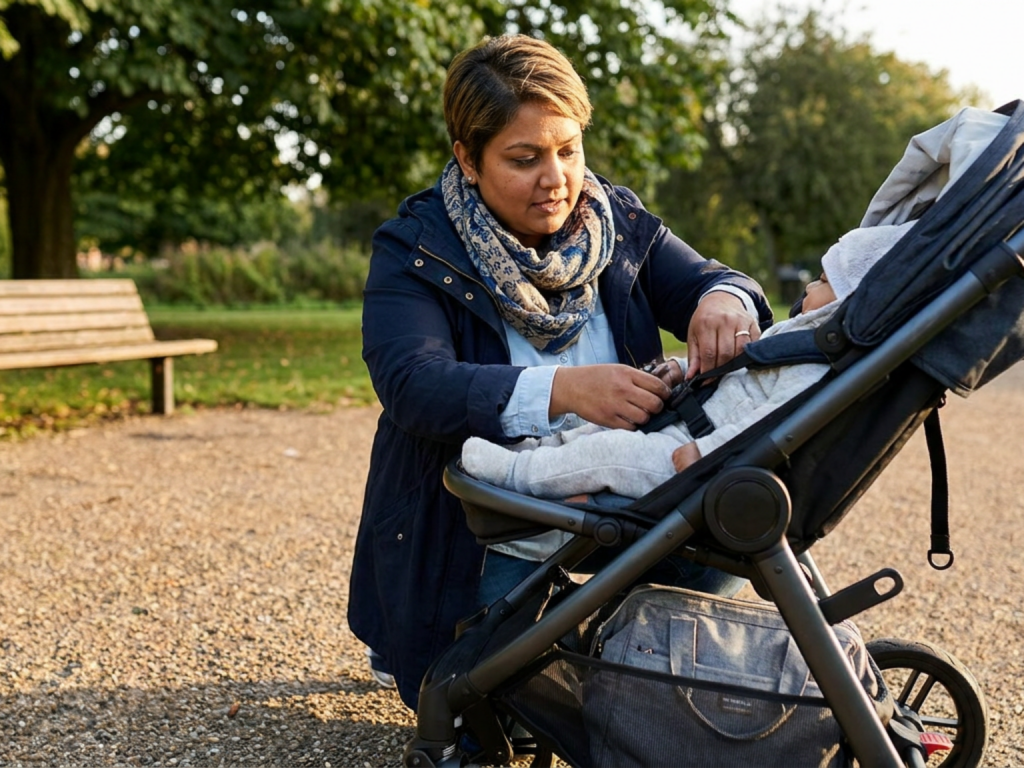
Many stroller injuries happen during ordinary moments: stepping off a curb, turning quickly, leaning into a basket, or stopping to answer a phone. Buckling the harness every time protects against falls and partial ejection, including during short trips from the car to the clinic or from the front door to the mailbox.
A five-point harness secures the shoulders, hips, and between the legs. The straps should lie flat, not twisted, and fit snugly enough that your baby cannot slide down into a slumped position. Avoid bulky coats or thick blankets under the harness because they can compress and create looseness. If warmth is needed, buckle the harness first, then layer a blanket over the baby while keeping the face uncovered.
Check the crotch strap and waist straps carefully. A baby who slips downward may develop chin-to-chest flexion, abdominal compression, or airway obstruction, especially if very young or sleepy. If your baby repeatedly slumps despite correct harnessing and recline, pause stroller use and ask your pediatrician, neonatal follow-up team, physical therapist, or occupational therapist to assess positioning.
Prevent tip-overs and balance hazards
Tip-overs are a major stroller hazard because the handlebar can act like a lever. Hanging a diaper bag, grocery bag, purse, or backpack from the handle may shift weight behind the rear wheels and flip the stroller backward, even when your baby is buckled. Use the storage basket only within its stated weight limit, and place heavier items low and centered.
Do not let older children climb on the stroller, stand on the axle, ride on unapproved footrests, or push without close adult control. If your stroller has an approved ride-on board, follow the manufacturer’s weight limits and instructions. A stroller designed for one child should not carry two unless it is specifically built for that configuration.
Terrain also affects stability. Slow down on slopes, uneven sidewalks, gravel, grass, door thresholds, and curb cuts. Approach curbs straight on when possible rather than at an angle. Keep both hands available in crowded or uneven areas, and avoid using a phone while pushing near traffic, stairs, or drop-offs. If you need to stop, engage the brake before turning away, reaching into a bag, or helping another child.
Use brakes, locks, and folding parts deliberately
Brakes are not just for parking on hills. Engage them whenever the stroller is stopped, including at a crosswalk, in a store aisle, beside a clinic reception desk, or while loading your baby in and out. After setting the brake, gently try to move the stroller to confirm it is locked.
Before each outing, confirm that the stroller is fully opened and locked into position. A partially engaged folding lock can fail under movement or weight. Keep your baby and any older siblings away from the frame when opening or closing it, because folding joints can pinch fingers or skin. Loose toys, straps, or blankets can also become caught in hinges.
Make maintenance part of your routine. Look for cracked plastic, bent metal, loose screws, frayed harness webbing, worn wheel tread, sticky brakes, or missing caps. Stop using the stroller until damaged parts are repaired or replaced according to the manufacturer’s instructions. Registering the stroller or checking recall databases helps you learn about safety defects that may not be obvious during daily use.
Protect breathing and sleep safety
Strollers are for supervised transportation, not routine unsupervised sleep. Many babies fall asleep during walks, and that is common, but sleep in a seated or semi-reclined device can increase the risk of positional airway obstruction if the head falls forward or the body slumps. Watch your baby’s face, chest movement, color, and posture. Keep the nose and mouth visible at all times.
Avoid adding pillows, loose padding, sleep positioners, thick blankets, or aftermarket inserts that did not come with the stroller. These products can alter harness fit, increase suffocation risk, or interfere with the stroller’s tested safety design. For planned sleep, the safer option is a firm, flat infant sleep surface that follows infant sleep guidance.
If your baby falls asleep in the stroller, keep them supervised and move them to a safe sleep surface when you can do so without creating another hazard. This is especially important for newborns, premature infants, and babies with respiratory, neurologic, or feeding concerns. Similar principles apply to car seats and carriers: devices designed for transport need attentive positioning rather than being used as substitutes for a crib or bassinet.
Manage heat, cold, sun, and airflow
Babies have immature thermoregulation, a larger surface-area-to-mass ratio than adults, and limited ability to communicate distress. In warm weather, stroller covers can trap heat and reduce airflow, even if they seem lightweight. Use the stroller canopy for shade, choose breathable clothing, offer feeds according to your baby’s usual needs, and check the back of the neck or chest for overheating. Sweating, flushed skin, lethargy, rapid breathing, or unusual irritability should prompt moving to a cooler place and seeking medical guidance if symptoms do not resolve quickly.
Do not drape a blanket tightly over the stroller opening. It may block visibility and ventilation. If insect protection is needed, use a stroller-compatible mesh cover designed for airflow and keep checking your baby. For sun protection, shade is preferred for young infants; discuss sunscreen use with your pediatric clinician, particularly for babies under 6 months.
In cold weather, buckle first and layer afterward. Keep blankets away from the face and wheels. Check hands, feet, and face frequently, but remember that cold hands alone do not always mean the baby’s core temperature is low. If your baby has a history of prematurity, poor weight gain, cardiac disease, or respiratory illness, ask your clinician how to handle longer outdoor exposure.
Know where strollers should not go
Strollers should not be used on stairs or escalators. The risk of tipping, wheel entrapment, or losing control is high, and even a strong caregiver may not be able to recover quickly. Use an elevator or ramp instead. If neither is available, consider whether another safe option, such as carrying the baby separately while another adult handles the folded stroller, is possible.
Near roads and parking lots, keep the stroller close to your body and never let it roll ahead into traffic space. Engage the brake when waiting at crossings, train platforms, bus stops, or sloped sidewalks. Reflective materials and good visibility are helpful in low light, but they do not replace close supervision.
Strollers also require caution around water, pets, cords, heaters, and store displays. Do not leave a baby unattended outside a shop, beside a pool, near a doorway, or in a vehicle entry area. The same mindset used for Baby bath safety basics applies here: stay close, anticipate slips or sudden movement, and keep one hand or immediate control available when risk increases.
Adapt for real family life
Safety routines work best when they fit the caregiver’s actual day. Keep a small pre-outing checklist near the stroller: harness, brakes, wheels, storage weight, weather plan, and recall awareness. If you use public transport, practice folding and lifting the stroller without the baby in it first, so you are not learning under pressure.
If you alternate between stroller, car seat, and carrier, remember that each device has its own safety rules. Using baby carriers correctly involves close attention to airway position, hip support, and caregiver balance; stroller safety involves restraint, stability, brakes, and supervised positioning. Switching between tools is normal, but avoid assuming that a safe position in one device automatically transfers to another.
Caregiver fatigue is real, especially after night feeds in early infancy. When you are exhausted, simplify the outing: take a familiar route, reduce bags, avoid stairs, and ask for help when possible. Safety is not about perfection; it is about reducing predictable risks with consistent habits.
Safety warnings
- Never leave a baby unattended in a stroller, even if they are asleep or buckled.
- Do not hang heavy bags from the handlebar because the stroller can tip backward.
- Do not use pillows, loose blankets, or aftermarket padding to prop a baby in the stroller.
- Avoid stairs and escalators with a stroller; use elevators or ramps whenever possible.
- Seek urgent medical care if a baby has breathing difficulty, blue or gray color, unusual limpness, or cannot be awakened normally.
Tools & Assistance
- Register the stroller with the manufacturer for recall notifications
- Check national recall databases before using a secondhand stroller
- Keep the stroller manual accessible for weight limits and maintenance instructions
- Ask a pediatric clinician about positioning if your baby was premature or has airway, tone, or feeding concerns
- Use a simple pre-walk checklist for harness, brakes, wheels, and weather protection
FAQ
When can a newborn ride in a stroller?
A newborn can use a stroller only if the model is approved for newborn use, usually with a full recline, bassinet, or compatible infant car seat attachment. Babies without head control need careful airway positioning and support.
Is it safe for my baby to nap in the stroller?
Brief supervised sleep during a walk is common, but a stroller should not replace a safe sleep surface. Keep the baby visible, prevent slumping, and move them to a firm, flat infant sleep surface when practical.
Can I attach toys to the stroller?
Use only secure, short attachments that cannot wrap around the neck, detach into small parts, or interfere with the harness, wheels, or folding mechanism. Remove loose toys that could fall or create choking hazards.
Are stroller blankets safe?
Blankets can be used cautiously over a buckled baby for warmth, but they should not cover the face, be placed under the harness, or hang near wheels. Avoid using blankets as padding or positioners.
What should I do if my stroller is damaged?
Stop using it until the damaged part is repaired or replaced according to the manufacturer’s instructions. Pay particular attention to brakes, wheels, frame locks, hinges, and harness straps.
Sources
- HealthyChildren.org, American Academy of Pediatrics — How to Choose a Safe Baby Stroller
- Health Canada — Stroller and carriage safety
- Mosaic Life Care — Stroller safety: Tips for parents
Disclaimer
This article is for general educational purposes and does not replace medical evaluation or individualized advice. Consult your pediatrician or another qualified healthcare professional about your baby’s specific needs, especially after prematurity, illness, injury, or breathing concerns.














Please log in to leave a comment.