
Intro
For many families, a baby's first recognizable word is an eagerly anticipated milestone. Yet speech develops gradually, and there is a broad range of typical timing. Some babies say a meaningful word before their first birthday, while others begin closer to 15 or 16 months. The exact month matters less than the overall pattern of communication, including gestures, eye contact, vocal play, babbling, and understanding.
This month-by-month guide explains what language development may look like from birth through the second year. It is intended to support observation and informed conversations with a pediatrician, not to provide a pass-or-fail timetable. Babies who were born prematurely may need developmental timing interpreted using corrected age for preterm babies.
Highlights
Many babies produce a first meaningful word between about 8 and 16 months, although individual variation is substantial.
By around 12 months, some babies say words such as mama, dada, or uh-oh, while others communicate mainly through babbling, gestures, and vocal imitation.
Understanding language, pointing, joint attention, and social interaction are important parts of communication even before clear words emerge.
Loss of previously acquired communication skills, poor response to sound, or broader developmental concerns should prompt timely professional advice.
What counts as a first word?
A first word is usually a consistent vocalization that a baby uses intentionally to refer to a person, object, action, or social routine. It does not have to be pronounced clearly. For example, a baby who repeatedly says “ba” while reaching for a bottle may be using an early word approximation. A sound such as “da” may count if it consistently means a parent, dog, or another familiar target in context.
Random babbling is different from a meaningful word because it is not reliably connected to a specific meaning. Caregivers often recognize the transition through repetition, anticipation, and gesture: the baby looks toward an object, makes the same sound, and expects a response. Early words commonly relate to highly familiar people, foods, animals, toys, routines, or social expressions.
Speech production is only one component of language. Receptive language, meaning the ability to understand words and communication, often develops ahead of expressive language, meaning spoken output. A baby may understand a familiar instruction, recognize a name, or use pointing long before speaking a recognizable word. These behaviors are meaningful signs of communication and should be considered alongside vocabulary.
Birth to 5 months: communication before words
Newborns communicate primarily through crying, changes in facial expression, body movement, and states of alertness. During the first months, babies gradually become more attentive to human voices and may quiet, turn toward sound, or show preference for familiar caregivers. Their vocal system is developing, but these early responses are not yet spoken words.
By approximately 2 to 3 months, many infants begin cooing with vowel-like sounds. They may smile in response to social interaction and take part in early “conversations” by vocalizing after a caregiver speaks. Around 4 to 5 months, vocal play often becomes more varied, with changes in pitch, volume, and rhythm. Babies may laugh, squeal, or experiment with sounds.
These early exchanges provide the foundation for later speech. A caregiver can respond to a sound, pause, and allow the baby to answer with another vocalization. This reciprocal pattern, sometimes called serve-and-return interaction, helps build attention, turn-taking, and auditory discrimination. Parents do not need to teach vocabulary formally at this stage; responsive interaction is the central activity.
6 to 8 months: babbling begins to resemble speech
Between about 6 and 8 months, many babies begin canonical babbling, in which consonant and vowel sounds are combined into repeated syllables such as “ba-ba,” “da-da,” or “ma-ma.” At first, these sequences are usually vocal practice rather than words with stable meaning. A baby may produce the same sounds while playing, feeding, or becoming tired.
Babies also become increasingly interested in the social properties of speech. They may respond to their name, recognize emotional tone, imitate sounds, and participate in vocal turn-taking. Some use gestures such as reaching, lifting their arms, or turning away to communicate wants and preferences.
A few babies may produce a meaningful word during this period, but it is also typical for an 8-month-old to have no recognizable words. Research on early vocabulary shows that first spoken words can emerge across a wide range, approximately 8 to 16 months, and the timing may vary across languages and cultural contexts. The quality and progression of communication are more informative than comparing one baby with another.
9 to 11 months: intentional communication becomes clearer
From roughly 9 to 11 months, babies often combine vocalizations with gestures and eye gaze. They may point, show an object, give something to a caregiver, or look back and forth between a person and an interesting item. These behaviors reflect shared attention, an important foundation for learning word meanings.
Some babies say their first meaningful word around 10 or 11 months. Common early words may include names for caregivers, familiar objects, food, animals, or social routines. Pronunciation may be simplified: “nana” might refer to banana, “wawa” to water, or “ba” to ball. The key features are consistency, intentionality, and meaning in context.
At this age, a baby may also understand more words than they can say. They might look toward a familiar person when named, respond to “no,” or search for a known object. A baby who is not yet speaking but is babbling, gesturing, engaging socially, and showing understanding may still be progressing typically. Concerns should be considered in the context of the whole communication profile.
12 to 14 months: first words and a growing vocabulary
By the end of 12 months, many babies may say a few words, although some have no consistent spoken words yet. The Mayo Clinic describes examples such as mama, dada, and uh-oh. Other early words may be specific to a family’s routines or language. A baby may use a sound for a favorite food or a familiar caregiver even when the pronunciation is difficult for others to understand.
During the 12- to 14-month period, vocabulary may expand gradually or appear to increase in bursts. Some babies add words every few weeks; others spend time consolidating comprehension, gestures, and sound patterns before adding several words close together. A “word” can include an approximation used consistently, not only a correctly articulated adult form.
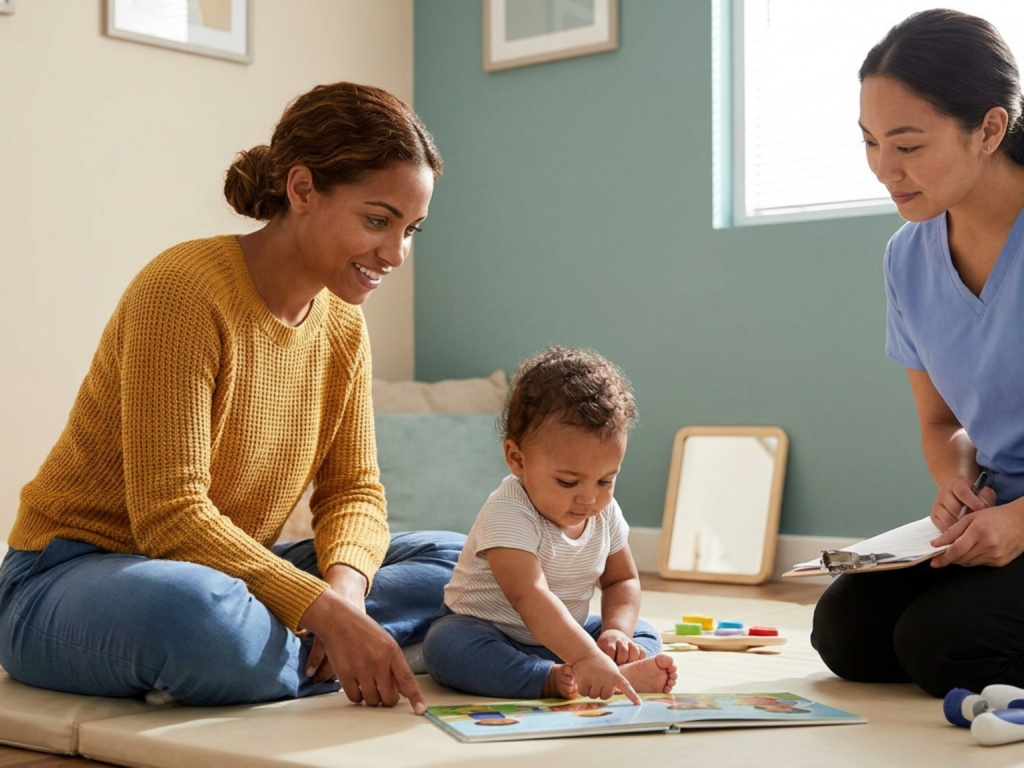
Gestures remain important. Pointing to request or share interest, waving, shaking the head, and imitating actions all support language learning. Caregivers can label what the baby is looking at, use short repeated phrases, and wait briefly for a response. Reading picture books, singing, and describing ordinary activities provide repeated exposure without turning communication into a test.
15 to 18 months: vocabulary often accelerates
Between 15 and 18 months, many toddlers begin using a larger set of meaningful words and may name familiar people, objects, foods, and actions. Some still rely heavily on gestures and sound approximations, while others have a rapidly expanding vocabulary. Speech may remain difficult for unfamiliar listeners because articulation develops gradually and many consonant clusters are not yet mastered.
At this stage, a child may follow simple directions, identify familiar objects, and communicate refusal or preferences. They may also begin combining a word with a gesture, such as pointing and saying “up.” Word combinations are often expected later than single words, so the absence of two-word phrases at 18 months should be discussed in the context of other developmental observations rather than interpreted in isolation.
Caregivers can support expressive language by expanding the child’s message. If a toddler says “car,” an adult might respond, “Yes, a red car is going.” This provides a slightly richer model while preserving the child’s lead. Frequent face-to-face interaction, shared play, and reduced background television or device noise make it easier for the child to notice speech sounds and conversational turns.
How to encourage first words naturally
Language grows through repeated, meaningful social experiences. Follow the baby’s attention rather than directing every interaction. When the baby looks at a spoon, name it; when the baby reaches for a cup, acknowledge the request and model a simple word such as “cup” or “more.” Use clear, natural speech with short phrases, while still speaking in the family’s usual language or languages.
- Pause after speaking so the baby has time to vocalize, gesture, or look toward you.
- Repeat useful words across routines such as feeding, bathing, dressing, and going outside.
- Offer choices, such as “banana or yogurt?”, and accept pointing or sounds as communication.
- Share sturdy picture books and talk about the images rather than requiring the baby to repeat words.
- Respond to attempts with interest, even when pronunciation is unclear.
It is not necessary to correct every sound or pressure a baby to perform. Warm responsiveness helps preserve communication as a social activity. Families who speak more than one language can continue using the languages that are natural and emotionally meaningful; multilingual exposure does not inherently cause language delay.
When to seek professional guidance
Variation in first-word timing is common, but caregivers should contact a pediatrician when concerns persist or when communication appears to be regressing. A clinician may review hearing, oral-motor function, receptive and expressive language, social communication, and broader development. A hearing evaluation for speech delay can be important because fluctuating or unrecognized hearing loss may affect access to speech sounds.
Discuss the situation promptly if a baby does not seem to respond to loud sounds or familiar voices, rarely makes eye contact or engages socially, does not babble by the expected developmental period, does not use gestures such as pointing or showing, or has no meaningful words by a timeframe that concerns the clinician or family. Loss of words, babbling, gestures, or social engagement warrants especially timely assessment.
Assessment does not automatically indicate a diagnosis. A pediatrician may recommend monitoring, formal developmental screening, an audiology assessment, or evaluation by a speech-language pathologist. Early speech development signs can be subtle, and professional advice is most useful when based on the child’s history, corrected age if applicable, languages heard, and observed behavior across settings.
When to contact a healthcare professional
- The baby loses previously acquired words, babbling, gestures, or social engagement.
- The baby rarely responds to voices, their name, or environmental sounds.
- There is little babbling, pointing, showing, imitation, or shared attention.
- Speech concerns occur together with feeding, motor, vision, or broader developmental concerns.
- Caregivers feel worried, even if the baby has some words; concerns deserve discussion.
Tools & Assistance
- Keep a dated list of sounds, gestures, words, and the meanings you observe.
- Record a brief natural interaction to share with the pediatrician or audiologist.
- Use a developmental screening questionnaire provided by your healthcare service.
- Ask about hearing assessment and local speech-language pathology services.
- Bring information about languages used at home and, for premature babies, corrected age.
FAQ
What is the average age for a baby's first word?
There is no single average that predicts every child. Many babies say a meaningful first word between about 8 and 16 months, and some begin earlier or later while developing communication appropriately.
Do mama and dada count as words?
They count when the baby uses them consistently and intentionally for a particular person or purpose. Repeated babbling that is not connected to meaning is usually considered vocal practice rather than a word.
Should a 12-month-old be saying words?
Some 12-month-olds say several words, while others are still primarily babbling and using gestures. The baby's understanding, social engagement, vocal development, and trajectory are important. Discuss individual concerns with a pediatrician.
Can speaking more than one language delay first words?
Multilingual exposure does not inherently cause language delay. Words should be considered across all languages the child hears and uses, and families can continue communicating in the languages that are natural to them.
What if my baby says a word and then stops?
A temporary change may have several explanations, but loss of a previously consistent word or other communication skill should be discussed promptly with a healthcare professional.
Sources
- PubMed — Baby's first 10 words
- Mayo Clinic — Language development: Speech milestones for babies
- Raising Children Network — Baby language development: 3-12 months
Disclaimer
This article provides general educational information and does not diagnose or treat any medical condition. Consult a qualified healthcare professional for advice about your baby's individual development or any concerns.













Please log in to leave a comment.